Buyer Fit Snapshot
| Best fit | Compostable Packaging Manufacturer projects where brand print, material claims, artwork control, MOQ, and repeat-order consistency need to be specified before quoting. |
|---|---|
| Quote inputs | Share finished size, material target, print colors, finish, packing count, annual reorder estimate, ship-to region, and any compliance wording. |
| Proofing check | Approve dieline scale, logo placement, barcode or warning zones, color tolerance, closure strength, and carton packing before bulk production. |
| Main risk | Vague material claims, crowded artwork, missing packing details, or unclear freight terms can make a low unit price expensive after revisions. |
Fast answer: Compostable Packaging Manufacturer: How It Works and Costs should be specified like a repeatable production item. The safest quote records material, print method, finish, artwork proof, packing count, and reorder notes in one written spec.
Production checks before approval
Compare the actual filled-product size with the drawing, then confirm tolerance on folds, seals, hang holes, label areas, and retail display edges. Reserve space for logos, QR codes, warning copy, and material claims before decorative graphics fill the panel.
Quote comparison points
Review material grade, print process, finish, sampling route, tooling charges, carton quantity, and freight assumptions side by side. A quote is only useful when the supplier can repeat the same color, closure quality, and packing count on the next order.
The first time I watched a compostable packaging manufacturer fight a humidity spike on a forming line, the lesson hit hard: green materials still answer to physics. The room sat at 58% relative humidity, the fiber blanks curled by 1.5 mm, and the press operator kept shaving seconds off dwell time so the trays would still stack cleanly at 200 pieces per carton. Buyers rarely see that part. They see a tray, a carton, a neat logo. They do not see the pressure to hold tolerance while the room gets sticky and the machine starts pushing back. I remember thinking, very clearly, that the romantic version of sustainable packaging was missing a few ugly details. That is why a compostable packaging manufacturer is a process partner first and a materials supplier second, whether the plant is in Dongguan, Guangdong, or Ohio.
If you are comparing branded Packaging for Food service, retail packaging, e-commerce mailers, or personal care cartons, the real question is not whether the material sounds sustainable. The real question is whether the compostable packaging manufacturer can source the right substrate, engineer a structure that protects the product, test it under actual shipping and storage conditions, and document the claim so your legal team does not spend a week decoding it. I have sat through enough buyer meetings to know the lowest quote often turns into the most expensive decision once spoilage, freight, and rework show up on the ledger. A quote that looks great at $0.09 per unit can quietly become $0.17 after extra inserts, 8% spoilage, and a second print run. That part is rarely glamorous, but it is where projects live or die.
At Custom Logo Things, the strongest conversations start with product behavior, not artwork. A snack bar in a 45 g flow-wrap, a sauced meal that sweats inside the pack, and a cosmetic kit that only travels by parcel all need different decisions, even if they all want eco-friendly packaging with sharp package branding. If you are also shopping for Custom Packaging Products or want a better sense of the team behind the recommendations, About Custom Logo Things gives useful context before you request samples. I know that sounds like the boring part, but the boring part is usually where the expensive mistakes get hidden, especially when the first production run is only 5,000 units.
What does a compostable packaging manufacturer really do?
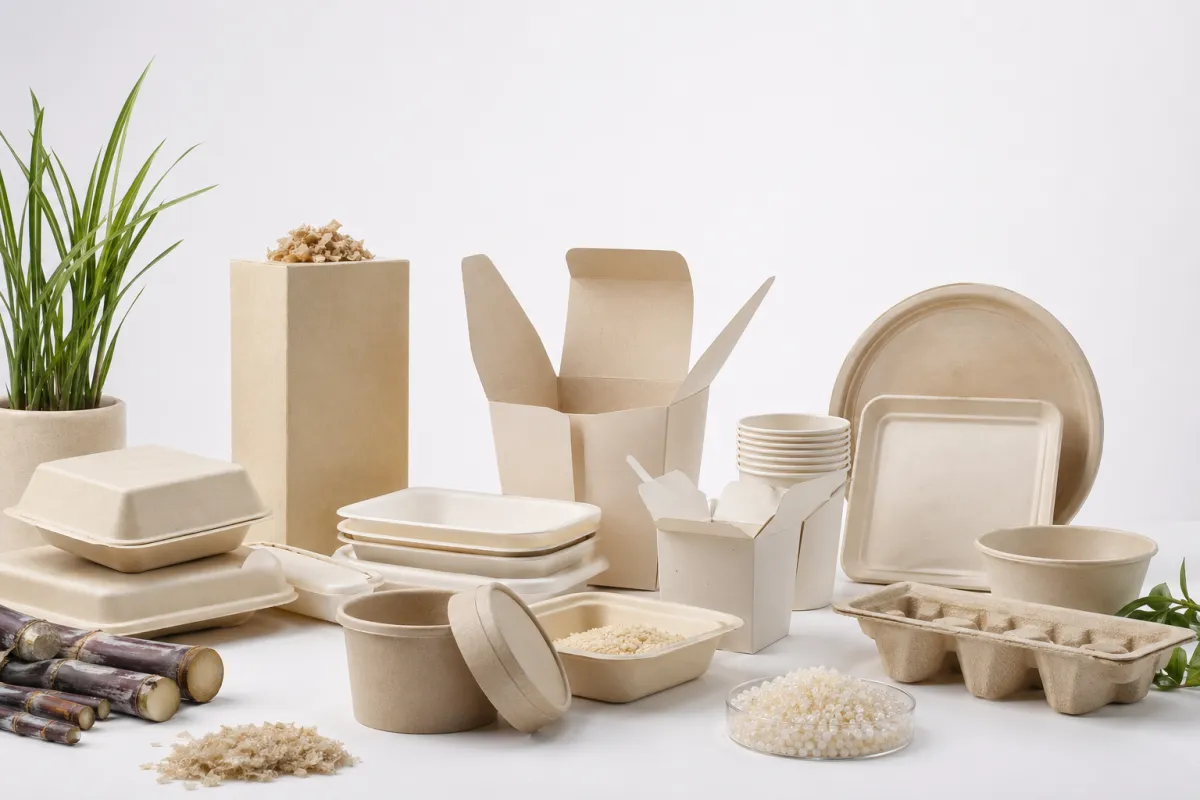
A true compostable packaging manufacturer does far more than print a logo on a fiber tray or a kraft mailer. The job starts with material sourcing, because a 600 gsm molded fiber blend made from sugarcane bagasse behaves very differently from a 100% virgin kraft board with a dispersion coating. One will absorb moisture faster. One will hold a sharper fold. One will tolerate stack pressure better on the pallet. The manufacturer chooses the furnish, checks moisture content, and decides whether the substrate can survive the press temperature, forming depth, and stack load your line demands. Two vendors can quote the same product name and still deliver completely different results, which is maddening if you are the buyer trying to compare apples to something that only vaguely resembles apples.
Structure design comes next. A good compostable packaging manufacturer will ask for product dimensions, fill weight, cold-chain exposure, grease load, and whether the item needs a window, a tamper seal, or a shelf-ready display face. I still remember a client in the salad category who wanted a shallow clamshell with a clear lid; the first mock-up looked fine on a render, then the live product sweated in transit and softened the hinge. We changed the geometry by 3 mm, moved the venting pattern, and the leak rate dropped sharply on the second pilot run. That kind of change sounds tiny. It is not. In packaging, 3 mm can separate a stable launch from a customer-service headache, and I say that with the weary confidence of someone who has seen a "small tweak" turn into a five-day fire drill.
That design work is only one slice of the operation. The same compostable packaging manufacturer should also handle testing, compliance support, and production coordination. Testing can include compression checks, grease resistance, seal integrity, and transport simulation. On shipping projects, I have seen teams use ISTA 3A-style parcel tests to mimic the abuse a box sees in a courier network, because a package that looks great on a bench can still fail after 36 hours in a hot van. For transport science and testing references, I often point teams to ISTA test protocols, which are widely used across packaging validation programs. A factory in Guangzhou may run those tests differently than a plant in Monterrey, but the pass/fail logic should still be documented the same way.
Compliance support matters just as much. A serious compostable packaging manufacturer should know the difference between industrial compostable claims, home compostable claims, and loose biodegradable language that sounds friendly but tells a buyer almost nothing useful. The best suppliers will tell you which standard they are building to, whether that is ASTM D6400, ASTM D6868, EN 13432, or a certification route recognized in your market. If a supplier gets vague at this stage, I treat that as a warning sign. Claims without documentation are a fast way to create risk at launch, and a very fast way to make a marketing team regret being optimistic on a Friday afternoon.
There is also a real difference between a manufacturer, a broker, and a print-only shop. A broker may have strong relationships and useful pricing, but if they do not own tooling, line setup, or QC checks, they are not controlling the outcome. A print-only shop can give you attractive graphics for Custom Printed Boxes or outer sleeves and still rely on someone else for the substrate and conversion. A real compostable packaging manufacturer owns the process where the quality lives: pulp preparation, die-cut tolerances, heat sealing windows, and the final pack-out. In a plant near Suzhou, that might mean one team controls molding and trimming; in Wisconsin, it may mean one line handles board conversion and another handles coating validation.
"If the pack survives on a showroom table but fails in a 95-degree loading dock, it is not production-ready." I heard that line from a plant manager in Akron, Ohio, and it stuck with me because it is exactly how a compostable packaging manufacturer should think.
Brands that need this partner most are usually the ones balancing shelf appeal with disposal targets. Food service groups want fiber trays and takeout clamshells that carry hot meals without warping at 82 to 90 degrees Celsius. Retailers want package branding That Feels Premium but still matches sustainability messaging. E-commerce brands want mailers and inserts that lower the carbon footprint without crushing product protection on a 1,200-mile truck lane. Personal care companies want cartons and sleeves that look refined, print well, and still support credible eco-friendly packaging claims. In each case, the compostable packaging manufacturer is not an afterthought; it is a technical partner shaping the launch.
How a compostable packaging manufacturer turns materials into finished packs
The material conversation usually starts with five common substrates: molded fiber, sugarcane bagasse, kraft paper, PLA, and compostable coatings. A compostable packaging manufacturer will not treat those as interchangeable, because each one has a different personality on the line. Molded fiber handles cushioning and structure well, but it can absorb moisture if the blend and drying cycle are not tuned. Bagasse is popular for food service because it forms quickly and has a natural look, yet it can telegraph imperfections if the mold surface is rough. Kraft paper is strong and economical for wraps and cartons, but barrier performance depends heavily on coatings and laminate choices. PLA can work for clear windows and some cold applications, although it is sensitive to heat and needs the right industrial composting context. Compostable coatings, meanwhile, are either the quiet hero or the hidden problem, depending on whether they are matched to the base stock and the seal method.
On the converting side, the main methods are thermoforming, pulp molding, die-cutting, lamination, and heat sealing. Thermoforming shapes sheets under heat and pressure, which makes it useful for trays, lids, and compartments with consistent geometry. Pulp molding takes fiber slurry and forms it into a mold, then dries it under controlled conditions; this is common for egg trays, insert trays, and protective shippers. Die-cutting is the precision work that turns paperboard into cartons, sleeves, and inserts with tight fold lines. Lamination adds barrier or strength, but it has to be handled carefully because the wrong film can destroy compostability. Heat sealing is essential for many pouches and lidding applications, and the seal window has to match the substrate, the machine speed, and the fill temperature. A converter in Ho Chi Minh City may run a 150-meter-per-minute line, while a carton plant in Ontario may run far slower, but both still live or die by setup accuracy.
In real production, the details that matter most are moisture resistance, grease barrier, stacking strength, and shelf presentation. A compostable packaging manufacturer may build a tray that looks perfect at 22 degrees Celsius in a dry room, then watch it buckle after 45 minutes in a steamy kitchen. I have seen this happen with bakery clamshells that held up fine in a test carton but collapsed when a buyer left them near a dish line where rinse mist kept hitting the pack. The fix was not a thicker wall alone; it was a better rib pattern, a sharper draft angle, and a coating selected for the actual humidity profile. Packaging people love to blame the latest thing they touched. The truth is usually less glamorous and more annoying.
Here is what many buyers miss: compostability can be lost through the wrong inks, adhesives, or barrier layers even when the base material looks right. A metallic ink that looks elegant on a mock-up, an aggressive pressure-sensitive label, or a non-compostable window film can compromise the whole format. The smartest compostable packaging manufacturer designs around those limits early instead of trying to patch them after artwork approval. That usually means water-based inks, low-migration adhesives where required, and barrier treatments that are documented for the intended composting pathway. I would rather hear "we cannot do that exact finish, but here is the closest compliant option" than watch a supplier promise a miracle and then scramble during prepress. Miracles are lovely in stories; in packaging, they usually arrive as change orders.
For shelf-facing product packaging, design choices also affect how the consumer reads the pack in the first 3 seconds. A crisp window placement can show the product, but it may also weaken the panel if the die line is not reinforced. A matte natural finish can signal eco-friendly packaging, but it still needs registration control so the logo does not drift 1.5 mm off center. A compostable packaging manufacturer that understands retail packaging knows that structure and branding are connected, not separate tasks handed to different departments after the fact. On a 350 gsm C1S artboard carton, even a half-toned image shift becomes visible under store lighting at 4000K.
One negotiation I remember clearly involved a coffee brand that wanted a pouch with a full-front matte look, a zipper, and a compostable claim. The supplier sample was attractive, but the zipper seal temperature was 8 degrees too narrow for the client’s pack line, which meant rejects climbed above 6% during a 2-hour trial. We stepped back, changed the laminate stack, and gave up a little gloss in exchange for a wider operating window. That is what experienced compostable packaging manufacturer work looks like: trading vanity features for stable performance. I wish more teams were honest about that from the start; it would save everybody a few headaches and a few gray hairs.
The same thinking applies to custom printed boxes and inserts. A carton may be made from kraft board with a compostable coating, but if the scoring is too deep, the corners crack during erector setup. A tray may be formed from fiber, but if the drying cycle is rushed, the water content stays too high and the part warps after 24 hours. The difference between a good pack and a problematic one often comes down to a few controlled variables that never show up in a mock-up image. A 0.2 mm score adjustment or a 5-second longer cure can decide whether a box reaches a shelf in one piece. That is the sort of detail that separates pretty samples from actual production.
Key factors a compostable packaging manufacturer uses to set cost, certifications, and performance
Pricing starts with tooling, and tooling can swing a project more than most buyers expect. A simple die-cut sleeve might only need a one-time tool charge of $300 to $900, while a custom thermoformed mold or pulp tool can run from $1,500 to $8,000 depending on cavity count, steel grade, and finish detail. A serious compostable packaging manufacturer will explain whether that tooling is owned by the customer, amortized into the unit price, or held by the supplier. That matters because ownership changes your ability to move production later if volumes grow or service slips. A mold cut in Dongguan can look cheap up front and still cost you if the supplier controls the tool file and the spare cavity.
Minimum order quantities also matter. I have seen a compostable snack tray price at $0.18 per unit for 5,000 pieces, then fall to $0.11 per unit at 30,000 pieces because the setup time gets spread across a larger run. A compostable stand-up pouch with a printed kraft face and a barrier liner may land at $0.42 per unit for 3,000 pieces, mostly because the material stack is more complex and the press waste is higher on small runs. If a quote sounds cheap but the MOQ is 50,000, the unit number is only telling part of the story. In one case, a buyer saved $600 on the quote and lost $2,400 in freight because the packs could not nest efficiently and filled 11 pallets instead of 8.
Total landed cost is where a smart compostable packaging manufacturer earns trust. Freight, warehouse space, spoilage risk, and pack density all change the real economics. A lighter molded fiber insert can reduce freight by 12% to 18% versus a rigid plastic part, especially on long truck lanes, and that savings can offset a higher piece price. If the pack design nests well, you may also save pallet height, which can be the difference between 20 pallets and 24 pallets on a container. I have watched procurement teams save more by trimming 14 mm of height than by negotiating a half-cent off the print line. Nobody puts that on a slide deck, which is probably why it surprises people so much.
Certifications are another place where careful buyers separate real partners from polished sales decks. Industrial compostable packaging is built for controlled facilities with specific heat, moisture, and timing conditions, while home compostable packaging has to break down in a slower, lower-heat environment. That home claim is harder to achieve and should be backed by recognized testing, not just marketing language. A credible compostable packaging manufacturer will tell you exactly which claim is supported by which test, which region it applies to, and whether the local disposal system can actually process it. A pack certified for EN 13432 in Europe may still need separate review for BPI recognition in the United States.
Some brands also need chain-of-custody support for paper-based components. If the carton stock is FSC certified, the documentation should be easy to produce and easy to read. For sourcing references, I often suggest teams review FSC certification guidance so they understand how paper claims are documented and where the boundaries sit. A supplier that knows the paperwork path saves your legal and sustainability teams hours of back-and-forth later, especially when the carton is a 350 gsm C1S artboard folded into a shelf-ready display box.
Product geometry changes cost just as much as material choice. A flat sleeve is cheaper than a deep formed tray, but only if the product fits without crushing. A pack that must survive hot, wet, greasy, or refrigerated conditions may need a thicker wall, a better coating, or a different sealing method. One lunch container can live happily at 4 degrees Celsius in a fridge for 72 hours, while another fails after 20 minutes over a steam line. That is why the same format can look identical on paper and still price very differently. A compostable packaging manufacturer is paid to understand those hidden differences before production starts.
| Format | Typical unit price | Common MOQ | Best use | Main tradeoff |
|---|---|---|---|---|
| Molded fiber tray | $0.18 to $0.32 | 5,000 to 10,000 | Food service, inserts, protective retail packaging | Good structure, but moisture control matters |
| Kraft carton with compostable coating | $0.09 to $0.21 | 3,000 to 15,000 | Custom printed boxes, sleeves, sleeves with inserts | Great branding, barrier level depends on coating |
| PLA window pouch | $0.24 to $0.48 | 10,000 to 25,000 | Dry goods, sample packs, light retail packaging | Clear presentation, heat sensitivity can limit line speed |
| Bagasse clamshell | $0.12 to $0.27 | 10,000 to 50,000 | Takeout, meal kits, deli items | Strong food-service appeal, but lid fit must be tested |
Those numbers move with print coverage, barrier treatments, rush schedules, and whether the line needs a custom setup. A compostable packaging manufacturer should be able to explain why a black-ink-heavy design costs more than a two-color layout, and why a 12-business-day turn can stretch to 18 business days if you revise artwork twice. If the quote only gives one number and no explanation, I start asking more questions. The same goes for a supplier in Shenzhen versus one in Mexico: freight, duty, and resin sourcing can change the total by 14% before anyone notices.
There is also a subtle cost called failure cost. If a tray warps, a zipper leaks, or a lid pops open, the damage is rarely limited to one SKU. It becomes customer complaints, reships, possible chargebacks, and extra warehouse handling. That is why I always push buyers to compare unit price, total landed cost, and risk cost together. A good compostable packaging manufacturer will help you do that math honestly, even if the answer makes the cheaper-looking quote less attractive. A 2-cent savings on unit cost is small comfort when 800 cases need rework.
The step-by-step process and timeline from brief to production
The process usually begins with discovery, and the more precise the brief, the faster the rest moves. I want to know product dimensions to the millimeter, fill weight in grams, fill temperature, whether the item is dry or greasy, and how long it will sit in storage before sale. I also want to know if the distribution path includes truck, parcel, cold room, or shelf display. A compostable packaging manufacturer can work much faster when the brief says "350 g soup bowl, 74 mm height, sealed at 82 degrees Celsius, 21-day refrigerated life" instead of "we need something sustainable for food." Vague briefs make vague samples, and vague samples make everyone pretend to be excited while privately worrying. Been there, and it is not a fun place.
From there, the sampling phase starts. First come structural drawings, usually in CAD or dieline form, then a flat prototype or a rough formed sample, and finally physical samples built to closer-to-production specs. The first test is often simple: does the product fit, does the seal close, and can the pack hold together while a line worker opens and closes it 20 times? After that, the compostable packaging manufacturer should move into more realistic trials, including heat, humidity, compression, and transport checks. I have seen teams discover a lip height issue only after the third sample, which is exactly why patience saves money later. Nobody loves extra rounds of sampling, but I would rather spend an extra week there than spend a month cleaning up a launch mess.
A realistic timeline depends on tooling and compliance. A straightforward paper sleeve with no new tool can sometimes move from concept approval to approved production in 12 to 15 business days from proof sign-off. A new molded fiber tray with fresh tooling might need 4 to 6 weeks for sample iteration and mold correction, then another 1 to 2 weeks for pilot runs and pack-out approval. If you need printed graphics, add prepress review, color proofing, and possible varnish adjustments. A reliable compostable packaging manufacturer will map those steps before you commit to a launch date, because skipping the map is how marketing teams end up promising a trade show sample the factory cannot safely ship.
Decision checkpoints should be built into the process. I recommend one checkpoint for structure, one for artwork, one for seal strength or closure performance, and one for final spec sign-off. The structure checkpoint is where you decide whether the pack needs a deeper rib, a tighter fold, or a different lid profile. The artwork checkpoint is where you confirm logo size, QR code placement, and print coverage. The seal checkpoint matters for pouches and lidding because a 2-degree change in heat or a 0.1 second change in dwell can alter reject rates. The final sign-off is where the compostable packaging manufacturer documents the approved sample and the production tolerance so nobody argues later about what "close enough" means.
Here is a simple timeline I often use with new buyers:
- Discovery and brief - 2 to 3 days if product details are ready.
- Structure concept and first samples - 3 to 7 business days for simple formats, longer for molded tooling.
- Revision round - 2 to 5 business days depending on corrections.
- Pilot run or press proof - 1 to 3 days, plus review time.
- Production - 12 to 25 business days for many custom jobs, more for large or complex runs.
- Freight and receiving - 3 to 10 days domestically, longer if the shipment moves internationally.
That schedule is not universal, and I would never pretend it is. A compostable packaging manufacturer serving a single plant in the Midwest may ship faster than one balancing multiple overseas tooling partners. Heat waves, port delays, and a simple artwork change from procurement can move the finish line by a week. Still, if the supplier cannot give you a stage-by-stage timeline, you are probably looking at a broker or a shop that has not worked through the details yet. A plant in Milwaukee can handle a simple die-cut carton in 14 business days, while a molded pulp program in Vietnam may need a 6-week mold ramp before the first pallet leaves the dock.
Common mistakes brands make when choosing compostable packaging
The biggest mistake I see is treating compostable, biodegradable, and recyclable as if they all mean the same thing. They do not. Compostable packaging is designed to break down under specific conditions, biodegradable can mean almost anything over a long enough period, and recyclable means the material has a recovery path that varies by region and stream. A careful compostable packaging manufacturer will help you use the right claim language, but brands still need to understand the difference before launching a sustainability message that sounds stronger than the evidence. In California, Oregon, and parts of Ontario, that distinction can matter as much as the pack design itself.
Another common error is choosing a material before understanding the product's moisture, oxygen, grease, or heat requirements. I once sat with a dessert brand that loved a natural kraft look, then discovered their filling had a 32% moisture content and would sit in chilled distribution for five days. The first sample absorbed enough condensation to soften the panel edges. A better compostable packaging manufacturer would have asked for that data on day one and steered the team toward a different coating or a different structure. That kind of early question can save weeks, and, frankly, prevent everybody from pretending the flaw is "quirky" instead of a problem.
End-of-life infrastructure is the next trap. A pack can look beautiful on a design board and still fail the real-world disposal test if the customer has no access to composting services. Industrial compostable packaging only works as intended when the local system can actually process it. That is why I tell brands to check the disposal path in the target market before they print claims in big green letters across the front panel. The Environmental Protection Agency has useful public guidance on food waste and diversion programs at EPA sustainable materials resources, and that kind of reference can keep a launch grounded in reality rather than marketing wishful thinking. A box sold in Chicago may face a very different end-of-life route than one sold in Austin or Toronto.
There is also a habit of ignoring tooling, minimums, and lead times because the team is used to commodity plastic packaging. That works badly in this category. A compostable packaging manufacturer may need a new mold, a coating validation, or a slower line speed to protect the substrate. If your launch date is fixed because a retailer has reserved shelf space or a trade show box deadline is immovable, you need those constraints stated up front. Otherwise the project gets compressed, and compressed projects usually create waste, rework, and unhappy buyers. I have seen a 20-day launch compress to 9 days and produce a shipment of 4,000 unusable sleeves.
One client meeting in the personal care space taught me this the hard way. The buyer wanted a compostable carton for bath salts, but the first quote looked high because they had asked for foil stamping, a folded insert, and a custom window in the same run. They were comparing that quote to a plain stock box, which was never a fair comparison. After we broke out the cost by component, they could see exactly where the money went and which pieces could be simplified. A good compostable packaging manufacturer should be able to have that conversation without getting defensive. The difference between a $0.24 box and a $0.41 box is often just one feature, one insert, and one embellishment too many.
Finally, brands often underestimate how much warehouse conditions matter. If a pallet sits in 90-degree heat for 48 hours, or in 75% humidity near a dock door, paper-based eco-friendly packaging can behave differently than it did in the sample room. I have seen a carton lose squareness after a humid weekend because the receiving team left it in a non-climate-controlled bay. That is not the packaging's fault alone; it is a system issue, and a seasoned compostable packaging manufacturer will warn you about it before you launch. The best factories plan for 55% to 65% relative humidity, not the ideal 40% you get in a showroom.
Expert tips for working with a compostable packaging manufacturer
Ask for the paperwork early. You want material certifications, test reports, substrate data sheets, and sample notes before you compare quotes line by line. If the product is paper-heavy, ask for the chain-of-custody documents too, especially if you need FSC-supported sourcing. If the pack is going through transport testing, ask how the supplier validates compression and vibration. A strong compostable packaging manufacturer will welcome those questions because clear documentation reduces surprises later. If they can send a spec sheet with 350 gsm C1S artboard, water-based ink, and a 12-business-day proof cycle, they are already speaking your language.
Design around the material's strengths instead of trying to force a plastic shape into a compostable format. That advice sounds simple, but I have seen teams cling to a sharp corner radius or a deep undercut because the original plastic pack had it. Fiber does not like every geometry, and some barrier films hate extreme folds. A better approach is to let the structure tell the branding story. Natural texture can support package branding, while cleaner panel areas can make the logo pop without fighting the substrate. The right compostable packaging manufacturer will usually sketch two or three feasible options instead of one fantasy version. A 2 mm larger radius can matter more than an extra color on the panel.
Be direct about the machine you are running. If your line seals at 140 to 155 degrees Celsius, say so. If your warehouse sits at 60% humidity in summer, say that too. If the finished pack must survive refrigerated storage, a hot-fill step, or 10 days in a fulfillment center, put that in the first brief. A compostable packaging manufacturer can only solve the problem you actually describe, and vague briefs create vague samples. The best briefs include the fill weight, the pallet pattern, and whether the cartons travel through Dallas, Rotterdam, or Singapore.
It helps to ask practical questions that sound almost boring. What is the seal window? What happens if the product sits in heat for 8 hours? Can the print survive rub testing after a cold-chain cycle? How much line speed do we lose if we move to a heavier barrier layer? Those are the questions that keep a launch stable. I prefer a supplier who says, "The seal is safe between 148 and 156 degrees, but we would rather test at 152," because that kind of answer shows real production thinking. A compostable packaging manufacturer that speaks in specifics usually saves money downstream.
Communication also matters more than people admit. Send drawings in PDF and CAD if you have them. Share target volumes for the first order and the next three orders. Tell the supplier whether you are testing in North America, Europe, or multiple markets, because claim language and disposal expectations can change across regions. When a buyer shares those details up front, the compostable packaging manufacturer can plan tooling, print plates, and certification work with fewer revisions and fewer late-night emails. A team in Toronto may ask for bilingual labeling, while a brand in Berlin may need EN 13432 documentation from day one.
Here is the honest version from the factory floor: the best projects are never the ones where everything is perfect on the first try. The best projects are the ones where the buyer, the design team, and the compostable packaging manufacturer admit the tradeoffs early, test the ugly version first, and then refine the details once the structure proves itself. That is how you get branded Packaging That Feels premium, performs in shipping, and still supports a lower carbon footprint story your sales team can stand behind. A 5,000-piece pilot in week one is far better than a 50,000-piece apology in week eight.
What to do next: shortlist, sample, and compare suppliers
If you are ready to move, start with three things: product specs, sustainability goals, and the performance limits you cannot compromise. Write down the exact dimensions, fill weight, target shelf life, and any heat, grease, or moisture exposure. Then decide whether you need industrial compostable packaging, home compostable packaging, or simply a fiber-based format that supports a better disposal story. A compostable packaging manufacturer will move faster when your brief is specific, and you will get better quotes because the suppliers are pricing the same job. A note that says "5000 pieces, 12-color print, 74 mm by 92 mm format, ship to Illinois" is infinitely more useful than "need sustainable packaging."
Next, request comparable samples and test them the way the product will really be used. Put food in the tray, load the retail insert with actual weight, and store the pack in the same conditions it will face after launch. If the product rides a courier route, run a small parcel test. If it sits in a refrigerated case, test condensation. If it goes through a warehouse with hot docks, test that too. A compostable packaging manufacturer worth trusting will not object to that level of scrutiny; they will usually respect it. I would want to know what happens after 36 hours in a delivery van, not just what happens under a studio light.
Compare suppliers on more than price. Look at certifications, tooling ownership, communication speed, lead time clarity, and how they handle revisions. Ask whether they produce in-house or coordinate through outside converters. Ask what happens if a sample passes visually but fails on seal strength by 10%. Ask how they document claims so your legal team can review them without rework. In my experience, the most expensive supplier is not always the one with the highest quote; sometimes it is the one that creates the most uncertainty. A plant in the Midwest that answers in 24 hours can be worth more than a cheaper plant that needs 5 days for every revision.
For brands building eco-friendly packaging or refreshing retail packaging with better material choices, the right partner can simplify a lot of the launch math. The supplier should understand structure, print, barrier behavior, and the practical side of production on real machines. If you need a place to start building out the rest of the package, browse Custom Packaging Products and use the samples to compare fit, finish, and durability against your current pack. If you want to know more about the people making the recommendations, About Custom Logo Things is a straightforward next stop. A 350 gsm C1S artboard carton, a molded fiber insert, and a compostable coating may sound simple on paper, but the factory details decide whether the launch stays on schedule.
My simplest advice is this: choose the compostable packaging manufacturer that understands your product, not just your artwork. Match the material to the fill, the process control to the line speed, and the service to the launch risk. If those three pieces line up, you get packaging that protects the product, supports the brand, and makes the sustainability story credible instead of decorative. The difference between a box that looks sustainable and one that actually performs is often one test report, one humidity reading, and one honest conversation.
How do I choose the right compostable packaging manufacturer for my product?
Start with proof, not promises. Ask for material certifications, sample test data, and examples of similar products with the same kind of moisture, heat, or grease exposure. A good compostable packaging manufacturer will also explain whether design, tooling, and compliance support happen in-house, because that usually improves accountability and shortens the back-and-forth. If the supplier cannot explain tradeoffs clearly, keep looking. A partner that can name the exact substrate, such as molded fiber at 600 gsm or kraft board at 350 gsm C1S, is usually more prepared than one that only says "eco-friendly."
What is the difference between industrial and home compostable packaging?
Industrial compostable packaging is designed for controlled facilities with specific heat, moisture, and processing conditions, while home compostable packaging is meant to break down more slowly in lower-temperature conditions. Home compostable claims are harder to achieve and should be backed by solid testing, not just a green label. Always match the claim to the disposal system available in your target market. A pack sold in Paris, Melbourne, or Vancouver may face different local collection rules, so the claim should match the region, not just the artwork.
How long does it take to develop custom compostable packaging?
Simple projects can move through sampling and approval in a few weeks, while new tooling, print changes, or barrier adjustments can extend the schedule. A straightforward sleeve might be ready in about 12 to 15 business days after proof approval, but a custom molded tray can take 4 to 6 weeks or more. The biggest variables are sample revisions, compliance checks, and whether the supplier needs new tooling or line setup. If a factory in Guangdong is waiting on a second proof and a revised dieline, that can add 3 to 5 business days immediately.
Why does compostable packaging cost more than plastic packaging?
Raw materials often cost more, and production may require tighter controls, lower run speeds, or extra testing. Smaller order quantities and custom structures can raise the unit price as well, especially if the pack needs special barrier performance or premium print. The best way to judge the economics is total landed cost, because lighter packs and fewer damages can improve the final numbers. A carton that saves $0.03 per unit on material but adds $180 in freight per pallet is not actually cheaper.
Which products are best suited to compostable packaging?
Dry goods, short-shelf-life foods, takeout items, and many retail accessories are strong candidates when the performance needs are clearly defined. Products with heavy moisture, long shelf life, or aggressive chemical exposure may need more testing before a compostable format is approved. The best fit usually comes from matching the material to the product's real handling conditions rather than choosing it for branding alone. A 48-hour bakery item, a 21-day refrigerated meal, and a 3-month dry snack each need a different structure, even if all three want the same sustainability message.