Corporate Gifting Woven Label Beanies Bulk Order Planning
Plan a woven-label beanie bulk order with exact specs, realistic pricing ranges, lead times, certification checkpoints, and quality checks that keep corporate gifts useful instead of forgettable.
Why woven-label beanies work better than generic swag
Most promotional spend gets wasted on items that look fine in a mockup but never earn a second use. A beanie is different because it is practical, easy to ship, and more likely to stay in rotation through the cold season. For buyers planning a corporate gift program, that makes it easier to justify the cost and easier to distribute across teams, events, and client lists. A good bulk plan usually targets a landed cost band, not just a factory quote, because freight, packaging, and rework can move the real number by 10%-25%.
Beanies also avoid the sizing headache that comes with hoodies, jackets, and shirts. One-size fits most is not perfect, but it removes a major source of mismatch and leftover inventory. That simplicity matters when the order has to land on time and be handed out without sorting dozens of size variations. For a standard cuffed beanie in a single color, the easiest production path is usually a 2x2 rib knit or a 1x1 rib knit on a flat knitting machine, then finished with a sewn woven label.
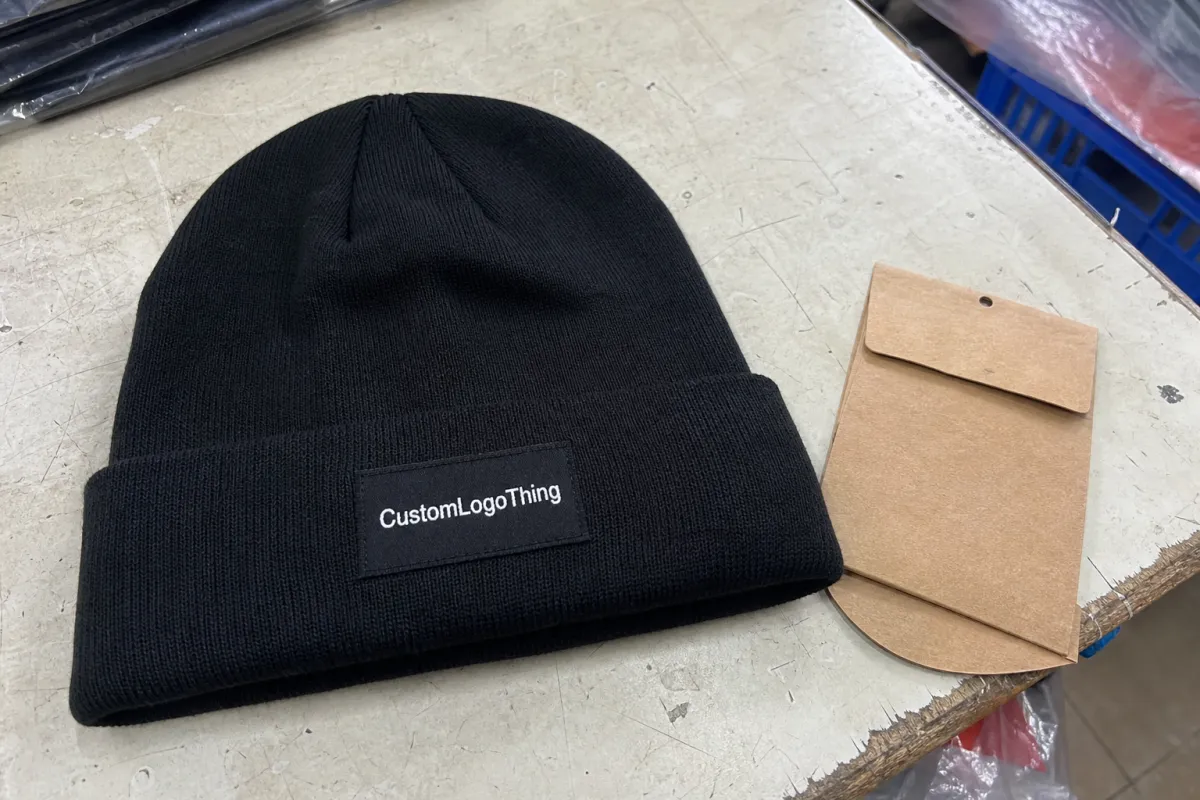
The woven label is what moves the item from generic swag to a more considered gift. It gives the logo a clean, durable finish and usually reads more polished than a large print or heavy embroidery. In a gifting context, that difference affects whether the piece feels chosen or simply branded. If the goal is repeat wear, the quieter option usually wins. Woven labels also hold up well after repeated washing because the artwork is built into the weave instead of sitting on top of the fabric.
The cheapest beanie is often the most expensive program once you count rework, late freight, and gifts that never get used.
For buyers comparing options, the main case for woven labels is simple: the beanie is useful, the decoration is controlled, and the order is easier to manage than size-based apparel. That leaves specs, pricing, certifications, and timing as the real decision points.
Beanie styles, knit options, and label placements
Style choice affects both appearance and cost. A cuffed beanie is usually the safest corporate option because it gives the label a flat front panel and a familiar silhouette. A slouch beanie feels more relaxed and can work for creative teams or event drops. Ribbed knits look denser and more structured, while fisherman beanies feel shorter and more fashion-led. Most bulk orders use either 100% acrylic, an acrylic-wool blend such as 80/20 or 70/30, or recycled polyester yarn when a sustainability brief requires it.
Cuffed, slouch, ribbed, and fisherman styles
| Style | Best use | Brand feel | Cost impact |
|---|---|---|---|
| Cuffed | Executive gifts, onboarding kits, broad programs | Clean, familiar, easy to brand | Usually the most efficient |
| Slouch | Creative teams, events, lifestyle gifting | Relaxed, casual, less formal | Similar base cost, sometimes more yarn |
| Ribbed | Cold-weather utility, field staff, winter campaigns | Structured, substantial, durable | Can rise with heavier yarn and denser knit |
| Fisherman | Fashion-led gifting, premium drops | Compact, trend-aware, refined | Often higher because of niche construction |
Label placement changes the tone of the piece. Front cuff placement gives the strongest visibility and the cleanest repeatability across a run. Side-seam labels feel quieter and are useful when the beanie should read more like apparel than merchandise. Hem tabs and interior labels keep the outside cleaner, though they do not create the same immediate brand presence. A common woven label size is 40 x 20 mm or 50 x 25 mm, with a 2-color or 3-color weave for clear readability.
Material choice matters as much as style. Standard acrylic is the workhorse for bulk gifting because it is warm, stable in production, and usually the least expensive. Acrylic-wool blends feel richer and can drape better, but they add cost and may extend lead time if the yarn is not already stocked. Recycled fibers can support a sustainability brief, but the claims should be backed by the right documentation and packaging. If the recycled content is part of the selling point, ask for GRS documentation for the yarn chain and confirm whether recycled claim language is allowed on the hangtag or carton.
Color is another cost lever. Stock yarn colors are faster and cheaper because they already exist in production. Custom-dyed yarn improves brand matching, but it usually adds cost and time. If exact color is important, build that into the brief instead of assuming a near match will look close enough in person. For a tighter brand match, give the supplier Pantone references and ask for yarn swatches before knitting starts.
In most cases, the simplest spec is the safest one: choose a strong stock beanie color, use one woven label, and avoid extra decoration unless it clearly adds value. Thin logos, tiny copy, and crowded layouts tend to lose clarity once they are translated into thread. If you want a premium feel without adding much cost, a single woven label plus a discreet side tab usually performs better than adding embroidery, patchwork, and multiple trims.
Specs to lock before you request quotes
Fast quotes come from clear briefs. If the supplier has to guess at style, label size, color build, or packing method, the pricing will either be padded for risk or too vague to trust. A short, precise brief saves time and gives you a cleaner comparison between vendors. The best briefs also state whether the order needs to meet a certification target such as OEKO-TEX Standard 100 for skin-contact safety, GOTS for organic cotton content, GRS for recycled fiber claims, or factory social compliance like WRAP or BSCI.
What to include in the brief
- Beanie style: cuffed, slouch, ribbed, fisherman, or another defined shape.
- Label size and placement: for example, 40 x 20 mm on the front cuff.
- Knit details: yarn weight, stitch density, and whether the beanie is single-layer or double-layer.
- Artwork format: vector logo files, brand colors, and any one-color or multi-color label rules.
- Packaging level: bulk packed, polybagged, boxed, or gift-set ready.
- Compliance details: fiber content, country of origin, and any tagging requirements.
Woven labels can hold more detail than many other trims, but they still have limits. Very thin text can collapse, and fine lines that look sharp on screen can blur once they are translated into thread. If the logo includes small copy, ask for a label mockup before approval. That is especially important when the beanie is intended for clients or executives, where a bad detail reads as a quality issue. For most woven labels, keep the smallest text no smaller than about 3 mm in height and avoid reversing thin type out of a dark background.
Order structure should be defined early as well. One style or multiple? One label across every unit or variations by office? One destination or split shipping? Mixed runs are possible, but they increase complexity and can affect MOQ, labor, and packing time. If the order needs to arrive gift-ready, specify folding, hang tags, insert cards, and any boxing details before the first proof is approved. If you need branded cartons, ask for carton print, outer carton count, and whether the supplier can carton-pack to 25 or 50 units per case.
For direct-to-recipient programs, packaging is part of performance, not just presentation. Carton strength, unit packing, and fill level determine whether the beanie arrives looking polished or compressed. ISTA guidance at ista.org is a useful reference when an order is moving through multiple carriers or long final-mile routes. A simple drop-test or compression check on packed cartons helps catch crushed crowns, bent labels, and overfilled boxes before shipment.
Pricing, MOQ, and unit-cost levers to watch
Price is usually the first question, but the unit quote only becomes useful when the assumptions are clear. Yarn quality, knit density, label complexity, packaging, quantity, and artwork status all change the number. So does whether the order is final or still under revision. A quote that ignores those variables is not especially useful for planning. If the supplier includes decoration setup, label weaving, sewing, and carton packing in one number, that is easier to compare than a quote that separates them into ambiguous line items.
Typical MOQs often start around 100 to 250 pieces, though some suppliers will go lower. Lower minimums are possible, but the per-piece cost rises because setup is spread across fewer items. For pilot programs or executive-only gifts, that may still be the right tradeoff. For larger staff programs, a bigger run can improve unit economics, as long as the recipient count is stable. For a simple cuffed beanie with one woven label and bulk packing, 500 MOQ is a common sweet spot for cost control.
| Run size | Typical unit price range | What usually changes |
|---|---|---|
| 50 pieces | $8.50-$12.00 each | Setup costs dominate, limited room for packaging extras |
| 100 pieces | $6.90-$9.20 each | Better balance, still sensitive to custom yarn or label complexity |
| 250 pieces | $4.80-$6.20 each | More efficient production, better leverage on setup |
| 500 pieces | $2.50-$4.00 each | Best balance for standard acrylic, one woven label, and bulk packing |
| 1000 pieces | $2.10-$3.30 each | Lower decoration overhead per unit, better freight efficiency |
At 500 MOQ, a basic woven-label beanie in standard acrylic often lands around $2.50-$4.00 per unit before shipping if the artwork is final and the packaging stays simple. Add custom-dyed yarn, upgraded acrylic-wool blend yarn, embroidery, individual polybags, or gift boxing, and the unit cost can climb by $0.40-$2.00 per piece. If the supplier promises a price that seems too low, confirm whether the quote excludes label weaving, sewing, setup, cartons, or inspection.
Lead time is just as important as price. A practical sample cycle is 3-5 business days for a digital proof and 7-10 business days for a stitched pre-production sample if the lab is building a new label or yarn combination. Bulk production for a straightforward run is commonly 18-22 business days after sample approval and deposit, with another 3-7 business days for packing and export-ready cartonization. Shipping time sits on top of that, depending on the carrier and service level.
Cost levers worth watching include stitch density, yarn count, label color count, packing format, and whether the factory has to change yarn lots mid-run. More colors in the woven label mean more weaving time and more risk of fine-detail loss. A thicker rib knit uses more yarn and can increase both material and machine time. If the beanie is for a winter campaign, a heavier 5-gauge or 7-gauge knit may be worth the upgrade; for large giveaways, a lighter 9-gauge or 12-gauge knit is usually easier to keep on budget.
Production process, timeline, and approval checkpoints
A good production plan reduces surprises before they become expensive. For woven-label beanies, the work usually starts with tech pack review, then label artwork confirmation, yarn sourcing, knitting, linking, washing or steaming, label sewing, trimming, final inspection, and packing. Suppliers that run flat knitting machines can hold consistent panel shapes, while circular knitting machines are often used for fully knit bodies depending on the style. The final shape is usually finished with linking or sewing at the crown and then pressed or steamed for a cleaner hand feel.
The first checkpoint is artwork and spec approval. The factory should send a digital mockup that shows label size, position, and colors. If the label is woven, ask for a weave simulation or thread chart so the logo can be checked at the actual stitch count. The second checkpoint is a sample or pre-production sample. This should confirm the yarn hand feel, the cuff depth, the seam finish, and the label placement in real fabric, not just on screen. If the order includes recycled content or certification language, this is the time to verify that the documentation matches the claim.
Sampling usually follows a simple path: tech pack review, yarn and label confirmation, first sample, revision if needed, then approval to bulk. A clean sample process helps avoid rework, which is where schedules get lost. If the first sample misses the target, one revision cycle is normal; two or more usually signals a spec problem that should be fixed before production starts.
During bulk production, the main inspection checkpoints are yarn lot verification, knit consistency, label placement, trim cleanliness, and finished measurement. A practical QC plan checks crown height, cuff width, label alignment, and seam strength on representative pieces from each lot. Many buyers use AQL-style inspection with a common target such as 2.5 major and 4.0 minor defects, but the exact standard should match the program risk. For a gifting order, visible flaws like crooked labels, loose threads, oil marks, or color mismatches matter more than tiny imperfections hidden inside the seam.
Final packing should also be checked. Count cartons, verify unit folds, confirm polybag suffocation warnings if applicable, and inspect carton markings against the packing list. If the order needs a sustainability claim, verify the documentation before it ships: GOTS for certified organic cotton claims, GRS for recycled fiber claims, OEKO-TEX Standard 100 for tested safe-to-wear materials, and WRAP or BSCI for factory social compliance. If the supplier cannot provide current certificates, treat the claim as unverified and remove it from the brief.
For most programs, a realistic timeline looks like this: 1-2 business days for quote and spec alignment, 3-5 business days for digital proof, 7-10 business days for sample approval if needed, 18-22 business days for bulk production after approval, and then freight. That is fast enough for seasonal gifting if the buyer freezes the spec early and avoids design changes after sampling starts.
How to keep orders on brand and on schedule
The easiest way to keep a beanie program on track is to lock the details that create avoidable churn. Once the style, yarn, label size, and packing format are set, changing them midstream usually costs more than the value of the change itself. Small adjustments can still ripple through knitting, label weaving, and packing, especially when the factory has already reserved machine time.
Color approval deserves extra care. If the brand needs a close match, ask for yarn swatches or a lab dip before bulk starts. For woven labels, approve the thread color against both daylight and indoor light, because subtle blues, greys, and charcoals can shift noticeably under warm lighting. If the beanies will be distributed at an event, remember that branding seen under stage lighting can look different from what the design team approved on a monitor.
Packaging should be treated as part of the product, not an afterthought. A beanie folded too tightly can arrive with a compressed cuff, while loose packing can create crushed cartons and mixed counts. If the order is being shipped to multiple offices, ask for carton labels that clearly identify style, color, size, and quantity. That saves receiving time and reduces the chance that a mixed pallet gets sorted incorrectly.
If the order is serving an executive audience, prioritize consistency over novelty. A clean woven label, matching yarn, balanced cuff height, and neat packing do more for perceived quality than extra decoration. If the order is for a broad employee program, use a standard spec and keep the variation limited to color or label copy. The fewer moving parts in the run, the lower the chance of late approval or avoidable defects.
What to prepare for a fast bulk order quote
A fast quote usually comes down to whether the buyer has the right inputs ready. The clearer the brief, the faster the supplier can price yarn, machine time, label weaving, and packing without padding the risk. A tight brief also lets you compare suppliers on the same basis instead of trying to translate three different assumptions into one budget.
- Target quantity: 100, 250, 500, 1000, or another exact run size.
- Beanie style: cuffed, slouch, ribbed, fisherman, or another defined shape.
- Fabric and yarn: 100% acrylic, acrylic-wool blend, recycled polyester, or another specified material.
- Label details: size, placement, color count, and whether the label is woven or sewn as a patch.
- Packaging: bulk pack, polybag, gift box, insert card, or ship-ready carton count.
- Compliance: OEKO-TEX Standard 100, GOTS, GRS, WRAP, BSCI, or no certification requirement.
- Artwork: vector files, Pantone references, and any required brand copy.
- Timeline: target delivery date plus whether sample approval has already started.
If a certification is required, ask for the current certificate number, scope, and expiration date before you approve the quote. For example, GOTS is relevant when the beanie includes certified organic cotton content, GRS matters when recycled fiber claims are being made, and OEKO-TEX Standard 100 is useful when the priority is tested chemical safety for wearables. WRAP and BSCI are not product certifications, but they are useful when the buyer wants evidence of social compliance at the factory level.
It also helps to state what the order should not include. If embroidery, mixed labels, retail hang tags, or gift boxes are out of scope, say so. Every extra line item gives the quote more room to drift. A clean request is often the difference between a fast answer and a long back-and-forth.
FAQs
What is a realistic MOQ for woven-label beanies? Most bulk programs start around 100 to 250 pieces, but the best pricing usually appears at 500 pieces or more. At 500 MOQ, a simple acrylic cuffed beanie with one woven label often prices around $2.50-$4.00 per unit before shipping.
How long does production usually take? For a straightforward order, plan on 18-22 business days after sample approval and deposit. Add 3-5 business days for a digital proof and 7-10 business days if you need a stitched pre-production sample.
Which certifications matter most? Use OEKO-TEX Standard 100 for tested safe-to-wear materials, GOTS for certified organic cotton content, GRS for recycled fiber claims, and WRAP or BSCI when you want factory-level social compliance documentation.
What is the most reliable beanie style for corporate gifting? A cuffed beanie is usually the safest choice because it gives the woven label a flat placement area, reads clearly in photos, and works for executive gifts as well as broad employee programs.
What should be inspected before shipment? Check yarn color, knit density, label alignment, seam strength, trim cleanliness, folded dimensions, carton count, and packing list accuracy. If the order is certified, confirm the paperwork before release.
``` If you want, I can also turn this into a tighter SEO version or a more premium, editorial-sounding version while keeping the same HTML structure.