Buyer Fit Snapshot
| Best fit | Corrugated Packaging Lead Time projects where brand print, material claims, artwork control, MOQ, and repeat-order consistency need to be specified before quoting. |
|---|---|
| Quote inputs | Share finished size, material target, print colors, finish, packing count, annual reorder estimate, ship-to region, and any compliance wording. |
| Proofing check | Approve dieline scale, logo placement, barcode or warning zones, color tolerance, closure strength, and carton packing before bulk production. |
| Main risk | Vague material claims, crowded artwork, missing packing details, or unclear freight terms can make a low unit price expensive after revisions. |
Fast answer: Corrugated Packaging Lead Time: What Slows It Down should be specified like a repeatable production item. The safest quote records material, print method, finish, artwork proof, packing count, and reorder notes in one written spec.
Production checks before approval
Compare the actual filled-product size with the drawing, then confirm tolerance on folds, seals, hang holes, label areas, and retail display edges. Reserve space for logos, QR codes, warning copy, and material claims before decorative graphics fill the panel.
Quote comparison points
Review material grade, print process, finish, sampling route, tooling charges, carton quantity, and freight assumptions side by side. A quote is only useful when the supplier can repeat the same color, closure quality, and packing count on the next order.
Custom Logo Things
Corrugated Packaging Lead Time: What Slows It Down
Corrugated packaging lead time is usually longer than the box run itself, and that catches people off guard. The machine is only one piece of the timeline. Artwork review, structural checks, proof approval, scheduling, freight booking, and palletizing can all sit in front of the press. I have watched a supposedly simple order lose four business days because the file had no dimension callouts. The boxes were never the problem. The handoffs were.
If you buy Custom Packaging Products or order Custom Shipping Boxes, the real question is not only how fast a plant can make cartons. It is how quickly every step before and after production can move without adding cost. A clean brief keeps corrugated packaging lead time tight. A vague one can stretch it by a week before production even starts, which is just painful and kinda avoidable.
That gap matters because corrugated packaging lead time is not one number. Stock, semi-custom, and fully custom boxes move on different clocks. The cheapest quote is not always the fastest path, and the fastest path is not always the cheapest in total. For a buyer, the right schedule is the one that fits demand, freight capacity, and internal approvals without forcing a rush fee later.
What Corrugated Packaging Lead Time Actually Means
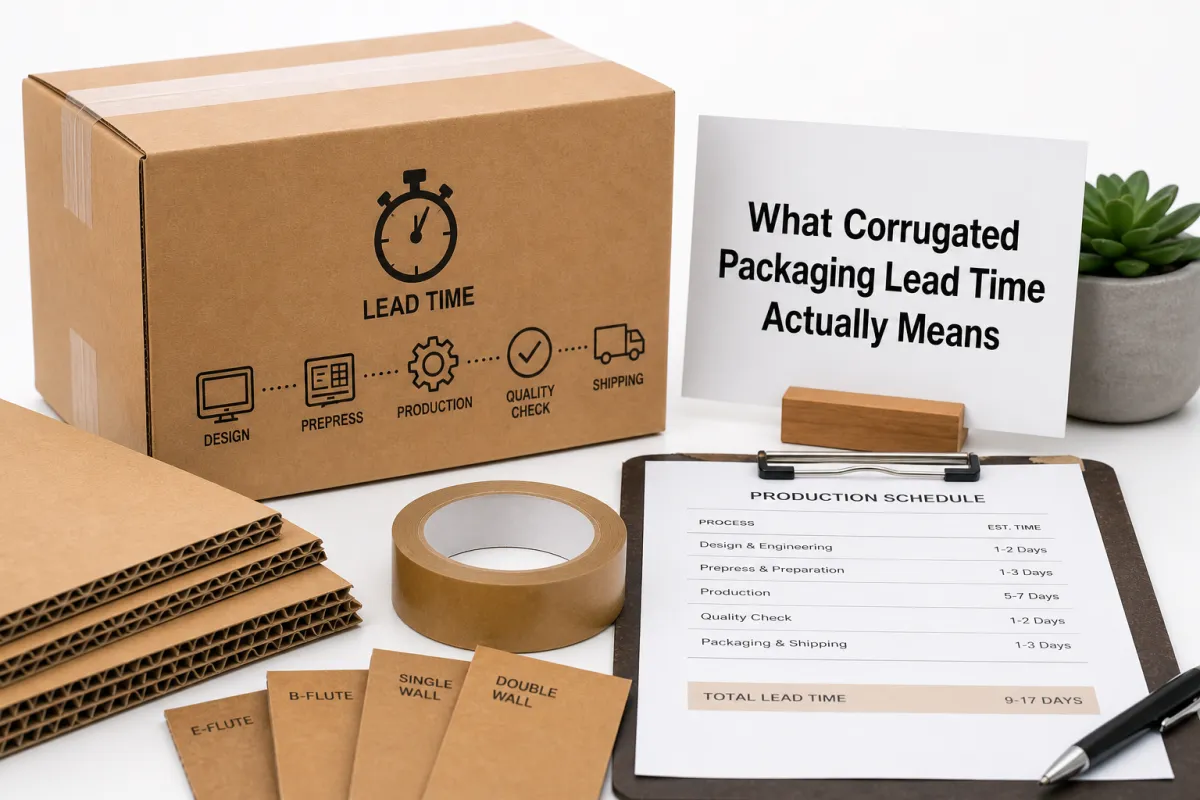
Corrugated packaging lead time is the full span from an approved order to boxes landing at your dock. That includes quote confirmation, structural review, artwork setup, proofing, production, finishing, palletizing, and transit. People love to shrink it down to machine time, but machine time is only one slice of the clock. A press can run cleanly and still miss a launch because the dieline sat in someone’s inbox for three days. I wish that were rare. It is not.
The difference between stock, semi-custom, and fully custom packaging is big. Stock mailers or plain shipping cartons can sometimes move in a few business days if inventory is already on hand. Semi-custom work, such as a standard box with a printed logo or one-color branding, usually needs setup and proofing, so corrugated packaging lead time grows. Fully Custom Retail Packaging or product packaging can take longer because the structure, print, inserts, coatings, and board selection all need to line up before the run starts.
Why does that matter so much? Shipping teams and e-commerce operators do not get rewarded for saving a dollar per box if that savings causes a stockout. A brand preparing a launch can miss a retailer receiving window if corrugated packaging lead time was underestimated by even a few days. For lean inventory programs, every extra approval loop turns into real risk.
A practical rule: shorter corrugated packaging lead time usually comes from cleaner specs, fewer revisions, and better forecast accuracy. The more you standardize box style, board grade, and artwork requirements, the easier it is for a manufacturer to slot your order into production. That does not mean every project should be stripped down. It means the design should do a job, not create avoidable friction.
The fastest corrugated packaging lead time is rarely the one with the highest rush fee; it is the one with the fewest surprises.
That sounds obvious. It still gets ignored. A company will spend two weeks debating branding while skipping the basic question of whether the carton size actually fits the product. Then production starts, and someone discovers the insert needs to change. Now corrugated packaging lead time is longer, cost is higher, and everybody is acting shocked by a delay that was sitting in plain sight.
For buyers who care about package branding, corrugated packaging lead time is part logistics and part decision discipline. The better the upfront brief, the faster the order can move. Strong packaging programs treat box specifications like operational data, not a design afterthought.
How Corrugated Packaging Lead Time Works
Most corrugated packaging lead time problems start with the same sequence. Quote first. Structural review next, if the box is custom. Then artwork prep, proofing, or sampling. After that, the order gets scheduled, manufactured, finished, packed, and shipped. Each step can be fast on its own. Put them together and the timeline can still drag if one handoff stalls.
A same-day quote does not mean a short corrugated packaging lead time. I have seen orders where pricing came back quickly, then dieline approval took a week because the file format was wrong or the dimensions were missing. The buyer feels momentum because someone answered fast, but the project has not actually moved. That distinction matters more than people admit.
Box style changes the pace too. A regular slotted container, or RSC, with no print is usually simpler than a printed mailer with inserts and coatings. Flute type matters as well. A single-wall B flute or E flute box can be easier to source and process than a heavier double-wall structure. Add spot UV, aqueous coating, foil, or complex die cuts, and corrugated packaging lead time often lengthens because finishing and setup take extra steps.
Quantity changes the math. A 500-unit run may feel small and easy, but low-volume work can be slower per unit because the plant still has to set up the line, verify the print, and clear the job. A 10,000-unit run may take longer to manufacture, yet it can move more predictably once scheduled. Corrugated packaging lead time should always be discussed alongside order quantity, not in isolation.
Typical ranges help frame the decision:
- Plain RSC shipper: often 5-10 business days after approval, depending on board availability and freight distance.
- Printed mailer: often 10-18 business days after proof approval, especially if color matching needs a revision.
- Custom retail packaging with inserts: often 15-25 business days or more, since structural review and finishing add more handoffs.
That is not a universal schedule. It depends on the plant, the season, and the complexity of the job. The range still explains why corrugated packaging lead time can feel inconsistent from one project to the next. A buyer who understands the sequence can spot the bottleneck early, before the due date starts looking fake.
Transportation is part of the timeline too. A box may be finished on time but still arrive late if the freight plan is weak, the pallet count is wrong, or the ship-to location creates a longer transit path. Cross-country orders often need extra buffer because trucking capacity can tighten quickly. If a launch depends on a specific in-hand date, build transit into the schedule instead of treating it like an afterthought.
For teams that want a more technical benchmark, industry groups such as ISTA help define how packaging performs under transport stress, and that matters when you are balancing board strength, damage rates, and speed to market. If a program also needs fiber sourcing verification, FSC provides a recognized chain-of-custody framework that can affect material selection and documentation time. Those standards do not replace production planning, but they do shape it.
Branded packaging teams also underestimate how many people touch the file before a box goes live. Marketing wants the logo larger. Operations wants the carton smaller. Procurement wants the lowest unit cost. None of those requests is wrong. The delay shows up when they arrive one by one instead of being resolved in one approval cycle. That is how corrugated packaging lead time slips without anyone noticing the real cause.
Key Factors That Change Lead Time and Cost
The biggest driver of corrugated packaging lead time is board availability. If the mill has the grade you need, the order can stay on track. If the paper machine is tight, the schedule moves. Paper grade shortages, seasonal demand spikes, and supply-chain interruptions can all push lead times out even when the box design itself is simple. Buyers sometimes focus on the converter and forget that the converter may still be waiting on raw material.
Tooling and setup matter just as much. A die line that already exists can save days. A new cutting die or insert tool adds setup time and sometimes a tooling charge. Print complexity adds another layer. One-color flexo on a shipping carton is not the same as full-coverage litho-lam print with a matte finish and tight registration. The more precise the appearance, the more chances there are for a proof round to slow corrugated packaging lead time.
Artwork revisions are a silent budget killer. A missing Pantone target, an outdated logo file, or a SKU count that changes after proof approval can force rework. The cost of that rework is not always obvious on the invoice. Sometimes it shows up as a missed production slot, a second proof, or freight that had to be upgraded because the schedule moved. In many cases, the delay costs more than the box.
Pricing and timing merge here. A rush fee is not only a premium for faster output; it is compensation for interrupting a planned production sequence. If a plant must reshuffle equipment, staff, or freight, that disruption carries cost. Faster corrugated packaging lead time usually means higher pricing. The real cause is not just speed. It is schedule friction.
Seasonality is another factor that catches people off guard. Retail packaging programs often tighten before promotions, holidays, and large launch windows. E-commerce brands feel it when fulfillment volumes spike and inventory turns faster than expected. If an order lands in the middle of a busy cycle, corrugated packaging lead time can stretch even if nothing is wrong with the order.
Low-volume orders and multiple SKUs also create drag. A single SKU can be scheduled cleanly. Ten SKUs with different sizes, print files, and insert counts create more chances for mistakes. A buyer requesting product packaging across many product lines should think about consolidation. Standardizing dielines or reducing size variations often lowers both cost and corrugated packaging lead time.
From a cost perspective, the hidden line items are usually the ones people forget to ask about:
- Proof rounds beyond the first mock-up
- New die cutting tools or insert tooling
- Small-run inefficiency and minimum order charges
- Special finishing, such as lamination or aqueous coating
- Split shipments to meet urgent warehouse dates
- Expedited freight on short notice
All of those items can raise unit price while also changing corrugated packaging lead time. That combination matters because a low per-box price is meaningless if the order misses the ship date and forces an emergency replacement later. Buyers who manage branded packaging programs well usually compare landed cost, not just piece price.
There is also a material planning issue hiding underneath all of this. Corrugated packaging lead time can shrink if the buyer can reuse an existing structure, approve artwork faster, or specify a standard board grade that the supplier already runs regularly. In packaging design, the smartest move is often not the fanciest one. It is the option that does the work with the fewest unique variables.
Corrugated Packaging Lead Time vs Cost: What Buyers Miss
Buyers often treat price and speed as separate decisions, but corrugated packaging lead time and cost are tied together. Faster schedules can raise the unit price because a supplier has to break into a normal production sequence. Slower schedules may look cheaper on paper, yet they can carry a real business cost if inventory runs out or a launch slips.
Minimum order quantities complicate this trade-off. A smaller run may seem safer if you only need a short-term supply, but lower volumes can be less efficient to produce. That means a higher unit price and, in some cases, less schedule flexibility. A larger order can improve pricing and stabilize corrugated packaging lead time, but only if storage space and demand forecasts are solid.
Typical trade-offs look like this:
| Option | Typical Lead Time | Typical Unit Cost at 5,000 Units | Best Fit | Main Trade-Off |
|---|---|---|---|---|
| Stock corrugated shipper | 3-7 business days | $0.45-$0.90 | Fast replenishment, simple shipping needs | Limited branding and size options |
| Semi-custom printed box | 8-15 business days after approval | $0.75-$1.35 | Branded packaging with moderate design needs | Proofing and print setup add time |
| Fully custom box with inserts | 15-25 business days or more | $1.20-$2.40 | Retail packaging, premium presentation, fragile products | More steps, more revision risk |
| Expedited custom order | Shortened by several days | Usually 15% to 35% higher | Launches, emergency restocks, missed forecast corrections | Rush fees and freight premiums |
Those numbers are directional, not guaranteed. Board grade, print coverage, shipping zone, and carton dimensions can move them around. The basic pattern stays the same: faster corrugated packaging lead time tends to cost more, especially once the order leaves stock inventory and enters custom manufacturing.
A premium quote can still be the better value. If a slower, cheaper order causes a stockout, the business may lose sales, trigger split shipments, or pay for emergency replenishment later. Those costs do not sit on the packaging invoice, which is why they are easy to miss. A smart packaging buyer looks at total landed cost, not just the box price.
Freight can distort the picture even more. A low box price with expensive priority shipping can wipe out the savings. A slightly higher production price with efficient palletization and planned transit can lower the total bill. In many corrugated packaging programs, the freight line is where the real budget leak hides.
There is a useful comparison with retail packaging here. If a package needs premium appearance but the product itself has low margin, the box cannot absorb endless cost increases. Package branding decisions should be tied to sales volume and replenishment cadence. The prettier box is not automatically the better box if it slows corrugated packaging lead time by a week and forces air freight later.
The best cost strategy is usually not dramatic. It is consolidation. Fewer sizes, fewer finishing steps, fewer file revisions, and a better reorder rhythm. Those choices reduce corrugated packaging lead time because they reduce uncertainty. They also keep the annual packaging budget from getting chewed up by emergency decisions.
Step-by-Step Guide to Shorten Corrugated Packaging Lead Time
If you want shorter corrugated packaging lead time without paying rush fees, start before the reorder is urgent. That sounds obvious, but many teams wait until inventory is almost gone and then expect the supplier to make up the difference. By then, the schedule is already boxed in. Pre-order planning is the cheapest speed boost available.
Lock the spec early
Dimensions, flute type, print method, board grade, finish, and quantity should be known before the first quote goes out. The more of those details you finalize upfront, the fewer surprises appear later. A supplier can usually work fast with a solid brief. A weak brief slows corrugated packaging lead time because every unanswered question becomes a follow-up email, and nobody wants to play email tennis with a launch date on the line.
Use a submission checklist
One of the simplest ways to shorten corrugated packaging lead time is to submit complete information the first time. A strong request should include box dimensions, carton style, quantity, delivery address, target in-hand date, artwork files, Pantone targets, and any testing requirements. If the artwork is still in progress, say so. Ambiguity creates rework.
- Final dimensions and style code
- Estimated annual volume and initial run quantity
- Print colors, coverage, and finish
- Dieline or reference sample if one exists
- Ship-to location and required delivery window
Give one person final approval authority
Internal misalignment is a bigger threat than many teams admit. Engineering may want a stronger board, marketing may want brighter color, and operations may want the carton flattened for storage. If those teams all send separate comments, corrugated packaging lead time can expand without any production issue at all. One approval owner prevents that churn.
Ask for a real schedule map
Ask the manufacturer to separate proof time, production time, and transit time. That distinction matters because each stage behaves differently. A job might only need five days of production but eight days of approvals. Or the manufacturing run could be easy while freight takes longer than expected. If you cannot see the schedule in pieces, you cannot control corrugated packaging lead time intelligently.
A clean semi-custom shipping box might be quoted at 10 business days total. A more useful breakdown could be 2 days for proofing, 5 days for production, and 3 days for freight. Once you see the stages separately, the actual bottleneck becomes obvious. Often it is not the plant. It is the approval chain.
Build fallback options
Good packaging teams keep a backup plan. That could mean a second box size, an alternate print treatment, or a safety stock trigger. If the preferred spec slips, you can switch to a plan B without restarting the entire corrugated packaging lead time cycle. Flexibility costs less than emergency panic.
That logic applies to Custom Packaging Products across the board, not only to shipping boxes. Standardizing one or two structural families can make future orders faster because your team already knows the spec, the artwork boundaries, and the freight pattern. Packaging design decisions made now can remove delay later.
One last tip: track actual lead times against promised lead times. If a supplier consistently ships two days earlier than quoted, that is useful. If they are consistently a day late, that matters even more. Over a few cycles, the data will tell you which assumptions are real and which are wishful thinking. That makes corrugated packaging lead time easier to forecast and easier to defend internally.
Common Mistakes That Delay Corrugated Packaging Lead Time
Calling a project urgent without final specs is one of the fastest ways to slow corrugated packaging lead time. It sounds dramatic, but urgency without detail only pushes the work backward. The supplier still needs dimensions, artwork, quantity, and delivery date. If those pieces are missing, the job cannot be scheduled with confidence.
Changing specs after proof approval is another common problem. A small change in box size can alter fit. A change in board grade can affect sourcing. A new insert count can force a redesign. Each revision adds time, and the delay often lands after the team thought the order was finished. That is how corrugated packaging lead time quietly stretches beyond the original plan.
Seasonal congestion is easy to ignore until it is already hurting you. Holiday volume, retail launch windows, and freight bottlenecks all create pressure on the same supply chain. If you wait until those peaks arrive, you are asking for trouble. The smart move is to build more buffer into corrugated packaging lead time before the calendar gets crowded.
Internal approval layers create another invisible delay. Even if the supplier is ready, the order cannot proceed if legal, marketing, and operations each need separate sign-off. One missed approval can add days. Two missed approvals can add a week. A faster supplier does not fix a slow process inside the buyer's own organization.
Ordering just enough units for the current need is a trap that repeats itself. A small order may feel fiscally cautious, but it can force you to restart the whole corrugated packaging lead time cycle a few weeks later. If demand is stable, a larger order with a better reorder point often makes more sense than repeated emergency buys.
Teams also underestimate the role of testing and compliance. If the box must meet distribution requirements, it may need ISTA-style testing or internal performance checks. A carton that looks fine on screen may not survive transit once weight, stacking, and vibration are involved. Designing around those realities early can prevent a late-stage redesign that wrecks corrugated packaging lead time.
The delay is usually not one huge mistake. It is five small ones. Missing spec data. A late color change. An internal approval that takes too long. A freight assumption that never got checked. A reorder placed too late. Each one looks minor. Together, they turn a manageable corrugated packaging lead time into a scramble.
For teams that buy retail packaging or custom printed boxes regularly, the fix is process discipline. Use a standard intake form. Keep approved files in one place. Document the final carton dimensions. Review the reorder point every quarter. Those habits sound plain, but they do more to stabilize corrugated packaging lead time than any last-minute rush request.
Expert Tips and Next Steps for Faster Reorders
The fastest reorders usually come from the least dramatic systems. If you want shorter corrugated packaging lead time on repeat orders, start with inventory triggers based on actual usage, not optimism. A reorder point should reflect sales velocity, transit time, and the buffer needed for proofing or scheduling. If the math is wrong, the box will be late no matter how good the supplier is.
Keep a locked spec library. That means dielines, approved artwork, print standards, and vendor contacts live in one place and stay current. It sounds administrative, but it removes the restart problem. Future orders do not have to begin from zero, which is why corrugated packaging lead time can shrink so much on the second and third run.
Review your slowest SKUs first. One stubborn package can reveal a bigger process issue. Maybe the box is oversized, which drives freight cost. Maybe the print coverage is too complex. Maybe the insert is custom when a standard support would do the job. Fixing one recurring bottleneck can reduce corrugated packaging lead time across the whole program.
Quarterly packaging reviews are worth the time. Compare lead time, cost, freight, and damage rates by SKU. If a box is cheap but arrives late, it may be costing more than a slightly pricier option that moves faster and damages less product. Packaging buyers who track the data tend to make cleaner decisions than those who rely on memory alone.
Think ahead in order cycles instead of single buys. If annual volume is reasonably stable, place larger, better-timed orders instead of many tiny ones. That can improve pricing and reduce rework. If volume is volatile, define your safety stock and backup structure now so the next corrugated packaging lead time starts before you are in danger.
For brands balancing branded packaging and product packaging across multiple channels, consistency is usually a bigger advantage than novelty. Reusing a proven structure makes reorders faster, simplifies inspection, and lowers the odds of a spec change derailing the schedule. The visual design can still evolve. The underlying box does not need to reinvent itself every time.
Here are the next steps I would recommend:
- Gather your top three box specs and confirm the current dimensions.
- Estimate annual volume and note the monthly usage pattern.
- Request a lead-time estimate that separates proofing, production, and transit.
- Set a reorder calendar so corrugated packaging lead time starts before inventory gets tight.
- Review whether any SKU can move to a standard structure or simpler print treatment.
If you do those five things, corrugated packaging lead time becomes easier to manage, easier to forecast, and easier to defend inside the business. You will still see variation from supplier to supplier, but you will stop treating every delay like a mystery. For most teams, that shift alone saves time, money, and a lot of avoidable back-and-forth.
FAQs
What is a normal corrugated packaging lead time?
Simple stock-style orders can move quickly, while custom printed boxes usually take longer because proofing and setup add steps. A normal corrugated packaging lead time depends on quantity, print complexity, board availability, and shipping distance, so ask for a timeline that separates production from transit. A reliable supplier should be able to show exactly where the schedule can compress and where it cannot.
Why does custom corrugated packaging take longer than stock packaging?
Custom orders need dieline setup, artwork approval, and often a sample or proof before production starts. Stock packaging skips most of that work, so the box can move straight into fulfillment. More customization usually means more handoffs, and handoffs are where corrugated packaging lead time tends to disappear.
How can I reduce corrugated packaging lead time without paying rush prices?
Send complete specs the first time, including dimensions, quantities, print details, and delivery date. Choose a standard structure or reuse an existing dieline whenever possible. Approve artwork quickly and keep one internal decision-maker so the order does not get trapped in revision loops. Those moves reduce corrugated packaging lead time without forcing an expedited fee.
Does faster corrugated packaging lead time always mean higher cost?
Often yes, because expedited work can disrupt a normal production schedule or require priority freight. But not always. A cleaner spec, simpler design, or better forecast can shorten corrugated packaging lead time without raising unit price. The real question is total landed cost, not just the box price.
What should I send to get an accurate lead time quote for corrugated boxes?
Provide box dimensions, style, flute or board preference, print details, quantity, ship-to location, and your required in-hand date. Include artwork files and note whether they are final or still in progress. The more complete the request, the more accurate the timeline and pricing will be, and the easier it is to control corrugated packaging lead time on the next reorder.


