Buyer Fit Snapshot
| Best fit | Corrugated Partition Inserts Bulk projects where brand print, material claims, artwork control, MOQ, and repeat-order consistency need to be specified before quoting. |
|---|---|
| Quote inputs | Share finished size, material target, print colors, finish, packing count, annual reorder estimate, ship-to region, and any compliance wording. |
| Proofing check | Approve dieline scale, logo placement, barcode or warning zones, color tolerance, closure strength, and carton packing before bulk production. |
| Main risk | Vague material claims, crowded artwork, missing packing details, or unclear freight terms can make a low unit price expensive after revisions. |
Fast answer: Corrugated Partition Inserts Bulk: Specs, Pricing, Lead Time should be specified like a repeatable production item. The safest quote records material, print method, finish, artwork proof, packing count, and reorder notes in one written spec.
Production checks before approval
Compare the actual filled-product size with the drawing, then confirm tolerance on folds, seals, hang holes, label areas, and retail display edges. Reserve space for logos, QR codes, warning copy, and material claims before decorative graphics fill the panel.
Quote comparison points
Review material grade, print process, finish, sampling route, tooling charges, carton quantity, and freight assumptions side by side. A quote is only useful when the supplier can repeat the same color, closure quality, and packing count on the next order.
Corrugated Partition Inserts Bulk: Specs, Pricing, Lead Time
Corrugated partition inserts bulk usually enters the conversation after the first round of damage claims has already landed in someone’s inbox. One cracked bottle. One scuffed cosmetic kit. One tray of metal parts that arrived as a rattling mess. The carton looked economical on paper, sure, but paper does not pay replacement freight. What fixes the problem is rarely flashy: slotted corrugated dividers doing quiet, repetitive work inside the box, keeping products from colliding in transit.
Packaging buyers learn this lesson the hard way because every shipment carries three costs at once: the carton, the labor, and the failure rate. Corrugated partition inserts bulk help on all three fronts if the dimensions are right and the loading pattern is disciplined. They do not replace a proper shipping box, and they do not make a fragile product indestructible. They do reduce movement enough to change the economics of a shipping program, which is the part that actually matters. Move glass, bottles, samples, or small components often enough and the pattern is obvious. A sloppy load pattern turns into a returns problem faster than most budgets can absorb.
The simple truth is less glamorous. Corrugated partition inserts bulk are one of the least expensive ways to stabilize mixed shipments, and one of the most dependable. They are easier to standardize than loose-fill, paper wrap, or the improvised padding somebody grabs during a rush at the packing station. That predictability matters. Repeatable packouts beat guesswork by a wide margin, and they make the whole operation calmer. Calmer lines make fewer mistakes. That is not a slogan; it is usually what happens on the floor.
“The difference shows up on the floor immediately. Too loose and the product shifts. Too tight and packing slows to a crawl. The right fit makes the entire line calmer, and calmer lines make fewer mistakes.”
Corrugated partition inserts bulk: why breakage drops fast
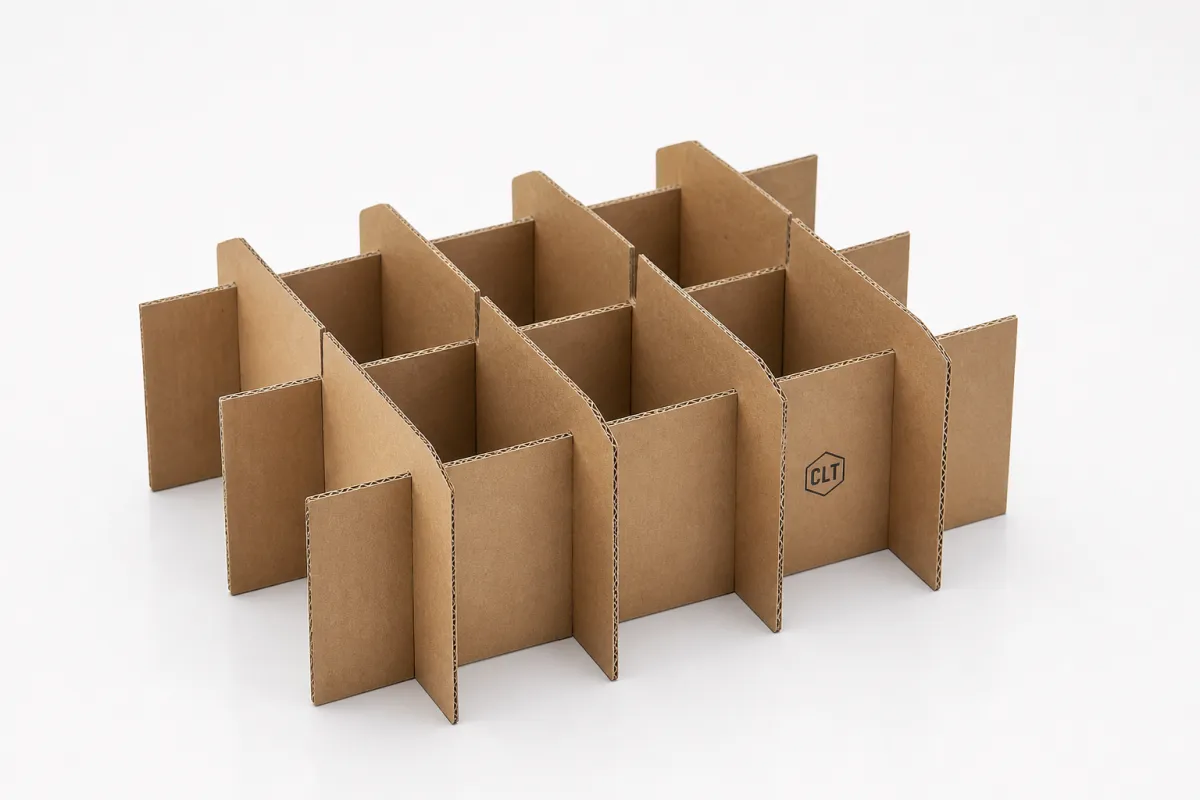
Picture a carton filled with glass jars or small metal parts, none of them separated. The pallet may look clean when it leaves the dock. A few bumps later, that same load can fail at the corners, under vibration, or after a drop test that looked harmless in the lab and brutal in the real world. Corrugated partition inserts bulk interrupt that chain reaction. They stop product-to-product contact, which is usually where the damage starts. Once each item sits in its own cell, the shipment behaves more like a controlled arrangement and less like a moving pile of liability.
Loose-fill can cushion, but it cannot lock items into place. Bubble wrap protects surfaces, yet it adds labor and still allows movement if the carton leaves extra void space. Corrugated partition inserts bulk create structure. That distinction matters more than people admit, especially for cylindrical items like bottles and jars, or rectangular parts with sharp edges that can rub during transit. The insert handles the boring job. Boring, in packaging, is a compliment.
There is a second cost that gets missed far too often. Damage is not just a replacement line on a spreadsheet. It is the time spent repicking orders, the freight paid to resend goods, the customer service hours used to calm an angry buyer, and the brand hit when a customer opens a box and finds shards. A 1% breakage rate on a 20,000-unit run is 200 damaged pieces. That is not a rounding error. That is a problem with a freight bill attached. Corrugated partition inserts bulk usually cost far less than the product they protect, which is why the comparison should never stop at box price.
I have seen operations cut damage simply by moving from loose, inconsistent stuffing to a divider layout that kept every bottle in its own lane. The part that surprised the warehouse team was not the reduction in breakage. It was the reduction in packing friction. Workers stopped rechecking every carton. They stopped compensating for voids by eye. The line got faster because the packout became predictable.
Repeat programs benefit the most. If the same SKUs ship week after week, the divider layout can be engineered once and reused with fewer surprises. Beverage brands do it. Cosmetics teams do it. Industrial suppliers do it. Kitting operations do it because the math works. Stable product, stable carton, stable insert. The arrangement is plain, and plain is useful.
For buyers comparing protection methods, the carton design resources from industry groups such as the Packaging School and packaging community help frame the basics, while test standards from ISTA are useful when a shipping profile needs proof instead of optimism. Standards will not rescue a bad packout, but they do keep everyone honest about what the carton actually has to survive.
Corrugated partition inserts bulk also reduce the “fix it later” labor that creeps into busy fulfillment spaces. Once the insert is set, the loading pattern is clear. Workers do not have to guess where each piece goes or improvise under pressure. That kind of repeatability is not flashy. It simply saves time, lowers training friction, and cuts the odds of one rushed shift blowing up a week of good work.
When the shipment includes delicate goods, the divider becomes a quiet insurance policy. A basic carton with a well-designed partition system often performs better than a premium carton with too much free space inside. Buyers still get that wrong because they compare component prices instead of comparing failure rates. The divider is the unglamorous part of the order. It is also the part that keeps the rest of the order from becoming a complaint.
Corrugated partition inserts bulk: product details and fit options
Corrugated partition inserts bulk are slotted corrugated sheets or divider sets that create separate cells inside a carton, tote, or shipper. Each cell holds one item or a tightly grouped item set, which keeps contents from colliding during handling and transit. That basic structure does a lot of work. It protects surfaces, cuts rattling, holds heavier items away from lighter ones, and makes packouts easier to train and repeat.
The most common uses show up in wine and beverage packaging, cosmetics, glassware, auto parts, hardware, and e-commerce kits. Corrugated partition inserts bulk appear anywhere a buyer needs organized separation inside a box. Bottle shippers are the obvious example, but they are not the only one. Small metal components, lab samples, candle jars, food jars, and promotional kits also benefit from a divider layout that reduces contact damage and keeps the packout tidy.
Several configurations come up again and again. Full-depth dividers run through the whole carton interior and build uniform cells. Half-slotted inserts are useful when the carton needs more flexibility or the product height varies slightly. Die-cut trays can add retention for odd shapes, while custom cell layouts can combine different cell widths in the same packout. Corrugated partition inserts bulk are most useful when the item size stays stable and the shipping program needs predictable internal spacing instead of improvised padding pulled together five minutes before pickup.
Off-the-shelf sizes work well for standard cartons and standard product dimensions. Custom-fit runs make more sense for specialty boxes, totes, retail shipper programs, or multi-SKU packouts where the internal dimensions are tight. The rule is simple: if the product keeps moving, the insert is not tuned correctly. If workers have to fight the insert into place, it is probably too tight. Good corrugated partition inserts bulk give enough clearance to load quickly, but not enough room for motion.
Repeat shipments are where corrugated partition inserts bulk really pay off. A replenishment program, a weekly sample box, or a recurring product family all benefit from a standard divider layout. Labor goes down. Errors go down. Inventory management gets easier because the internal packaging stops changing every time a new order comes in. That kind of consistency matters more than Packaging Ideas That look attractive on a sample shelf and collapse on a loading dock.
Packaging buyers often try to solve too many problems in one decision. Protection, presentation, and low price all get pushed into the same quote request, which is how mediocre answers are born. Corrugated partition inserts bulk work best when the main job is separation and stability. If the program also needs display value, printed messaging, or retail presentation, those layers can be added around the divider. The insert itself still has one job: stop collision damage.
If the outer carton also needs a new format, pairing the insert with Custom Shipping Boxes can clean up the entire packout. For recurring purchasing programs, Wholesale Programs often keep replenishment organized and pricing easier to forecast.
Corrugated partition inserts bulk: specifications, board grade, flute, cell count, and strength
Buyers often ask for “an insert” before they know what the insert needs to do. That sequence is backward. The useful starting point for corrugated partition inserts bulk is the specification set: board grade, flute type, caliper, cell count, and inside dimensions. Those details decide whether the insert holds shape, resists crushing, and fits the carton without eating up usable space.
Board grade comes first. Singlewall corrugated works for lighter loads and lower-stress shipping, while doublewall can make sense for heavier products, taller stacks, or cartons that need better compression resistance. Common flute choices include B-flute, C-flute, and E-flute. B-flute usually offers a solid balance between strength and compactness. C-flute brings more cushioning and thickness. E-flute is thinner and can help where fit and presentation matter. No one flute wins every category. The right choice depends on product weight, carton size, and how hard the shipment will be handled once it leaves the dock.
Cell count changes both protection and pack density. More cells mean more separation, which helps smaller fragile items. Fewer larger cells can work for bigger bottles or parts that need less internal partitioning. The tricky part is spacing. Corrugated partition inserts bulk that are too roomy allow movement. Inserts that are too dense make loading awkward and can waste packout volume. The better layout usually lives in the middle: enough contact support to prevent shift, enough clearance to keep packing efficient.
Fit details matter more than most teams expect. Internal carton dimensions matter more than outside box size. Product width, diameter, height, and the headspace above the product all matter too. If the insert is hand assembled, labor changes the picture as well. A simple slotted divider may be quick to build, while a complex multi-cell pattern can slow the line if the board is too heavy or the fit is too tight. Corrugated partition inserts bulk should support the workflow, not become another point of frustration for the packing team.
Performance checks should cover stacking strength, moisture exposure, and whether the packout needs printing or labeling. In many shipping environments, packaging teams also watch ECT values, compression resistance, and how the assembly behaves after humidity exposure. If the shipment is heading through rough parcel networks, distribution testing deserves attention. ASTM D642 is commonly used for compression testing, and ISTA profiles are widely used to simulate transit. That is not academic trivia. It is the gap between “we think it will hold” and “we verified the load path.”
Here is the practical rule. The heavier, taller, or more fragile the product, the less trust a thin generic insert deserves. Corrugated partition inserts bulk can still be efficient in those cases, but the spec needs to be deliberate. A lightweight cosmetic jar does not need the same board as a heavy glass bottle set. A small electronic part does not need the same cell depth as a tall candle shipment. Matching the insert to the product usually saves more money than shaving a few cents off the board.
Buyers should also think about sourcing and sustainability claims early. If recycled content or certified fiber matters to your brand, ask for FSC-certified material options and verify the claim before production starts. Nobody enjoys cleaning up a packaging claim after the fact. The question is easier to ask early than to explain later.
- Board grade: singlewall for lighter packs, doublewall for heavier or higher-risk shipments.
- Flute type: B, C, or E flute depending on thickness, cushioning, and carton fit.
- Cell count: set by product diameter, width, and the amount of separation needed.
- Inside dimensions: always use carton internal measurements, not outside box size.
- Handling method: hand pack, automated fill, or mixed kit assembly changes the spec.
Cost, pricing, MOQ, and quote basics for bulk orders
Pricing for corrugated partition inserts bulk comes down to a few predictable factors: board grade, custom sizing, cell count, print requirements, and order volume. The more complex the layout, the more material and labor it consumes. The more repeats you order, the lower the unit cost usually drops. That part is not mysterious. The confusion starts when buyers compare a stock divider to a custom program and expect the pricing logic to behave the same way. It will not.
MOQ is where the real conversation begins. Lower quantities usually carry a higher unit price because setup costs have fewer pieces to absorb them. Custom runs often need a larger minimum than standard sizes, especially if tooling, slotting, or die-cut work is involved. Corrugated partition inserts bulk live in a volume market. If you need a small pilot, ask for a sample or a staged release before committing to full volume. That is a better move than ordering blind and hoping the fit sorts itself out later. Hope is expensive in packaging.
Landed cost matters just as much as the unit price. Lightweight corrugated can still become costly to ship if the pallet count is high or the inserts consume a lot of cube. Freight method changes the math. So does how efficiently the product nests on a pallet. Buyers should ask for destination-based shipping estimates, not only a warehouse price. Corrugated partition inserts bulk can look inexpensive on paper and become annoying once freight is added. A clean quote should include carton size, quantity, and delivery location.
| Option | Typical MOQ | Unit price range | Lead time | Best use case |
|---|---|---|---|---|
| Stock-style slotted divider | 500-1,000 units | $0.18-$0.45 | 7-10 business days | Standard cartons and repeat packouts |
| Custom slotted partition | 1,000-2,500 units | $0.32-$0.80 | 10-15 business days | Exact fit for specific carton and product dimensions |
| Die-cut tray insert | 500-2,000 units | $0.55-$1.50+ | 12-20 business days | Odd shapes, retention features, or presentation packs |
Those ranges help, but they are not magic numbers. A simple corrugated partition inserts bulk order with light print coverage will sit toward the lower end. Thicker board, tighter tolerances, and a more complex cell pattern push the price up. Print registration, labels, special finishing, and moisture-resistant board add cost too. The tradeoff never disappears. The only question is whether the money goes into the parts of the packout that actually prevent damage.
If you want a faster quote, send the carton size, item dimensions, quantity, performance target, and destination zip code. Add a photo of the current packout if one exists. That single image usually reveals more than a five-minute phone call. It shows where items shift, where voids appear, and whether the failure comes from the insert, the box, or both. Corrugated partition inserts bulk work best when the quote is built from the real packout instead of a rough guess hidden inside a spreadsheet cell.
Process and timeline: from sample to production
The cleanest production path starts with dimensions. Not a mood board. Not a rough sketch. Real measurements. For corrugated partition inserts bulk, the sequence usually runs like this: request specs, confirm carton and product sizes, review a sample or mockup, approve the quote, then release production. That order prevents expensive mistakes. Skip a step and the bill tends to show up later as rework or lost time.
Simple repeat orders move faster because the layout already exists and the material choice has been settled. New layouts take longer because they need proofing and fit checks. If the insert has multiple cell sizes, unusual depth, or a special board requirement, the supplier may need to confirm the assembly method before production starts. Corrugated partition inserts bulk are straightforward once the geometry is locked. Before that, they are mostly a stack of assumptions with a line item attached.
A practical planning window is often 7-10 business days for a straightforward repeat order after approval, and 10-20 business days for a custom layout depending on complexity, sampling, and factory load. Add time if a sample is required. Add more time if several departments need to weigh in. Procurement, operations, and quality rarely hand back feedback on the same day, which is how schedules drift.
The checkpoints that matter most are fit check, material confirmation, and packaging method review. Fit check means the insert actually holds the product without too much slack or too much pressure. Material confirmation means the board grade matches the load and the shipping risk. Packaging method review means the loading team can assemble it without turning the line into a puzzle. Corrugated partition inserts bulk should reduce friction, not add another training manual to the shelf.
Most delays come from the same handful of problems. Unclear carton dimensions are one. Last-minute spec changes after the sample is already moving are another. A third slowdown appears when one person signs off on the drawing and someone else rejects the loading method three days later. The fix is simple: get the key people aligned before production begins. It sounds obvious because it is. That still gets skipped constantly, and then everybody acts surprised when the schedule slips.
For buyers managing inventory, the safest move is to schedule replenishment before the current stock runs thin. Waiting until the final pallet disappears usually leads to rushed freight and compressed lead times. Corrugated partition inserts bulk are easier to manage when a buffer exists. A small safety stock can prevent a much larger headache.
One more practical point: if the operation also ships a range of carton sizes, keep the insert program tied to the carton program. That keeps shelf clutter down and prevents mismatched components from piling up. It also explains why pairing inserts with a proper carton family can be smarter than forcing one divider design to stretch across too many box sizes.
Why choose us for corrugated partition inserts bulk
The right insert saves money only when it fits the carton and the product. That sounds basic because it is basic, yet plenty of packaging programs still fail at the fundamentals. Our approach to corrugated partition inserts bulk starts with the product dimensions, the carton interior, the load pattern, and the way the packout moves on the line. If the design does not make practical sense, it is not a good design, no matter how polished the quote sheet looks.
Repeatability matters just as much. A buyer should get the same result on reorder that they got on the first approved run. Corrugated partition inserts bulk only earn their place if the dimensions stay consistent and the quality checks stay disciplined. That consistency helps procurement, warehouse teams, and customers who expect shipments to arrive intact. One-off samples are easy. Repeatable production is the part that matters.
Custom manufacturing capability helps too. Some teams need a pilot run first. Some need a larger replenishment order after the layout is set. Some need both. The useful supplier can adjust material grade, cell count, and fit before the order is locked. That avoids the classic mistake of approving a design that looks fine on paper and fails when the actual product gets loaded. Corrugated partition inserts bulk should solve a problem, not generate a second one.
Communication also matters. Fast answers beat polished jargon. If a quote needs clarification, it should be clarified. If a dimension looks wrong, it should be flagged. If the packout would work better with a different carton format, that should be said plainly. That is how you protect the budget and the shipment at the same time. If the outer box needs help as well, Custom Shipping Boxes can bring the full packout into alignment. If the order repeats across the year, Wholesale Programs make replenishment less chaotic.
Bottom line: buyers do not need hype. They need corrugated partition inserts bulk that fit, protect, and repeat without drama. That is the job. Do it well and the shipping operation gets quieter, cleaner, and less expensive to run. Miss it and the conversation turns back to damage claims, which is always a more expensive meeting.
Next steps for corrugated partition inserts bulk orders
Start with the carton. Measure the inside length, width, and height. Then measure the product itself: width, diameter, thickness, fragile points, and any features that need extra clearance. For corrugated partition inserts bulk, those numbers matter far more than assumptions. A half-inch mistake can be the difference between a clean packout and a maddening one. Measure properly now, and you avoid paying later for empty space or a fit that is too tight to be useful.
Next, decide how many cells or partitions the pack needs. Are you separating bottles? Small parts? Glass jars? Sample kits? The answer tells you whether you need full-depth dividers, partial dividers, or a custom cell layout. If the product has a top-heavy shape or a fragile neck, say that up front. Corrugated partition inserts bulk can be tuned around product risk, but only if the risk is identified before production starts.
Then gather the operational details: quantity, target ship date, whether samples are needed, whether the insert needs printed markings, and whether the order has storage or stacking limits. Add photos of the current packout if you have them. That is usually the fastest route to a useful quote because it shows what the product does in the real world, not just on a spec sheet. Corrugated partition inserts bulk should be judged by how the loaded carton behaves, not by how polished the drawing looks in an email.
If you are on a procurement team, compare sample fit, confirm MOQ, and lock production before inventory runs thin. That keeps the program orderly and avoids rush costs. It also gives operations time to train on the final assembly before the full order arrives. Corrugated partition inserts bulk work best when the handoff from engineering to purchasing to fulfillment is clean. Messy handoffs are where packaging programs become expensive.
The practical takeaway is straightforward: measure the packout, match the board and cell layout to the product, and confirm the order before stock gets low. Corrugated partition inserts bulk are not a decorative add-on. They are the part of the shipping system that keeps the shipment intact. Get that right first, and the rest of the program gets easier to run.
How do I choose the right corrugated partition inserts bulk size?
Start with the inside carton dimensions, not the outside box size. Measure the product width, diameter, or thickness, then leave just enough clearance for easy loading. If the items shift or rub, the insert is too loose. If workers struggle to pack it, it is too tight. For corrugated partition inserts bulk, the goal is controlled fit, not a squeeze.
What MOQ is typical for corrugated partition inserts bulk orders?
MOQ depends on whether the insert is stock-style, custom slotted, or die-cut. Custom runs usually need a higher minimum than standard sizes because setup and tooling must be covered. If you need a smaller pilot run, ask for a sample or staged release before committing to full volume. That is usually cheaper than guessing wrong on corrugated partition inserts bulk.
Can corrugated partition inserts bulk be custom made for odd-shaped products?
Yes, custom layouts are common when standard cell sizes do not protect the product properly. Share product dimensions, carton size, and any fragile points that need extra spacing. Odd shapes usually need a fit check or sample before production so you do not waste a bulk run. Corrugated partition inserts bulk are often the right answer, but only after the layout is matched to the shape.
How much do corrugated partition inserts bulk orders usually cost?
Pricing changes with board grade, insert size, cell count, quantity, and whether the design is custom. Higher volumes usually reduce unit cost, but freight and pallet count still matter. The cheapest quote is not always the best value if the insert fails in transit and creates damage claims. That is especially true for corrugated partition inserts bulk in fragile shipments.
What is the lead time for corrugated partition inserts bulk production?
Lead time depends on sample approval, material availability, and whether the order is stock or custom. Simple repeat orders move faster than new layouts that need a proof or sample review. If your ship date is fixed, tell the supplier early so production can be scheduled without guesswork. Corrugated partition inserts bulk are easier to plan when the timeline is set before the order is released.
Corrugated partition inserts bulk are the practical choice when protection, repeatability, and controlled packout matter more than decoration. Measure carefully, specify the right board, and build around the actual product. That is how you get a cleaner shipping program without paying for unnecessary drama.