Buyer Fit Snapshot
| Best fit | Sustainable Subscription Box Packaging Ideas projects where brand print, material claims, artwork control, MOQ, and repeat-order consistency need to be specified before quoting. |
|---|---|
| Quote inputs | Share finished size, material target, print colors, finish, packing count, annual reorder estimate, ship-to region, and any compliance wording. |
| Proofing check | Approve dieline scale, logo placement, barcode or warning zones, color tolerance, closure strength, and carton packing before bulk production. |
| Main risk | Vague material claims, crowded artwork, missing packing details, or unclear freight terms can make a low unit price expensive after revisions. |
Fast answer: Sustainable Subscription Box Packaging Ideas: Structure, Print Proof, Packing, and Reorder Risk should be specified like a repeatable production item. The safest quote records material, print method, finish, artwork proof, packing count, and reorder notes in one written spec.
Production checks before approval
Compare the actual filled-product size with the drawing, then confirm tolerance on folds, seals, hang holes, label areas, and retail display edges. Reserve space for logos, QR codes, warning copy, and material claims before decorative graphics fill the panel.
Quote comparison points
Review material grade, print process, finish, sampling route, tooling charges, carton quantity, and freight assumptions side by side. A quote is only useful when the supplier can repeat the same color, closure quality, and packing count on the next order.
Sustainable Subscription Box Packaging ideas can sound straightforward right up until a box opens and you find three extra layers of material hiding inside it. The outer carton may be recyclable, sure, but the real waste usually shows up in the inserts, wrap, sleeves, void fill, and oversized cavities that never needed to be there in the first place. From a packaging buyer's point of view, the best Sustainable Subscription Box packaging ideas protect the product, preserve the unboxing experience, and keep landed cost under control without turning the pack-out into a mess.
That balance matters because subscription packaging is not a one-and-done shipment. It has to perform month after month, through seasonal assortment changes, product swaps, and fulfillment teams that need a process they can repeat without slowing the line. A beauty box, snack box, or wellness kit can look polished on a concept sheet and still fail badly in transit if the structure is loose, the insert is wrong, or the materials fight each other at end of life. The strongest sustainable subscription box packaging ideas solve those issues with fewer parts, tighter sizing, and material choices that make sense at scale.
The better question is not just, "Can this box be recycled?" A more useful one is, "How much material does this system use to do one unit of real work?" That is where sustainable subscription box packaging ideas move from theory into practice, because the smartest designs remove waste at the source instead of trying to dress it up with a green label. For brands comparing Custom Packaging Products or planning a refresh with Custom Logo Things, the right packaging design usually starts with the product itself, not the artwork on top.
A box can be recyclable and still be wasteful if it arrives crushed, rattles in transit, or needs replacement shipments because the fit was wrong.
Sustainable Subscription Box Packaging Ideas That Cut Waste Fast
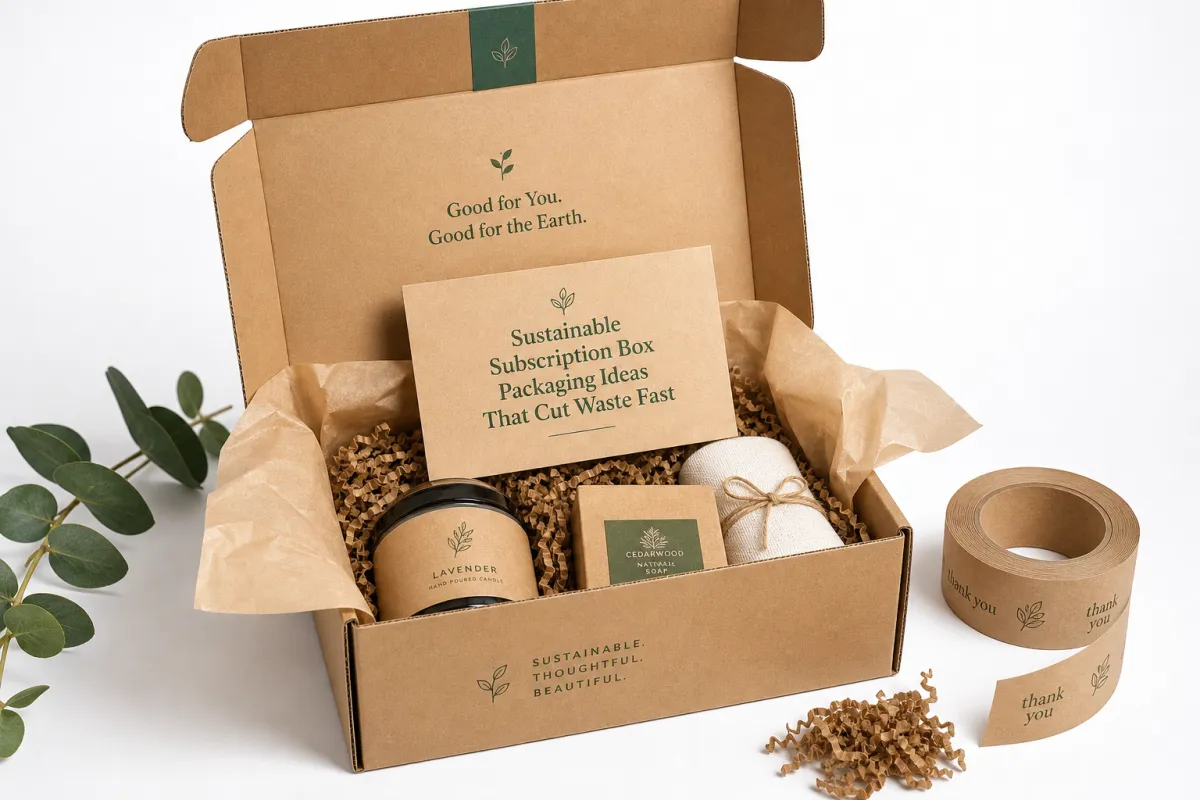
The fastest sustainability wins are often sitting in plain sight. Most brands focus on the outer corrugated mailer because it is the most visible part of the shipment, yet the bigger opportunity is usually inside the box, where void fill, plastic wraps, and unnecessary inserts quietly pile up. Sustainable subscription box packaging ideas work best when they reduce those hidden layers first, because every piece removed lowers material use, labor time, and disposal complexity for the customer.
Right-sizing is the cleanest place to start. If the box is two inches too deep, the pack team will naturally reach for fillers, cushions, or spacers to stop the contents from moving. That extra space is not harmless; it changes compression performance, raises the chance of corner damage, and makes the package feel less intentional. Strong sustainable subscription box packaging ideas use a box depth and footprint that fit the actual assortment, not the largest possible assortment someone might imagine six months later.
Materials matter too, but not in the overly simple "kraft equals green" way that gets repeated too often. Kraft corrugated, recycled paperboard, molded fiber, paper tape, and Paper Void Fill are strong starting points, yet they only help if the full structure is designed well. A plain board grade can still fail if the insert is flimsy. A recycled carton can still create trouble if it uses mixed-material windows, heavy lamination, or a magnetic closure that turns a simple mailer into a disposal puzzle.
Sustainable subscription box packaging ideas also have to account for recurring shipments. One-off ecommerce packaging can tolerate a little inconsistency because the buyer only sees it once. Subscription packaging lives or dies on repeatability. If one month the box ships with a folded insert and the next month it needs loose crinkle fill to make the same assortment work, the whole system becomes harder to forecast, harder to assemble, and harder to explain to the customer. Consistency belongs in the sustainability conversation because it reduces scrap, training time, and rework. Honestly, that part gets missed a lot.
A premium unboxing experience does not need to turn noisy or busy. In fact, many of the strongest sustainable subscription box packaging ideas rely on clean structure, crisp folds, a restrained print palette, and thoughtful sequencing. A well-built paperboard tray inside a snug corrugated shell can feel more premium than a heavily decorated box full of inserts, because the product lands in the right place immediately and the customer can see that the package was designed, not stuffed.
From a branding angle, that matters quite a bit. Branded packaging and package branding should support the product story, not fight it. If the brand is wellness-oriented, natural-fiber materials and low-coverage print usually make sense. If the brand is colorful and energetic, a small set of high-impact graphics can carry the experience without flooding the box with ink. Sustainable subscription box packaging ideas are strongest when the visual language is aligned with the material system rather than layered on top of it like decoration.
There is also a useful rule of thumb for waste reduction: the fewer material families you use, the easier the package is to understand and dispose of. One-material systems are not always possible, especially for fragile products, but every step toward a simpler system helps. That may mean using corrugated board for the outer carton, paperboard for the insert, and paper tape for sealing, instead of mixing in plastic bubble, foam, and metallized sleeve stock.
For brands shipping brittle or leakage-prone products, the most responsible option is often not the lightest package, but the package that reduces total waste over the full journey. A design that eliminates one damaged item per hundred shipments can save more material than shaving a few grams off the carton. That is why sustainable subscription box packaging ideas should be judged on real performance, not just on a material spec sheet.
From the buyer's side, that means asking a supplier to quote the actual system. Do not compare only the carton price. Compare the structure, the insert, the print, the assembly labor, and the likely damage rate. When you do that, a well-designed package often looks better than a "cheap" one that needs extra padding and generates more claims. That gap is the difference between packaging design on paper and product packaging that survives the mail stream.
How Sustainable Subscription Box Packaging Ideas Work in Production
Sustainable subscription box packaging ideas move through production as a system, not as a single part. Structure selection comes first, then board grade, insert engineering, print method, assembly method, and final pack-out testing. When one of those choices is off, the entire package can lose efficiency. A well-drawn dieline is a useful start, but it is not the same thing as a box that can survive fulfillment, palletization, carrier sorting, and delivery to the door.
For most programs, the outer shell is still a corrugated mailer or folding carton-style shipper. Common starting points include single-wall corrugated in a 32 ECT or 44 ECT class, depending on weight and handling stress, or a sturdy paperboard format for smaller, lighter kits. Inside that shell, the insert does the real positioning work. Molded fiber, die-cut paperboard, and folded corrugated inserts are often the easiest sustainable choices because they keep the contents stable without introducing a mixed-material disposal problem.
Printing should serve the structure, not cover weak decisions. Low-coverage flexo, water-based inks, and restrained graphics keep the visual story clean while helping the carton stay more recyclable. That does not mean the box has to look plain. It means the print coverage should be intentional. A clean logo panel, a strong secondary message, and a few accent graphics can produce a more elegant result than a heavy full-bleed design that adds ink, drying time, and cost without adding function.
Where sustainable subscription box packaging ideas often go wrong is in the add-ons. A carton can be technically recyclable and still be a poor environmental choice if it uses soft-touch lamination, plastic windows, multi-layer labels, foil-heavy treatments, or foam inserts that make sorting harder. Those details look small during design approval, but they matter when the customer is standing at the recycling bin wondering what to peel off and what to separate.
Assembly method is another production detail that gets overlooked. If a box requires too many folds, too many glue points, or too much manual nesting, the labor cost rises quickly. A simple, repeatable pack-out process is one of the quietest benefits of sustainable subscription box packaging ideas because it lowers touch time, reduces mistakes, and makes the box easier to scale across multiple shipments. In a real fulfillment environment, a clever box that takes twice as long to build is not clever for long.
The best teams usually test two things at once: performance and speed. A carton should protect the product under realistic carrier conditions, and it should also be efficient for the people packing it. That is why ISTA testing matters. Standards such as ISTA procedures, along with common compression and drop methods, help verify that a sustainable design still holds up in the real world. If a package passes visually but fails in transit, it is not sustainable; it is just under-tested.
In addition to transit testing, many teams run simple in-house pack trials. They measure how many boxes a packer can assemble in an hour, how often the contents shift, and whether the insert keeps everything oriented the same way each time. Those data points are boring in the best possible way. They tell you whether the sustainable subscription box packaging ideas on your shortlist actually reduce waste or simply move it into another part of the operation.
One of the most useful production habits is to build the package from the product outward. Start with the heaviest or most fragile component, define the necessary protection distance, and then size the insert and outer shell around that requirement. Once that fit is locked, the graphics can be applied without disturbing the structure. This order of operations matters especially for subscription boxes, because the contents change and the packaging needs enough flexibility to handle month-to-month variation without a fresh redesign every cycle.
Think of packaging as a chain, and the weakest link usually determines the outcome. Sustainable subscription box packaging ideas are not about picking one "green" material and hoping it does the job. They are about matching the board, the insert, the print, and the assembly method to the actual shipment so the box works all the way from the packing table to the customer table.
Cost, Pricing, and MOQ: What Drives the Numbers
Pricing for sustainable subscription box packaging ideas usually comes down to five things: material choice, structural complexity, print coverage, finishing, and quantity. A simple recycled corrugated mailer with one-color print and a paper insert can be very reasonable at scale, while a small run with custom tooling, specialty die cuts, and premium finishing can jump fast. The trick is to separate emotional preference from operational need. A brand may love a soft-touch finish, but if the same look can be achieved with better typography and cleaner board, the lower-impact option often wins on cost and recyclability.
At lower quantities, setup costs matter more. Plates, dies, sample adjustments, and proofing all spread across fewer units, so unit pricing rises. At higher quantities, the line behaves differently: setup costs become easier to absorb, but inventory risk becomes more important because the brand has to forecast the assortment well enough to avoid wasteful overruns. That is one reason sustainable subscription box packaging ideas should be evaluated with a full demand plan, not just a one-box comparison.
Here is the part many buyers miss: sustainability can lower cost in ways that do not show up on the carton invoice. If a tighter fit removes the need for secondary mailers, if a stronger insert reduces breakage, or if paper void fill replaces a more expensive mixed-material cushion, the system cost may drop even if the outer board grade is slightly higher. Damage prevention is a cost line. So is assembly time. So is returned inventory. Sustainable subscription box packaging ideas often save money by preventing the expensive stuff from happening later.
The right pricing conversation asks suppliers for separate numbers on the structure, print, inserts, finishing, and assembly. That split matters because it shows where the waste is hiding. A quote that bundles everything into one number can look simple, but it hides the tradeoffs. Separate line items make it easier to see whether the cost increase is coming from board thickness, special coatings, or a needlessly complex insert design.
| Option | Typical Unit Cost at 5,000 pcs | Best Use | Tradeoff |
|---|---|---|---|
| Plain kraft corrugated mailer, one-color print | $0.55-$1.05 | Light to medium kits that need a clean, recyclable shell | Limited premium feel unless the structure and typography are well designed |
| Custom printed folding carton with paperboard insert | $0.45-$0.95 | Smaller products, beauty items, accessories, or curated sets | Less crush resistance than a heavier corrugated build |
| Corrugated mailer with molded fiber insert | $0.72-$1.35 | Fragile items that need immobilization without plastic foam | Tooling and fit development can take longer |
| Paperboard sleeve plus corrugated shipper | $0.80-$1.60 | Premium branded packaging with a layered reveal | Can add labor and material if the sleeve is decorative only |
| Paper void fill and paper tape system | Add $0.03-$0.10 | Replacing plastic fill and simplifying recycling | May need pack-line retraining if the team is used to plastic cushions |
These numbers are directional, not universal. Board grade, print coverage, freight terms, and region all affect the final quote. Still, they give a realistic sense of how sustainable subscription box packaging ideas can be budgeted. A $0.10 swing in material cost may sound small, but over 50,000 shipments it becomes a serious budget line. That is why teams should compare landed cost, not just unit price.
MOQ is another place where sustainability decisions need discipline. Low minimums are helpful when you are still testing a concept, but they usually carry higher unit pricing because the setup burden is spread across fewer units. Larger subscription programs often benefit from locked dielines and repeat orders, which reduce waste in both production and planning. If your box program changes every month, ask whether the assortment can be supported with modular inserts or a stable outer shell rather than a new structure every cycle.
There is also a finish-versus-recyclability tradeoff worth being honest about. Foil stamping, heavy lamination, and complex coatings can make a box feel luxe, but they can also complicate end-of-life behavior. That does not mean those finishes are always wrong. It means they should earn their place. If a brand is trying to improve both sustainability and cost, the most effective sustainable subscription box packaging ideas usually use fewer special effects and better structural design.
If you want to compare options with a supplier, ask for three separate quotes: one for the structure, one for the insert, and one for assembly or kitting support. Then ask what happens if the print is reduced by one color, or the insert is switched from mixed material to folded corrugated. Those simple questions often uncover the most practical path. They also reveal whether the vendor understands sustainable subscription box packaging ideas as a system, not just a SKU.
Process and Timeline: From Dieline to Delivery
A good timeline starts with discovery, not artwork. Before anyone opens a design file, the team needs to know the product dimensions, fragility points, shipment weight, fulfillment method, and target unboxing style. Sustainable subscription box packaging ideas only hold up when the structure is built around real product data. If the box is being asked to carry glass bottles, snack pouches, or rigid jars, those items each impose different load and shift patterns inside the carton.
After discovery comes structural development. This is where the dieline, board grade, and insert concept are defined, and it is usually the stage that saves the most time later. A first sample can catch practical issues immediately: weak corners, a lid that pops open too easily, an insert that slows pack-out, or print zones that interfere with folds. In many programs, one good sample is worth more than three rounds of theoretical discussion because it shows how the system behaves in the hand.
From there, the graphics move into proofing. This step matters a lot in branded packaging, because color shifts and panel placement can change how the box feels without changing the structure at all. For custom printed boxes, a soft brown board with minimal ink can look intentional and premium, while the same design on the wrong substrate can look dull or off-brand. That is why proof approval should include both color and assembly checks, not just a visual signoff from a screen.
Once the proof is approved, production timing depends on the complexity of the build. A simple corrugated mailer might move through manufacturing in roughly 12-15 business days after final approval, while a more complex program with custom inserts, specialty tooling, or heavy finishing can take longer. Freight and receiving add their own layer of timing risk, especially when boxes need to arrive before a launch date that cannot move. Sustainable subscription box packaging ideas only work operationally if the supply plan is as well designed as the package itself.
A staged approval plan helps here. Lock the structure first. Then approve the graphics. Then confirm pack-out performance with a pilot or limited test run before the first large production batch. That sequence sounds obvious, but rushed programs often reverse it and pay for the mistake later. A box that looks ready in artwork review can still fail when the insert does not hold the product firmly enough or the assembly steps are too slow for fulfillment.
Testing should be practical, not ceremonial. A carton can be checked against compression, vibration, and drop behavior using internal methods or standards-based protocols such as ASTM-style tests and recognized transit routines. If the product is delicate, testing against ISTA 3A-type conditions is often a smart move. The goal is not to collect a certificate; it is to prove that the sustainable subscription box packaging ideas will survive the carrier network without generating replacement shipments.
Order coordination matters too. Subscription boxes are often tied to monthly drops, seasonal edits, and promotions that leave very little slack. A delay in one component can ripple through the whole schedule. Paperboard inserts, printed sleeves, and corrugated shippers should all be planned together so the final pack-out line is not waiting on one missing piece. Sustainable subscription box packaging ideas become much easier to manage when the pack plan and the sourcing plan are built together from the beginning.
One more production habit pays off repeatedly: save the sample, the approved dieline, and the final pack-out notes. Repeating a successful box is far cheaper than redesigning it from scratch every cycle. That is especially true for subscription brands that grow into multiple assortments over time. Stable packaging design supports scale, and scale is where sustainable choices become most visible in both cost and waste reduction.
Common Mistakes That Undercut Sustainable Packaging
The biggest mistake is assuming that a recyclable carton automatically equals a sustainable system. It does not. A box can be made from paper-based material and still be burdened by mixed inserts, plastic windows, oversized sleeves, or a decorative layer that adds no protective value. Sustainable subscription box packaging ideas fail fastest when they are judged by one material label instead of the full package structure.
Over-packaging is another common problem. Brands sometimes add tissue, paper wrap, crinkle fill, secondary sleeves, and extra inserts because they want the unboxing to feel premium. In reality, premium usually comes from better fit and better presentation hierarchy, not from stacking more material into the box. A clean pack-out with the product placed deliberately can feel more elevated than a crowded carton that takes a minute to dig through. That sort of clutter is kinda the opposite of thoughtful packaging.
Weak testing causes a lot of trouble as well. If the box has not been checked for compression, vibration, and drop behavior, it may look sustainable in the office but perform poorly in transit. Then the brand pays for replacement shipments, customer service time, and lost goodwill. That is the hidden cost of poor packaging design. Sustainable subscription box packaging ideas should lower the total amount of material and the total number of failures, not trade one problem for another.
Printing mistakes are easy to miss until the numbers come back. Excessive coverage, dark flood coats, and hard-to-recycle finishes can make the package more expensive and less environmentally tidy. Glue points can also become a bottleneck if the assembly is more complex than the product needs. A simple design with good hierarchy, smart typography, and a restrained ink system often performs better as both product packaging and retail packaging.
Inventory planning creates its own waste when brands size the box for only one assortment. Monthly subscription programs change. A box that fits one configuration perfectly may create dead space the next month, which then needs fill material or a new insert. Sustainable subscription box packaging ideas work better when the outer format and inner structure can handle a range of contents without constant one-off tweaks.
Another mistake is not involving fulfillment early enough. The pack line knows where the process slows down. They know which folds tear, which inserts snag, and which closures are annoying after the thousandth unit. If sustainable subscription box packaging ideas are built without that operational feedback, the brand may end up with a box that is elegant in concept but inefficient in the real world. Packaging is a production system, not just a visual one.
Finally, some teams talk about sustainability as if it only lives in material choice. That is too narrow. Waste also comes from reprints, late approvals, over-ordering, damage, and complicated assembly. Reduce any of those, and the package gets better. That is why practical sustainable subscription box packaging ideas are more about disciplined design than about a single eco-material hero.
Expert Tips for Stronger, Greener Box Design
Design from the product outward. That sounds simple, but it changes everything. Start with the fragile points, the weight distribution, and the orientation the customer should see first. Then build the insert so it does the heavy lifting. The outer carton can stay cleaner and lighter when the inner fit is doing its job. That is one of the most dependable sustainable subscription box packaging ideas I can recommend because it reduces unnecessary structure without reducing protection.
Keep the material family as simple as possible. One-family or same-family systems are easier for customers to understand and easier for recycling streams to process. A corrugated outer box with paperboard or molded fiber inserts is usually cleaner than a package with foam, plastic film, magnets, and laminated sleeves all competing for attention. Sustainable subscription box packaging ideas tend to age better when they are designed for disposal as carefully as they are designed for shipping.
Reduce ink coverage where you can, and use typography, spacing, and board texture to create the premium feel. Custom printed boxes do not need to be loud to be memorable. Often the strongest package branding comes from a few well-placed elements that let the material speak. Less ink can mean fewer production variables, lower drying demands, and a cleaner recycling profile. That is a real functional win, not just an aesthetic preference.
Use modular inserts if your assortment changes often. A fold-flat corrugated insert or a paperboard insert with configurable tabs can adapt better than a rigid tray built for one specific SKU mix. Subscription businesses value flexibility, and flexible inserts are often a quieter sustainability win than a complete structural redesign every month. They keep the outer packaging stable while letting the contents vary.
Test three things, not one: damage rate, assembly time, and customer feedback. A box that saves material but slows the line may not be the right answer. A box that looks elegant but causes returns is definitely not the right answer. Sustainable subscription box packaging ideas are strongest when they improve all three areas at once. That combination is what makes them worth scaling.
For brands that want outside references, the paper and fiber recovery resources from the industry and nonprofit world can help frame better decisions. The EPA sustainability resources and fiber-certification guidance from FSC are useful starting points when you are comparing claims, recycled content, and sourcing language. Those resources do not replace pack testing, but they do help keep the claims honest.
It also helps to look at the package through a customer's hands. Will they know what to recycle? Will the box open cleanly? Does the insert release the product without a tug-of-war? Those tactile details matter. A simple, well-structured box can feel more premium than a highly decorated one because it respects the user's time and the product's fit. That is where sustainable subscription box packaging ideas become good brand strategy, not just good environmental housekeeping.
When you are comparing suppliers or browsing Custom Packaging Products, ask whether the recommended structure can be repeated for a full subscription cycle without retooling. Ask whether the insert uses paper-based material, whether the print can be simplified, and whether the box can survive a realistic transit test. Those questions quickly separate cosmetic green claims from packaging that is actually designed to hold up.
Action Steps to Turn Sustainable Subscription Box Packaging Ideas Into a Pilot
If a subscription box program needs a cleaner, smarter packaging system, start with an audit of what is already inside the carton. List every component, including the outer box, insert, wrap, filler, tape, labels, and any decorative layers. Then mark each item as either protective, structural, or purely decorative. That one exercise often reveals which parts are doing real work and which parts are simply adding weight, labor, and disposal complexity.
Next, ask for one revised structure sample, one revised print proof, and one pack-out test. Those three deliverables give the team enough information to compare the current build with a better option. Sustainable subscription box packaging ideas are easier to approve when the comparison is visible. People are much better at judging a real sample than an abstract sustainability claim.
During the pilot, track three numbers: shipping damage, assembly time, and material cost per box. Those metrics tell the truth quickly. If the new design lowers waste but raises damage, it is not ready. If it lowers cost but takes twice as long to pack, it needs another pass. The best sustainable subscription box packaging ideas improve at least two of those metrics and, ideally, all three.
Set up a simple approval checklist before the next drop. Confirm board grade, insert fit, print coverage, recyclability claims, and timeline milestones. This is a small administrative step, but it prevents the recurring scramble that often creates waste in the first place. A repeatable checklist turns sustainable subscription box packaging ideas into a process the team can use again and again instead of a one-off project.
For brands that want a more premium look without a heavier footprint, keep the design language calm and deliberate. Use the structure to create the reveal, not extra fillers. Use the print to guide attention, not cover the whole surface. Use the insert to stabilize the product, not to decorate empty space. That mindset keeps branded packaging sharp and makes the box easier to scale across seasons.
Most of all, treat the pilot as a learning run, not a perfection contest. A good prototype will show what needs to change. A useful sample may reveal that the flap needs a stronger score, the insert needs a tighter pocket, or the outer shell needs a different flute. Those are good problems to find early. They mean the sustainable subscription box packaging ideas are doing their job before full production starts.
When the pilot works, the final box should feel obvious in the best way. The product should sit still. The pack line should move quickly. The customer should open the box and understand that the package was designed with care. That is the real goal behind sustainable subscription box packaging ideas: not just lower waste on paper, but a better system in practice.
If you want to scale that kind of packaging discipline, keep the structure stable, keep the materials simple, and keep the testing honest. Sustainable subscription box packaging ideas are not a trend piece; they are a repeatable method for making product packaging cleaner, more efficient, and easier to ship month after month. And for a subscription brand, that consistency is often where the biggest savings show up.
FAQ
What are the best sustainable subscription box packaging ideas for fragile products?
The strongest approach is usually a right-sized corrugated outer box with custom inserts that stop movement instead of overfilling the carton. Molded fiber, paperboard, and folded corrugated inserts are often better choices than plastic foam when the goal is to keep the package recyclable and controlled. The important part is testing the packed box for drop and vibration resistance so the sustainable subscription box packaging ideas still protect fragile items under real shipping conditions.
How do sustainable subscription box packaging ideas affect cost per box?
Cost is usually driven by material grade, print coverage, insert complexity, and order quantity. A simpler structure can lower labor and reduce damage-related replacements even if the board itself is slightly better quality. When comparing quotes, ask for separate pricing on the box, inserts, and finishing so you can see which sustainable subscription box packaging ideas actually save money and which ones only look cheaper on the surface.
What is the typical timeline for developing sustainable subscription box packaging ideas?
The usual process includes structure design, sampling, proofing, approval, production, and freight coordination. Custom inserts, specialty printing, and larger runs can stretch the schedule, so it is smart to start well before the first shipment date. A pilot run is often the fastest way to validate fit, pack speed, and overall performance before committing to a full subscription cycle.
Which materials are easiest to recycle in subscription box packaging?
Plain corrugated board and uncoated paperboard are usually the simplest options for end users to recycle. Paper tape, paper void fill, and fiber-based inserts are easier to keep within a single-material system than mixed plastics or heavy laminations. Even when the carton itself is recyclable, mixed-material add-ons can complicate disposal and weaken the recycling story.
How can I keep the unboxing experience premium with sustainable subscription box packaging ideas?
Focus on structure, fit, and layout instead of piling on extra decoration. A strong reveal comes from thoughtful sequencing, precise folds, and inserts that present the product clearly without excess filler. Premium feel usually comes from precision and consistency, not from adding more material, which is why well-planned sustainable subscription box packaging ideas can feel more refined than heavier, less disciplined builds.
The clearest takeaway is simple: start with the product, strip out every layer that does not protect, position, or explain it, and then test the box before you scale it. That is the practical path for sustainable subscription box packaging ideas, and it is usually where the waste drops, the pack line speeds up, and the final package starts to feel like it was built on purpose.


