Buyer Fit Snapshot
| Best fit | Courier Poly Mailers Bulk projects where brand print, material claims, artwork control, MOQ, and repeat-order consistency need to be specified before quoting. |
|---|---|
| Quote inputs | Share finished size, material target, print colors, finish, packing count, annual reorder estimate, ship-to region, and any compliance wording. |
| Proofing check | Approve dieline scale, logo placement, barcode or warning zones, color tolerance, closure strength, and carton packing before bulk production. |
| Main risk | Vague material claims, crowded artwork, missing packing details, or unclear freight terms can make a low unit price expensive after revisions. |
Fast answer: Courier Poly Mailers Bulk: Pricing, Specs, and Supply should be specified like a repeatable production item. The safest quote records material, print method, finish, artwork proof, packing count, and reorder notes in one written spec.
Production checks before approval
Compare the actual filled-product size with the drawing, then confirm tolerance on folds, seals, hang holes, label areas, and retail display edges. Reserve space for logos, QR codes, warning copy, and material claims before decorative graphics fill the panel.
Quote comparison points
Review material grade, print process, finish, sampling route, tooling charges, carton quantity, and freight assumptions side by side. A quote is only useful when the supplier can repeat the same color, closure quality, and packing count on the next order.
For soft goods, courier Poly Mailers Bulk buying changes the math fast. Shirts, socks, accessories, and lightweight sets do not need a box just because that is the habit everyone inherited. A carton adds air, tape, extra labor, and storage headaches. Switch to courier poly mailers bulk, and the savings can show up in postage, pack-out speed, and warehouse space all at once.
The bigger win is not the unit price. It is control. courier Poly Mailers Bulk orders let a brand lock in one size, one print style, and one closure method, so every outbound parcel follows the same routine. That matters when orders spike and the pack line starts moving like it had too much coffee and not enough supervision. No guessing. No fiddling with three different box sizes. One SKU in. One seal. One label. Done.
I have watched brands overpack simple apparel into cartons for years, and the bill always lands in the same place: labor, shipping, or storage. Usually all three. If the product is soft and the route is sane, you are probably gonna pay extra for no reason by using a box that never needed to be there.
Below, the focus stays on the parts that actually matter: what courier mailers are made of, which specs deserve attention, how pricing and MOQ really work, what lead times look like, and what to ask before placing a courier Poly Mailers Bulk order. The point is simple. Cut waste. Keep the process tight.
Courier poly mailers bulk: why volume changes the math
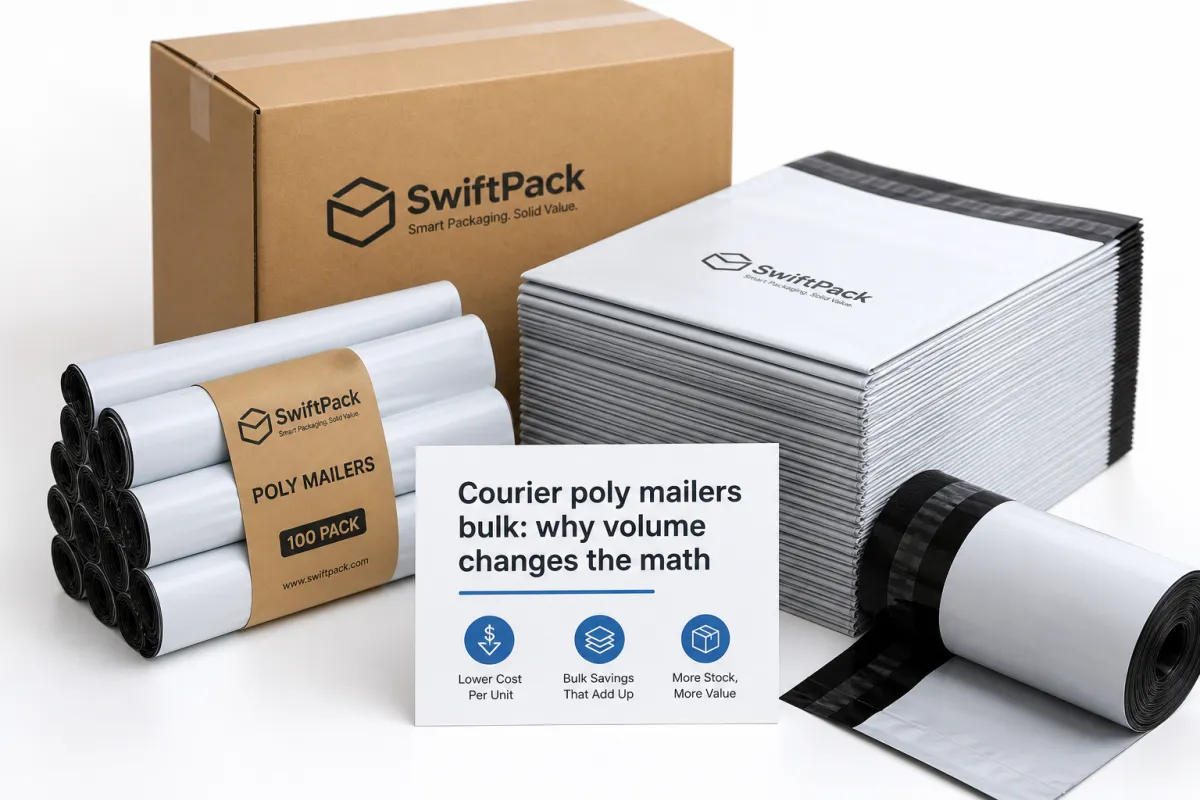
Small test orders hide the upside. Volume makes it obvious. courier Poly Mailers Bulk orders reduce the number of materials entering the building. No inner carton. No void fill. Usually no tape. That shrinks material cost, but it also cuts touches. A packer can fold the item into a mailer, pull the strip, seal it, and move on without dragging the order through a long setup routine.
Savings start multiplying once the workflow gets simpler. A carton protects well, sure. It also creates unnecessary dimensional weight for soft, non-fragile goods. courier poly mailers bulk packaging can trim parcel size enough to drop shipping cost brackets, depending on carrier rules and the final packed thickness. It is not magic, and it is not automatic. Check the lane. Check the SKU. Guessing is expensive.
Storage gets better too. A pallet of mailers takes far less room than the same number of corrugated cartons. Brands with seasonal drops feel that difference quickly. Extra space can go to finished goods instead of packaging inventory that just sits there looking important. courier poly mailers bulk buying also helps the line move faster because the team works from one repeatable pack method instead of swapping between carton sizes.
Predictability is the real argument. A one-off quote might look attractive, then the second order arrives with a different film feel, a sloppy print, or a closure that acts up. That is how cheap turns into annoying. If a supplier can repeat the same gauge, the same print quality, and the same seal performance on every run, courier poly mailers bulk becomes a planning tool instead of a random purchase.
So the comparison has to go beyond sticker price. A serious buy should cover construction, print options, minimum order quantity, production timing, and repeatability. For brands that are scaling instead of daydreaming about scaling, those details matter more than a neat little discount line.
Courier poly mailers bulk product details: what you are buying
Courier poly mailers are lightweight shipping envelopes made for apparel, accessories, soft kits, and other non-fragile items. They are usually made from polyethylene film, often in a co-extruded multi-layer structure that adds toughness without piling on bulk. The result is a mailer that is light, flexible, and easy for fulfillment teams to handle at speed.
The structure looks simple from the outside. The details are not. A typical mailer includes a body panel, side seals, a flap, and an adhesive closure. Some versions use a permanent pressure-sensitive strip. Others include a second seal for returns or tamper evidence. For courier poly mailers bulk, those choices affect both the way the mailer performs and the way the customer experiences it. A clean seal saves time. A weak seal creates complaints. The internet already has enough of those.
Branding matters too. Stock white and black mailers are common, but many buyers choose custom colors, printed logos, handling text, or an inside print for a cleaner unboxing moment. That is especially useful for ecommerce brands that want the shipment to feel deliberate before the product is even touched. In courier poly mailers bulk programs, outer print can carry a logo, tagline, website, or a simple shipping cue such as “Thank you” or “Open here.”
Typical use cases include:
- Apparel and soft goods shipping
- Marketplace orders that need low pack-out time
- Subscription items and promo kits
- Fulfillment centers handling repeat SKUs
- Seasonal campaigns that need consistent branding
For buyers comparing courier poly mailers bulk with cartons, the question is not whether mailers can replace every package type. They cannot. The real question is whether the product is soft enough, uniform enough, and low-risk enough to make the switch worthwhile. If yes, the operating savings can be meaningful. If the item has hard edges, liquid risk, or breakage risk, the package spec needs to change.
Many buyers also compare mailers with other Custom Packaging Products before making a final call. Smart move. A mailer might fit the main assortment, while a rigid mailer or carton still makes more sense for premium kits or fragile add-ons. For repeat apparel programs, though, Custom Poly Mailers usually stay near the top of the list because they balance speed and cost so well.
Specifications that affect performance and appearance
If there is one mistake buyers make with courier poly mailers bulk, it is treating every mailer like a clone. They are not. Size, thickness, seal type, and print coverage all change how the mailer behaves on the line and in transit. Start with the basics: width, length, gusset depth if there is one, flap length, and film thickness. Those numbers shape fit, pack speed, and postage outcome.
For light apparel, many buyers work with film thickness in the 2.5 to 3.0 mil range. Heavier bundles, sharper accessory edges, or rougher shipping lanes may need 4.0 mil or more. That does not mean thicker is automatically better. It means the mailer should match the load. With courier poly mailers bulk, going thicker than necessary raises cost without improving the customer experience. Going too thin invites punctures, seam splits, and scuffed product. Neither one is a fun email.
These are the specs worth checking before signoff:
- Width and length for the folded product plus any insert
- Gusset depth if the item needs room to expand
- Film gauge or mil thickness
- Closure type such as peel-and-seal or dual-seal
- Opacity for privacy and brand presentation
- Barcode and label visibility for scan performance
- Scuff and puncture resistance for transport durability
Appearance is not just cosmetic fluff. A dark, opaque mailer hides product silhouettes and reduces visible wear. A bright custom color makes the shipping moment feel branded instead of generic. In courier poly mailers bulk runs, print placement matters too. A centered logo with enough breathing room usually reads better than a crowded front panel. Tiny details. Big difference. Reorders stay cleaner when the original spec is clean.
Operational compatibility matters just as much. Some packing stations use manual sealing, while others are set up for high-volume pick-and-pack. If the team is moving fast, the adhesive strip has to release cleanly and stick on the first pass. Sample testing saves headaches here. I always want at least one real sample on the table before a custom run is approved, especially if the mailer has a glossy finish or the seal sits close to a printed area.
For higher-confidence transit testing, the ISTA testing standards are a useful reference point for pack performance, especially when the route includes multiple handoffs. Buyers who want to reduce packaging waste should also compare the setup against guidance from the EPA on recycling and materials handling, especially if paper components are part of the pack.
If recycled-content claims or paper inserts are part of the brief, spell that out separately. The mailer film and any paper collateral are not the same thing, and the sourcing rules should not get mashed together. A clean spec sheet says exactly what is recyclable, what is not, and what the customer should do after opening. That clarity matters more than a polished sales line.
Courier poly mailers bulk pricing and MOQ explained
Pricing for courier poly mailers bulk comes from several moving parts, and none of them should be judged alone. Size is the obvious one. Bigger mailers use more film. Thickness comes next, because heavier gauge uses more raw material and can affect converting speed. Then print enters the picture. One-color print is usually simpler than a two-color or full-panel design, and specialty finishes can add cost. Order quantity matters too, because setup gets spread across more pieces.
MOQ, or minimum order quantity, works the same way. Stock courier poly mailers bulk options usually allow lower entry points because the product already exists in standard sizes and colors. Custom-printed mailers often need a higher MOQ to cover tooling, setup, and color matching. Ask whether the MOQ is driven by size, print count, or both. That answer can change the best option faster than a spreadsheet can blink.
Here is a useful comparison for planning. These are planning ranges, not promises, and freight can move the landed number around more than people expect.
| Option | Typical MOQ | Unit price range | Best fit | Main tradeoff |
|---|---|---|---|---|
| Stock plain mailers | 500-1,000 pieces | $0.07-$0.14 | Quick replenishment and low-risk testing | Limited branding and fewer size choices |
| Custom 1-color print | 3,000-5,000 pieces | $0.11-$0.22 | Apparel brands needing a clean logo presence | Setup cost is spread across the run |
| Custom 2-color print | 5,000-10,000 pieces | $0.15-$0.30 | Retail-ready presentation and stronger shelf recognition | Higher print cost and longer proof review |
| Heavy-gauge or specialty mailers | 3,000-10,000 pieces | $0.13-$0.28 | Higher abuse routes, sharper contents, or premium feel | More material cost and potential postage impact |
Those numbers are planning ranges, not fixed quotes. A buyer with a simple one-color logo in courier poly mailers bulk might land lower than the table suggests if the artwork is clean and the specification is standard. A complex full-coverage design on a thick opaque mailer can climb higher. Freight mode, geography, and carton packing also affect landed cost.
Cash flow deserves attention too. Bigger orders usually lower the per-piece price, but overbuying can park money in inventory that sits around for months. The better decision is often the order size that clears a meaningful price break without creating dead stock. A decent supplier should quote tiers so the buyer can see the jump from 3,000 to 5,000, or 5,000 to 10,000, and decide whether the next step actually pays back.
Courier poly mailers bulk shoppers should also ask about reprint thresholds. If the same design is likely to repeat, the second order should not require the same setup pain as the first. That is how a packaging program turns into a system instead of a one-off purchase with a fancy invoice.
The cheapest quote is rarely the lowest landed cost. A mailer that seals badly, prints off-register, or arrives late can cost more in labor and rework than a stronger spec that adds a few cents per unit.
Process and timeline for bulk courier mailer orders
The order flow for courier poly mailers bulk is simple enough, but every step matters. It usually starts with a quote request that includes size, quantity, print needs, and delivery destination. Then comes specification confirmation. That is where the buyer and supplier lock down dimensions, film gauge, color targets, closure type, and artwork format. Skipping that step is asking for trouble. A vague brief is a great way to get something that looks fine in a PDF and behaves badly in real life.
Once the spec is locked, the supplier creates a proof. For custom print, that proof should show logo placement, color breaks, and any required text such as handling instructions. After proof approval, production starts. Stock courier poly mailers bulk orders can move faster because they skip print setup, while custom jobs need more time for conversion and quality checks.
Typical timing ranges look like this:
- Stock mailers: often 3-7 business days after order confirmation
- Custom-printed mailers: often 12-15 business days after proof approval
- Shipping time: depends on destination, freight mode, and carton count
Delay points are usually easy to spot. Missing vector artwork slows proofing. Late color changes reset approval. Big revisions after signoff push the job back into the production queue. In courier poly mailers bulk work, one of the biggest planning mistakes is waiting until the launch date is already too close. That leaves no cushion for proof revisions or freight delays.
A better rule is to match packaging to the demand calendar, not the packing deadline. If a seasonal promotion starts in six weeks, the mailers should be approved before the final two weeks begin. That gives receiving time to count, stage, and slot inventory before orders hit. Basic? Yes. Easy to ignore? Also yes. It saves a lot of stress.
If a program runs on a tight schedule, I like to build one extra buffer into the mailer timeline, just in case the proof needs a second round. That small cushion keeps the launch from turning into a scramble, which is the kind of thing nobody misses once they stop doing it.
Why choose us for courier poly mailers bulk supply
Supplier quality is where courier poly mailers bulk programs succeed or fall apart. A low quote means very little if film gauge drifts from box to box, seams split in transit, or carton counts come in short. Good suppliers get the basics right: consistent film quality, accurate dimensions, dependable adhesive, and repeatable print color across reorders. None of that is flashy. All of it protects margin.
At Custom Logo Things, the value is practical. Buyers need a manufacturing partner that helps prevent mismatched specs, weak closures, and expensive rework after the first run. That means clear communication on sample review, art preparation, and production checkpoints. It also means being honest about what the mailer can handle and what it should not be asked to do. For example, courier poly mailers bulk is a strong fit for apparel, but it is not the right choice for fragile hardware or liquids unless extra protection is added.
Support should show up before the order is placed, not after a problem appears. A good buying process includes:
- Sample review before production approval
- Artwork guidance for logo placement and file setup
- Transparent pricing with tiered quantity breaks
- Clear updates while the order moves through production
- Simple reorder history so repeat runs stay consistent
There is also a hidden cost buyers overlook all the time: variability. If one batch is slightly thinner or the flap adhesive behaves differently, packing slows down and customer complaints rise. A supplier that keeps a tighter process window can save more than a bargain offer on the front end. That is why courier poly mailers bulk should be judged by the total operating impact, not just the invoice.
For brands comparing packaging channels, it helps to keep the larger mix visible. A mailer may handle standard garments, while other items still need cartons, labels, or inserts. That is where Wholesale Programs can be useful, especially if the business wants a repeatable supply plan across several SKUs. The smartest buyers do not chase the lowest number in isolation. They build a system that is easy to reorder, easy to store, and easy to pack.
Honestly, the cheapest quote can get expensive fast if defects, delays, or reprints show up. courier poly mailers bulk works best with a supplier that treats repeatability as a requirement, not an extra.
Next steps to order courier poly mailers bulk
Before requesting pricing for courier poly mailers bulk, gather the basics. Product dimensions. Folded thickness. Target color. Print needs. Monthly volume. Destination market. If the buyer knows those inputs, the first quote is usually much more useful, and the back-and-forth drops hard. That matters because every revision burns time, and time is the cost that never shows up neatly in a quote.
Compare samples and tiered quotes side by side. A mailer that looks great in a digital proof can feel different in hand. The adhesive release should be clean. The film should not feel brittle. The print should sit where the eye expects it. For courier poly mailers bulk, those tactile details matter because they affect how the pack team works and how the customer reads the brand. A supplier can promise a lot. A sample proves it.
It also helps to confirm the reorder point before approval. If a brand burns through 4,000 mailers per month and lead time runs two weeks after proof approval, the reorder trigger should kick in early enough to protect the next shipment wave. That prevents emergency replenishment, which is usually the most expensive way to buy packaging. Put simply, courier poly mailers bulk should support the launch schedule, not drag the launch behind it.
To move forward, use the spec sheet to request pricing, approve the proof, and lock the production slot. If the program is expanding, keep the supplier list tight and the size count sensible. Too many mailer sizes create confusion. Too few force awkward packing. The right balance is usually one primary size and one secondary size for variants, not a giant catalog nobody asked for.
For teams ready to scale, courier poly mailers bulk offers a simple value proposition: less waste, less handling time, and more predictable outbound costs. That is why this format keeps winning in apparel, accessories, and soft goods. Used well, it is not just a bag in bulk. It is a cleaner shipping workflow.
What sizes are best for courier poly mailers bulk orders?
Pick the smallest size that fits the product plus any insert, because oversizing raises postage and material cost. For courier poly mailers bulk, the best approach is to match the mailer to the main product line first, then test a second size for accessories or bundles before placing a full run.
How does MOQ work for courier poly mailers bulk with custom print?
Stock mailers usually allow lower MOQs, while custom-printed mailers need higher minimums to cover setup and production efficiency. Ask for MOQ by size and print color, since those variables can change the minimum more than the order total alone. That detail matters in courier poly mailers bulk buying because one extra color can shift the economics.
How long do courier poly mailers bulk orders usually take?
Stock items can move quickly once size and quantity are confirmed, while custom print adds proofing and production steps. The fastest orders happen when artwork is final, the spec sheet is clear, and approval does not bounce back for revisions. That is usually true for courier poly mailers bulk programs with standard sizes and simple logo placement.
Can courier poly mailers bulk be custom printed with a logo?
Yes, most bulk mailers can be printed with a logo, brand colors, warning text, or simple handling instructions. The cleanest results come from supplying vector artwork, confirming color targets early, and reviewing a digital proof before production. In courier poly mailers bulk orders, that preparation reduces the chance of rework.
Are courier poly mailers bulk suitable for apparel and soft goods?
Yes, they are a strong fit for apparel, textiles, accessories, and other non-fragile products that do not need rigid protection. If the item has sharp edges, fragile components, or liquid risk, add an inner wrap or choose a different mailer spec. That judgment keeps courier poly mailers bulk useful where it belongs and avoids misuse.
Bottom line: lock the spec before you lock the quantity. If the size, film gauge, closure, print, and reorder point are clear, courier poly mailers bulk stops being a guessing exercise and starts doing what it is supposed to do: cut waste, keep pack-out moving, and hold the shipping plan together without drama.