Buyer Fit Snapshot
| Best fit | Eco Poly Mailers Bulk Order projects where brand print, material claims, artwork control, MOQ, and repeat-order consistency need to be specified before quoting. |
|---|---|
| Quote inputs | Share finished size, material target, print colors, finish, packing count, annual reorder estimate, ship-to region, and any compliance wording. |
| Proofing check | Approve dieline scale, logo placement, barcode or warning zones, color tolerance, closure strength, and carton packing before bulk production. |
| Main risk | Vague material claims, crowded artwork, missing packing details, or unclear freight terms can make a low unit price expensive after revisions. |
Fast answer: Eco Poly Mailers Bulk Order: Specs, Pricing & Lead Times should be specified like a repeatable production item. The safest quote records material, print method, finish, artwork proof, packing count, and reorder notes in one written spec.
Production checks before approval
Compare the actual filled-product size with the drawing, then confirm tolerance on folds, seals, hang holes, label areas, and retail display edges. Reserve space for logos, QR codes, warning copy, and material claims before decorative graphics fill the panel.
Quote comparison points
Review material grade, print process, finish, sampling route, tooling charges, carton quantity, and freight assumptions side by side. A quote is only useful when the supplier can repeat the same color, closure quality, and packing count on the next order.
Eco Poly Mailers Bulk Order: Specs, Pricing & Lead Times
An Eco Poly Mailers bulk order can lower shipping costs in a place many teams overlook: the package itself. A well-sized mailer trims empty space, keeps products from rattling around, and avoids the extra expense that comes with oversized cartons, filler, and the handling time those materials demand.
From a packaging buyer's point of view, an eco Poly Mailers Bulk order is never just film and adhesive. It shapes pack speed, warehouse presentation, storage footprint, and the total cost of getting one order to a customer without paying for more material than the shipment actually needs.
The spec matters because the wrong choice shows up quickly. A low-price mailer can look appealing on paper, then fail at the seam, scuff the print, or split on a conveyor. A mailer that matches the product keeps fulfillment predictable, which is the quiet advantage buyers feel long after the quote is approved.
A mailer only looks inexpensive until it starts costing time in rework, returns, or weight penalties.
For apparel, accessories, cosmetics, and subscription kits, an eco poly mailers bulk order often makes more practical sense than forcing every shipment into a rigid box. The goal is not to reduce care. The goal is to choose a package that fits the product closely enough to protect it without paying for structure the item does not need.
I have seen plenty of pack-out rooms where the difference between a clean shipping line and a frustrating one came down to a mailer that was either a half-inch too tight or a little too loose. That small mismatch can turn into a surprisingly expensive habit over a few months, especially once the team is shipping at volume.
Eco Poly Mailers Bulk Order: What You Get and Why It Pays Off
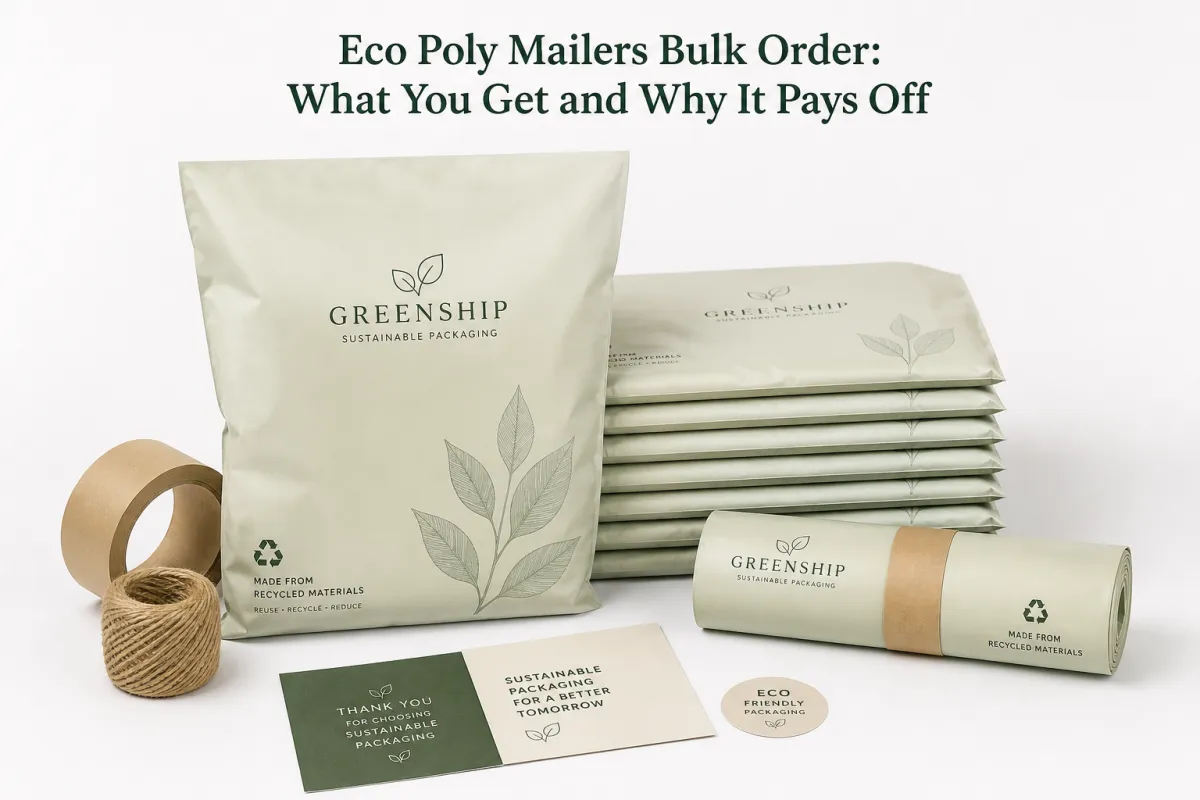
An eco poly mailers bulk order gives buyers more than a stack of printed bags. It delivers a lighter shipping format, faster packing, a cleaner brand impression, and often a lower cost per shipment once the size and film strength are matched to the item.
The savings do not always show up in the unit price alone. They often appear in less void fill, fewer damaged shipments, less storage space consumed by packaging inventory, and fewer minutes spent taping, folding, and cushioning a box. That is where an eco poly mailers bulk order starts to pay for itself in practical terms.
Common uses are easy to picture:
- Folded apparel such as T-shirts, hoodies, and leggings
- Soft accessories like socks, hats, scarves, and fabric pouches
- Beauty items in secondary cartons that do not need hard-shell protection
- Subscription inserts and promotional kits with low crush risk
- Lightweight e-commerce orders that need a branded outer layer
An eco poly mailers bulk order is not simply a hunt for the cheapest film. The real job is selecting a mailer that survives the route it will actually travel, whether that means hand packing, sorter lanes, parcel conveyors, or mixed-carrier networks with varied handling conditions.
A cheap mailer with weak seams may fail during the first week of use, while a slightly better construction can hold up through an entire season of replenishment orders. Seal strength, gauge, print quality, and handling feel all shape the outcome just as much as the headline price.
If the products are soft, flat, and non-fragile, the case for an eco poly mailers bulk order gets stronger. If the contents are sharp-edged, irregular, or sensitive to abrasion, the spec should move up rather than asking a lighter mailer to do a heavier job.
Buyers also gain consistency. Once the size, closure, and artwork are approved, later runs should behave the same way. That kind of repeatability matters in fulfillment, especially where packing speed and simple steps keep the line moving.
The best bulk programs usually feel boring in the right way. The mailers arrive, the team packs without drama, and nobody is hunting for a backup carton because the packaging failed to do its job. That kind of predictability is not flashy, but it saves money and keeps the whole operation calmer.
Product Details: Materials, Construction, and Print Options
An eco poly mailers bulk order usually starts with the film structure. Common eco-conscious options include recycled-content blends, recyclable formats where the local stream supports them, and compostable alternatives only where the application and the recovery system make sense together.
That distinction matters. Compostable does not automatically suit every brand or every shipment. If the mailer will land in a municipality that cannot process it correctly, or if the contents need more puncture resistance than the structure can provide, a recycled-content or recyclable construction with verified performance is often the more practical choice.
Material Choices That Affect Performance
For an eco poly mailers bulk order, buyers often compare the outer feel, film thickness, and tear behavior before they compare graphics. A mailer made from recycled-content plastic can still be strong, clean-looking, and well suited to branded printing, provided the gauge and seam construction match the product weight.
Some programs call for a matte surface because it reduces glare and gives the logo a more premium look under retail lighting. Others prefer gloss because it resists smudging and can hold dense color fields at a lower cost. Neither finish wins in every case. The better choice depends on the artwork, storage conditions, and how much handling the finished pack will see.
There is also a practical difference between a film that looks good on a photo and one that still looks good after it has been stacked, dragged, and scanned three times on its way out the door. That gap is easy to underestimate until a seasonal rush exposes it.
Construction Details That Buyers Should Ask For
An eco poly mailers bulk order should be judged on mechanics as much as appearance. Film gauge affects puncture resistance and how the mailer feels in hand. Side seams influence how well the bag tolerates stretching. A peel-and-seal strip needs enough adhesive strength to stay closed during transit, even if the parcel sits in a cold dock or a humid truck trailer.
Tear strips add another useful layer of function. They make opening easier for the recipient and reduce the chance that a customer cuts into the product inside. For brands that care about the unboxing moment, a tear strip can turn a plain shipping bag into a much better customer experience without changing the shipping method.
Some mailers use side gussets for slightly bulkier contents. Others stay flat for slimmer pieces and cleaner stacking in a fulfillment cart. That small structural difference can matter more than buyers expect once the orders start moving at scale.
If the product has sharp trims, metal hardware, or awkward edges, ask for a thicker gauge or a different build rather than hoping the mailer will hold up just because the photo looks nice. Kinda obvious, but it gets missed more often than it should.
Print and Branding Options
Print style also Shapes the Final result. A simple one-color logo keeps the order economical and reads clearly at the door. Full-coverage graphics create a stronger branded impression, though they usually raise setup complexity and can add cost if the artwork uses multiple colors or broad ink coverage.
For an eco poly mailers bulk order, restrained branding often looks the most polished: a logo, a short message, a return panel, and perhaps a subtle pattern. That approach usually ages better than covering every inch of film with ink, and it tends to stay consistent across reorders.
For buyers comparing material and print choices, the right reference point is not a style trend. It is the shipping method, the product weight, and the fulfillment environment. If the mailers will travel through conveyor systems or parcel sorters, the spec should prioritize sealing, abrasion resistance, and legibility over decoration alone.
Specifications: Sizes, Thickness, Seal, and Sustainability Claims
An eco poly mailers bulk order works best when the size comes from the product outward, not from a generic chart alone. Measure the item in its packed form, include folds or bundling, and leave just enough room for easy insertion without creating a bag that swallows the contents.
That snug fit matters. A mailer that is too large wastes material and can shift around in transit. A mailer that is too tight strains the seal and can slow the packing line more than necessary. The aim is a balance: enough room to load quickly, little enough slack to keep the parcel tidy.
Thickness deserves more attention than it usually gets. A lighter gauge can suit soft garments, while heavier soft goods, accessories with sharp corners, or product kits with mixed components often need a thicker film to resist puncture and stretch at the seams.
Seal performance also deserves a hard look. Permanent adhesive should close cleanly, hold under normal transit stress, and resist opening from temperature swings or rough handling. If tamper evidence matters, the design should make that obvious so the customer can tell whether the package has been opened.
From a sustainability perspective, the language needs discipline. Recycled-content is not the same thing as recyclable. Recyclable claims should match the actual film structure and the facilities that can process it. If your team wants a reality check on local recycling acceptance, the EPA recycling guidance is a useful starting point, but the final answer still depends on the receiving stream.
Careful wording protects both the brand and the buyer. It is easy to overstate a claim. It takes more work, and it is better work, to document what the mailer is made from, how it should be disposed of, and what the current recovery infrastructure can actually handle.
For larger programs, the specification sheet should be clear enough that purchasing, operations, and marketing all read the same thing. A strong eco poly mailers bulk order spec usually includes:
- Flat width and length
- Material type and recycled content percentage, if applicable
- Film gauge or thickness range
- Closure style and adhesive notes
- Print colors and printable area
- MOQ and reorder expectations
If paper components are part of the program, such as inserts or shipper cartons, FSC-certified paper can support the broader sustainability story. For parcel validation and transit testing, many teams also reference common industry methods like ISTA procedures, along with ASTM-style film and seal checks that help compare performance before a large run goes live.
One caution worth keeping in mind: a sustainability label is not a performance guarantee. I have seen teams get too comfortable with the environmental story and then discover the mailer was under-specced for the actual route. The better approach is to let the material claim and the shipping reality support each other.
Eco Poly Mailers Bulk Order Pricing and MOQ
An eco poly mailers bulk order price is shaped by five practical factors: size, material structure, film thickness, print coverage, and total quantity. Those inputs matter more than the word “eco” on a product page because they determine how much raw material, setup time, and production capacity the job requires.
The biggest pricing pattern is simple: unit price usually drops as quantity rises. Fixed costs such as artwork preparation, plates, or print setup stay fairly steady, so a larger order spreads those costs across more mailers. That is why buyers often see a real break between small runs and true bulk runs.
MOQ, or minimum order quantity, follows the same logic. A custom printed eco poly mailers bulk order may start at a higher threshold because the press setup and material waste need enough volume to make the job workable. Standard sizes and less complex print layouts can sometimes lower the minimum.
What Drives the Price Up or Down
For an eco poly mailers bulk order, a plain recycled-content mailer usually costs less than a full-coverage branded version. A thicker film costs more than a lighter gauge. A larger mailer uses more material. Add multiple print colors, special finishes, or a custom gusset, and the price steps up again.
Freight matters too. A low unit price can lose its appeal if the order ships in several cartons across a long distance or if the buyer needs split delivery to multiple locations. The cleanest quote is the one that includes the actual landed cost, not just the factory number.
Typical Cost Ranges Buyers Can Expect
Actual pricing changes with market conditions, print method, and supply chain timing, but a rough working range helps buyers budget. For a standard eco poly mailers bulk order, the numbers below are common starting points for a quote request.
| Option | Typical MOQ | Typical Unit Price | Common Lead Time | Best Fit |
|---|---|---|---|---|
| Standard recycled-content mailer | 1,000-2,500 pcs | $0.12-$0.20 | 7-12 business days | Low-complexity apparel and soft goods |
| Custom printed recycled-content mailer | 2,500-5,000 pcs | $0.18-$0.32 | 10-15 business days | Branded e-commerce shipments |
| Premium matte branded mailer | 2,500 pcs+ | $0.24-$0.42 | 12-18 business days | Retail-ready presentation and stronger shelf appeal |
| Compostable-format mailer | 2,500 pcs+ | $0.30-$0.60 | 15-20 business days | Programs with verified disposal pathways |
That table is not a promise. It is a practical way to narrow expectations before a quote request. In a real eco poly mailers bulk order, the final price can move based on exact dimensions, artwork complexity, ink coverage, and whether the project uses stock tooling or a new custom run.
There is another buying tradeoff that is easy to miss. Ordering too little can keep the unit price high and force a reorder sooner than planned. Ordering too much can tie up storage space and cash. The best point is often somewhere in the middle, where the mailer discount is strong enough to matter but inventory does not become a burden.
A useful rule helps here: if the order is a repeat item used every day, it is usually worth moving up one quantity tier if the storage plan can support it. If the design is still being tested, start smaller, validate packing behavior, and scale after the fit is proven.
Bulk pricing also becomes clearer once the buyer separates the real cost buckets. Material, printing, freight, and any special handling can be compared side by side, which makes it easier to see whether a higher quote is genuinely expensive or just carrying a feature the team actually needs.
Eco Poly Mailers Bulk Order Process and Timeline
An eco poly mailers bulk order follows a predictable path: inquiry, quote review, spec confirmation, artwork prep, proof approval, production, packing, and freight coordination. The faster those steps move, the faster the mailers reach the warehouse and begin doing their job.
For most buyers, the quote stage decides whether momentum holds. A complete request should include size, quantity, print colors, shipping destination, and any material preference such as recycled-content or recyclable construction. If those details are missing, the response usually takes longer because the supplier has to make assumptions.
Artwork is another common delay point. Vector logos, correct color references, and clear placement instructions reduce back-and-forth. If the design uses small text, fine lines, or several color blocks, the proof stage deserves extra attention so the final print does not blur, crowd, or shift awkwardly on the film.
What a Typical Schedule Looks Like
An eco poly mailers bulk order is often fastest when the buyer is ready with clean files and a single decision-maker. A simple run may move from proof approval to production in 7-12 business days. More complex print work, special finishes, or larger quantities can stretch that to 12-18 business days or more.
Freight adds its own window after production. Domestic shipping may take only a few days once the cartons leave the facility, while longer routes or split shipments can add more time. Separating production time from transit time keeps expectations realistic.
For brands that want to validate how the mailer performs in the supply chain, testing language matters. The packaging team may compare handling, closure strength, and parcel abuse expectations against ISTA procedures and common transport tests before approving a larger roll-out. That is usually a better use of time than finding problems after peak season begins.
One thing that slows teams down more than they expect is internal indecision. Marketing wants the logo bigger, operations wants the seal stronger, and purchasing wants the price down. Sorting that out before the proof stage saves a lot of back-and-forth later, and it keeps the production window from getting stretched for no good reason.
How to Shorten Lead Time Without Cutting Corners
There are a few practical ways to keep an eco poly mailers bulk order moving. Send the product dimensions in packed form, not just flat product size. Confirm the ship-to address before the quote is issued. Approve proofs promptly. Keep artwork changes to a minimum once the print spec is set.
Another useful habit is to establish who owns the final sign-off. When purchasing, marketing, and operations all need to approve the same proof, the order can stall for days. A single decision-maker, backed by the right inputs, usually saves more time than rushing the production floor ever could.
Handled well, the mailers arrive on schedule, packing starts smoothly, and the reorder path is already clear. That is the kind of reliability a daily shipping item should deliver.
Why Choose Custom Logo Things for Poly Mailers
Custom Logo Things focuses on practical packaging decisions, which is exactly what an eco poly mailers bulk order needs. Buyers do not usually want a long speech about sustainability marketing. They want a mailer that fits the product, prints cleanly, seals reliably, and holds up through the carrier network.
That is where packaging experience matters. A well-built mailer is not just a film bag with a logo on it. It has to work in the real flow of a fulfillment line, where employees pack at speed, cartons move continuously, and the product inside still needs to arrive presentable.
A buyer comparing Custom Poly Mailers against other Custom Packaging Products often needs one thing more than a polished pitch: useful guidance on which spec makes sense for the item, the carrier, and the budget. That becomes even more valuable when the mailer is part of a wider shipping program or a seasonal campaign.
For recurring programs, Wholesale Programs can help keep reorder continuity steady. That matters because once a mailer becomes part of daily fulfillment, the standard should stay stable from one run to the next. Reorder consistency saves time, reduces mistakes, and keeps the customer experience familiar.
A good shipping package should disappear into the process: easy to pack, hard to fail, and consistent from one run to the next.
An eco poly mailers bulk order also benefits from straightforward communication. Buyers need clear notes on dimensions, print area, proof expectations, and what happens if the design changes after approval. Honest answers here are more valuable than inflated claims about performance or environmental impact.
In short, the right supplier helps align branding, shipping efficiency, and material selection. That kind of support saves time early and prevents expensive surprises later.
Next Steps for Your Eco Poly Mailers Bulk Order
An eco poly mailers bulk order moves more smoothly when the buyer arrives with a few specifics already in hand. First, confirm the packed dimensions of the product, not just the retail size. Second, estimate how many shipments the program will generate each month or each season.
After that, decide whether recycled-content, recyclable, or compostable is the best fit. That choice should reflect the product, the shipping route, and the disposal claims the brand is comfortable making. If sustainability matters to the business, the material spec should be honest enough to stand up to questions from customers and internal stakeholders alike.
Then move to the branding decisions. Will the mailer be a simple logo print, a bold full-coverage graphic, or something more restrained? How many colors are needed? Will the design call for a matte finish, a gloss finish, or a subtle tone-on-tone look?
If the item falls between two standard sizes, ask for a recommendation before locking in the order. A slightly smaller mailer can reduce waste and improve the pack feel. A slightly larger one may be safer if the product has irregular edges or if the packing team needs extra clearance for quick insertion.
- Measure the product in its packed state.
- Estimate monthly or seasonal shipment volume.
- Choose the film type and closure style.
- Prepare logo files, color references, and print notes.
- Request a quote with the shipping destination included.
Once those details are ready, pricing becomes much clearer and the lead time is easier to plan. That is the point where an eco poly mailers bulk order stops being a general idea and becomes a usable procurement decision.
If you are comparing options, the cleanest next move is to line up three things in one pass: the packed size, the material claim that matches your disposal reality, and the ship-to destination. That gives the quote team enough information to recommend a mailer that fits the product instead of guessing, and it usually keeps the whole order from getting messy later.
What is the minimum eco poly mailers bulk order quantity?
MOQ depends on size, print coverage, and material type, but custom printed orders usually start higher than stock mailers. Standard sizes often allow lower minimums because the base film and tooling are already established. If you only need a small test run, ask for a sample pack or a short-run option before committing to a larger production order.
Are eco poly mailers bulk order options actually recyclable?
Some options are recyclable, but that depends on the exact material structure and what local recycling programs accept. Recycled-content mailers and recyclable mailers are not the same thing, so the specification should be verified before purchase. If sustainability claims matter to your brand, request written material details instead of relying on general product descriptions.
How do I choose the right size for an eco poly mailers bulk order?
Measure the product in its packed form, not just its flat dimensions, and allow a small margin for easy insertion and sealing. For folded apparel or soft goods, a snug fit usually ships more cleanly than an oversized mailer. If you are between sizes, ask for a recommendation based on product weight, fold thickness, and shipping method.
What affects pricing on eco poly mailers bulk order quotes?
The biggest price drivers are material type, size, film thickness, print coverage, and total quantity. Higher volumes usually lower the per-unit price, while custom artwork or special finishes can add setup cost. Freight and packaging format also matter, especially if the order ships to a single warehouse or multiple locations.
How long does an eco poly mailers bulk order take to produce?
Timeline depends on whether the order is stock or custom printed, plus how quickly artwork and proof approvals are completed. Complex print jobs and larger quantities usually need more production time than simple stock orders. The fastest path is to send complete specs up front, approve proofs quickly, and keep revisions to a minimum.


