A Cuffed Knit Beanies unit cost breakdown usually shows that the visible part of the product is not the expensive part. The cuff carries the logo and most of the branding value, but the cost is driven by yarn, machine time, finishing, decoration, packing, and freight assumptions. Buyers who only compare the headline unit price often miss the real landed number.
That matters because a low factory quote can become average once setup fees, sampling, and shipping are added. The reverse also happens: a slightly higher quote can still deliver better margin if the construction is simple, the decoration is stable, and the packing is not overcomplicated. For promo, retail, team, and seasonal programs, cuffed beanies sit in a useful middle ground where the spec can stay clear and the economics are easier to judge.
Why Cuffed Knit Beanies Can Protect Margin Better Than You Think
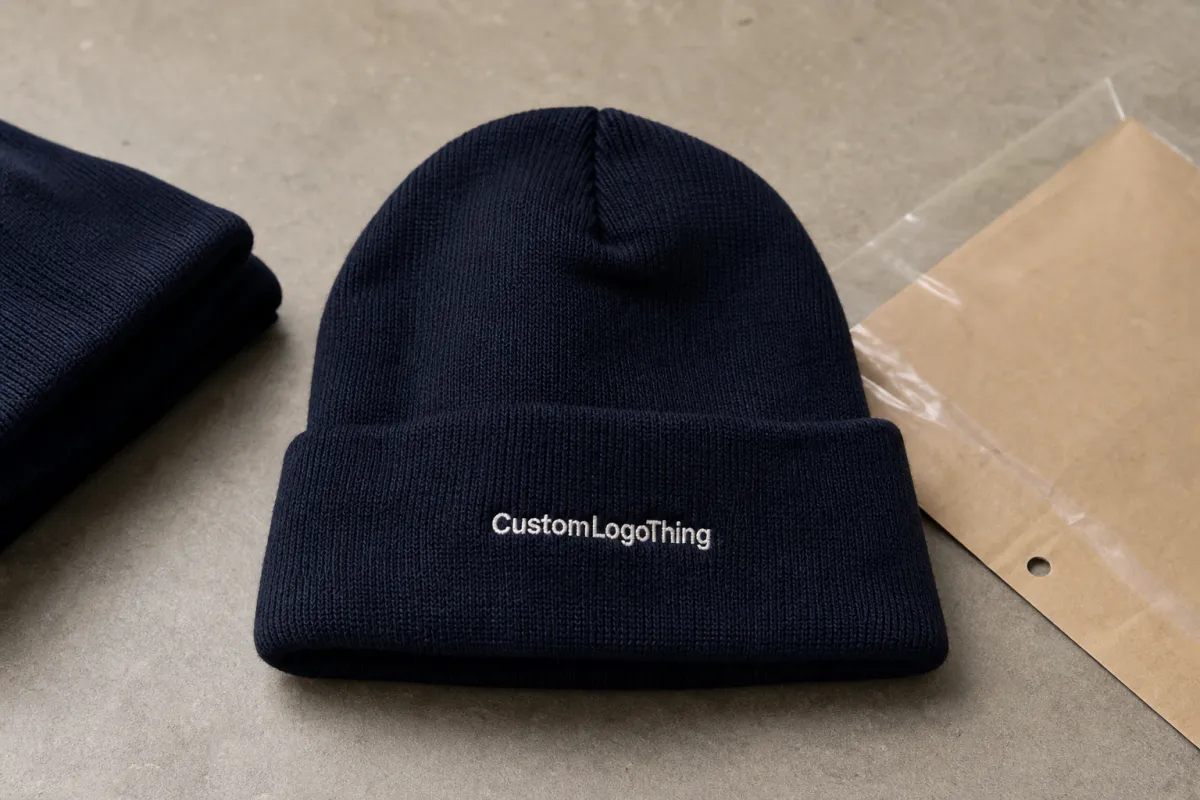
The cuff creates a focused branding zone without changing the whole hat structure. That lowers technical risk and keeps the product easy to quote, repeat, and reorder. A logo on the cuff reads well in photos and in person, which is one reason the style works for both retail and promotional use.
Margin is protected when the spec stays controlled. Small changes in yarn, decoration, or packing can add up faster than buyers expect. A few cents in decoration or carton costs can erase savings from cheaper yarn, especially on smaller runs where fixed work is spread over fewer units. The order becomes less efficient long before the product looks meaningfully different.
Channel also changes the buying logic. Retail buyers may accept a slightly higher unit cost if the beanie feels polished and photographs well. Promo buyers usually care more about total cost and deadline certainty. Team and event orders often need a balance of speed, readability, and predictable sizing. The same beanie can be a smart buy or a poor one depending on who is paying for it and how it will be used.
Spec discipline is the main lever. One cuff width, one yarn family, and one decoration method usually produce cleaner quotes and easier reorders. Once custom stripes, special labels, or multiple embellishment types are added, the order starts behaving like a bespoke knit program instead of a standard cuffed beanie run.
Cuffed Knit Beanies Unit Cost Breakdown: What You Actually Pay For
A practical cuffed knit Beanies Unit Cost Breakdown starts with the layers most buyers do not see on the quote line. The factory price is usually the sum of yarn, knitting time, finishing, decoration, packing, quality control, and a freight assumption. If those items are bundled together, the quote may be real but it is not very useful for comparison.
Yarn is the starting point, but it is not always the biggest cost swing. Standard acrylic is common because it is consistent and widely available. Recycled blends, wool blends, and softer acrylics can raise the cost, though the fiber choice is only part of the story. Color matching can matter just as much, especially if the program needs a specific brand shade.
Knitting time often drives more cost than buyers expect. Tighter gauge, denser rib, multi-color work, and jacquard patterns all take longer on the machine and demand more control. Longer machine time does not just add labor; it also raises the risk of defects if tension or yarn feed slips. That is why a visually simple beanie can still be more efficient than a more expensive-looking custom knit.
Finishing includes closing, trimming, steaming, folding, and any attachment work. A sewn-in woven label, stitched patch, or heat-applied element all add labor and inspection time. Clean finishing can make a mid-priced beanie look far better than a cheaper one with loose threads or uneven folds.
Setup and tooling are easy to underestimate because they are not always listed clearly. Knitting program preparation, artwork cleanup, sample production, and color approvals can be fixed costs or hidden inside the unit price. On small orders, those costs are spread over fewer pieces and push the per-unit price up.
Packing is another quiet cost center. Basic polybagging is inexpensive. Retail-ready inserts, hang tags, barcode labels, carton marks, and special folds add cost and handling time. Packaging also affects damage risk, so cheap packing can become expensive if the cartons arrive crushed or the cuffs deform in transit.
A quote is only comparable when it separates base product, decoration, packing, and freight. If those pieces are bundled together, the number may be valid, but it is not a clean buying comparison.
| Spec level | Typical unit cost range | What drives it |
|---|---|---|
| Basic acrylic cuffed beanie with woven label | $1.40-$2.20 | Lower yarn cost, simple knit, standard packing |
| Mid-level beanie with embroidery or patch | $1.95-$3.10 | Decoration labor, extra finishing, tighter QC |
| Custom knit with special yarn or stripe work | $2.80-$4.80 | Longer machine time, yarn matching, higher setup charges |
Those ranges are practical, not universal. Smaller quantities usually land above them, while larger runs and simpler specs can move lower. Freight can change the delivered number by a wide margin. A low ex-factory quote with expensive air shipping is not a bargain; it is just a deferred cost.
Specs That Move the Price: Yarn, Gauge, Cuff, and Decoration
Yarn sets the baseline, but gauge changes how polished the beanie feels. A finer gauge usually gives a cleaner surface and a more retail-friendly look, but it can take longer to knit and requires tighter production control. A looser gauge can reduce cost and speed up production, though the result may look bulkier.
The cuff affects both appearance and pricing. A longer cuff gives more branding space and a stronger visual anchor, but it uses more knit material and slightly more labor. A shorter cuff can reduce cost a little, but the logo area becomes tighter. In most cases the savings are modest, while the branding difference is more noticeable.
Decoration method often changes the quote more than yarn choice. Embroidery is common because it is durable and easy to read. Woven labels are tidy and often economical. Patches feel more premium but add attachment work. Direct knit-in artwork integrates the design into the fabric, though the artwork has to stay simple enough to knit cleanly and the setup cost can rise.
Fit and wearability matter too. Crown depth, stretch, seam finish, and cuff width all affect how the beanie feels on head. A product can pass inspection and still wear poorly if the body is too short or the cuff collapses. That is a design decision, not just a factory issue.
Material choice also affects warmth and seasonality. Acrylic is the most straightforward budget option. Wool blends improve handfeel and insulation, but they usually raise cost and can introduce care concerns. Recycled fibers support sustainability goals, but they still need the same quality checks as any other yarn.
Packaging should be defined early because it changes both price and presentation. A retail program may need hang tags, barcode labels, or a specific fold. A distribution order may need stronger cartons and better transit protection. If the order will pass through warehousing or retail distribution, ask about carton strength before production starts. For paper components, FSC is a useful reference for certified stock. For transit expectations, ISTA testing standards are worth checking when cartons need to arrive in sellable condition.
Pricing, MOQ, and Quote Math That Makes Sense
MOQ reflects fixed production work, not just a supplier preference. The factory still has to prepare the machine, confirm yarn, approve artwork, and inspect output whether the order is 200 pieces or 2,000. That is why low-volume orders usually carry a higher per-piece price.
As a buying pattern, small runs are usually the least efficient, mid-size runs are the most balanced, and larger runs offer the best unit cost once setup is spread across more units. The break point depends on decoration complexity and yarn availability. A plain beanie with a label can scale sooner than a custom knit with multiple colors or special finishing.
Ask for three quantity tiers when possible, such as 300, 1,000, and 3,000 units. The first jump shows setup pressure; the second shows whether the supplier prices volume efficiently. If the unit cost barely changes as quantity rises, the quote may be padded or the spec may be unusually expensive to produce.
Compare only like with like. Factory cost is not the same as landed cost. Factory cost covers the product leaving the plant; landed cost includes freight and sometimes inland handling or import charges depending on how the quote is structured. A low ex-factory number is not meaningful if the shipping assumption is not the same.
Use a simple quote checklist:
- Base beanie price.
- Decoration method and charge.
- Sample or mockup cost.
- Setup, tooling, or program fee.
- Packing, carton, and label cost.
- Freight term and delivery assumption.
If the budget is fixed, the fastest savings usually come from simplifying the spec. One decoration method, one yarn family, one cuff width, and one packaging standard often protect margin better than aggressive price pressure. In softgoods, restraint usually beats complexity.
Production Steps, Lead Time, and Shipping Milestones
A normal production path is straightforward on paper: artwork approval, sample or mockup approval, yarn matching, knitting, finishing, quality control, and packing. The order only stays on schedule if each approval comes back cleanly. Revisions to logo size, cuff width, color matching, or label placement can reset part of the timeline.
Lead time varies by season, quantity, and decoration complexity. A simple beanie order can move relatively quickly once approvals are complete. A custom knit with special yarn, multiple colors, or patch assembly takes longer because it demands more from the factory and gives quality control more to check. A practical production window for straightforward orders is often around 12-15 business days after approval, but that does not include sampling, freight, or peak-season congestion.
Samples and bulk production should be treated as separate stages. A digital proof or single sample can be turned around quickly because it is a controlled item. Bulk production still needs yarn allocation, machine scheduling, trimming, and packing. Buyers who expect the same pace in bulk usually get frustrated for the wrong reason.
Quality control is most useful when it is specific. Check stitch consistency, cuff symmetry, color accuracy, label placement, and loose-thread count. If the decoration is embroidered, confirm stitch density and edge finish. If the beanie uses a patch, verify placement and attachment strength. A product can look fine in a photo and still fail inspection if those basics are ignored.
Shipping deserves its own milestone. Freight can take a few days by air or several weeks by ocean, depending on route and customs timing. Production complete is not the same as delivery complete, and a supplier who only gives a factory-ready date is giving half the picture. Buyers need to know when goods leave the plant, how they move, and when they are likely to arrive.
What to Send for an Apples-to-Apples Quote
The cleanest quote starts with a clean spec sheet. Send target quantity, logo file, cuff height, yarn preference, decoration method, packing requirement, and the delivery term you want priced. If suppliers are allowed to quote different assumptions, the numbers will not compare meaningfully. The cheapest quote may simply be the least complete one.
Ask for one clear sample plan before approving bulk production. A sample catches problems that are expensive to fix later: logo scale, color tone, cuff proportion, and finishing quality. On custom programs, that step often prevents a costly rework.
Keep the design disciplined. A standard cuff width, a realistic yarn choice, and one decoration method usually protect margin better than a complicated spec that looks impressive on paper. The more variables that are added, the more the unit cost tends to creep.
If the goal is a serious Cuffed Knit Beanies unit cost breakdown, compare only the same spec, the same quantity, and the same shipping assumption. Once those three things are fixed, the quote becomes much easier to read. That is where the buying advantage comes from: it shows where the product is truly expensive and where the cost is only coming from avoidable complexity.
What is a realistic cuffed knit beanies unit cost for small bulk orders?
Small bulk orders usually sit at the higher end of the range because setup work is spread over fewer units. For a simple acrylic style, the final number often rises once decoration, packing, and freight are included. A factory quote alone is not enough to judge value.
How much does the cuff change cuffed knit beanies pricing?
The cuff usually changes price modestly rather than dramatically. A longer cuff adds material and knit time, but the bigger value is visual: it creates space for a cleaner logo. Standard cuff dimensions are usually the safest choice when cost control matters.
What MOQ gives the best unit cost on cuffed knit beanies?
The best price usually appears once the order passes the first meaningful production tier. Very small quantities are possible, but the unit cost tends to stay less efficient because setup charges do not disappear. If quantity cannot increase, the spec should be simplified.
Does embroidery or a woven label change the quote a lot?
Yes, though the impact depends on size, stitch count, placement, and how the decoration is attached. Embroidery can be efficient for clear logos. Woven labels are often tidy and economical. Patches and more complex applications add labor and inspection time.
How long does production take after approval?
Simple orders often move faster than custom knits with multiple colors or special finishing. The clock starts after artwork and sample details are approved. Freight adds its own timeline, so production time and shipping time should always be separated in the quote.

