Buyer Fit Snapshot
| Best fit | Custom Apparel Hang Tags Wholesale projects where brand print, material claims, artwork control, MOQ, and repeat-order consistency need to be specified before quoting. |
|---|---|
| Quote inputs | Share finished size, material target, print colors, finish, packing count, annual reorder estimate, ship-to region, and any compliance wording. |
| Proofing check | Approve dieline scale, logo placement, barcode or warning zones, color tolerance, closure strength, and carton packing before bulk production. |
| Main risk | Vague material claims, crowded artwork, missing packing details, or unclear freight terms can make a low unit price expensive after revisions. |
Fast answer: Custom Apparel Hang Tags Wholesale: Pricing & Specs should be specified like a repeatable production item. The safest quote records material, print method, finish, artwork proof, packing count, and reorder notes in one written spec.
Production checks before approval
Compare the actual filled-product size with the drawing, then confirm tolerance on folds, seals, hang holes, label areas, and retail display edges. Reserve space for logos, QR codes, warning copy, and material claims before decorative graphics fill the panel.
Quote comparison points
Review material grade, print process, finish, sampling route, tooling charges, carton quantity, and freight assumptions side by side. A quote is only useful when the supplier can repeat the same color, closure quality, and packing count on the next order.
Custom Apparel Hang Tags Wholesale: Pricing & Specs
Shoppers often notice the hang tag before they notice the stitching. That makes custom apparel Hang Tags Wholesale a retail packaging decision, not a decorative extra, because the tag shapes perceived value, supports package branding, and changes how finished the product feels once it hits the rack.
Good fabric, clean labels, and a hang tag that bends like office paper send the wrong message. The garment may be solid, yet the presentation feels unfinished. Ordering custom apparel Hang Tags Wholesale solves that problem without turning every reorder into a last-minute scramble.
Why custom apparel hang tags wholesale make a small brand look sorted
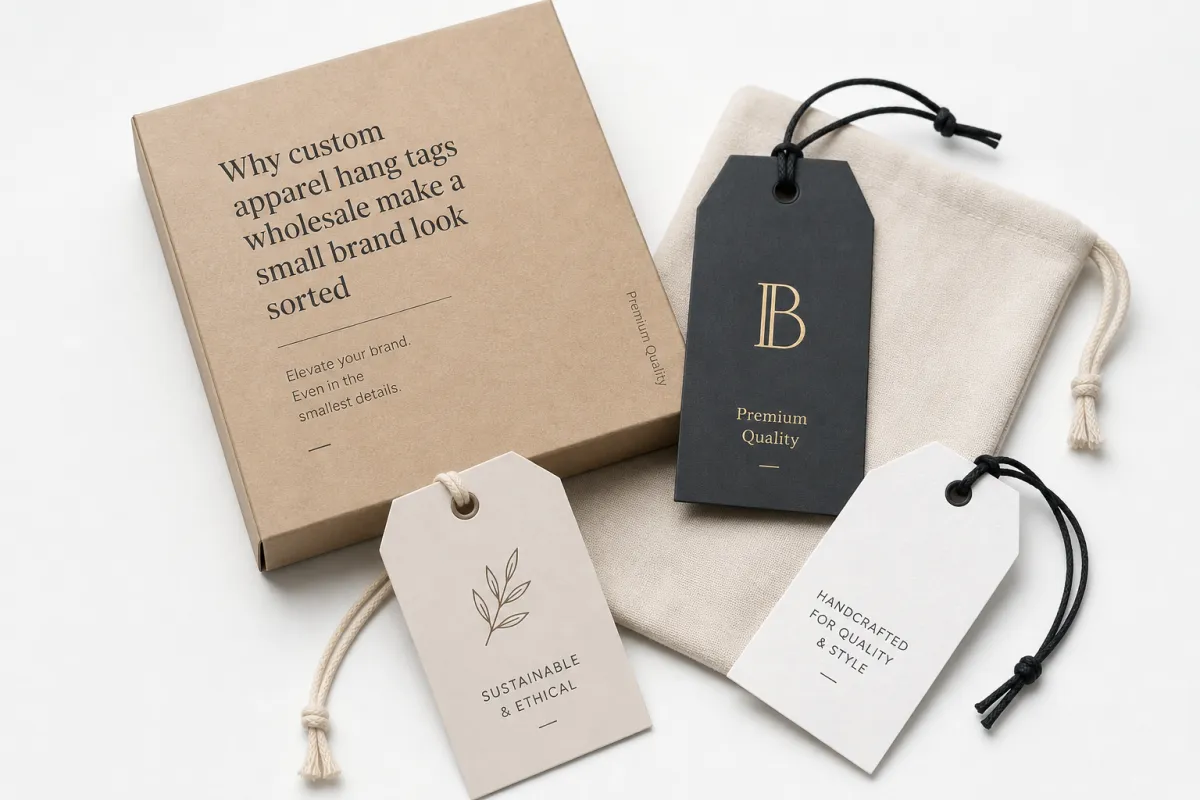
Plain truth: a hang tag is part of the sell, not a spare piece of trim. In retail packaging, it sits beside the garment, the label, the fold, and the box or bag the customer carries out. If one of those pieces feels cheap, the whole item drops in perceived quality. That is why custom apparel hang tags wholesale matters even for smaller brands. It gives the line a deliberate look instead of an improvised one.
A lot of small brands do the hard work first. They upgrade fabric weight, refine fit, improve stitching, and order better labels. The tag gets left behind as a flimsy afterthought. That choice stings. A tag that smears, curls, tears, or pulls apart too easily tells buyers the brand cut corners where it was most visible. In practice, that weakens package branding and narrows the price you can justify on the shelf.
Wholesale buying solves three problems at once. Unit cost drops, every SKU stays visually consistent, and you keep enough inventory for the next reorder. That last point tends to get ignored until the second or third production cycle. Then the original tag is gone, the next launch is waiting, and someone is trying to match color from a phone screenshot. That is a bad way to spend a week.
A smarter path is to treat custom apparel hang tags wholesale as part of the same system as your branded packaging and product packaging. If your line already uses custom printed boxes or premium mailers, the tag should sit in the same visual family. Not identical. Just coherent. Same voice. Same finish level. Same care in the details.
I have seen brands spend good money on fabric and then attach a tag that looked like it came from a copier room, and the disconnect was obvious the second the garment hit the table. That kind of mismatch is avoidable, and honestly, it is kinda painful to watch because the fix is usually simple.
A hang tag should make the garment feel complete in five seconds or less. If it needs a speech, the design is doing too much or too little.
From a buyer's point of view, that is the business case. A clean tag improves the first impression, helps the garment feel retail-ready, and keeps the line looking steady as it grows. That matters most for small apparel brands that launch one collection, test sell-through, and then need a second or third production run without redesigning the entire package.
The tag may be small. The effect is not. If you want custom apparel hang tags wholesale to do its job, think of it as a repeatable retail asset, not a one-off print job. That mindset keeps a brand organized while it is still growing.
Custom apparel hang tags wholesale product options, stocks, and finishes
The stock sets the tone. For custom apparel hang tags wholesale, the common choices are paperboard, coated paper, kraft board, and specialty textured stock. Each one sends a different message. Kraft feels natural and a little rugged. Coated board prints cleaner and holds sharper color. Thick premium board feels more expensive in the hand. Textured stock can add character, but only when the layout is built for it. Adding texture to a weak design just makes the weak design more expensive.
Size matters too. Common apparel hang tag formats include 2 x 3.5 inches, 2 x 4 inches, and 2.5 x 4.5 inches, along with folded or multi-panel versions for brands that need story copy, care information, or a more detailed pricing hierarchy. Single-sided tags stay simple and economical. Folded tags give you more room for copy without crowding the front. Die-cut shapes can work well for denim, activewear, or streetwear, but they bring tooling cost with them and should have a clear reason to exist.
Finishes are where brands often overspend or underspend. Matte feels safe and clean. Gloss boosts color contrast, though it can read loud on minimalist packaging. Soft-touch adds a velvety feel that looks premium in person. Foil and embossing can look excellent, but they belong on lines that can carry the added cost. A modest-priced garment with a heavy metallic treatment on the tag can feel out of balance. That is not luxury. That is a mismatch.
Attachment details matter just as much as print. Cotton cord, black elastic, satin string, plastic fasteners, and safety pins all change the look and the handling. A round hole works for most styles. A reinforced opening helps when the tag is thick or when the garment will be handled often on the rack. If the tag is too heavy for the fastener, it droops. If the string is too thin, it twists and cheapens the presentation. Small details. Big effect.
When I am reviewing a tag spec, I usually ask one simple question: will this still look intentional after it has been handled by a buyer, folded by a store associate, and touched a dozen times in a fitting room? If the answer is no, the finish is probably working harder than the material can support.
| Build | Best For | Typical Spec | Rough Unit Price at 5,000 |
|---|---|---|---|
| Standard matte tag | Basics, volume styles, everyday retail | 16pt coated board, full color front, simple back | $0.08-$0.16 |
| Kraft tag | Natural, eco-forward, heritage branding | 18pt kraft board, one- or two-color print | $0.10-$0.18 |
| Soft-touch premium tag | Higher-priced apparel, giftable pieces | 18pt board, soft-touch lamination, full color | $0.16-$0.30 |
| Foil or embossed tag | Luxury drops, limited editions, premium retail | 18pt-20pt board, specialty finish, custom die cut | $0.24-$0.45 |
Note: those numbers are rough wholesale ranges for comparison, not a promise. Quantity, print coverage, string type, and shape all affect the price. A basic 1,000-piece run will usually land much higher per unit than a 5,000-piece order.
There is a rule I use for this type of product: the tag should survive ordinary store handling without looking tired. That means no curling at the corners, no rubbed-off ink on dark backgrounds, no edge crush, and no tag that feels like it should be recycled before the customer leaves the store. Good retail packaging does not ask for sympathy.
The best hang tag is the one the customer notices once, reads quickly, and never thinks about again. That is a sign it did its job.
If you are choosing between options, do not chase the fanciest finish just because it sounds premium. Pick the version that fits your custom apparel hang tags wholesale order, your garment price point, and the handling it will see in stores and warehouses. For sourcing decisions, consistency matters more than novelty.
Specifications that control durability, color, and retail performance
Before you request a quote for custom apparel hang tags wholesale, lock the spec sheet. Not the mood board. The spec sheet. A good supplier can help refine the design, but they cannot guess what you need if the details are loose. The essentials are straightforward: final size, stock thickness, print sides, color mode, finish, hole placement, string or fastener choice, and whether the tag needs variable data such as SKU, size, or barcode.
Paper weight changes the feel more than most buyers expect. Too thin, and the tag reads disposable. Too thick, and it can feel clunky or push cost higher without giving the customer any real benefit. For many apparel runs, 14pt to 18pt stock is the practical range. Heavier stock can work for premium brands or folded pieces, but there is no prize for overbuilding a tag just to make it heavier in the hand.
Color control is where many first-time orders wobble. Dark backgrounds can shift a little from screen to print. Heavy ink coverage can dry differently on coated versus uncoated stock. Bleed and safe zones are not just prepress jargon; they keep logos, copy, and barcodes from getting clipped or sitting too close to the edge. If your tag carries a barcode or QR code, test it before production starts. A scannable code is useful. A decorative one is just an expensive square.
Retail performance also comes down to durability. The tag should not pick up scuff marks the first time it is touched. Folded pieces should not spring open in a messy way. Cut edges should be clean, not fuzzy. Hole placement should hold the string without tearing. These things sound minor until store staff handles your product thirty times in one day. Then they are not minor anymore.
For sourcing and transit discipline, two references are worth keeping in mind. FSC certification helps you identify paper sourced from responsible forestry, which matters if your brand claims eco-aware packaging. ISTA test logic is useful whenever tags are packed with garments or shipped inside larger retail packaging and need to survive compression, vibration, and handling. See FSC and ISTA for the standards side of that conversation.
Here is the proofing checklist I would use on any custom apparel hang tags wholesale order:
- Confirm the final size in inches or millimeters.
- Check front and back copy for spelling, pricing, and SKU accuracy.
- Verify barcode or QR code placement and scan test it on the proof.
- Review fold direction, hole location, and string attachment method.
- Inspect color build, especially on dark or heavily inked backgrounds.
- Approve bleed and safe zone margins so no important text gets trimmed.
That checklist saves money. It also protects credibility. A bad tag can make good product packaging look careless, and that is a hard thing to explain after the goods are already boxed.
Custom apparel hang tags wholesale pricing, MOQ, and quote basics
Price is not random. It is math with a few moving parts. For custom apparel hang tags wholesale, the biggest cost drivers are quantity, stock type, print coverage, finish, die cutting, and attachment hardware. If you want a lower unit cost, the cleanest path is usually a larger run on a standard size and a standard shape. Fancy cuts and premium finishes are where the budget starts climbing.
MOQ, or minimum order quantity, depends on the build. Standard rectangular tags on common board are usually easier to price at lower quantities than die-cut shapes or multi-panel pieces. If a supplier can gang several SKUs into one run with the same stock and same setup, you can often reduce waste and still keep the design consistent across styles. That is especially useful for brands with several colorways or size ranges.
Here is the practical truth about unit cost: the cheapest per-tag price only matters if the order size matches your sell-through and storage space. Ordering 20,000 tags to save two cents each can become a bad trade if the line changes before you use them. Wholesale is supposed to make the business easier, not turn your back room into a paper archive.
A clean quote for custom apparel hang tags wholesale should spell out exactly what you are buying. That means unit price, setup or plate charges if they apply, proof cost, shipping, turnaround, and what happens if there is a file issue. If reprints are needed because the artwork was wrong, that needs to be clear before production starts. A vague quote is not a bargain. It is a later problem with better lighting.
One thing I always recommend is asking whether the quoted spec includes attachment hardware. A tag without the string or fastener is not the same product as a tag that arrives fully assembled, and mixing those two numbers can make the budget look better than it really is. That kind of detail sounds small until you are sitting in a packing room with a launch date breathing down your neck.
| Run Size | Standard Matte Tag | Two-Sided Full Color | Premium Finish |
|---|---|---|---|
| 1,000 | $0.18-$0.32 | $0.24-$0.42 | $0.35-$0.60 |
| 5,000 | $0.08-$0.16 | $0.11-$0.22 | $0.16-$0.30 |
| 10,000 | $0.06-$0.12 | $0.08-$0.18 | $0.13-$0.25 |
Important: those are comparison ranges, not a fixed price card. If one quote includes soft-touch lamination, reinforced holes, and individual stringing while another quote is plain stock with no finishing, the two numbers are not equal. Compare like with like or the spreadsheet will lie to you.
The MOQ question is tied to design stability too. If your line changes artwork every month, smaller runs can make sense. If your core logo and structure stay the same across seasons, larger wholesale quantities usually pay off faster. That is the kind of judgment call that turns custom apparel hang tags wholesale into a useful buying strategy instead of a discount hunt.
For brands building out broader product packaging, the same logic applies across the rest of the kit. If the hang tag needs to match labels, inserts, or shipping pieces, compare the order with Custom Labels & Tags, then decide whether you should pull the rest of the line into Wholesale Programs or bundle it with other Custom Packaging Products. One coordinated spec set is easier to manage than five disconnected ones.
Custom apparel hang tags wholesale process, timeline, and lead time
The ordering process for custom apparel hang tags wholesale should be boring in the best way. Send the specs. Get the quote. Review the proof. Approve the sample if one is needed. Then move into production. If any part of that chain turns into guesswork, the timeline stretches and the chance of a mistake goes up. Boring beats expensive.
Timing depends on a few practical things. Artwork readiness matters. So does whether the proof needs one revision or four. A simple rectangular tag with standard finishing can move quickly. A folded tag with foil, embossing, or a custom cut takes longer because the setup is more involved. If the order includes individual stringing or packing by style, expect more handling time.
For planning purposes, a straightforward run often takes about 7 to 12 business days after proof approval, plus shipping. More complex custom apparel hang tags wholesale jobs can land in the 15 to 20 business day range before transit. Rush jobs are possible on simple formats, but premium finishes or custom tooling usually put a ceiling on how fast the shop can move. Machines do not care about your launch date. They only care about the setup.
Buyers can speed this up by sending exact dimensions, final copy, artwork files, quantity by SKU, and a clear in-hand date. The more complete the brief, the fewer back-and-forth messages you need to clear before production. That matters because the real delay is often not press time. It is the time wasted waiting for missing information, one more logo version, or a barcode that still needs approval.
If tags are being packed with garments for store delivery or fulfillment, do not forget the transit side. Bundled tags, boxed garments, and pre-attached fasteners should survive handling without rubbing, bending, or arriving loose in the carton. That is where the packaging design and the physical pack-out need to work together. Pretty is nice. Functional is paid for.
One more practical note: if you are planning the tag to launch alongside custom printed boxes, printed mailers, or a larger branded packaging refresh, schedule the whole set together. Separate timing on connected pieces creates small gaps that turn into big schedule slips. A coordinated run of custom apparel hang tags wholesale is easier to receive, inspect, and deploy across the line.
My experience has been that the best timelines come from the least dramatic jobs: one clean spec, one approved proof, one firm date. The more a team tries to improvise midway through production, the more the calendar starts to wobble.
Why choose us for wholesale hang tags that hold up in real use
For a buyer comparing suppliers, the difference is not just print quality. It is consistency. A tag that matches the first run on the second run, the third run, and the seasonal reorder is worth real money because it keeps the line looking stable. That is the kind of thing customers do not praise directly, but they absolutely notice when it goes wrong.
What should you expect from a supplier handling custom apparel hang tags wholesale? Clear proofs. Clean specs. Honest notes about what the finish will do in hand. No guessing on color shifts. No pretending that a paper choice is premium just because it sounds premium. That kind of clarity is boring to sell and very useful to buy.
A good supplier also understands that tags sit inside a wider retail packaging system. They need to fit the brand voice, the garment price point, and the rest of the product packaging. If the line is minimalist, the tag should not scream. If the line is high-energy streetwear, the tag can be bolder. If the product is luxury-adjacent, the tag has to feel composed. Package branding is not one-size-fits-all, no matter how often lazy vendors say otherwise.
That is where ordering through a packaging-focused provider helps. A team that works with labels, inserts, and other retail materials can keep the whole set aligned instead of treating the hang tag like a random print insert. If your program needs matching components, use Custom Labels & Tags for the detail work and compare the rest of the line through Custom Packaging Products. For brands with recurring volumes, Wholesale Programs are the better route because repeatability matters more than one-time novelty.
The best wholesale partner does not just print what you send. They catch the problems before the run becomes expensive.
My view is simple: the right vendor should make custom apparel hang tags wholesale feel controlled. Same cut. Same finish. Same color. Same communication. Fewer mistakes, fewer delays, fewer do-overs. That is what a professional buying experience looks like.
Next steps to order custom apparel hang tags wholesale
If you are ready to move, gather the basics first. That saves time and gives you a quote that means something. For custom apparel hang tags wholesale, the minimum input should be:
- Final tag size and shape.
- Quantity by SKU or style.
- Paper stock preference, if you have one.
- Front and back artwork files.
- Finish choice, such as matte, gloss, soft-touch, foil, or embossing.
- Hole placement and attachment preference.
- Barcode, QR code, or variable data needs.
- Shipping location and target in-hand date.
Before you request a quote, do one internal check. Confirm the SKU list. Confirm the price copy. Confirm whether any tags need multiple versions for different sizes or colors. If your line has half a dozen garments but only two tag templates, say so. If each item needs its own tag, say that too. Clean input produces a cleaner quote, and a cleaner quote is easier to compare.
From there, ask for a spec-based estimate and review the proof carefully. Do not rush past the small things. Check the barcode. Check the spelling. Check the hole position. Check the safe zone. One mistake in a small printed area can cause a full reprint, and that is a painful way to learn patience.
If you are building a launch package, this is also the right time to align the rest of your branded packaging. A hang tag that works with the labels, the box, and the insert makes the whole product feel coordinated. That is what people mean when they say the packaging looks complete. It is not magic. It is just consistent decisions made before production starts.
The simplest takeaway is this: lock the spec first, then price the spec, then proof the spec. If you do those three things in order, custom apparel hang tags wholesale stops being a guessing game and starts being a reliable part of the product launch.
Send the specs, compare the numbers, and lock the run that fits your sell-through. That is the cleanest way to buy custom apparel hang tags wholesale.
Frequently Asked Questions
What is the usual MOQ for custom apparel hang tags wholesale?
MOQ depends on stock, size, and finish, but standard tags usually start lower than fully custom die-cut or premium-finish jobs. If you need multiple versions, ask whether the supplier can combine SKUs into one production run to reduce waste. The best MOQ is the one that matches your sell-through, not the biggest number you can technically afford.
How much do custom apparel hang tags wholesale orders cost per tag?
Unit cost is driven by quantity, paper thickness, print coverage, finishing, and any special cut or string add-ons. Simple one- or two-color tags on standard stock are usually the most economical. Request a quote on the exact same spec sheet so you are comparing real numbers, not guesses.
How long does production usually take for wholesale hang tags?
Production time depends on proof approval, artwork readiness, and whether the order needs special finishing or custom tooling. Straightforward runs move faster than heavily finished or multi-piece tags. Build in extra time for shipping and receiving so the tags arrive before product packing starts.
What file format should I send for custom apparel hang tags wholesale?
Vector files are best for logos and text because they keep edges clean at print size. Include final copy, barcode data, bleed, and any required cut lines or hole positions. If your artwork is not final, send the best available version and flag what still needs approval.
Can I order multiple apparel styles in one wholesale tag run?
Yes, if the specs are close enough to share the same stock and production setup. Versioned copy, SKU changes, or size differences can often be handled as separate print variations within one order. Ask for a combined quote to see whether batching styles lowers total cost.

