Buyer Fit Snapshot
| Best fit | Custom Bag Packaging Design Service projects where brand print, material claims, artwork control, MOQ, and repeat-order consistency need to be specified before quoting. |
|---|---|
| Quote inputs | Share finished size, material target, print colors, finish, packing count, annual reorder estimate, ship-to region, and any compliance wording. |
| Proofing check | Approve dieline scale, logo placement, barcode or warning zones, color tolerance, closure strength, and carton packing before bulk production. |
| Main risk | Vague material claims, crowded artwork, missing packing details, or unclear freight terms can make a low unit price expensive after revisions. |
Fast answer: Custom Bag Packaging Design Service: Material, Print, Proofing, and Reorder Risk should be specified like a repeatable production item. The safest quote records material, print method, finish, artwork proof, packing count, and reorder notes in one written spec.
Production checks before approval
Compare the actual filled-product size with the drawing, then confirm tolerance on folds, seals, hang holes, label areas, and retail display edges. Reserve space for logos, QR codes, warning copy, and material claims before decorative graphics fill the panel.
Quote comparison points
Review material grade, print process, finish, sampling route, tooling charges, carton quantity, and freight assumptions side by side. A quote is only useful when the supplier can repeat the same color, closure quality, and packing count on the next order.
A Custom Bag Packaging design service sounds simple until the mockup has to survive real use, real folds, real weight, and a real production run. I have seen a polished render hide a dozen problems that only show up once the bag is actually made: the handle crowding the logo, the gusset stealing room from the artwork, the material feeling flimsy in the hand, or the finish looking sharp on a screen and oddly flat under store lighting. That gap between concept and production is where bag projects either become useful brand assets or turn into expensive lessons.
A strong custom bag packaging design service is less about decoration than judgment. Bag style, dimensions, material, print method, finish, and reinforcement all have to work together, or the package never feels finished no matter how good the logo looks. For branded packaging, retail packaging, and promotional product packaging, the smartest decisions usually happen before the art file is even opened.
Buyers looking for practical starting points often begin with Custom Packaging Products, yet the real work is matching the product to the structure. A good custom bag packaging design service keeps the project anchored to use, not just appearance, so the final bag supports the product instead of fighting it.
What a custom bag packaging design service actually does
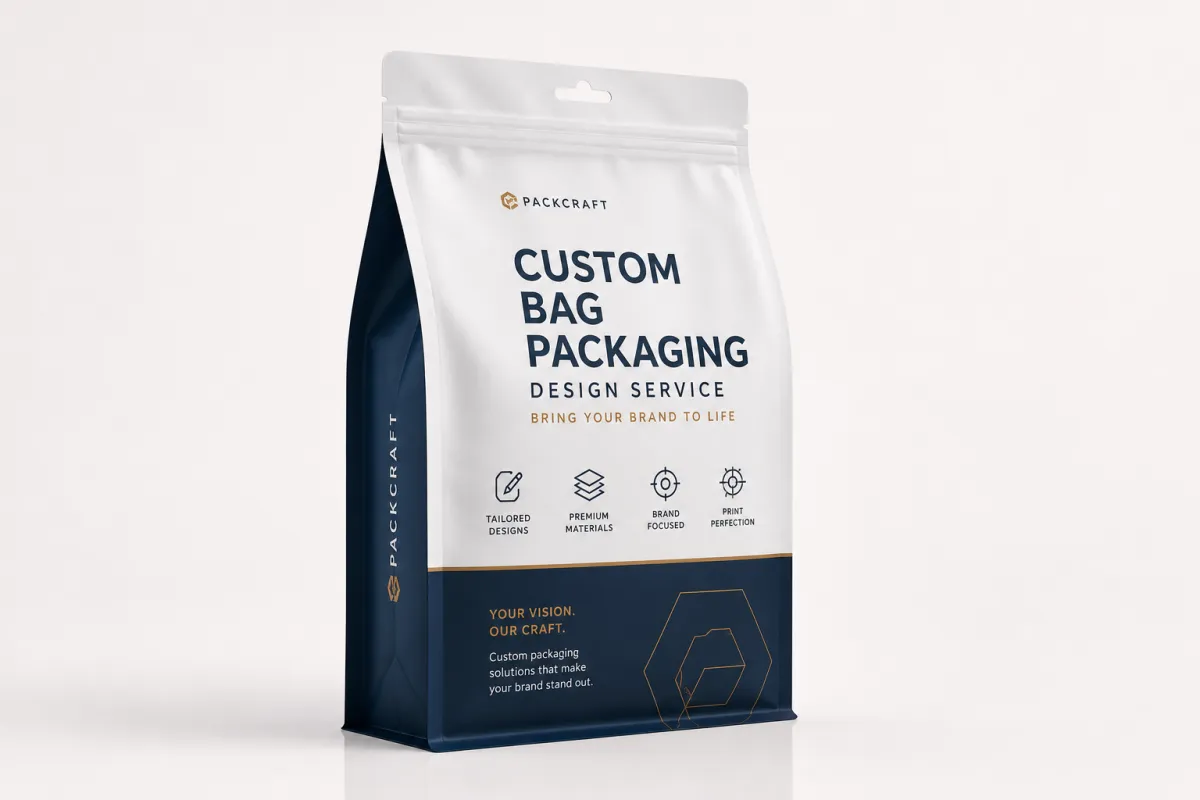
A custom bag packaging design service connects branding with production in a way that makes the finished bag buildable, printable, and usable. It takes a logo, a product, and a sales goal, then turns those inputs into a bag specification that can move through sampling and manufacturing without avoidable problems. Artwork is only part of the work. The service also covers the bag style, exact dimensions, material selection, print method, finishes, handles, reinforcements, and the structural limits of the format.
Packaging design often gets described as a visual task, which misses half the job. Structure matters just as much as appearance, and in bag projects structure is usually the part that prevents the whole thing from falling apart. A front panel that looks elegant but leaves no room for reinforcement, a side gusset that crowds the branding, or a bottom panel that cannot support the intended load will make the bag feel weak the moment someone picks it up. No amount of graphic polish can hide a bad proportion. It only makes the mistake cost more.
A proper custom bag packaging design service asks practical questions early: What is going inside the bag? How heavy is it? Will it hang on a display hook, sit on a shelf, or travel across a counter? Retail Carry Bags, gift bags, food bags, and promotional bags all behave differently once they leave the mockup stage. A kraft gift bag with rope handles follows a different design logic from a laminated retail bag or a folded paper food bag, even if they share the same basic shape.
Bags are unforgiving in a way boxes are not. A box can sometimes absorb a weak proportion or a slightly awkward layout. A bag puts every issue in view at once. Crooked print, crowded panels, undersized handles, or a bottom that sags under load all show up immediately. That is why a good custom bag packaging design service has to do more than make the package look polished. It has to make the bag feel dependable in the hand.
“The cleanest bag usually starts with fewer forced decisions. Good packaging design leaves room for structure, not just decoration.”
In real use, the strongest results come from treating the project as package branding rather than ornament. The bag becomes part of the product experience, whether it is a boutique retail bag, a trade show giveaway, or a food carry bag handed over the counter. When message, material, and print style all point in the same direction, the bag reads as intentional. When they do not, people notice right away.
Custom bag packaging design service process and timeline
The usual custom bag packaging design service workflow begins with a discovery brief. That brief should spell out what is being packed, how many pieces are needed, the visual direction, and any hard constraints such as size limits, loading requirements, or retail display rules. From there comes the dieline, the flat template that maps the bag structure in production terms. Artwork gets fitted to the dieline after that, followed by proofing, sample review, and release for production.
The order of decisions matters more than most buyers expect. Changing dimensions after artwork is already placed is how projects lose time and money for no useful reason. A larger bag usually needs layout changes too. A different handle often shifts the artwork. A matte finish behaves differently from gloss in both appearance and print feel. In a custom bag packaging design service, structure first and graphics second is usually the least painful route.
For a simple job with clean specs, seven to twelve business days from brief to proof approval is a common range, with sampling and production following after that. Projects with custom structural changes, special finishes, or several revision rounds can take two to four weeks before production release feels comfortable. Rushing rarely breaks at the press; it usually breaks during review, when feedback arrives late and incomplete. Slow decisions are what drag a schedule out.
Speed in a custom bag packaging design service comes from clear dimensions, approved logo files, final quantity, one color system, and one person who can actually sign off. Delay usually comes from vague print instructions, competing opinions from multiple departments, and comments like “make it pop” that do not tell anyone what to change. A note such as “move the logo 8 mm higher and reduce the side copy by 20%” can be used. The first one cannot.
Comparing suppliers also depends on what each team actually includes. Some providers only prepare print setup. Others manage the dieline, prepress, proofing, and sample coordination as part of a broader custom bag packaging design service. If fewer handoffs matter to you, ask who owns each step before the project starts. That question saves a lot of confusion later.
Custom bag packaging design service cost, MOQ, and quote basics
Pricing for a custom bag packaging design service depends on more than print area. Bag style, material, number of colors, finish, reinforcement, and the number of printed panels all affect the final cost. A plain paper carry bag with a single-color logo and standard handles sits in a very different price zone from a laminated retail bag with full-coverage artwork, foil accents, and reinforced gussets. The category name is the same. The cost structure is not.
MOQ matters because setup costs have to be spread across the run. Smaller orders usually carry a higher unit price for that reason. A run of 1,000 bags may land in one band, while 5,000 or 10,000 pieces can lower the unit cost noticeably. The setup cost does not disappear, though. In a custom bag packaging design service, small runs can still make sense, just not as efficiently as larger runs when unit economics are the priority.
Quote comparisons get messy whenever one supplier includes dieline work, proofs, or freight while another only lists blank bag cost and printing. Buyers see two numbers and assume they are equal. They usually are not. A low quote can hide sampling fees, tooling, freight, or extra revision charges that appear later with a friendly little invoice and none of the friendliness.
Here is the kind of comparison that actually helps.
| Bag type | Typical use | Common print setup | Usual MOQ range | Rough unit cost at mid-size runs |
|---|---|---|---|---|
| Kraft paper carry bag | Retail, events, gifting | 1-2 colors, logo-centric | 500-3,000 pieces | $0.18-$0.45 |
| Laminated retail bag | Fashion, premium product packaging | Full-color, coated finish | 1,000-5,000 pieces | $0.35-$1.10 |
| Gift bag with rope handle | Luxury retail packaging, seasonal promos | Spot color or process print | 500-2,000 pieces | $0.40-$1.25 |
| Food carry bag | Takeout, bakery, beverage packaging | Utility-first branding | 1,000-10,000 pieces | $0.12-$0.60 |
The ranges above are typical, not fixed promises. Material thickness, handle style, print coverage, and finishing can move the price quickly. Even so, this is the right way to think about a custom bag packaging design service: match the structure to the use case first, then compare quotes line by line. Starting with price alone often leads to a bag that is cheaper only in the narrowest sense and worse in daily use.
Hidden costs deserve attention too. Custom tooling, special coatings, sample freight, inserts, and rush fees can all show up in a real quote. If the project needs compliance labeling or sustainability documentation, include that in the budget as well. For material and transit references, resources from FSC, ISTA, and your supplier's own technical data sheets are the safest place to start. I would be cautious with any claim that is not backed by a document you can read yourself.
A practical buying rule keeps the decision clean: compare like with like. If one quote includes a custom bag packaging design service, sample development, and verified print setup, while another leaves those pieces out, the cheaper option is not actually cheaper. It is only less complete.
Step-by-step bag design process from brief to sample
The strongest custom bag packaging design service projects start with the product itself. What is going inside the bag, and how does it behave? A folded T-shirt is one thing. A boxed candle is another. A stack of bakery items is another again. Weight, fill method, and shape all affect the bag size and structure. Ignore those realities and the design may look fine on paper while failing in use.
Step one is a practical spec sheet. Keep it focused: product dimensions, target quantity, fill weight, branding goals, preferred material, and any compliance text or recycling marks. If the bag must satisfy a retail display rule or a food-use requirement, write that down from the start. A custom bag packaging design service moves faster when the facts are visible instead of buried in email threads and half-finished PDFs.
Step two is choosing the structure before getting distracted by graphics. A tote-style paper bag, a flat-bottom food bag, a folded merchandise bag, and a premium gift bag all carry different design constraints. Shape decides the layout. If the layout is wrong, even strong artwork can feel cramped. A careful custom bag packaging design service usually checks the dieline before anyone gets attached to colors or finishes.
Step three is building the artwork hierarchy. Logo first. Brand message second. Regulatory or care copy third. Filling every surface just because there is space usually weakens the result. People scanning retail packaging want clarity more than they want every possible message at once. A restrained layout often feels more premium, especially on smaller bags where folds, gussets, and handle anchors take away usable space fast.
Step four is checking the dieline with production realities in mind. Safe zones, bleed, fold lines, seam allowances, and handle reinforcements all matter. A beautiful file can still fail if critical text lands too close to a fold or if a logo crosses a seam in the wrong place. In a custom bag packaging design service, the dieline is not just paperwork. It is the map that decides whether the final bag looks deliberate or careless.
Step five is sample approval. This is not the place to skip ahead. A sample shows hand feel, color behavior, rigidity, closure, and load performance in ways a PDF never will. If the bag is for shipping or heavier carry use, the sample should reflect the real fill weight, not just an empty shell. A good custom bag packaging design service treats sampling as a decision point, not a box to check.
“If the sample looks fine but the bag feels wrong, the bag is wrong. People handle packaging with their hands, not with a render.”
For retail packaging and promotional product packaging, this step-by-step process saves money more often than it adds cost. There is no reward for approving a bad spec quickly. The real cost arrives later as reprint, rework, and awkward explanations to a sales team that expected the packaging to carry its weight.
Common mistakes that wreck bag packaging design
One of the worst mistakes in a custom bag packaging design service is designing for the mockup instead of the real bag dimensions. Mockups are useful, but they can hide problems by smoothing out proportions. The software makes everything look balanced. Then the real bag arrives and the front panel feels too narrow, the gusset steals artwork space, or the handle eats into the logo area. Reality shows up fast.
Ignoring load weight and handle strength is another common failure. A lightweight giveaway bag can tolerate some shortcuts. A heavier retail bag cannot. When the product is dense, sharp-edged, or packed in a rigid inner container, handle selection and reinforcement become central decisions. A weak seam or undersized rope handle does more than look bad. It creates a product packaging issue and a customer service problem in the same move.
Overloading the front panel causes trouble too. Too much copy, too many colors, and tiny decorative elements can make a bag look busy and cheap. Curved surfaces, folds, and matte finishes already reduce visual clarity. Add more detail than the format can carry and the artwork starts fighting itself. The best custom bag packaging design service results usually keep one side strong and let the rest breathe.
Quote mismatch is another classic. Buyers compare two suppliers without matching specifications, then wonder why the samples do not line up. If one bag uses heavier paper, a different coating, or a different print method, the quote is not directly comparable. That kind of mistake happens because people want a shortcut. There is no shortcut, only a faster route to the wrong answer.
Skipping sample testing is the most expensive way to save time. A sample can reveal weak seams, off-color print, poor stiffness, smudging, or a finish that hates fingerprints. It can also show whether the bag collapses awkwardly under real fill weight. In a proper custom bag packaging design service, the sample is where assumptions get corrected before the whole run is locked in.
There is a quieter mistake that still causes damage: picking a style because it looks expensive rather than because it fits the brand. Foil, embossing, and specialty coating can work beautifully. They can also feel excessive if the product is practical, everyday, or price-sensitive. Package branding should match the message. Otherwise the bag becomes a costume instead of a fit.
Expert tips for stronger custom bag packaging design service results
Use one strong focal side and keep the rest calmer than instinct suggests. The idea sounds simple because it is, and it works. In a custom bag packaging design service, especially for retail packaging, one clear front panel usually delivers more impact than wrapping every surface in visual noise. Full coverage can be right for some brands. For many others, restraint reads better and ages better too.
Match the finish to the brand position. Matte coatings usually feel softer and more premium. Gloss can create stronger shelf presence and more vivid color. Specialty effects such as foil, spot UV, or embossing should earn their place. If they do not strengthen the story or improve visibility, they are decoration pretending to be strategy. Buyers using a custom bag packaging design service should know the difference.
Build tolerances into the design instead of treating the bag like a perfect one-off. Products vary a little. Fill weight varies a little. Handling varies a little. A bag that closes nicely at the exact target load but fails when the fill is slightly fuller is too fragile for production reality. Better to give the structure some breathing room so it performs across normal variation, not only under ideal conditions.
Ask for production-safe files early. Fixing art after approval is slower than setting it correctly at the start. Confirm image resolution, font outlines, bleed, safe zones, Pantone targets, and print method before release. In a careful custom bag packaging design service, prepress discipline is not fussiness. It is basic professionalism that keeps the project moving.
Request a sample that reflects actual use rather than a clean tabletop proof. If the bag will carry goods in transit, test it with the real fill weight. If it will sit under retail lighting, check color and sheen there. If it will be folded, stacked, or shipped flat, inspect how the material behaves in those conditions. The best sample is the one that tells the truth, even if the truth is slightly inconvenient.
For sustainability-minded buyers, ask what can be documented. FSC-certified paper, recyclable structures, and lower-ink print coverage can all matter, but only if the supply chain can support the claim honestly. A custom bag packaging design service should be able to explain what is certified, what is merely recyclable in theory, and what depends on local collection systems. Green claims are easy. Proof takes work.
Keep the review group tight. Every extra reviewer adds delay and increases the chance of conflicting comments. The best results usually come from one brand owner, one production contact, and one final approver. Not glamorous, but effective. A custom bag packaging design service runs more cleanly when decisions stay in one lane.
Next steps after choosing a custom bag packaging design service
Once you have selected a custom bag packaging design service, start with the facts that cannot be argued with. Gather product dimensions, fill weight, target quantity, sales channel, and the intended use of the bag. Is it for retail handoff, shipping, event giveaway, or food service? That answer changes the structure, the material, and often the print approach. A bag for boutique retail packaging is not the same job as a bag for casual promotional distribution.
Then gather the brand inputs: logo files, brand colors, copy that must appear on pack, and any compliance text. If you already know the bag style you want, say so. If you do not, describe the use case and let the supplier narrow the field. A good custom bag packaging design service can turn broad brand intent into a usable specification, especially when the starting point is clear enough to work from.
Ask at least two or three suppliers to quote the same spec sheet. Same size. Same material. Same print coverage. Same finish. That is how you get a comparison that actually means something. Then review more than price. Check sample policy, turnaround time, revision limits, and whether the quote includes dieline work. If one supplier is faster but vague and another is slower but clearer, the right choice depends on deadline, budget, and risk tolerance.
Set a deadline for dieline approval and sample review before the project starts. Endless revision cycles are rarely about design quality. They are usually about indecision. A custom bag packaging design service works best when one person has the authority to say yes or no. Without that, every small color change becomes a committee event, and committee events are where packaging timelines disappear.
If you are also developing other branded packaging, it helps to align the bag graphics with related formats such as Custom Packaging Products and other package branding pieces in the same range. That way the bag does not feel disconnected from the rest of the product packaging system. Consistency is quiet work, but it is what gives the line a finished, deliberate feel.
Here is the clean takeaway: lock the spec first, approve a real sample second, and only then move the run into production. That order keeps a custom bag packaging design service focused on structure, print quality, and performance instead of endless revision for its own sake. If the bag is going to carry your brand in someone’s hand, make sure it is built to do the job before you spend money on volume.
FAQ
How much does a custom bag packaging design service usually cost?
The cost depends on bag style, material, print colors, finish, and order quantity. Smaller runs usually carry a higher unit price because setup gets spread across fewer bags. That is normal, not a mystery.
Ask whether the quote includes dieline work, sample production, and freight so you compare like with like. A custom bag packaging design service that looks cheap at the start can become expensive once the missing pieces appear.
What do I need before requesting a custom bag packaging design service?
Have your product dimensions, target quantity, and intended use ready. Bring logo files, brand colors, and any required copy or compliance text. If you already know the bag style you want, include that too.
The fuller the brief, the less back-and-forth later. A clear brief makes a custom bag packaging design service easier to quote and faster to move into sampling.
How long does a custom bag packaging design service take from brief to sample?
Simple projects can move quickly when the artwork is ready and the spec is locked. More complex projects take longer when the bag needs structural changes, specialty finishes, or several revision rounds.
Fast approvals matter more than people expect. In a custom bag packaging design service, slow feedback is usually the real schedule killer, not the production team.
Can a custom bag packaging design service help with MOQ and supplier limits?
Yes, a good supplier can suggest formats that fit your volume instead of forcing a large minimum. MOQ often shifts with material, print complexity, and tooling requirements.
If your order is small, ask for the simplest build that still supports your branding goals. A custom bag packaging design service should fit the job size, not push you toward a bag you do not need.
What mistakes should I avoid when using a custom bag packaging design service?
Do not approve artwork before checking real bag dimensions and load needs. Do not compare quotes unless the specs are identical. Do not skip sample testing; it is the cheapest way to catch expensive problems.
Those three mistakes create most avoidable reprints. A careful custom bag packaging design service prevents exactly that kind of waste.

