Paper Bags

Custom Bakery Paper Bags Wholesale Pricing for Bulk Orders

✍️ Sarah Chen 📅 May 9, 2026 📖 11 min read 📊 2,230 words
Custom Bakery Paper Bags Wholesale Pricing for Bulk Orders

Custom Bakery Paper Bags Wholesale Pricing for Bulk Orders comes into focus when you separate the real cost drivers from the noise. Bag style, paper stock, print coverage, finish, quantity, and freight matter far more than a headline unit price. The best buy is the one that fits the product, supports fast service, and arrives with no surprises.

Buyers often ask for the lowest price per bag and then discover the true cost in storage, labor, or reprints. A better approach is to match the bag to the menu, the pace of service, and the brand standard. That is usually where savings show up in practice.

For bakeries, cafes, and grab-and-go counters, paper bags often beat rigid cartons for speed and efficiency. They are lighter, easier to store, and quicker to hand over during a rush. When the line is moving, fewer steps at the counter matter.

Why bakery bags beat boxes for fast service and lower waste
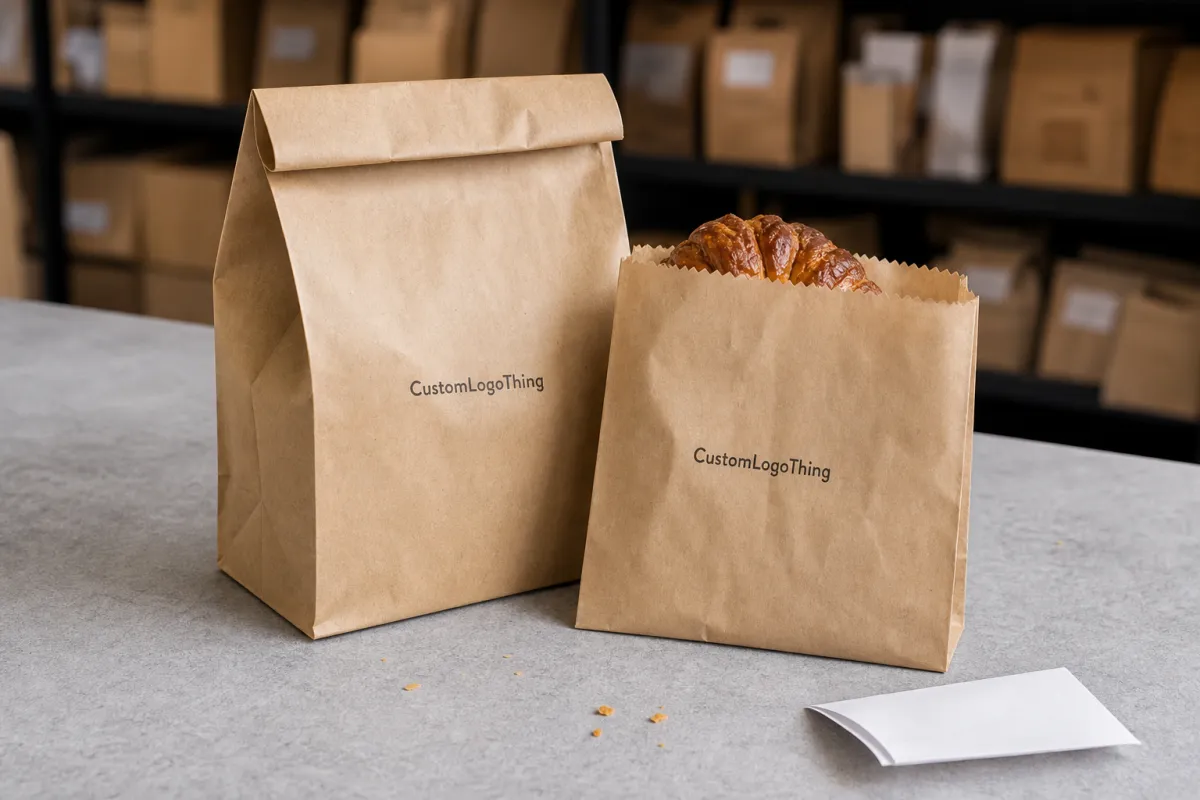
Why bakery bags beat boxes for fast service and lower waste - CustomLogoThing packaging example

Bakery bags make sense for products that leave the shop quickly. Cookies, rolls, croissants, muffins, mini loaves, and single pastries rarely need a full box unless they are fragile or being sold as a gift. A paper bag uses less board, takes less space, and is faster to pack.

That speed is practical, not theoretical. A counter team can fill, fold, and hand off a bag in seconds. A box takes more steps, and every extra fold, insert, or closure adds friction during busy service.

Waste is part of the decision too. A correctly sized bag uses less material than an oversized carton and takes up less room in totes, shelves, and delivery bins. For stores that watch packaging waste closely, that difference adds up across a week.

Grease resistance is where quality shows up fast. A dry cookie bag is easy; a warm pastry with butter or glaze is not. If the stock is too light, product can bleed through or soften the paper. That creates a mess for staff and a weak impression for customers.

"If the item is meant to be carried, eaten soon, and handed across a counter, a well-made bag is usually the more practical buy than a decorative box."

There is also a brand benefit. A clean paper bag with restrained printing often looks more credible than a package trying too hard to look premium. For many bakeries, that simpler presentation fits the product better and feels more honest.

If a bakery also sells take-home snacks, sandwich add-ons, or retail items, a paper bag program can sit alongside labels, tissue, and other Wholesale Programs without forcing every SKU into the same format. That keeps the packaging system flexible while preserving consistency.

Choose the right paper bag style for your menu and fill weight

The bag should follow the product. Flat paper bags suit lighter, lower-profile items such as cookies, thin pastries, and single servings. They are economical and simple to print. Gusseted bags add depth for thicker pastries, stacked items, and mixed assortments that need more room.

SOS-style bags, with their square bottom, are useful when the order needs to stand on its own or carry more weight. They work well for counter bundles, bulk take-home packs, and heavier bakery items. Handled bags are better for premium takeout or larger orders, but they usually raise cost and MOQ.

Size is where many buyers miss the mark. Too small, and the seam strains or the pastry crushes. Too large, and the bag looks sloppy, shifts in transit, and wastes paper. The right spec gives the product a little room without leaving unnecessary dead space.

For warm or greasy items, the barrier matters as much as the dimensions. Ask whether the paper is grease-resistant, coated, or treated in another way. Not all kraft stock performs the same once oil, steam, or heat enters the picture.

Handles, windows, and liners only make sense when they solve a real problem. Handles improve carry comfort on larger orders, but they increase cost. Windows show off the product, but they can change material choices and disposal behavior. Liners may help freshness, but they add cost and complexity. Add-ons should be selected, not assumed.

Here is a practical comparison of common bag styles:

Bag style Best use Typical MOQ Relative unit cost Notes
Flat paper bag Cookies, thin pastries, light take-home items Lower entry point Lowest Fast to produce; limited structure
Gusseted bag Croissants, rolls, thicker bakery packs Moderate Mid-range Better capacity and cleaner fill
SOS-style bag Bulk counter orders, heavier items, mixed assortments Moderate to higher Mid to higher Stands better and carries more weight
Handled bag Premium takeout and larger orders Higher Higher Adds convenience, but raises print and tooling cost

Paper stock, print methods, and finishing choices that change the outcome

Paper stock affects both appearance and performance. Light kraft is economical and easy to source. Heavier kraft improves stiffness and tear resistance. White paper gives a brighter printing surface and often reads as more polished. Recycled stock can work well, but it is not automatically the same as premium coated paper. Ask for a sample.

Print method changes cost and consistency. One-color flexographic printing is usually the most efficient choice for high-volume bakery bags with a simple logo. It keeps setup manageable and works well when the design is bold and restrained. Multi-color print adds complexity, more setup time, and a higher price.

Heavy ink coverage deserves special attention. The more area printed, the more time and material the press uses. Dark solids can look sharp, but they require tighter control during production. Simple branding often looks better than a crowded layout that tries to use every inch of the bag.

Finishing is another cost lever. Matte usually feels practical and understated. Gloss can sharpen color, but it will not suit every bakery identity. Aqueous coatings may improve surface durability and moisture resistance. Grease-resistant treatment can be worth paying for on pastries and donuts, though buyers should ask how it affects recyclability.

For buyers checking sustainability claims, two references are useful: the FSC standard for responsibly sourced paper and the EPA recycling guidance for understanding how coated or treated paper products are handled in practice. If a supplier cannot explain the material clearly, keep asking.

Packaging groups such as ISTA and the broader network at Packaging Professionals outline the kinds of checks that matter once a bag starts moving through shipping, storage, and daily use.

Custom bakery paper bags wholesale pricing and MOQ

The biggest pricing drivers are bag size, paper grade, print colors, finish, handle style, and total quantity. Quantity lowers unit price by spreading setup costs across more pieces, while special features push the price up because they require more labor, more material, or more press time.

A realistic pricing picture often looks like this: basic uncoated kraft bags with one-color print may sit in the low cents per unit at larger volumes, while multi-color or specialty-finish bags can move into the mid-teens or higher depending on size and coverage. Small custom runs usually carry setup charges that matter as much as the unit number.

MOQ is not arbitrary. It is the point where a run becomes efficient enough to price properly. Smaller bakeries often accept a higher per-unit cost in exchange for lower volume. Mid-size shops tend to sit in the middle, and chains or distributors usually get the best economics once tooling and press setup are spread over more units.

Do not compare quotes by headline price alone. A useful quote should show the material, print method, dimensions, MOQ, plate or tooling cost, sample cost, shipping terms, and lead time. If those items are missing, the quote is incomplete.

Here is a practical snapshot of how pricing often shifts:

Order profile Typical quantity Price pressure What usually raises cost Best fit
Small custom run 1,000-3,000 pcs Higher unit cost Setup, plates, short-run inefficiency Independent bakeries testing a new look
Mid-volume order 5,000-20,000 pcs Balanced Print colors, grease resistance, bag size Growing shops and multi-site operators
Large bulk order 25,000 pcs and up Lowest unit cost Freight, storage, complex graphics Chains, distributors, and seasonal programs

Landed cost is where many buyers get surprised. Freight, duties, packing, and rush production can turn a strong quote into a weak one. A bag that looks inexpensive at the factory may not be inexpensive once it reaches your dock. For wholesale pricing, the delivered number is the one that matters.

Production steps, timeline, and lead time expectations

The production path is straightforward: inquiry, spec confirmation, artwork review, proof approval, sample production if needed, full production, packing, and freight booking. Most delays start with unclear artwork, a missing dimension, or a change made after quoting.

If the bag size is wrong, the print file may be built incorrectly. If the colors are not specified clearly, the press may need adjustments. If the buyer changes the style after the quote, the estimate usually shifts. None of this is dramatic, but it adds time and cost.

Standard production windows vary by supplier, paper availability, and print complexity. Simple orders usually move faster than multi-color or specialty-finish runs. Transit time is separate from production time, and that distinction matters for inventory planning.

Speed is easiest to control when the file is ready the first time. Clean artwork, confirmed dimensions, exact quantity, and quick proof approval reduce the chance of rush fees. If the bags are for a seasonal menu or holiday spike, reorder early.

A sample is worth more than a polished mockup. It verifies size, print clarity, paper feel, and whether the bag handles grease or moisture the way the spec suggests. Fixing a sample is cheap. Fixing a full run is not.

How to place a clean bulk order and avoid expensive reprints

Start with the details that shape the order: bag dimensions, product type, target quantity, print colors, paper thickness, finish, and shipping destination. If the fill weight is uncertain, send examples of what the bag will carry. A photo is better than a vague description, and a sample item is better than a photo.

Ask for a proof or sample whenever the bag style, print layout, or finish is new. That step confirms sizing, print contrast, paper feel, and performance under real conditions. For branded packaging, it is the check that keeps a weak assumption from becoming a full reprint.

Supplier comparisons only work if the basis is the same. Check whether the quotes match on paper grade, print method, MOQ, shipping terms, and delivery timing. A thinner stock or a simpler print process may be cheaper, but it is not the same product.

Here is a clean order sequence:

  1. Choose one bag style that matches the product.
  2. Lock bag dimensions and paper grade.
  3. Prepare artwork in the correct format.
  4. Request a sample or proof.
  5. Confirm quantity and landed cost.
  6. Approve production only after the details match.

If you buy multiple packaging formats, it helps to think in systems. Bakery bags, labels, and Custom Packaging Products should carry the same visual language instead of competing for attention. That kind of consistency is subtle, but customers notice it.

The cleanest quotes are the ones that break out every cost driver. Once the buyer sees plates, freight, special handling, and material grade in the same view, most surprises disappear. Clarity is the real advantage here.

What affects custom bakery paper bags wholesale pricing the most?

Bag size, paper grade, print colors, and order quantity usually move the price fastest. Special finishes, handles, windows, and heavy ink coverage add cost quickly. Freight and packing can matter as much as the unit price on larger orders.

What is a realistic MOQ for bakery paper bag wholesale orders?

Smaller custom runs are possible, but the unit price is usually higher. Mid-volume MOQs work well for bakeries that want branded bags without holding too much inventory. Chains and distributors generally reach better pricing once volume supports tooling and setup.

How long does custom bakery paper bag production usually take?

Production time depends on artwork approval, paper availability, and print complexity. Simple orders move faster than multi-color or specialty-finish runs. Transit time should be counted separately so inventory planning stays realistic.

Which bag style works best for greasy pastries or donuts?

Grease-resistant paper stock is the first thing to check. Gusseted or slightly larger bags help reduce crushing and smearing. If the product is oily or warm, ask for a sample before approving a full run.

Can I get a sample before placing a wholesale order?

Yes, and for a new print layout it is the safest move. A sample helps verify size, print clarity, paper feel, and grease resistance. It is much cheaper to correct a sample than to reprint a full batch.

Good bakery packaging does not need theatrics. It needs the right size, the right stock, the right print method, and a delivered price that matches the quote. Keep those pieces aligned, and wholesale ordering becomes far more predictable.

Get Your Quote in 24 Hours
Contact Us Free Consultation

Warning: file_put_contents(/www/wwwroot/customlogothing.com/storage/cache/blog/e98a6cf7792ae4d30ff3da183253696c.html): Failed to open stream: Permission denied in /www/wwwroot/customlogothing.com/inc/blog/PageCache.php on line 20

