Buyer Fit Snapshot
| Best fit | Custom Barcode Labels for Products projects where brand print, material claims, artwork control, MOQ, and repeat-order consistency need to be specified before quoting. |
|---|---|
| Quote inputs | Share finished size, material target, print colors, finish, packing count, annual reorder estimate, ship-to region, and any compliance wording. |
| Proofing check | Approve dieline scale, logo placement, barcode or warning zones, color tolerance, closure strength, and carton packing before bulk production. |
| Main risk | Vague material claims, crowded artwork, missing packing details, or unclear freight terms can make a low unit price expensive after revisions. |
Fast answer: Custom Barcode Labels for Products: Material, Adhesive, Artwork, and MOQ should be specified like a repeatable production item. The safest quote records material, print method, finish, artwork proof, packing count, and reorder notes in one written spec.
Production checks before approval
Compare the actual filled-product size with the drawing, then confirm tolerance on folds, seals, hang holes, label areas, and retail display edges. Reserve space for logos, QR codes, warning copy, and material claims before decorative graphics fill the panel.
Quote comparison points
Review material grade, print process, finish, sampling route, tooling charges, carton quantity, and freight assumptions side by side. A quote is only useful when the supplier can repeat the same color, closure quality, and packing count on the next order.
Custom Barcode Labels for products can look straightforward right up until a receiving team rejects a pallet because the code will not scan under warehouse lighting. I have seen that kind of problem ripple through an entire operation: inventory sits, people reprint labels, someone double-checks data that should have been right the first time, and a cheap label turns into a surprisingly expensive afternoon. Custom barcode labels for products are not just stickers with bars on them; they are part of the identification system that keeps product packaging, inventory, and shipping moving without unnecessary friction.
From a packaging buyer’s point of view, decoration is not the main job here. The label has to survive the surface, the handling, and the scanner. If the finish is wrong, the adhesive is wrong, or the barcode lands too close to a fold, the whole system starts to wobble. Custom barcode labels for products should be built around use conditions first and appearance second, because a label that fails in the field never earns back the time spent approving it.
There is also a practical truth that gets glossed over a lot: a label only has value if it can be applied consistently by the people on the line or in the warehouse. That means the spec has to make sense outside the design file, not just in a neat mockup on a screen.
What Custom Barcode Labels for Products Actually Are
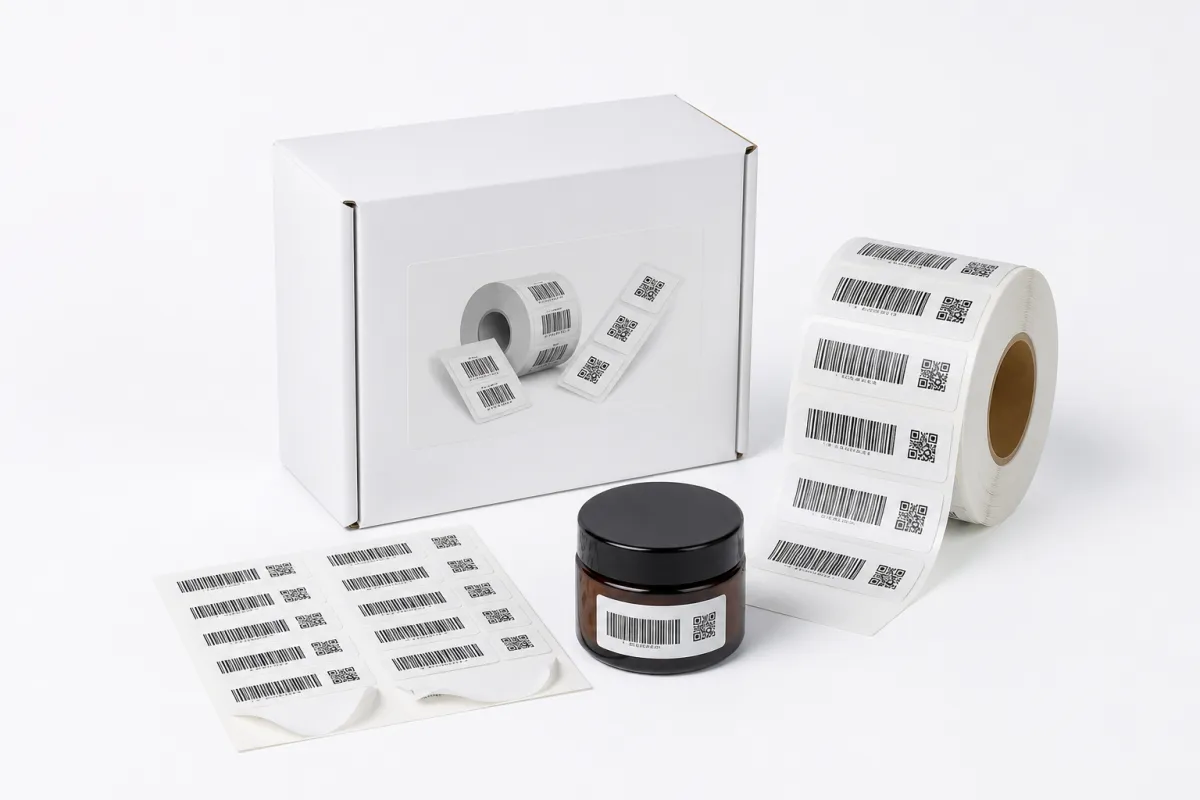
People often treat custom barcode labels for products like a last-minute add-on. That mindset usually creates the trouble later. A barcode label is a functional piece of package branding, inventory tracking, and retail packaging compliance. It can sit on a carton, a poly bag, a bottle, a mailer, or a shelf-ready tray, but the job stays the same: identify the item quickly and accurately.
A label can look perfect on screen and still fail at receiving because the print density is too light, the barcode is too small, or the label crosses a seam. That mistake shows up constantly in production. Artwork gets approved because it looks clean in a proof, then the first pallet lands in a real warehouse and the scanner starts missing reads. The issue is rarely the concept. It is usually the production setup, the material choice, or the application method.
Custom barcode labels for products usually carry more than the barcode itself. Most runs include human-readable text, SKU numbers, product names, batch or lot codes, and sometimes pricing, country-of-origin data, or regulatory marks. In some product packaging workflows, the label also needs to support traceability for recalls or expiration tracking. When traceability matters, the layout has to make sense to both scanners and people who still need to read it by eye.
Retail-facing labels, warehouse labels, and compliance-driven labels each play a different role. Retail packaging may need a polished look because the label sits in front of the customer. Warehouse labels are built for speed, durability, and scan accuracy under rough handling. Compliance-driven custom barcode labels for products may need specific text, symbol placement, or data structure. Mixing those three jobs together is how budgets get burned without improving the result.
Good custom barcode labels for products are built around four questions:
- What surface is the label going on?
- What conditions will it face after application?
- What scanner or software will read it?
- How long does it need to stay legible?
Answer those honestly and the rest of the process gets easier. Skip them and you end up redesigning labels after launch, which always costs more than doing the work carefully the first time.
A barcode that scans in the office but fails on a dusty receiving dock is not a working label. It is a complaint waiting to happen.
For teams building broader branded packaging programs, it helps to think of custom barcode labels for products as part of the same system as Custom Labels & Tags, not as a separate afterthought. The strongest labels support the product, the carton, and the workflow at the same time.
How Custom Barcode Labels for Products Work in Real Use
Custom barcode labels for products work through a chain, not a single event. First, someone creates the product data in a system. The barcode format gets assigned next. After that, the label is printed, applied, scanned, and pushed into inventory or fulfillment software. If any one of those steps is sloppy, the label becomes a bottleneck. That is the part people miss when they focus only on the artwork.
The barcode itself is a machine-readable language. The symbology, whether it is Code 128, EAN, UPC, QR, or another format, determines how the data gets encoded. Pick the wrong format and the barcode may still look fine while failing in the software stack or at the retailer. Custom barcode labels for products have to match system requirements, not just whatever seems convenient in the design file.
Placement matters more than most buyers expect. On curved bottles, reflective pouches, textured cartons, and cold containers, a barcode can fail because of distortion, glare, or weak adhesion. A label placed a few millimeters too close to a flap can wrinkle. A label placed over a seam can lose its quiet zone. Once that happens, the scanner has to work harder than it should. That is not the scanner misbehaving; it is the label doing exactly what the placement asked it to do.
Scanner conditions matter as well. Handheld scanners, fixed-mount readers, mobile device cameras, and conveyor systems all behave a little differently. Distance, angle, lighting, and speed can change the read rate. A code that scans fine at arm’s length may not be reliable at a longer distance or under low light. Strong custom barcode labels for products are designed with the actual reading environment in mind, not a polished version of it that exists only in a mockup.
The database and printer setup have to cooperate too. If the barcode data is correct but the printer is miscalibrated, the bars can spread, shrink, or blur. If variable data is being printed, the file logic has to be clean. If labels are serialized, one typo in the source file can send the wrong code to hundreds of units. Custom barcode labels for products are as much an operations task as a print task, which is why the data review matters so much.
The system makes the most sense when it follows a straightforward sequence:
- Define the data and barcode format.
- Choose the right substrate and adhesive.
- Set the label size and placement.
- Print and verify a sample.
- Apply, scan, and test in real conditions.
- Lock the spec for future runs.
The sequence sounds basic because it is. Even so, most failures happen when someone skips a step and assumes the label alone will solve the problem. It will not. Custom barcode labels for products work only when the label, the software, and the handling process line up.
One small but useful habit: keep a sample from the approved run. Tuck it into the spec sheet or save it with the artwork archive. When a reorder comes around three months later, that physical reference can save a lot of guessing.
Key Factors That Affect Scan Quality and Durability
Material choice is where many custom barcode labels for products either become dependable or turn into a recurring expense. Paper is usually the lowest-cost option and works well for dry, short-life applications. Polypropylene handles moisture and abrasion better. Polyester is tougher still and can hold up in harsher environments. Specialty stocks exist for freezer storage, chemical exposure, tamper evidence, and more. The right choice depends on the product packaging, the storage life, and how rough the handling gets after the label goes on.
Adhesive choice matters just as much. Permanent adhesive is common for long-term identification. Removable adhesive makes sense when labels may need to come off cleanly. Freezer-grade adhesive is built for cold-chain use. High-tack adhesive helps on textured or difficult surfaces. In practice, the wrong adhesive causes lifting far more often than the wrong barcode font causes scanning trouble. People love to obsess over the code and ignore the glue, and that is where a lot of avoidable failures begin.
Print method changes both durability and cost. Direct thermal printing is simple and common, but it can fade with heat, sunlight, or time. Thermal transfer printing uses a ribbon and usually gives better durability, especially on synthetic stocks. Digital printing is useful for color, short runs, or variable data, but the right finish and ink system still matter. For custom barcode labels for products, the print method should match the shelf life of the item and the environment it will live in.
Size and quiet zones are another frequent failure point. A barcode that is technically correct can still fail if it is squeezed too tightly into the layout, scaled badly, or surrounded by clutter. The scanner needs margin around the code. It also needs strong contrast between the bars and the background. Crowding the label because someone wants to fit more information almost always reduces scan reliability.
The environment does the final damage. Heat can soften adhesive. Cold can make adhesive brittle. Oils can attack the face stock. Abrasion can scuff the print. Sunlight can fade ink. Chemical exposure can wreck even a decent label if the stock is wrong. That is why custom barcode labels for products should be selected by use case, not by the cheapest quote that lands in the inbox.
Here is a practical comparison of common material options:
| Material | Best For | Typical Cost Range | Tradeoffs |
|---|---|---|---|
| Paper | Dry cartons, short-life retail packaging, internal inventory labels | $0.03-$0.08 per label at mid-volume | Lowest cost, but weak against moisture and abrasion |
| Polypropylene | Moisture-prone packs, shelf-ready cartons, general product packaging | $0.06-$0.14 per label | Good balance of cost and durability, not ideal for extreme heat |
| Polyester | Long-life identification, warehouse use, rough handling | $0.10-$0.22 per label | Higher cost, but stronger resistance to wear and chemicals |
| Freezer-grade synthetic | Cold storage, chilled logistics, food and pharma-style workflows | $0.12-$0.28 per label | Needs the right adhesive and application temperature |
If you want sourcing confidence, look at packaging standards and test methods instead of marketing fluff. The ISTA family of test methods is useful for understanding how packs behave in shipping and handling, and it is much better than guessing whether a label will survive a real distribution cycle. For paper sourcing, the FSC framework matters if your brand cares about responsibly sourced fiber in branded packaging and custom printed boxes.
One more practical detail: do not confuse good-looking print with good scan performance. Glossy finishes can create glare. Matte finishes usually scan better, especially on retail packaging under bright lights. That does not mean gloss is wrong. It means custom barcode labels for products should be tested with the exact lighting and angle they will see in the real world.
And yes, there are situations where a gloss stock still makes sense because the brand presentation matters more than a purely industrial look. You just want to be sure the label can do both jobs without kinda cheating one side of the equation.
Custom Barcode Labels for Products: Process and Timeline
The production path for custom barcode labels for products is usually straightforward, but only if the brief is clean. It starts with a data review. Then comes material selection. Then artwork and proofing. Then sample approval. Then production. Then shipping. None of that is exotic. The time gets eaten by missing data, unclear label sizes, poor artwork, and late approval rounds.
The data check is the most underrated step. If the file has duplicate SKUs, incorrect prefixes, or barcode values that do not match the product system, the print run may be technically perfect and operationally useless. A clean spec sheet saves money because it keeps custom barcode labels for products consistent across reorders and reduces the chance of someone trying to fix the data in a rush.
Simple runs can move quickly once the artwork and data are approved. A straightforward order with a standard material and a single barcode style may ship in roughly 5-10 business days after proof approval. More complex orders often take 12-15 business days, especially if variable data, custom die sizes, or specialty adhesives are involved. If the job needs testing on actual product packaging, add time for that. Rushing the process usually costs more than waiting a few extra days.
Approvals matter because scan testing should happen before full production. A small proof or sample sheet can catch bar width issues, contrast problems, or placement mistakes before hundreds or thousands of labels are printed. That is especially useful for custom barcode labels for products used on curved or textured surfaces. Once boxes are packed, nobody wants to discover the label only works from one exact angle.
Reorders are faster when the spec is locked. If the barcode type, material, adhesive, label dimensions, and placement are already approved, repeat runs become a controlled repeat instead of a fresh project. That is why a good packaging program keeps the same logic across product packaging, retail packaging, and warehouse use. It saves time, and time is usually the thing people burn the fastest.
If your line also uses broader branded packaging, keep the label spec tied to the rest of the package branding system. A carton that uses Custom Packaging Products should not force a different logic for every SKU. The cleanest operations work from one master spec and a small set of controlled variations.
My own rule here is simple: if the art team, operations team, and warehouse team are all looking at different versions of the label, the project is not ready. A single approved spec keeps everyone honest.
Custom Barcode Labels for Products: Cost and Pricing
Pricing for custom barcode labels for products depends on quantity, material, adhesive, print method, finish, size, and whether the data changes from label to label. There is no single number that fits every order, no matter how often people ask for one. Small orders usually cost more per label because setup is spread across fewer units. Bigger runs usually bring the unit cost down because the press time and prep are divided more efficiently.
Variable data can raise the cost a little because it adds file handling, verification, and sometimes extra proofing. Specialty materials do the same. A freezer-grade label, a chemical-resistant label, or a tamper-evident label will almost always cost more than a basic paper stock. That is not a markup trick. It is the cost of making the label survive the job it was asked to do.
Hidden costs show up when people skip data cleanup. If the source file is messy, the team spends time checking serial numbers, correcting SKUs, or reprinting bad labels. Proofing is another cost people forget to count. So is the replacement cost when a bad label fails in the field and someone has to relabel inventory, cartons, or finished goods. Cheap custom barcode labels for products are only cheap if they actually work.
Here is a simple way to compare budget and durable options:
| Option | Typical Use | Approx. Per-Label Cost | Best Reason to Choose It |
|---|---|---|---|
| Basic paper label | Dry storage, short-life product packaging, internal cartons | $0.03-$0.07 | Lowest upfront spend |
| Mid-grade synthetic label | Retail packaging, warehouse handling, moderate moisture | $0.07-$0.15 | Better scan life and handling strength |
| Durable thermal transfer label | Longer warehouse life, higher abrasion, rough logistics | $0.10-$0.20 | Good balance of cost and durability |
| Specialty cold-chain label | Freezer or chilled storage | $0.12-$0.28 | Reduces failure in low-temperature environments |
That table is not a quote. It is a pricing framework. A buyer should ask for three numbers every time: cost per label, total run cost, and replacement cost if the label fails in the field. That last one gets ignored constantly, which is funny in the least funny way possible. If a bad label creates a labor problem, the label was never really cheap.
For product packaging lines that also use custom printed boxes or shelf-ready cartons, the right label choice can reduce downstream labor. A clean barcode placement on branded packaging helps receiving, pick-and-pack, and retail replenishment. That kind of value does not always show up neatly on a spreadsheet line item, but it shows up in time saved and fewer corrections later.
Common Mistakes That Break Scans
The first mistake is using the wrong barcode type for the software or retailer requirement. A barcode can be printed perfectly and still fail if the format does not match the system. That is why custom barcode labels for products need a data check before artwork approval. The format is not decoration. It is the language the scanner expects to read.
The second mistake is making the code too small, too dense, or too close to the edge. That creates avoidable friction for the scanner. It also increases the chance of damage when the label is applied. Custom barcode labels for products work best when the barcode has enough quiet zone, enough contrast, and enough breathing room. Cramming extra copy into the label almost always hurts readability.
Glossy finishes are another problem. They can reflect light and throw off readers, especially on retail packaging under strong overhead lighting. Matte or satin is often safer for scan-heavy use. The finish should still fit the brand, though. Branded packaging does not have to look dull to scan well, but it does need to be tested under the same light the customer or warehouse team will actually see.
Skipping substrate tests on the actual product surface is one of the more expensive mistakes. A label that sticks well to a flat carton may fail on a curved bottle, a textured mailer, or a cold container. Cold chain, oily surfaces, and rough handling all create different risks. If custom barcode labels for products are going onto real product packaging, test them on the actual surface, not on a desktop sample that tells a prettier story than the material deserves.
Ignoring human-readable text is the last easy-to-avoid mistake. The barcode is the machine-readable backup. The printed number or SKU is the human backup. If the scanner fails, a warehouse worker should still be able to read the label and keep moving. That tiny detail saves time every single day.
- Wrong symbology for the system or retailer spec.
- Bars too small or too close to the edge.
- Gloss glare on high-light retail environments.
- Adhesive mismatch on cold, curved, or textured surfaces.
- No readable text fallback for manual entry.
If you want fewer surprises, build a label test sheet before full production. A short checklist for custom barcode labels for products should cover barcode type, size, quiet zone, material, adhesive, and placement. It is plain work, but plain work is often the reason a production line keeps moving.
Expert Tips and Next Steps for Better Label Runs
The smartest label runs start with a simple audit. List the product types, the storage conditions, the shipping conditions, and the surfaces the label will touch. Then decide where custom barcode labels for products should live on the pack. Front panel, back panel, side panel, carton flap, or secondary packaging each creates different risks. A label that works on a rigid carton may need a different spec than one used on flexible product packaging.
Request a sample sheet or short proof run before you commit to a full order. That is not overcautious. It is common sense. Test the label with the same scanner, the same lighting, and the same handling conditions your team actually uses. If your line is fast, test at speed. If your warehouse is cold, test in the cold. Custom barcode labels for products should be judged in real use, not in a perfect office environment.
Keep one spec sheet for each active label family. Lock the barcode type, size, material, adhesive, and placement. Add notes for print method and any surface prep required. That way, reorders stay consistent and the team does not reinvent the label every quarter. Good package branding is consistent branding, not constant improvisation.
Finally, connect the label work to the rest of the packaging system. If your line uses Custom Labels & Tags and Custom Packaging Products, keep the specs aligned so the whole operation behaves like one system. That matters for retail packaging, warehouse flow, and the rest of your product packaging mix. A label is a small piece, but it touches almost everything.
For the cleanest results, think about the next reorder before the current box is empty. That advice is not flashy, which is probably why it works. Custom barcode labels for products are cheapest and easiest when the spec is already locked, the artwork is clean, and nobody is panic-reordering because a carton line changed without warning.
The most useful habit is boring, but it saves the most money: keep the approved spec, the sample, and the scanner test results together so the next run starts from facts instead of memory.
Frequently Asked Questions
What should custom barcode labels for products include?
At minimum, custom barcode labels for products should include the barcode, a human-readable code, and the product or SKU identifier. If traceability matters, add batch, lot, or expiry data too. Keep the layout clean so the barcode stays scannable and the text stays readable.
Which material is best for custom barcode labels for products?
Paper works for dry, short-life packaging and the lowest cost. Polypropylene or polyester is better for moisture, abrasion, or longer warehouse life. The right choice depends on the product surface, handling, and storage conditions, which is why custom barcode labels for products should be specified by use case rather than guesswork.
How long do custom barcode labels for products take to produce?
Simple runs can move quickly once the artwork and data are approved. Custom materials, special adhesives, or variable data usually add more setup time. The fastest orders happen when the spec is already locked and the file is clean, which is exactly how custom barcode labels for products should be ordered if speed matters.
Can custom barcode labels for products be used in cold storage?
Yes, but only if the adhesive and face stock are rated for low temperatures. Cold surfaces can make standard labels lift, fog, or fail to bond properly. Ask for freezer-grade or cold-chain testing before you commit, because custom barcode labels for products that fail in cold storage are a waste of labor and inventory control.
How much do custom barcode labels for products usually cost?
Price depends on quantity, material, adhesive, print method, and whether the data changes on each label. Smaller orders cost more per label because setup is spread across fewer pieces. A durable label can cost more upfront and still save money by reducing relabeling and scan failures, which is why custom barcode labels for products should be judged on total cost, not just sticker price.
Custom barcode labels for products work best when you treat them like a production tool, not a decorative add-on. Lock the spec, test the label, and match it to the surface and environment. That is the difference between labels that quietly do their job and labels that generate avoidable headaches.

