Buyer Fit Snapshot
| Best fit | Custom Barcode Labels Wholesale projects where brand print, material claims, artwork control, MOQ, and repeat-order consistency need to be specified before quoting. |
|---|---|
| Quote inputs | Share finished size, material target, print colors, finish, packing count, annual reorder estimate, ship-to region, and any compliance wording. |
| Proofing check | Approve dieline scale, logo placement, barcode or warning zones, color tolerance, closure strength, and carton packing before bulk production. |
| Main risk | Vague material claims, crowded artwork, missing packing details, or unclear freight terms can make a low unit price expensive after revisions. |
Fast answer: Custom Barcode Labels Wholesale: Specs, Pricing & Supply should be specified like a repeatable production item. The safest quote records material, print method, finish, artwork proof, packing count, and reorder notes in one written spec.
Production checks before approval
Compare the actual filled-product size with the drawing, then confirm tolerance on folds, seals, hang holes, label areas, and retail display edges. Reserve space for logos, QR codes, warning copy, and material claims before decorative graphics fill the panel.
Quote comparison points
Review material grade, print process, finish, sampling route, tooling charges, carton quantity, and freight assumptions side by side. A quote is only useful when the supplier can repeat the same color, closure quality, and packing count on the next order.
Custom Barcode Labels Wholesale: Specs, Pricing & Supply
Custom Barcode Labels wholesale can look like a small purchase until one unreadable code slows a picking lane, sends a worker to key data by hand, and knocks a shipping schedule sideways. I have watched that happen in real facilities, and it is never just "one label." The cost of the label is rarely the real cost. A barcode label influences labor, inventory accuracy, shipment timing, and the amount of rework a team has to absorb when a scan does not go through on the first pass. In a warehouse, a fill room, or a retail stock area, the label is not decoration. It is a working part of the process, and it has to read cleanly under real conditions, not just on a clean proof sheet.
Wholesale buying matters for the same reason. Lower unit pricing helps, yet the larger value sits in consistency across SKUs, locations, and packaging lines. Done well, custom barcode labels wholesale gives packaging teams a dependable spec they can repeat without scrambling for emergency reprints or guessing at adhesive performance. It also supports cleaner receiving, steadier replenishment, and fewer surprises when labels move from proof to production. For brands managing product packaging, retail packaging, or broader branded packaging programs, the barcode label belongs inside the workflow, not on the edge of it.
From a packaging buyer's point of view, the math is straightforward. The label may cost pennies, yet a failed scan can create minutes of labor, and minutes stack up quickly across pallets, cartons, and shifts. The smarter move is to treat custom barcode labels wholesale as a controlled specification, then build around the application surface, the scanner, the storage environment, and the reorder pattern. That keeps the purchase grounded in how the label will actually behave once it reaches the line, which is the part that matters.
Custom Barcode Labels Wholesale: Why Misreads Cost More Than Labels
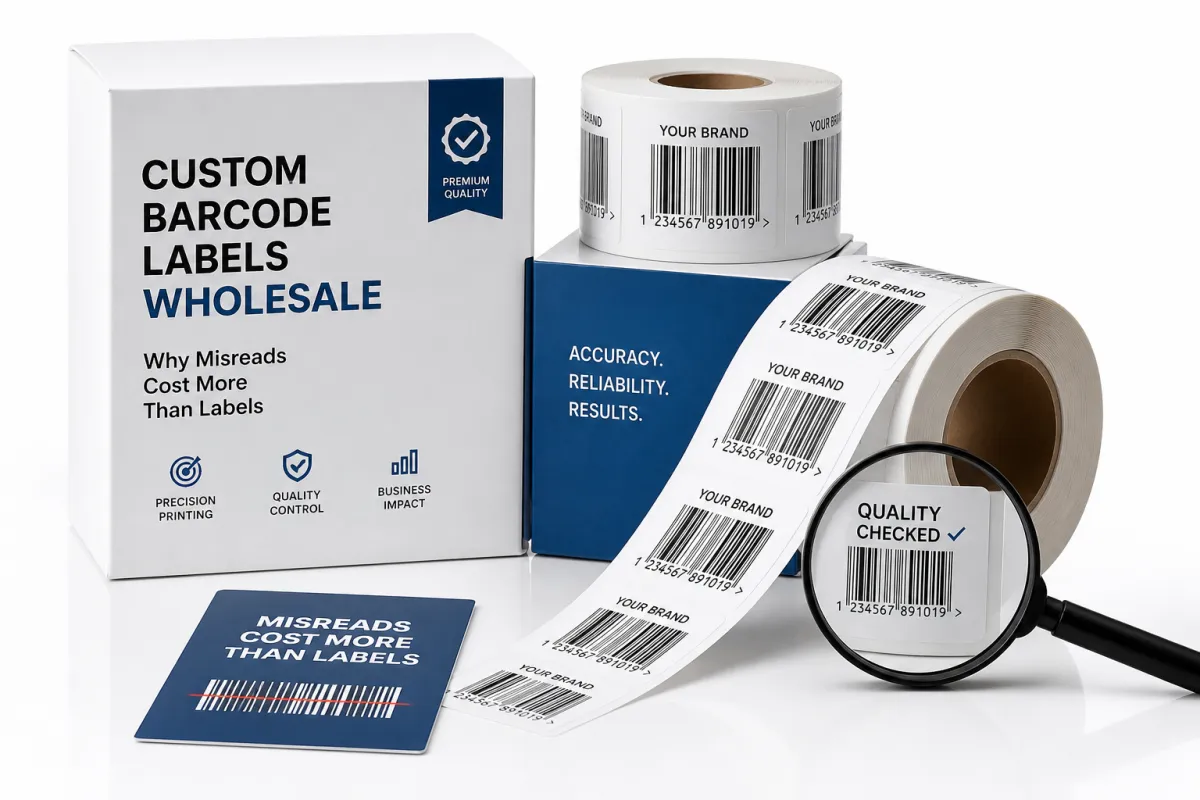
The first mistake is pricing a label by material alone. A more useful approach is to price the full chain reaction. If a scan fails, someone verifies the carton by hand, enters data manually, or pauses a conveyor long enough to pull the problem aside. That labor usually costs more than the label run, especially in a high-volume facility. Seen that way, custom barcode labels wholesale is not a stationery purchase. It is a decision about risk, throughput, and control.
A simple example makes the point. A label may cost $0.04 to $0.18 depending on size, stock, and print method, but a single bad read can trigger labor, missed shipment windows, and customer penalties. Chargebacks and service-level agreements make the stakes even higher. A cheap label that blurs under abrasion or condensation is expensive in disguise. That is why experienced buyers ask about print contrast, adhesive behavior, and substrate compatibility before they ask for the lowest price. They know the quote sheet does not capture the full cost of failure.
custom barcode labels wholesale also gives teams a way to keep standards consistent across departments. Receiving often needs one format, picking may need another, manufacturing may require lot code fields, and finance may want serialized tracking. Wholesale ordering brings those requirements under one repeatable label architecture instead of creating a patchwork of one-off versions. That kind of standardization matters in packaging design because the label still has to fit the carton, pouch, bottle, or pallet without slowing application or crowding the layout.
One unreadable barcode can cost more than an entire roll of labels once labor, reshipment, and inventory correction are counted.
That is the real value: fewer scan failures, faster receiving, cleaner inventory control, and less rework in fulfillment or manufacturing. Teams that care about package branding need the barcode label to pull its weight without clashing with the visual system. It should sit cleanly inside the layout, support the brand, and still scan on the first pass. Buyers keep returning to custom barcode labels wholesale programs because that balance is hard to find in one-off reorders and rushed replacements.
Custom Barcode Labels Wholesale Product Options and Uses
custom barcode labels wholesale orders usually begin with the substrate. Paper works well in dry environments and for short-term carton marking. Thermal transfer labels are common when the print has to survive more handling. Direct thermal fits shorter-life applications, though the print can fade faster under heat and light. Synthetic options such as polypropylene, polyester, and BOPP come into play when moisture, abrasion, or chemicals are part of the day-to-day environment.
Adhesive choice matters just as much. Permanent adhesives are the default for shipping and inventory labels, while removable options fit bins, reusable totes, and internal tracking. Tamper-evident constructions help in compliance labeling and asset control. Cold-chain packaging, condensation, and freezer storage call for low-temperature adhesives, not a best guess. custom barcode labels wholesale works best when the adhesive is matched to the surface and the environment, then tested before production begins. A good sample run can save a lot of grief later.
Buyers also ask for different print formats based on how the label will be used. Sequential numbers are common for inventory control. Serialized barcodes fit product authentication and asset tracking. Variable data can include lot codes, dates, routing details, or multi-panel layouts that pair a barcode with human-readable text and a logo. In some programs, the same label has to support retail packaging on one side and warehouse scanning on the other. That is where careful product packaging planning makes the whole system easier to manage.
The application surface often decides whether a label works or fails. Corrugated cartons accept different adhesives than glass bottles. Plastic totes behave differently from powder-coated metal racks. Even the size of the label affects speed and consistency. A narrow format can help on small tubes or pouches, while a wider layout often fits carton fronts and pallet labels more comfortably. For teams buying custom barcode labels wholesale across recurring SKUs, a standardized size can save time on the line and cut down on operator confusion.
Wholesale ordering makes the most sense around repeatable use cases. A SKU that ships once a quarter may not need the same tooling as a daily carton label. A construction that repeats across a product family, though, benefits from wholesale volume very quickly. The same logic often carries into related ordering through Custom Labels & Tags and broader Custom Packaging Products programs, where packaging components have to work together without constant resets.
Here is a practical way to compare common formats before requesting pricing for custom barcode labels wholesale.
| Label Type | Best Use | Typical Wholesale Range | Trade-Off |
|---|---|---|---|
| Paper thermal transfer | Cartons, bins, general warehouse use | $0.03-$0.08 each at 5,000+ | Lowest cost, limited moisture resistance |
| Direct thermal | Short-life shipping and internal labels | $0.02-$0.06 each at 5,000+ | Fast and simple, but print can fade |
| BOPP or polypropylene | Retail packaging, bottles, flexible packs | $0.06-$0.16 each at 5,000+ | Better moisture resistance, higher material cost |
| Polyester or tamper-evident | Asset tracking, compliance, security | $0.12-$0.28 each at 5,000+ | Strong durability, more expensive setup |
| Cold-temp synthetic | Cold-chain packaging and freezer use | $0.09-$0.22 each at 5,000+ | Performs better in refrigeration, needs testing on surface |
The range above is a planning tool, not a fixed promise. Print coverage, size, finishing, and barcode density all change the final math. Even so, it gives buyers a realistic starting point. For custom barcode labels wholesale, tighter spec discipline usually leads to a cleaner quote and fewer surprises when the order moves into production.
Specifications That Protect Scan Rates and Durability
Good barcode labels are built around readability. The starting point is the symbology. Code 128, Code 39, UPC-A, EAN-13, and Data Matrix each serve different use cases, and the choice affects print density and scan tolerance. A symbol that is too small for the scanner or the application environment lowers read rates fast. custom barcode labels wholesale should be spec-driven, not artwork-driven, because the barcode has to function before it has to look polished.
Three details carry more weight than most buyers expect: quiet zones, module width, and resolution. Quiet zones are the blank margins around the barcode. If graphics crowd those margins, scanners can miss the code. Module width controls bar density. Resolution shapes edge sharpness and contrast. High-speed conveyors and handheld scan routes both depend on those details. First-pass readability often comes down to them. A label that looks fine on screen can still fail in real life if those values drift even a little.
Durability depends on the environment. Dry storage cartons may only need basic paper stock. Refrigerated environments need adhesive performance and print protection that hold up under chill. Freezer conditions often call for a synthetic face stock and a low-temperature adhesive that bonds before the label fully drops in temperature. High-abrasion logistics settings, such as returns processing or pallet handling, usually need a tougher facestock so the print does not scuff away during movement. For custom barcode labels wholesale, durability should match the worst case, not the average day. That is the honest standard.
Roll configuration affects throughput too. Core size, outside diameter, unwind direction, and roll orientation can either speed up application or create problems at the dispenser. If a machine expects a certain unwind and gets the opposite, production slows down. If rolls are wound too tightly or too loosely, labels can slip, curl, or jam. A short conversation about those details often saves more time than buyers expect, especially on recurring orders.
Compliance and internal standards shape the layout as well. Some teams need the lot code near the barcode. Others require human-readable text in a fixed font size. Certain operations want a specific data field sequence for ERP or WMS matching. That is why custom barcode labels wholesale should be approved against the actual data structure, not a loose mockup. If the code has to align with an internal standard or a customer spec, the proof has to mirror that structure exactly.
Packaging standards groups and certification bodies can help sharpen expectations. The International Safe Transit Association publishes testing approaches used to evaluate package performance in distribution, and the FSC framework is useful when paper sourcing or liner choices enter the sustainability discussion. Those references do not replace label testing, though they do help buyers frame the right questions for custom barcode labels wholesale programs.
Before production, ask for a dimensional proof that shows barcode size, text placement, margin allowances, and any variable data zones. That step catches clipping, misalignment, and content overflow before a full run creates waste. If you buy custom barcode labels wholesale for recurring jobs, keep the approved dimensions on file and lock them against silent edits. The strongest wholesale programs are the ones that reduce decisions after the first approval.
Custom Barcode Labels Wholesale Pricing, MOQ, and Quote Factors
custom barcode labels wholesale pricing depends on more than quantity. Size is the first driver. Material follows. Adhesive type, print coverage, barcode complexity, finishing, and packing method all move the price as well. One-color variable data on paper labels usually costs less than a multi-color branded label with a gloss laminate, and the gap grows once specialty stock enters the job. Buyers who understand those levers usually get cleaner quotes because they can describe the job in practical terms.
MOQ is usually tied to setup economics. A printer has to load material, prepare files, confirm barcode data, and allocate press time. Larger quantities spread those setup costs over more units, which generally lowers unit price. That is why wholesale buying often makes more sense at 5,000, 10,000, or 25,000 pieces, depending on the label build. For a buyer comparing custom barcode labels wholesale with short runs, the better question is not just, "What is the unit price?" It is, "What is the total landed cost after setup, handling, and reorders?" That question gives you a much clearer picture.
Complete information tightens the quote. Send the finished size, shape, barcode symbology, quantity, surface type, storage conditions, ink coverage, and target delivery date. If variable data is involved, include the file format and the number of unique SKUs or sequences. Rough requests usually get placeholder pricing that changes later. A detailed brief makes the quote for custom barcode labels wholesale more accurate from the start.
Inventory carrying cost matters too. Buying too little means more frequent setup charges and a higher stockout risk. Buying too much ties up cash and can leave stale artwork on the shelf if the spec changes. The better balance is usually a volume that covers your reorder cadence plus a cushion for spikes. That matters even more when labels support retail packaging, seasonal launches, or compliance codes that may change as the line evolves.
Many packaging teams use a simple rule. If the label stays stable, repeats monthly or quarterly, and the artwork rarely changes, wholesale quantity usually wins. If the spec is still moving, smaller orders make more sense until the label is locked. That is why custom barcode labels wholesale works best in programs with a clear spec, a predictable demand curve, and a defined storage plan.
The same buying discipline often extends into related packaging purchases. A team that standardizes custom barcode labels wholesale may also streamline custom printed boxes, shipping inserts, and shelf-ready materials so the brand presentation stays consistent. That kind of coordination improves package branding without forcing the operations team to manage a different vendor for every component.
Custom Barcode Labels Wholesale Process, Timeline, and Proofing
The production path is usually straightforward, but each step still matters. It starts with a brief, moves into spec review, then artwork check, digital proofing, production, finishing, packing, and shipment. For custom barcode labels wholesale, proofing is the point where expensive mistakes are prevented. If the barcode is wrong, the job should stop there, not after a full run has already created waste.
Timelines vary by material and complexity. A repeat order with approved artwork may move faster than a first-time label with variable data and specialty adhesive. Proof turnaround can be quick, but setup time depends on file quality and press schedule. Finishing also adds time when the order needs slitting, die-cutting, laminated protection, or roll packing for machine application. A realistic lead time for many wholesale jobs is often 12-15 business days after proof approval, though the exact window depends on specs and volume. Rush work can happen, but it should be treated as the exception, not the plan.
Digital proofs are useful because they let buyers verify dimensions, layout, and data before printing starts. That matters when the barcode has to match ERP, WMS, or POS data exactly. A proof is not just a visual check. It is a data check. For custom barcode labels wholesale, the strongest proofing process includes a barcode scan test, a content review, and a dimensional review against the application surface.
Missing art files slow a job down. Incomplete data does too. So does a last-minute request to change the barcode type, unclear print colors, late approvals, or specialty materials that need sourcing. Even a small edit can affect the schedule if the label is built around serialized data or an unusual layout. The smoother the file handoff, the more predictable custom barcode labels wholesale becomes.
Recurring programs benefit from a reorder-ready template. Save the dimensions. Save the adhesive spec. Save the unwind direction. Save the approved barcode symbology. Keep a versioned artwork file for each SKU family. That makes reorder approvals faster and lowers the chance that someone "improves" a working label into a broken one. The best custom barcode labels wholesale systems are the ones that make repeat orders boring, because boring is efficient.
There is a broader supply-chain benefit too. If your label spec stays stable, the same template can support purchasing across related programs, from Wholesale Programs to matching packaging lines that include product packaging and outer shipper materials. Stable specs lower the odds of last-minute substitutions, and substitutions are where costs tend to rise.
Why Buy Custom Barcode Labels Wholesale From Us
Packaging teams do not just need a printer. They need a partner that understands how labels behave on the line. That is one reason clients choose custom barcode labels wholesale through Custom Logo Things. Consistent print quality matters, and so do repeatable color, accurate sequencing, and a label construction that survives the actual use case. A barcode that looks fine in the proof but fails in the field is not a solution.
We focus on packaging reality, not just print output. If your labels go on cartons, pouches, bottles, or shipper packs, the surface changes the adhesive requirement. If they are part of a branded packaging system, the layout has to support the rest of the design instead of crowding it. If they are tied to retail packaging, the readable text has to stay clear even after handling, stacking, and transport. That is the kind of thinking that keeps custom barcode labels wholesale practical once production starts.
Quality control is another difference. A useful wholesale program should include checks for dimensions, barcode content, roll count, and finish consistency. If sequencing matters, it should be verified before shipment. If a customer needs a shift from matte to gloss or from paper to synthetic, the change should be documented clearly. That is how you reduce reprints and protect timelines. In a busy operation, clear documentation saves money because it keeps the next order aligned with the last one.
Support matters too. Artwork changes, spec changes, and reorder questions tend to arrive under pressure. A responsive team can sort those issues quickly, which becomes valuable when a customer launch moves or a production lot changes. custom barcode labels wholesale is not only about the first order; it is about what happens when volume grows, a SKU gets revised, or the shipping window tightens. Good communication keeps those changes manageable.
Transparency is the last point, and in packaging it carries real weight. Clear specs. Clear pricing. Clear lead-time communication. Buyers Should Know what they are getting before production starts, not after the boxes arrive. That approach reduces surprises and makes budget planning easier. It is also why some brands pair label procurement with wider packaging work through Custom Labels & Tags and the rest of their Custom Packaging Products lineup, so the entire branded packaging program stays aligned.
Honestly, the strongest custom barcode labels wholesale partner is the one that helps remove friction from buying, proofing, and reordering. The label is small. The operational effect is not. That is the part a lot of people miss until a shipment is stuck on a dock or a receiving line starts hand-keying codes.
How to Order Custom Barcode Labels Wholesale: Next Steps
If you are ready to move, start with a clean spec sheet. Gather the finished dimensions, barcode type, quantity, application surface, storage conditions, and target ship date. Add whether the label needs variable data, sequential numbering, or a logo. The more specific the brief, the faster custom barcode labels wholesale can be quoted accurately.
Next, ask for a sample, proof, or spec sheet before production is approved. Testing in your own environment is the fastest way to learn whether the label sticks, scans, and survives handling. A short test on the actual scanner model you use is better than a polished mockup. Check the label under the same light, temperature, and abrasion conditions it will face in day-to-day work. That step is especially useful for cold storage, high humidity, or high-traffic fulfillment zones. It is also the point where a "pretty close" label gets separated from a label that will actually hold up.
Then confirm your reorder cadence. If you know the label will be used every month, the first run should reflect that demand instead of a one-off emergency quantity. The goal is to make the spec easy to repeat. That is where custom barcode labels wholesale creates real efficiency. You are not just buying a batch of labels; you are setting up a repeatable purchasing pattern.
A practical sequence looks like this:
- Send dimensions, barcode type, quantity, and use case.
- Review the quote and confirm the material and adhesive.
- Approve the digital proof after scan and layout checks.
- Lock the timeline and shipping method.
- Save the final spec for the next reorder.
That process keeps the job moving and reduces rework. It also makes it easier to scale later if you add more SKUs, more locations, or a wider packaging program. For teams balancing label needs with broader package branding, product packaging, or custom printed boxes, the best result is a spec that can travel across lines without constant redesign.
Custom barcode labels are one of those purchases that seems simple until the details show up. Once they do, the logic is clear: the right stock, the right adhesive, the right barcode, and the right proof process create fewer failures and less waste. If you want a quote that matches current volume and use case, request custom barcode labels wholesale based on the exact surface, environment, and reorder plan. That is the cleanest path to labels that scan well and keep scanning after the boxes move through the real world.
What is the minimum order for custom barcode labels wholesale?
MOQ depends on size, material, print method, and whether the label uses variable data. Smaller runs are possible, but wholesale pricing usually improves as quantity increases. Ask for tiered pricing so you can compare unit cost at each volume level for custom barcode labels wholesale.
Which material is best for custom barcode labels wholesale orders in cold storage?
Use a synthetic facestock and an adhesive rated for low temperatures if the labels will face refrigeration or freezing. Test the label on the exact surface before production, since condensation changes adhesion. Choose a print process that resists smudging, rubbing, and moisture exposure.
Can you print sequential or variable barcodes on wholesale label runs?
Yes, variable data is common for tracking, serialization, and inventory control. Provide the data file in the required format so numbering stays accurate across the run. Request a proof or sample section to verify sequencing before full production.
How long does production usually take for custom barcode labels wholesale?
Lead time depends on proof approval, material selection, quantity, and finishing requirements. Simple repeat orders are usually faster than first-time jobs with new artwork or specialty adhesives. Shipping method also matters, so confirm whether the timeline includes transit time.
Do I need to test barcode labels before placing a wholesale order?
Yes, test on the actual packaging surface and with the scanner model you use in operations. Check readability in the real environment, including lighting, cold conditions, and handling wear. A short test run can prevent larger production errors and avoid expensive reprints.
For buyers who want fewer scan failures, cleaner inventory control, and a tighter supply plan, custom barcode labels wholesale is the practical route. Start with the exact surface, the real storage environment, the scanner you already use, and the reorder pattern you can actually support. That is the spec that keeps labels from turning into a problem later.

