Custom Beanies That Convert
Custom Beanies for Ecommerce stores work because they are easy to understand, simple to ship, and flexible enough to serve as a standalone product, a gift add-on, or part of a seasonal bundle. They take less storage than bulkier apparel and usually photograph well enough to sell from a product page without a lot of explanation.
They can also be strong margin items, but only if the specs are chosen carefully. Knit density, cuff shape, logo placement, and decoration method all affect how the product looks online and how it holds up after delivery. The most useful buyer questions are practical: does it feel premium in hand, does it read clearly in photos, and does the landed cost still support the target retail price?
Why custom beanies for ecommerce stores work
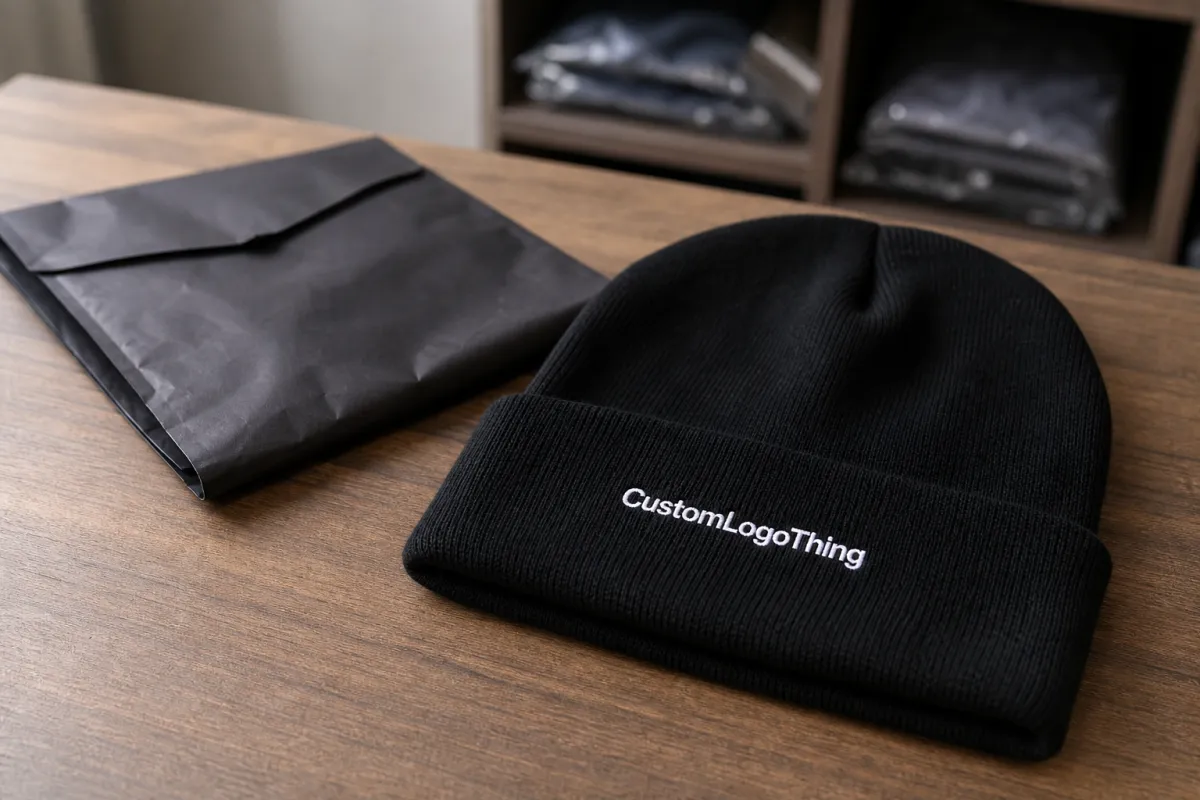
Beanies are relatively easy to merchandise because the value proposition is immediate. Customers understand warmth, style, and brand identity in a single item. That clarity helps on mobile product cards, where the image has only a moment to do the selling.
They also fit ecommerce logistics better than many apparel categories. A beanie packs flat, folds small, and ships well in a compact mailer or box. That leaves room for inserts, tissue, or branded packaging without pushing the parcel into oversized territory. If the hat, mailer, and insert all follow the same design system, the order feels intentional instead of improvised.
Seasonality gives beanies another advantage. Winter launches, holiday drops, team shops, creator merch, and streetwear capsules all use the same basic shape, but they each call for different decoration and color choices. That makes the product useful for testing demand and, if it sells, repeating the same spec with minimal changes.
They also work well in bundles. A lower-ticket accessory can raise average order value without asking the buyer to commit to a higher-priced item. If the colorway is clean and the thumbnail is strong, beanies often convert faster than buyers expect.
What makes the knit, cuff, and decoration feel premium
The knit is the foundation. A tighter gauge usually gives cleaner logo edges and a more polished surface, while a looser knit can feel softer and more relaxed but may blur fine detail. If the logo depends on small text or thin lines, the fabric has to support that artwork or the design will look weaker than the mockup.
Cuff height changes the whole product. A deeper cuff creates a more structured look and gives embroidery or a patch a better frame. A shorter cuff feels more casual but leaves less room for branding. For ecommerce photos, that framing matters because the logo needs to read clearly at thumbnail size.
Decoration method affects both cost and perceived value. Embroidery gives dimension and durability and is usually the easiest way to make a logo feel retail-ready. Woven patches are better when the artwork has small type, thin strokes, or multiple colors. Woven labels, sewn tabs, rubber patches, and faux leather patches each create a different visual lane, from minimal to premium to outdoor-inspired.
Color choice matters as much as decoration. A restrained two-color build often photographs better than a crowded palette, especially when the logo is already complex. Strong contrast can make branding pop, but only if the yarn and thread work together. On a phone screen, simple contrast is easier to read than subtle detail.
Fit is part of perceived quality. The beanie should stretch without feeling baggy, recover after wear, and sit evenly on the head. If the crown collapses, the cuff twists, or the body loosens too quickly, it will show up in returns and reviews. That is why a sample should be evaluated in hand, not just on a screen.
Pricing, MOQ, and unit cost: what changes the quote
Beanie pricing usually depends on quantity, yarn type, decoration complexity, color count, and finishing work. A basic acrylic cuff beanie with one-color embroidery is a very different job from a wool blend with a patch, hang tag, custom fold, and retail packaging. The item that looks small on paper can become expensive once setup, handling, and freight are included.
MOQ is where many ecommerce buyers get surprised. Smaller runs often carry a higher unit price because setup costs are spread across fewer pieces. That is normal. The real question is whether the higher cost still makes sense for a launch test. If the design is unproven, a smaller run can reduce risk. If the design is already selling, volume usually improves the math.
| Decoration option | Typical add-on per unit | Best use | Main tradeoff |
|---|---|---|---|
| Embroidery | $0.25-$0.80 | Simple logos, strong retail read | Fine detail can vanish on tight knit |
| Woven patch | $0.35-$1.10 | Detailed marks, fashion-forward branding | Adds another production step |
| Woven label or sewn tab | $0.12-$0.40 | Minimal branding, lower visual clutter | Less visible from a distance |
| Faux leather or rubber patch | $0.45-$1.25 | Outdoor, lifestyle, premium look | Can feel heavy on a soft knit |
At larger quantities, a basic program may land around $1.60-$4.20 per unit before shipping. Wool blends, specialty yarns, custom labels, and more complex finishing move the number up quickly. Landed cost is the number that matters, not the base quote. Freight, sampling, relabeling, inserts, and retail pack-out can change the final margin more than the decoration line alone.
A good unit price is not enough. If the sample needs rework or the pack-out is clumsy, the landed cost rises and the product may still fail to justify the retail price.
If the beanie is shipping in a gift set or boxed order, ask how it holds up in transit. Basic drop testing and distribution checks are more useful than guessing. For parcels that need a clearer benchmark, ISTA 3A is a practical reference for comparing pack-out strength and damage risk.
Production process and timeline from proof to delivery
The cleanest orders start with artwork review, not production. The logo should be checked at real stitch size, because tiny text, hairline strokes, and low-contrast colors often disappear once they are translated into knit or thread. A spec sheet should lock down yarn, cuff depth, body length, patch size, placement, and thread colors before bulk begins.
The usual workflow is straightforward: artwork approval, material matching, knitting or shaping, decoration, finishing, inspection, and packing. Patch-based styles add another checkpoint. If the order includes branded packaging, expect separate handling for inserts, barcode labels, folding instructions, or retail pack-out. None of that is unusual, but each step creates room for delay if the instructions are vague.
Timelines vary by complexity. Samples often take 7-14 business days after artwork and material approval. First bulk runs often take 12-25 business days. Repeat orders are usually faster because the spec is already locked and the approval cycle is shorter. Shipping can add more time than buyers expect, especially during peak season or when freight rates move.
The safest approach is to plan for one revision cycle and one buffer window. If the launch date is fixed, the order should be scheduled backward from that date, not forward from the quote. That is still the simplest way to avoid a missed release.
Choosing the right yarn, fit, and decoration method
Acrylic is the workhorse choice for many ecommerce runs because it is cost-effective, color-stable, and easy to source in consistent lots. It also gives buyers a dependable baseline for launch testing. That said, if the goal is a softer handfeel or a more elevated retail position, a blend may justify the higher cost.
``` If you want, I can continue with the rest of the article once you send the missing portion.
