Private label Beanies for Ecommerce brands look simple on a spreadsheet and a lot less simple once you start moving samples, quotes, and packaging specs around. A beanie is a small object. That is exactly why people underestimate it. Yarn choice changes hand feel. Stitch density changes shape. Cuff depth changes branding space. Even the way the carton is packed can change whether the product lands looking premium or just ... fine. I have seen buyers spend more time debating a label finish than the knit itself, and honestly, that is sometimes the right call.
The economics are not hidden, but they are easy to misread. Private label beanies for ecommerce brands usually make money through branding, presentation, and channel fit, not through raw fabric cost alone. A cheap acrylic knit can still be a bad buy if it pills fast or looks flat on camera. A more expensive blend can still pencil out if the product photos, bundle strategy, and retail price support it. That is the part people miss when they compare factory quotes like they are comparing apples to apples. They are not.
These products also sit in a sweet spot for ecommerce. Sizing is forgiving, giftability is high, and a good beanie photographs well in a way many apparel basics do not. Add seasonal demand, color repeat purchases, and relatively low fit anxiety, and the category starts looking much stronger than it first appears. The mistake is usually going after the cheapest blank in the catalog. The smarter move is to buy a beanie that already feels like it belongs to your brand the moment the box opens.
I say that as someone who has watched otherwise solid brands lose trust over tiny details. A crooked cuff label, scratchy yarn, or badly chosen hangtag can make a customer feel like the whole product was rushed. They do not call it that, of course. They just bounce.
Our Case Studies show how small packaging changes can move buyer response, and our Custom Labels & Tags page is useful if you want a cleaner finish than a standard printed tag.
What Private Label Beanies Mean for Ecommerce Brands
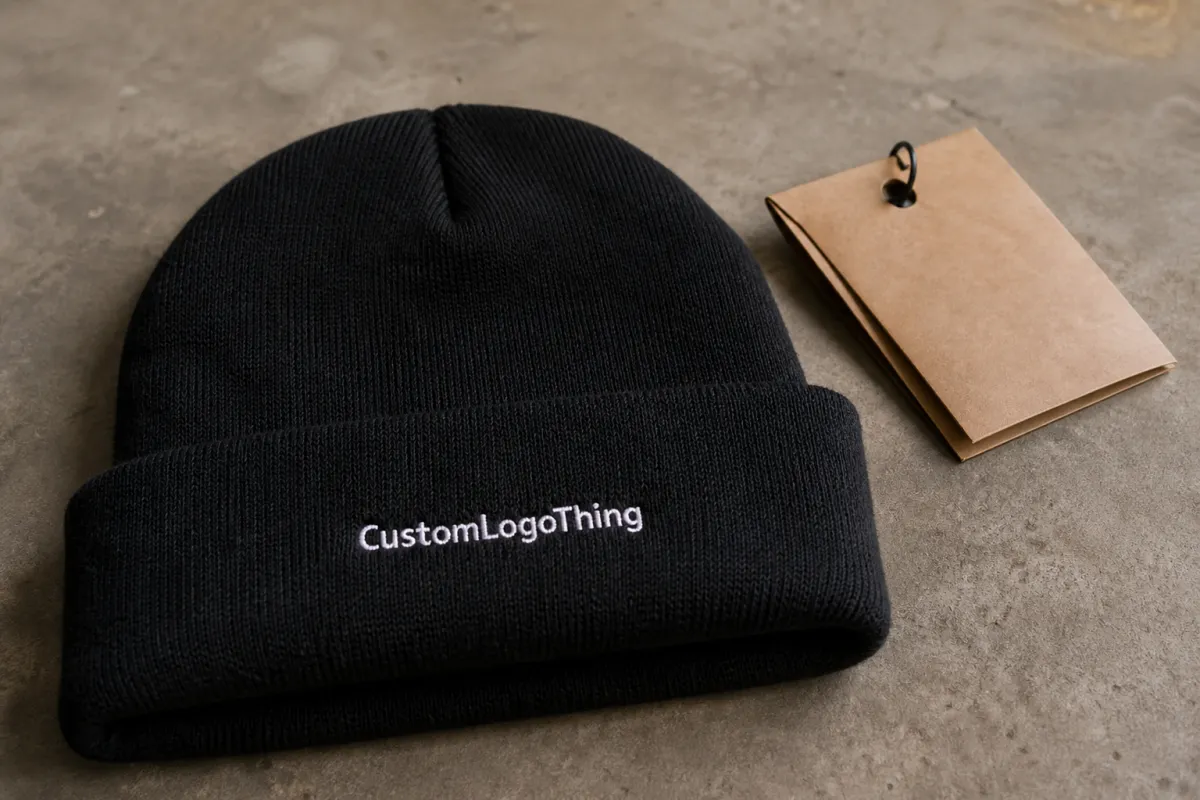
Private label beanies for ecommerce brands sit between two extremes: generic wholesale blanks and full custom knitwear. That middle ground is where a lot of launches make sense. You start with a base style, then add your own label, patch, tag, or packaging. The customer sees your brand, not a random off-the-shelf knit with a logo slapped on at the last minute.
The phrase private label gets used loosely, and that causes confusion fast. One supplier might mean a blank beanie with a woven label. Another might mean a stocked style with custom decoration and branded packaging. A third might mean a fully custom knit built from scratch with custom yarn, gauge, rib structure, and fit. Those are different programs with different timelines and price points. Private label beanies for ecommerce brands usually fall into the first two buckets, not the fully custom route. If a factory uses fuzzy language, ask what is stock, what is custom, and what the MOQ actually applies to. That little bit of clarity saves a lot of money later.
There are practical reasons beanies work so well online. The fit is forgiving. The product is seasonal without being too seasonal. It works in neutral colors for everyday wear and in brighter colors for sports, creator merch, or streetwear. Unlike many apparel categories, private label beanies for ecommerce brands do not need a huge SKU matrix to feel real. One strong silhouette in three colors can outperform five mediocre styles nobody remembers.
The margin story is where buyers either get disciplined or get burned. A beanie that costs $1.80 at the factory is not automatically profitable once packaging, freight, duties, storage, and receiving fees show up. A beanie that costs $4.50 can still work if the perceived value supports a retail price in the $28 to $38 range. Private label beanies for ecommerce brands are often won or lost on details that look secondary on paper: a woven label instead of a flimsy printed tag, a clean stitch finish instead of loose tension, a belly band instead of a plain polybag.
From a packaging buyer's point of view, that is the real story. Not the romantic version. The practical one. Customers rarely say, "This knit gauge feels premium." They say, "This looks warm, feels good, and the brand seems legit." That reaction comes from how the hat is finished and presented. A good private label beanie program understands that without pretending the product is more mysterious than it is.
"If the label feels cheap, the beanie feels cheap. Customers do not separate the two."
That is why private label beanies for ecommerce brands work best when the brand owner thinks beyond the product page. Packaging, unboxing, and shelf presence all influence the buying decision. Even a simple paper belly band or hangtag can make a budget knit feel intentional. If your line leans toward outdoor gear, minimalist fashion, or streetwear, that presentation work matters even more because the customer is buying identity, not just warmth.
One thing I always tell brands: do not overcomplicate the first run. A clean base style with one strong branding move is usually better than a pile of half-considered upgrades. You are not trying to build a museum piece. You are trying to ship something people will actually wear.
How Private Label Beanies for Ecommerce Brands Work
The sourcing model is straightforward, which explains why so many orders still go sideways. Private label beanies for ecommerce brands usually follow a basic sequence: choose a base silhouette, choose the fiber blend, decide on branding, approve a sample, then move into bulk production. The simple version moves fast if the factory already stocks the style. The more customized version takes longer because every added variable creates another place for the order to drift.
Start with the base style. A cuffed beanie gives you a visible branding area and a familiar retail look. A slouch beanie feels more fashion-driven but may not fit every audience. A fisherman-style beanie sits higher and can look sharper in streetwear photography. Some ecommerce brands also choose waffle knit or rib knit because texture reads well online. Private label beanies for ecommerce brands should be selected with the storefront photo in mind, not just a flat factory thumbnail. If the texture disappears in a small image, the product loses part of its sales story before the shopper even clicks.
Then pick the branding method. The common choices are woven labels, embroidered patches, leather or faux-leather tags, hem labels, and branded packaging. Woven labels are usually the cleanest low-cost option and work well on the cuff or hem. Patches read louder and can give the beanie more structure. Leather tags feel premium on outdoor or heritage-style products, although they are not always right for softer or more eco-focused brands. Hem labels stay subtle and fit minimalist lines that want the hat itself to remain visually quiet.
Not every part of a beanie is equally customizable. On stock beanies, the fiber content, gauge, and basic silhouette may be fixed. You can often choose color, decoration, and packaging, but full control over fit or knit structure usually means moving into a custom program. That is the tradeoff. Private label beanies for ecommerce brands can move quickly because you are not rebuilding the whole product, but speed comes with boundaries. If a supplier says everything is customizable at a very low MOQ, read the quote again. Something is probably missing.
Sample approval is where the real work starts. A digital mockup only proves that a logo can be placed on a beanie. It does not prove the logo is the right size, the stitch density is clean, the label sits flat, or the cuff has enough depth to hold shape in photos. A physical sample tells you how the product behaves. Does it stretch too much? Does the yarn feel scratchy? Does the patch buckle after a light pull? These are normal questions for private label beanies for ecommerce brands, and they are much cheaper to answer before production than after a pallet shows up.
I keep a simple test list for beanie samples: wear it for an hour, fold it twice, stretch the opening, photograph it in daylight, and check the label after each step. It is boring. It is also where problems show up. The brands that skip this step are the ones calling me later asking why the product looked better in the mockup than in the warehouse.
Branding Methods That Usually Perform Best
For most ecommerce brands, the best-performing branding method is not the flashiest one. It is the one that fits the audience and the margin target. Private label beanies for ecommerce brands selling minimalist basics often do better with a woven label and restrained packaging. Brands in streetwear or creator merch can get more traction from a patch because it reads clearly in social media imagery. Premium lifestyle brands sometimes use a small leather tag and a hangtag to give the product a more finished, collectible feel.
There is a tradeoff in every direction. A woven label is cheaper and easier to apply, but it may not stand out enough if the rest of the product is plain. An embroidered patch costs more and can signal quality, but it adds complexity and can affect flexibility if the knit is already thick. Printed labels are the cheapest, and they often look that way too. That is not a moral judgment. It is just how shoppers read them.
Private label beanies for ecommerce brands also benefit from package-level branding. A paper belly band, branded tissue, or a simple insert card can be enough to make a $6 item feel like a designed product. That helps when the brand is trying to support a higher AOV or bundle the beanie with scarves, gloves, or gift sets. The more the product is meant to be gifted, the more the packaging matters.
Private Label Beanies for Ecommerce Brands: Cost, Pricing, and MOQ
Cost is where the conversation gets real. Private label beanies for ecommerce brands can look inexpensive on a quote and expensive by the time the goods reach your warehouse. That is not always a supplier trick. Often it is a bad quote read. A proper landed-cost view should include the beanie itself, decoration, sample fees, packaging, freight, duties, customs brokerage, carton fees, and warehouse intake. Leave out even one piece and the margin math turns imaginary.
As a rough purchasing range, a simple stock acrylic beanie with a woven label might land around $1.20 to $2.80 per unit at lower MOQs, depending on yarn quality, knit density, and decoration method. A cotton or cotton-blend beanie often sits higher, sometimes in the $2.50 to $4.50 range. Wool blends, recycled fibers, and more structured fashion styles can move into the $3.50 to $7.00+ bracket quickly. Private label beanies for ecommerce brands do not all live in the same price band because the material story Changes the Cost base immediately. Acrylic is usually the cheapest entry point. Recycled or premium blends usually are not.
Decoration and packaging add more than people expect. A woven label may add only a small amount per unit, while a patch, custom hangtag, or belly band can increase the cost by several cents or more than a dollar depending on quantity and complexity. If the factory charges a sample fee, ask whether it is credited back on bulk. Some are, some are not. Freight can dwarf the decoration cost if the order is small or the route is inefficient. A $0.35 packaging upgrade looks harmless until it becomes a much larger landed-cost issue across thousands of pieces.
MOQ is tied to the factory's setup cost and the level of customization. Lower-MOQ private label beanies for ecommerce brands often start around 100 to 300 units per style if you are using a stock base beanie and simple branding. More custom colors, custom knitting, or premium packaging usually push the minimum to 500 to 1,000 units or more. MOQ can also be per color, per design, or per total order, and those are three very different rules. Ask for the exact version in writing. Otherwise, you may think you are ordering 300 units and discover the factory meant 300 units per color, which is a quick way to strain a launch budget.
| Option | Typical Factory Cost | Common MOQ | Best For | Main Tradeoff |
|---|---|---|---|---|
| Stock acrylic beanie + woven label | $1.20-$2.80 | 100-300 units | Fast launches, basic branding | Less unique fit and fabric control |
| Stock beanie + patch + branded packaging | $1.80-$3.80 | 200-500 units | Mid-tier retail positioning | Higher decoration cost and more approvals |
| Custom knit beanie with full design control | $3.50-$7.00+ | 500-1,000+ units | Long-term brand building | Longer lead time and more cash tied up |
| Premium blend with elevated packaging | $4.00-$8.50+ | 300-1,000+ units | Giftable, fashion, outdoor premium | Retail price must support margin |
The table is a planning tool, not a promise. Private label beanies for ecommerce brands vary by country of origin, factory capability, season, yarn market, and the exact finish you want. Even so, these ranges help you compare quotes without being fooled by a low factory number that ignores the rest of the pipeline.
The cleanest way to compare suppliers is to ask every factory to quote the same spec sheet. Same yarn blend, same color count, same label type, same packaging, same shipping assumption. If one quote lands lower, figure out why. Did they omit the label? Did they quote ex-factory instead of landed? Did they leave out packaging inserts? Did they ignore freight? Private label beanies for ecommerce brands are rarely won by the lowest line item. They are won by the supplier who actually included the whole order reality.
Retail math matters too. If your target retail price is $28 and your total landed cost is $9.80, you still have to subtract pick-and-pack, payment processing, returns, ad spend, and the occasional discount. That may work. It may also be tight. The answer changes by channel. DTC supports different numbers than wholesale. Amazon has different pressure points. Bundles shift the picture again. The point is simple: if the retail price cannot support a margin after real costs, the product is too expensive or the price point is too low. Private label beanies for ecommerce brands are not magic. They still have to clear the math test.
Sample cost belongs in the price, too. If you need three rounds of samples, overnight shipping, or color corrections, that is time and money. Budget for it. A sourcing plan that only funds the first production run usually underestimates the actual cost of getting a beanie launch right. That is how good ideas become awkward inventory.
Private Label Beanies for Ecommerce Brands: Process, Timeline, and Lead Time
Private label beanies for ecommerce brands follow a predictable path, but predictable does not mean quick. The basic process is brief, sample, revision, approval, bulk production, inspection, and delivery. Every step can move smoothly or lose time. The difference usually comes down to how clear the brief is and how many changes get introduced after the sample is already in hand.
A realistic timeline for a simple private label order might look like this: 5 to 10 business days for an initial sample if the base beanie is in stock, 3 to 7 business days for minor revisions or artwork corrections, 15 to 30 business days for production, then shipping on top of that. Air freight can arrive in about a week once it leaves the factory lane, while ocean freight can take several weeks depending on the route. That means a fast private label beanie program can sometimes land in roughly 4 to 8 weeks total. Sometimes. Not always. Custom colors, knitted patterns, and packaging changes add time.
For a more customized program, the calendar stretches. Custom knit development can take longer because the factory may need to create or adjust knitting programs, source yarn, and make fit samples. Extra approvals add days. Custom packaging adds another proofing layer. If you are building private label beanies for ecommerce brands for a holiday drop, that extra time matters more than most teams want to admit. Orders that start late often arrive after the buying peak. That is the expensive version of timing error because the product can still be good while the market has already moved on.
The main delays are rarely mysterious. Artwork approvals stall because someone on the brand side is juggling five other priorities. Color matching slows down because a screen color and a yarn color are different animals. Packaging changes create delay because even a small adjustment to a hangtag or belly band needs new proofing. Holiday congestion adds pressure on factories and freight. If your shipping plan depends on one vessel or a narrow air route, a single bottleneck can become a delivery headache very quickly.
Private label beanies for ecommerce brands also need a seasonality plan. Cold-weather demand does not start on the day your supplier gets organized. It starts earlier, often much earlier than people expect. If your audience shops for fall and winter accessories, the product needs to be photographed, listed, and ready for ad testing before the weather fully turns. Stock should be in place before customers start searching, not after.
And yes, you can be technically "on time" and still miss the market. If the beanies land in late November and your audience shops in September, the calendar has already done damage. Planning for the customer’s buying window matters more than planning for the factory’s calendar.
A Practical Fast-Track Timeline
Here is a lean timeline for private label beanies for ecommerce brands using a stock beanie and simple branding:
- Day 1-3: Finalize style, color, branding method, and quantity.
- Day 4-10: Review sample or photo proof and confirm adjustments.
- Day 11-30: Bulk production and finishing.
- Day 31-40: Freight, customs, and warehouse check-in.
That is the optimistic version. It works best when the artwork is ready, the factory has the base beanie in stock, and nobody changes the packaging halfway through. If you want private label beanies for ecommerce brands to launch without drama, keep the first order simple. One silhouette, one or two colors, one branding method, one packaging format. Simplicity is boring. Simplicity also ships on time.
A more customized order may stretch like this:
- Week 1-2: Build spec sheet and source yarn options.
- Week 3-4: Sample development and first revisions.
- Week 5-6: Pre-production approval and packaging proofing.
- Week 7-10: Bulk production and inspection.
- Week 11-13: International freight and receiving.
That slower pace is not a problem if you planned for it. It becomes a problem when the brand expects winter sales from an order that left the factory after the cold-weather window had already narrowed.
Common Mistakes When Sourcing Private Label Beanies
The first mistake is chasing the lowest unit cost like it is the only number in the deal. Private label beanies for ecommerce brands are a margin product, yes, but cheap is not the same as profitable. A low-cost beanie that pills after two wears, stretches out of shape, or comes back with a crooked patch can hurt the brand more than the extra $0.60 you saved. Customers do not care that you found a bargain at the factory. They care that the hat looks and feels like it belongs in a real store.
The second mistake is skipping physical samples. A photo mockup tells you almost nothing about how private label beanies for ecommerce brands will behave in hand. You need to feel the fabric, check the stretch, inspect the embroidery density, and look at the label placement in real light. If the beanie is meant to be worn around the cuff, confirm the cuff height. If the patch sits too high or too low, the front view changes. A sample is cheaper than a refund or a chargeback. That is not dramatic. It is just arithmetic.
The third mistake is writing vague specs. "Put logo on front" is not a specification. Neither is "premium packaging." Exact placement, stitch density, label size, finish type, fold direction, carton counts, and barcode requirements all need to be written down if the product will pass through a warehouse or marketplace channel. Private label beanies for ecommerce brands depend on repeatability. Repeatability depends on detail. If the supplier has to guess, they will guess differently from you.
Another common error is forgetting the hidden costs. Freight, customs, carton labels, storage fees, rework, and relabeling can turn a good factory price into a weak landed margin. If you sell through Amazon or a 3PL, you may also need prep services, labeling rules, or special pack counts. Those costs are not optional. They are the cost of getting the goods into customers' hands without creating an operational mess.
For brands that want eco-friendly claims, there is also a standards issue. If you use recycled paper packaging or want to make responsible sourcing claims, check the actual certification path. The chain-of-custody rules under FSC matter if you want to say the paper component is certified, and shipping durability standards from ISTA are a sensible reference for packout and transit testing. Nobody needs fake sustainability language attached to a bad parcel. That kind of claim ages badly.
The biggest timing mistake is the one that hits seasonal categories hardest: ordering winter inventory after demand has already started. Private label beanies for ecommerce brands sell better when the store has content, ads, and inventory ready before the customer starts hunting for warmth. If your first shipment is still in transit while your audience is already buying, you are basically financing an expensive lesson.
"Most sourcing mistakes are not sourcing problems. They are planning problems wearing a sourcing costume."
Here are the problems I see again and again:
- Unclear fit target: the brand wanted snug, the factory delivered oversized.
- No wash test: the product looked fine out of the bag, then twisted after use.
- Missing packaging specs: the beanies arrived in the wrong fold or the wrong count.
- Unverified logo size: the patch looked great on the proof and too small in reality.
- Late reorder planning: the brand sold through before the next batch could land.
Private label beanies for ecommerce brands do not need to be complicated, but they do need to be specified well. Buyers who do the boring work early usually get the cleanest results. Buyers who wing it spend their time firefighting later. That is rarely cheaper.
Expert Tips for Better Private Label Beanies
If you want private label beanies for ecommerce brands to feel more expensive than they are, start by narrowing the assortment. One hero silhouette usually beats five forgettable versions. A clean cuffed beanie in a strong neutral color can do more for conversion than a cluttered product grid filled with near-duplicates. Brands often assume variety creates choice. Sometimes it just creates hesitation. A tight line also makes photo planning, inventory planning, and reorder planning simpler. That matters in a category where time and attention both disappear fast.
Color choice is another place where practical thinking wins. Pick a palette that fits the brand and photographs well against a plain or lifestyle background. Black, charcoal, navy, cream, olive, and heather gray stay popular because they are easy to style and do not fight the rest of the outfit. Bright colors can work too, but they should feel deliberate. Private label beanies for ecommerce brands sell better when the color story supports the brand story instead of distracting from it.
Ask for a pre-production sample, not just a rendering. The rendering proves the design can exist. The pre-production sample proves the item can be made at production quality. Check the logo scale, the texture, the rib tension, the cuff depth, and the trim quality. Hold it in daylight. Photograph it. Fold it. Stretch it. If the beanie is going into a subscription box, gift bundle, or retail hang display, test it in that format too. The more real-world checks you complete before bulk approval, the fewer headaches you carry later.
Packaging is not decorative fluff. It is part of the sale. A branded tissue wrap, belly band, insert card, or hangtag can move private label beanies for ecommerce brands from "basic apparel item" to "giftable product." That can help with perceived value, social sharing, and bundling. For higher-AOV collections, packaging is often one of the cheapest ways to make the product feel more intentional. For repeat customers, the unboxing still matters because they compare the second order with the first. They notice when the second package feels cheaper. People are annoyingly good at that.
Fulfillment details should be built into the sourcing brief, not bolted on after production. If the beanies will go through a 3PL, ask for carton pack counts, flat-pack dimensions, and barcode placement. If the line may move into Amazon later, ask for the exact label format and master carton specs early. Private label beanies for ecommerce brands are easier to manage when production and fulfillment are aligned from the start. Otherwise, the warehouse ends up doing awkward fixes that eat margin and time.
One more practical tip: ask the factory how they handle shrinkage and seam tolerance. Not every supplier volunteers that information, and they should. If they cannot explain it, the sample probably has not been tested enough. I would rather know that on day one than after the goods are already in transit.
Use Packaging Like It Means Something
Most brands underestimate how far a small packaging upgrade can go. A neat fold, a paper sleeve, and a clean label can make a beanie feel premium without forcing you into a much more expensive fabric spec. That matters for private label beanies for ecommerce brands that need to hit a retail target in the $24 to $40 range. You do not need to make the hat absurdly expensive to make it look considered. You need the presentation to stop looking like an afterthought.
Protection still matters in transit. Beanies are not fragile in the same way glass is fragile, but they can get crushed, misshapen, or dirty if they are packed badly. A good fold, a light protective wrap, and sensible carton packing reduce damage when the order moves through multiple hands. If a supplier cannot explain how the goods are packed, they probably have not thought far enough ahead.
There is a small operational detail that saves a lot of grief: keep the packing style consistent across reorders. If the first shipment is folded one way and the second shipment is folded another way, the warehouse team will notice, and the customer might too. Consistency sounds dull. It is also how good private label beanies for ecommerce brands stay looking like one coherent product line instead of a series of accidental versions.
Next Steps for Private Label Beanies for Ecommerce Brands
The cleanest way to move forward is to treat private label beanies for ecommerce brands like a controlled launch, not a guess. Start with a target retail price, then work backward to the landed cost you can actually support. Decide whether you want a stock style, a semi-custom style, or a fully custom knit. Pick one branding method and one packaging format. Then set a realistic MOQ and timeline before you ask for quotes. That is the difference between a sourcing process and a vague hope.
If you are requesting quotes, ask every supplier for the same spec. Include yarn blend, gauge, cuff style, label type, packaging, quantity, and destination. Ask whether the MOQ is per color or per design. Ask how many days sample development will take. Ask what the factory price does not include. Private label beanies for ecommerce brands become much easier to compare once the quote structure is consistent. Otherwise, one supplier only looks cheaper because they quoted half the order reality.
Build the launch in stages. Approve the sample first. Lock content creation next. Line up the inventory arrival date with your photo shoot, product page build, and ad testing window. Set a reorder point before stock gets thin, not after. A lot of ecommerce brands wait until they are nearly sold out and then panic. That habit gets expensive. Better to plan for a second round while the first round is still moving.
Test one smaller drop before deciding whether to expand into more colors, more packaging, or a second silhouette. If the base product proves it can sell, then add complexity. If it does not, more variants will not save it. Private label beanies for ecommerce brands should earn the right to scale. Let the data decide what comes next.
Here is the short version: Buy the Right beanie, brand it cleanly, package it with intention, and calculate the landed cost before you promise a margin you cannot keep. That is how private label beanies for ecommerce brands stop acting like a commodity and start functioning as a workable ecommerce product line. The hat is the product, yes. The label, the finish, and the packout are what make it feel like your brand.
If you want the simplest possible decision framework, use this:
- Choose one silhouette that matches your audience.
- Specify branding, packaging, and carton requirements in writing.
- Compare landed cost, not just factory price.
- Test a sample before bulk approval.
- Order early enough to beat the season, not chase it.
Private label beanies for ecommerce brands reward discipline. They are simple enough to launch fast, but only if you keep the spec clean and the timeline honest. Do that, and the product has a real shot at becoming a repeatable, profitable SKU instead of another inventory experiment nobody wants to discuss later.
FAQ
What are private label beanies for ecommerce brands, exactly?
They are ready-made or semi-custom beanies branded with your own label, patch, tag, or packaging instead of sold as generic stock. Private label beanies for ecommerce brands let you move faster than fully custom knitting while still building a recognizable product line. The key difference is branding control, not just the hat itself.
How much do private label beanies for ecommerce brands cost per unit?
Simple stock beanies can start in the low single digits, but branding, packaging, freight, and duties push the landed cost higher. A realistic quote comparison should include the product, decoration, packaging, shipping, and any setup fees. If a quote looks unusually cheap, check what it left out. Private label beanies for ecommerce brands rarely end up cheap in the same way a plain blank is cheap.
What MOQ should I expect for private label beanies?
Lower-MOQ private label programs often start around 100 to 300 units per style, while more custom options can require more. MOQ usually rises when you add custom colors, custom knitting, or premium packaging. Ask whether MOQ is per color, per design, or per total order so there are no surprises. Private label beanies for ecommerce brands are easy to over-order if the MOQ language is sloppy.
How long does private label beanie production usually take?
Simple private label orders can move from sample to delivery in a few weeks, but custom work takes longer. Sampling, revisions, production, and shipping each add time, so the biggest mistake is starting too late. Seasonal orders should be planned well before cold-weather demand peaks. Private label beanies for ecommerce brands are a timing game as much as a sourcing game.
Can I sell private label beanies through Amazon or a 3PL?
Yes, but you need to match the Packaging and Labeling requirements of the channel before the order ships. Amazon and 3PLs often care about barcodes, carton counts, and consistent packing specs, not just the beanie itself. Build those requirements into the sourcing brief before production starts. Private label beanies for ecommerce brands move through fulfillment much more cleanly when the prep work is done early.
What should I ask a supplier before placing my first order?
Ask what is stock and what is custom, what the MOQ applies to, what is included in the factory price, and whether the sample fee is credited back on bulk. Also ask how they test stretch, shrinkage, and label placement. That sounds fussy, but it is the kind of fuss that keeps a launch from getting messy.


