A folded beanie can take less counter space than a boxed tumbler, yet it carries a logo shoppers may actually wear in public. Buyers requesting a custom beanies retail merch quote are rarely buying winter hats alone. They are buying margin, shelf efficiency, brand visibility, and a product that can be reordered without the size-run headaches that follow tees, hoodies, and fitted caps.
That is the quiet commercial strength of a beanie. It is apparel, but it does not behave like most apparel. A stretch knit cap usually avoids the small-medium-large-XL forecasting puzzle, and it does not leave a buyer staring at fringe sizes in the stockroom after the season changes. The product still needs careful specification, though. Yarn, cuff height, decoration, labeling, packaging, and freight can all shift the final landed cost.
Why Beanies Convert When Shelf Space Is Expensive
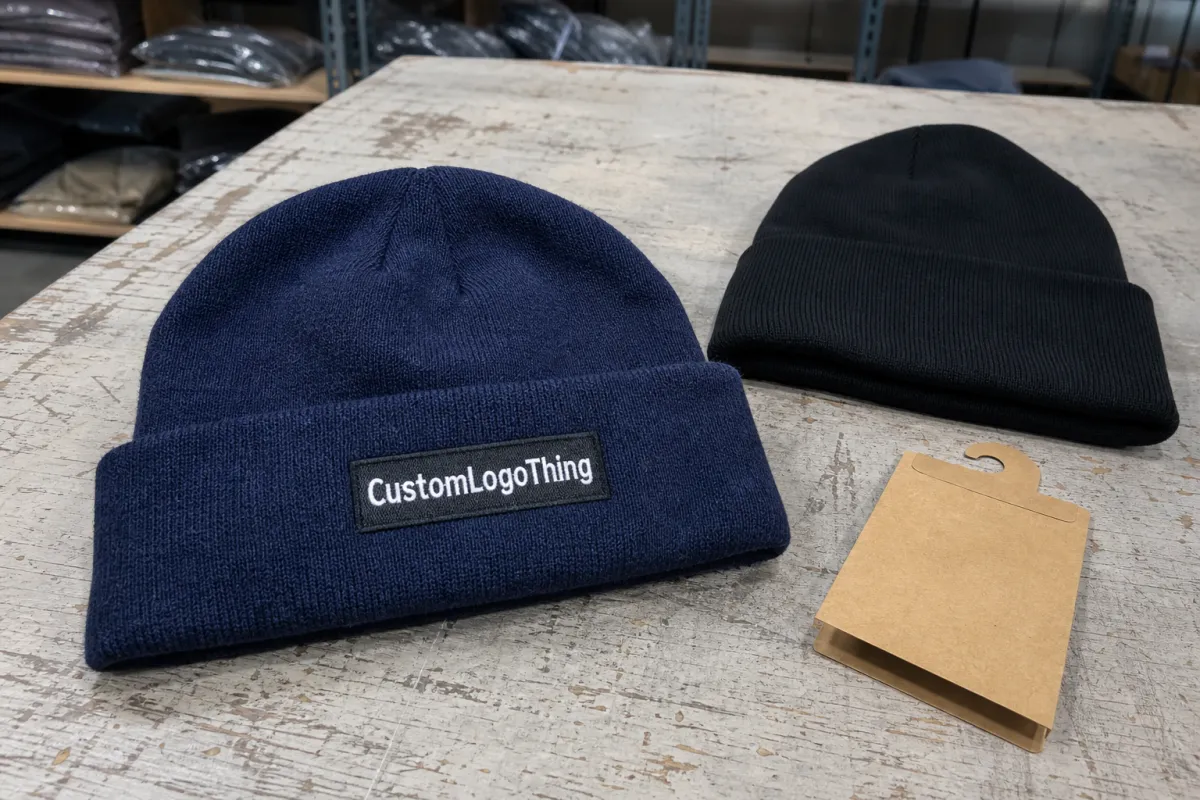
Retail space is expensive even on a four-foot counter. Beanies earn their spot because they fold tightly, ship efficiently, and display well in baskets, bins, wall pegs, checkout fixtures, and compact branded packaging. A dozen cuffed knits can occupy the footprint of two boxed drinkware items, which matters when a small retail wall has to carry seasonal gifts, core logo goods, and impulse purchases at the same time.
Compared with other merch categories, beanies sit in a useful middle lane. Stickers are cheap, but the average order value is low. Tees offer strong logo visibility, but size runs complicate buying and reorder timing. Tote bags can be practical, though weak artwork makes them look flat quickly. Caps sell well in many markets, but crown shape, closure preference, and fit divide shoppers. A beanie is compact, giftable, easy to understand, and relatively simple to replenish.
Different retailers use them for different reasons. Campus stores often want school-spirit density in a small footprint. Breweries may want wearable identity at a $20-$35 shelf price. Resort shops need cold-weather souvenirs that feel more useful than magnets. Corporate merch teams usually want a low-sizing-risk item employees will wear outside the office, not just at a kickoff meeting.
A useful quote does not hide the mechanics behind a single unit price. It should identify decoration method, yarn type, cuff height, label format, folding method, hang tag or belly band, carton count, freight assumptions, and reorder economics before artwork is approved. The product may look simple from the shopper side. The margin lives in the details buyers settle before production.
Beanie Styles That Fit Retail Merchandising Goals
Style choice sets the likely retail price ceiling before the logo touches the knit. Cuffed beanies are the workhorse because the fold creates a stable decoration zone, often about 2.5 to 3.5 inches high. Uncuffed beanies feel cleaner and more fashion-led, but they give less structure for patches and large embroidery. Pom beanies signal winter resort, school spirit, and family gifting. Fisherman beanies sit higher on the head, with a shorter body and a sharper streetwear feel.
Slouch beanies can work for lifestyle brands, but only if the knit has good recovery. A weak slouch body stretches out quickly and can look tired after a few try-ons. Rib knit has stretch and clean display value. Waffle knit adds texture and perceived weight. Recycled yarn options may support a sustainability position, although any claim placed on a tag or product page should be backed by documentation, not used as decorative copy.
Acrylic remains common because it is warm, cost-efficient, color-rich, and easy to care for. Cotton feels softer and more breathable, but it can stretch and recover differently after wear. Wool blends raise perceived value and warmth, while also adding care considerations and cost. Recycled polyester can support durability and sustainability goals. Performance yarns may reduce weight or add moisture management, which can matter for outdoor retail and athletic programs.
Cuff height deserves more scrutiny than it usually receives. A wider cuff gives woven labels, embroidered patches, and faux leather patches room to breathe. A narrow cuff can look refined, but it may compress the logo or force placement too close to the fold line. A 2-inch patch on a 2.25-inch cuff can look acceptable on a flat proof and crowded once the beanie is worn.
Retail finishing changes the presentation as much as the knit does. Hang tags, belly bands, UPC stickers, individual polybags, carton labels, and warehouse receiving marks can turn a basic cap into shelf-ready inventory. For related display and product presentation support, Custom Logo Things also offers Custom Packaging Products that can align beanies with broader branded packaging programs.
The best style is not automatically the most expensive one. It is the style that fits the target shelf price, decoration complexity, season, and sell-through forecast. A $12 impulse beanie and a $38 premium patch beanie should not be built from the same spec sheet.
Logo Decoration Options: Embroidery, Patches, Labels, and Tags
Decoration carries the brand and drives a large share of the quote. Direct embroidery is the cleanest route for simple marks, short text, and classic branded apparel programs. It works best with bold shapes, limited fine detail, and a stitch count that does not overload the knit. A front cuff logo around 2 to 3 inches wide is a common starting point.
Patches often perform better for retail. Woven patches capture small lettering more cleanly than direct embroidery because the artwork is created as a tighter woven surface before being applied. Embroidered patches add dimension and a traditional merchandise look. Faux leather patches suggest outdoor, maker, brewery, western, or heritage positioning. PVC patches are durable and dimensional, though they may feel too technical for some fashion-led programs. Suede patches look softer and more premium, but color, edge treatment, and abrasion should be reviewed before bulk production.
Jacquard knit-in logos belong in a different category. The design becomes part of the beanie structure rather than an applied decoration. That can be strong for bold wordmarks, stripes, team-style patterns, and private-label retail programs. It is less forgiving for detailed seals, gradients, and small taglines. A fully custom knit beanie can create real differentiation, but minimum order quantity and timeline usually rise because the product itself is being made to order.
Woven labels are quieter. They can make a beanie feel closer to fashion retail than promotional merchandise, especially when paired with thoughtful color and a clean fold. Custom Hang Tags add space for brand story, fiber content, care details, barcode placement, and price stickers. On a retail floor, the tag may do the explaining that a salesperson will not.
Quote accuracy depends on technical variables that are easy to overlook: stitch count, patch size, patch border, thread color count, backing method, heat press versus sewn-on application, logo colors, placement tolerance, and artwork quality. A 3-inch woven patch with six thread colors and a merrowed edge is not the same cost as a 1.5-inch folded woven label. Fine gradients, tiny taglines, and complicated seals often need simplification before sampling, especially on ribbed or textured knits.
Practical rule: submit vector artwork, Pantone references, desired logo size, placement notes, and retail compliance requirements before asking for final pricing. A vague logo request produces a vague quote.
A reliable custom beanies retail merch quote should flag artwork risks before production. If a supplier prices the job without mentioning small type, thread density, patch scale, or decoration placement, the buyer is carrying more risk than the quote shows.
Specifications Buyers Should Lock Before Approving Artwork
A beanie spec sheet is not paperwork for its own sake. It is risk control. Every blank field becomes a decision someone makes later, often under deadline pressure and after the purchase order is already moving.
A complete quote should identify style, material, knit type, cuff height, body color, decoration method, logo size, logo placement, label type, packaging, order quantity, shipping destination, and required delivery date. If the order will move into a store network or third-party warehouse, add fiber content labels, care labels, country-of-origin marking, UPC placement, carton marks, and retailer routing instructions.
Small specification changes can create large price differences. Switching from direct embroidery to a sewn faux leather patch changes materials, labor, sampling, and often the approval path. Moving from stock black acrylic to custom-dyed yarn can raise minimums and extend production. Adding individual polybags, belly bands, retail hang tags, or custom printed boxes for gift sets changes both unit cost and packing labor. Packaging is never just decoration; it affects receiving, scanning, shelf handling, and returns.
Color strategy is another decision point. Stock colors are faster and usually more economical. Custom-dyed yarns improve brand match, especially for universities, franchises, and lifestyle brands with strict color systems, but they may require higher quantities and longer lead times. Pantone references help, but knit color can shift under store lighting, and yarn texture affects how saturated a color appears.
Most retail beanies are one size, yet fit still needs a definition. Youth sizing, oversized slouch bodies, short fisherman cuts, and fitted cuff dimensions should be clarified early. A 9-inch cuffed beanie and a 12-inch slouch beanie serve different shoppers. They also fold differently, display differently, and change perceived value.
Artwork should not be approved in isolation. Review decoration size against the knit texture, fold line, patch shape, and final product photos. A logo that looks balanced on a PDF can land awkwardly on a rib knit if the patch crosses the curve of the cuff. Treat the proof as a checkpoint, not a rubber stamp.
How to Read a Custom Beanies Retail Merch Quote
A custom beanies retail merch quote should separate product cost, decoration cost, setup charges, sampling, packaging, freight, and optional retail finishing. If all costs are compressed into one line, comparison becomes harder. Worse, freight, hang tags, or setup charges may appear only after approval, when changing suppliers is no longer practical.
MOQ means minimum order quantity, but it is not only a production rule. It is the point where setup labor, decoration efficiency, material purchasing, packing, and freight economics begin to make sense. A 48-piece test may be possible for stock embroidered beanies. A fully custom knit pattern or custom-dyed yarn program may need several hundred units or more because the production route is different.
| Quote Option | Best Fit | Main Cost Drivers | Buyer Watchout |
|---|---|---|---|
| Stock cuffed beanie with embroidery | Fast retail tests, employee stores, budget-conscious drops | Stitch count, logo size, quantity, thread colors | Fine text can blur on rib knit surfaces |
| Patch beanie with hang tag | Premium merch, breweries, resorts, campus stores | Patch material, patch size, sewn application, tag printing | Patch scale must match cuff height |
| Fully custom knit beanie | Streetwear drops, private label retail, strong brand differentiation | Custom yarn, knit pattern, sampling, higher MOQ | Longer timeline and more approval steps |
Main unit cost drivers include beanie style, yarn, decoration method, logo color count, patch material, order quantity, packaging requirements, and delivery location. Price breaks usually improve as quantity rises because setup and handling spread across more units. Specialty yarns, custom colors, complex patches, and retailer-specific packaging can change that curve, so buyers should compare landed cost rather than unit cost alone.
Ask direct questions before comparing vendors. Is setup included? Is digital proofing included? Is sampling optional or required? Is freight estimated or firm? Do duties apply? What are the overrun and underrun policies? Are retail finishing steps included in the quoted unit price or listed separately?
The lowest unit cost may not be the lowest real cost. A beanie that saves $0.40 per unit but arrives late, needs relabeling, or ships in weak cartons can become more expensive than the cleaner quote. Landed cost should include product, decoration, packaging components, freight, duties if applicable, and any warehouse handling needed before sale.
Process, Timeline, and Lead Time From Quote to Delivery
The standard path is simple on paper: inquiry, specification confirmation, quote, artwork review, digital proof, sample or pre-production approval, bulk production, quality check, packing, and delivery. Delays usually begin when a buyer skips one of those steps and expects the timeline to remain unchanged.
Stock beanies with simple embroidery are usually the fastest route. Fully custom knit beanies, custom-dyed yarn, multi-component retail packaging, or specialty patches take longer because more materials and approvals are involved. A buyer with a three-week in-hands date should usually consider stock colors, one decoration location, and consolidated shipping. A premium retail launch should allow time for a physical sample.
The most common delays are not complicated. Incomplete artwork. Unclear placement. Late proof approval. Quantity changes after quote approval. Missing ship-to information. Retailer routing instructions arriving after cartons are packed. Each delay sounds small. Together, they can push delivery beyond the selling window.
Sampling deserves a practical conversation. A digital proof can confirm layout, spelling, thread colors, and patch shape. A physical sample shows more: knit feel, fit, cuff behavior, patch thickness, label comfort, and perceived value. For retail launches, premium products, investor-facing merch, or orders with custom materials, sampling is usually worth the extra time and cost.
Proof approval is not a formality. Inspect logo size, thread colors, patch layout, spelling, placement, and the relationship between decoration and cuff. If a hang tag includes care instructions or fiber content, check that too. For sustainability and materials claims, buyers can reference resources from the U.S. Environmental Protection Agency and ask suppliers for documentation instead of relying on marketing language.
Plan backward from the real commercial date. That may be the in-store date, event date, warehouse receiving date, retailer routing window, or photoshoot date. Desired ship date is less useful if receiving requires three extra business days and barcode checks before goods can move to the floor.
Quality Control Signals That Separate Retail-Ready Beanies
Retail-ready beanies need consistent fit, stable decoration, clean finishing, accurate labels, and packaging that survives freight and shelf handling. Promotional beanies can sometimes tolerate minor presentation flaws. Retail merch has to justify a price tag beside national apparel brands.
Inspection points should include knit tension, seam alignment, cuff consistency, embroidery density, patch adhesion or stitching, label placement, loose threads, color consistency, odor, packing method, carton count accuracy, and exterior carton condition. For shipments moving through parcel networks or distribution centers, packaging strength is part of the product experience. Organizations such as the International Safe Transit Association publish transport testing frameworks that show why carton performance should not be treated as an afterthought.
Good communication is also a quality signal. Expect clear quote breakdowns, realistic production timelines, artwork feedback before production, and early warnings if a logo may not reproduce cleanly. A supplier should be willing to say, "That tagline is too small for embroidery," before the order enters bulk production.
Custom Logo Things supports buyers by reviewing specifications, recommending decoration routes, coordinating proofing, offering sampling options, and advising on retail packaging details. The practical questions matter: Will the patch sit cleanly on this cuff? Does the hang tag need a UPC? Should the beanie be individually polybagged or bulk packed? Are carton labels clear enough for warehouse receiving?
Quality control protects revenue, not just aesthetics. One delayed shipment can miss a cold-weather selling window. One poor patch can turn a premium beanie into discounted inventory. One mislabeled carton can create receiving friction that costs more than the label itself.
Supplier selection is operational risk management. The right partner reduces ambiguity before money is committed. The wrong one pushes decisions downstream, where they become rushed, expensive, and harder to fix.
Preparing a Quote Request That Gets Accurate Numbers
Before asking for pricing, gather the details that affect cost and timeline. A useful request includes target quantity, preferred beanie style, desired material, body color, logo file, decoration preference, logo size, target retail price, packaging needs, ship-to ZIP code, and required in-hands date. If the order is for a retailer, add compliance requirements such as UPC labels, carton marks, care labels, fiber content, and country-of-origin marking.
Ask for good, better, and best options if the program is still taking shape. Good might be a stock cuffed beanie with embroidery. Better might be a patch beanie with a custom hang tag and retail finishing. Best might be a fully custom knit beanie if brand differentiation matters more than speed. This structure gives the buyer a realistic comparison instead of three unrelated guesses.
Send brand guidelines, past merch examples, competitor references, store photos, or packaging design notes if they are available. A beanie meant for a boutique resort shop should not be quoted like a trade show giveaway. Package branding, fixture style, lighting, and target shelf price all influence the right construction.
State constraints early: budget ceiling, launch date, sustainability preference, retailer compliance rules, and whether the order is a test run before a larger reorder. Those facts help the quote become a buying tool rather than a generic product list. If you need help shaping the request, use Contact Us to send the working specs and ask for options.
To get a custom beanies retail merch quote that can be acted on, submit complete specs and ask for landed cost, proofing steps, MOQ, and timeline in one response. Review the proof carefully, approve only after the quote and spec sheet match, and keep the final version on file so reorders do not start from scratch.
FAQs
What details do I need for a custom beanie retail merch quote?
Provide quantity, beanie style, color, material preference, logo file, decoration method, packaging needs, shipping destination, and required delivery date. Add your target retail price or budget range so the quote can be built around realistic margin goals. Include retailer compliance requirements such as UPC labels, carton marks, care labels, fiber content, or country-of-origin labeling.
What is the MOQ for custom beanies with retail packaging?
MOQ depends on whether you choose stock beanies with decoration, custom colors, custom knit patterns, specialty patches, or retail finishing. Stock styles usually support lower minimums than fully custom yarn colors or knit-in logo designs. Ask for price breaks at multiple quantities so you can compare unit cost, landed cost, and reorder strategy.
How long does custom beanie production usually take?
Lead time depends on artwork approval, sampling, decoration method, beanie availability, packaging requirements, and shipping method. Stock beanies with simple embroidery are usually faster than custom knit, custom-dyed yarn, or complex patch programs. The fastest orders typically have complete artwork, approved specs, stock colors, and no late changes after proof approval.
Which decoration method is best for retail beanies?
Direct embroidery works well for simple logos and classic branded apparel programs. Woven, embroidered, faux leather, or PVC patches are better for premium retail presentation or more detailed artwork. Woven labels and hang tags are useful when the brand wants a fashion-focused or understated retail look.
Can I get a sample before approving a custom beanies merch order?
Sampling is recommended for retail launches, premium price points, custom materials, or any design where texture and logo placement are critical. A digital proof helps confirm layout, but a physical sample gives better insight into fit, knit feel, patch quality, and perceived value. Sampling can add time and cost, so plan it into the Production Timeline Early.


