Custom Beanies With Custom Hang Tags: What Buyers Miss
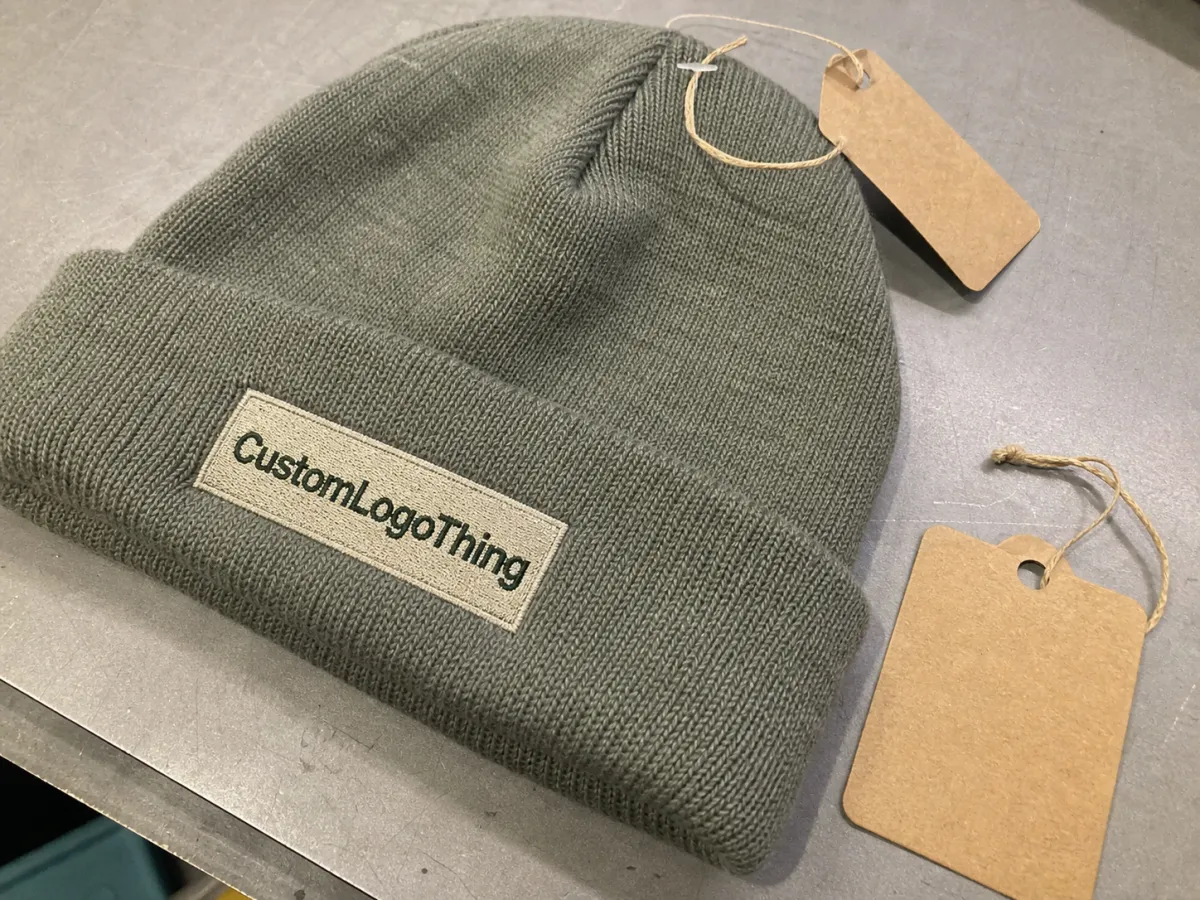
Two acrylic beanies can sit on the same retail shelf with the same rib knit, the same cuff shape, and the same $18 price point. One has a clean tag that explains the brand, fiber content, size, care, barcode, and gift appeal in a few seconds. The other has a loose sticker and a logo that feels unfinished. That small difference is often what separates a retail product from a giveaway.
Buyers tend to treat the beanie as the product and the tag as decoration. That is only half right. The beanie is the wearable part; the hang tag is the first sales tool a shopper handles, reads, scans, or ignores.
By custom beanies with custom hang tags, I mean Branded Knit Hats paired with printed tags attached by cotton string, plastic loop, safety pin, garment barb, or reinforced eyelet. They show up in retail stores, ski shops, school fundraisers, corporate gifting programs, tourism stores, winter promotions, music merch tables, and seasonal ecommerce kits. The product is soft goods, but the buying decision is shaped by packaging, handling, and presentation.
A hang tag is a compact information system. It can carry price, SKU, barcode, fiber blend, country-of-origin details, care instructions, claim support, QR traffic, wholesale contact details, and a short line of brand context. That is a lot of responsibility for a 2 x 3.5 inch card, especially when it has to look calm instead of crowded.
Packaging reality check: a strong tag will not rescue a poor beanie, but a weak tag can make a good beanie look like a bulk promo item.
The smarter conversation starts before anything goes to print. Materials, tag format, attachment method, artwork, pricing, lead time, assembly, and inspection all shape the finished unit. Miss one of those details and the quote may still look acceptable, while the shelf presentation tells a different story.
How Branded Beanies and Hang Tags Work Together
A beanie gives you several branding surfaces, each with limits. Direct embroidery works well for bold marks and short text, although stitch count can raise cost and make tiny details close up. An embroidered patch gives a heavier retail feel. A woven label handles fine lines better than embroidery. Leatherette patches can suggest outdoor, ranch, brewery, or heritage styling. Silicone patches feel modern and weather-friendly. A folded hem label is quieter, often better for minimalist apparel brands.
The tag does a different job. It can repeat the logo, but its stronger purpose is carrying information that does not belong on the hat itself. A cuff should not have to explain wash temperature, barcode data, fiber blend, wholesale reordering, and the brand story. The tag can handle that work, if the hierarchy is planned.
Common tag content includes logo, product name, SKU, barcode, MSRP, size, acrylic or wool blend percentage, care instructions, QR code, social handle, wholesale email, and supported product claims. If recycled yarn is mentioned, the claim should be backed by documentation rather than written as a mood. The U.S. Environmental Protection Agency provides useful guidance around recycling concepts at epa.gov/recycle, and buyers should be careful with environmental language that sounds stronger than the records behind it.
Format changes perception quickly. A single-panel coated tag feels efficient and promotional. A folded tag gives more room for care copy, barcode placement, and a short product story. Kraft stock suggests handmade or outdoor positioning, though it can reduce barcode contrast. A die-cut tag can be memorable, but the shape still needs to hang straight and pack cleanly. Textured or recycled stock may support a premium message. Foil, embossing, debossing, spot UV, or soft-touch lamination can lift perceived value, usually with added setup time and cost.
| Tag Format | Best Use | Watchout | Typical Cost Behavior |
|---|---|---|---|
| Single-panel coated card | Promotions, schools, giveaways | Limited space for compliance copy | Lowest per-unit cost at volume |
| Folded tag | Retail merch, gift programs | Needs accurate fold and hole placement | Moderate, with more print area |
| Kraft tag | Outdoor, heritage, handmade styling | Barcodes and small QR codes need testing | Moderate, depends on stock weight |
| Die-cut specialty tag | Streetwear drops, tourism, premium kits | Longer proofing and tooling review | Higher setup and longer lead time |
Attachment matters as much as the card. Cotton string feels boutique and works well for retail display. Plastic loops are fast and cost-efficient for large runs. A safety pin can fit vintage or workwear styling, but it may not suit youth items or retailers with strict handling rules. Reinforced eyelets help heavier tags survive cartons, pegs, and repeated customer handling.
Custom Logo Things treats Custom Labels & Tags as part of the product presentation, not as a loose print item ordered after the hats are finished. That timing affects hole placement, copy space, packing, labor, and how polished the finished beanie feels in hand.
Key Specs That Decide Quality Before Production
The beanie silhouette sets the rules. Cuffed beanies create a clear front branding zone, but a large tag can cover the patch if the hole is placed poorly. Uncuffed beanies need more care with logo height. Pom beanies add bulk during packing. Slouch styles hang differently on pegs and in photos. Fisherman, rib-knit, waffle-knit, cable-knit, and recycled yarn styles each change how the tag falls.
Material choice affects both feel and copy. Acrylic is cost-efficient, color-stable, and common for promotional knitwear. Wool blends feel warmer and more premium, but they need clearer care instructions because shrinkage and wash sensitivity are real concerns. Recycled yarns can support a stronger product story, provided the claim is documented through supplier records or recognized certification where relevant. FSC-certified paper can also support a responsible tag choice; certification basics are available at fsc.org.
Tag specifications deserve the same discipline as the hat. Paper weight for retail hang tags often runs from about 300gsm to 450gsm, depending on stock and finish. A 350gsm C1S artboard with matte lamination feels different from 18pt kraft or a textured uncoated sheet. Finish also affects readability. Gloss can make color feel sharper, but it may reflect light across a barcode. Matte is usually safer for scanning and easier to read under store lighting.
Small production details drive a surprising amount of quality: corner radius, hole diameter, hole distance from the edge, string color, string length, bleed, safe area, barcode quiet zone, and whether the barcode sits on a clean white block. A QR code that scans on a PDF may fail on textured kraft if it is printed too small. A thin serif logo may look elegant on the tag and break down in embroidery at 1.25 inches wide.
Color coordination is another common trap. The beanie color, embroidered thread, patch substrate, tag palette, and string color should be reviewed together before proof approval. If the beanie is charcoal, the logo patch is warm gray, and the tag is cool silver, the unit can look assembled from mismatched components. Sometimes that is exactly what happened.
Many quote surprises trace back to missing specifications. Tag size. Attachment method. Barcode requirements. Whether tagging is included. Whether the tags ship flat, bundled, or attached. Those variables can change labor planning and unit cost more than buyers expect, especially once quantities move beyond a few dozen pieces.
Pricing, MOQ, and Unit Cost Factors to Watch
The price of custom beanies with branded tags usually comes from four buckets: blank beanie cost, decoration method, Hang Tag Printing, and assembly labor. Freight can become a fifth bucket if the order is bulky, split across destinations, packed individually, or timed near winter demand spikes.
Cost behavior is uneven. Embroidery often includes a digitizing setup fee and may be sensitive to stitch count. A dense 12,000-stitch logo costs more than a simple 4,000-stitch mark. Patches add material, production, and application cost. Hang tags, by contrast, usually become cheaper per piece as print quantity rises. A small run may carry a noticeable setup burden, while a 5,000-piece run spreads that cost more comfortably.
For a practical budgeting frame, a basic acrylic beanie with a simple embroidered logo and standard printed tag will sit in a lower promotional range, depending on quantity, inventory, and decoration. A retail-ready beanie with a custom patch, heavyweight folded tag, string attachment, individual packing, and barcode verification costs more. Not always dramatically more, but enough to budget for before the design is locked.
MOQs can be deceptive because each component may have its own minimum. The beanie source might support 144 units. A patch run may price better at 300. A tag printer may prefer 500 or 1,000. Assembly labor may only become efficient above a certain count. The practical MOQ is often set by the least flexible component, not by the hat alone.
- Quote inputs: quantity, beanie style, yarn preference, decoration type, logo colors, tag dimensions, paper stock, finish, attachment, barcode or QR needs, packing, and destination ZIP code.
- Possible added charges: art redraw, digitizing, samples, rush production, color changes, split shipping, individual polybagging, barcode testing, and rework.
- Core decision: choose a lower unit cost with a standard tag, or invest in a stronger retail finish that can support a higher shelf price.
If a supplier quote does not separate beanie, decoration, tag printing, attachment, packing, and freight, ask for the breakdown. A single blended number hides the real cost story. For packaging buyers, hidden labor is often where budgets drift.
Production Steps and Timeline From Artwork to Delivery
A clean order follows a predictable chain: choose the beanie style, select the decoration method, specify the hang tag format, submit artwork, approve the digital proof, approve a sample if needed, produce, tag, inspect, pack, and ship. Simple on paper. Less simple when files arrive in six versions and nobody knows which barcode is final.
Timing depends on inventory and complexity. In-stock blank beanies with direct embroidery and standard tags can move much faster than custom-knit beanies with a private-label patch and die-cut folded tags. Standard tags may print in a few business days after proof approval, while foil, embossing, die cutting, specialty stocks, or unusual strings can add time. A fully custom-knit beanie usually requires longer scheduling than decorating blanks.
Many suppliers quote production after proof approval, not after the first email. That distinction matters. A buyer may think a 12-business-day order started Monday, while production is still waiting on PMS colors, revised care copy, and a barcode file that will scan correctly. The clock usually starts when approvals are clean.
Delays tend to cluster around the same issues: incomplete vector artwork, unclear PMS or CMYK guidance, low-resolution logos, missing barcode files, QR links that still point to staging pages, care instructions rewritten late, tag hole placement changes, and freight constraints during cold-weather buying peaks. None are glamorous. All are common.
Approve the beanie and tag proof together when possible. A flat PDF of a tag tells only half the truth. You want to see approximate tag scale against the cuff, logo, patch, pom, and string angle. A strong product can look improvised if the tag is oversized or if the logo colors drift across materials.
Sampling depends on risk. Digital proofs are efficient for straightforward promotional orders. A physical pre-production sample is worth considering for retail launches, influencer kits, premium gifts, and higher-quantity runs where a one-inch placement mistake turns into 2,000 awkward units. Sampling costs money, but rework costs more.
Confirm one operational point early: are the tags attached during production, bundled for self-tagging, or shipped to a fulfillment partner? Factory tagging can save internal labor. Self-tagging may help if you need to sort sizes, locations, or special packs. Fulfillment tagging can work, but only if the partner has clear instructions, enough time, and a sample unit to copy.
Step-by-Step Buying Guide for a Clean Order
Start with the use case. A ski resort gift shop, a tech company winter kit, and a streetwear merch drop may all order branded beanies with Custom Hang Tags, but they do not need the same product. The resort may need warmth, barcode accuracy, and giftability. The tech company may prioritize delivery speed and clean package branding. The streetwear drop may care most about patch texture, tag shape, and perceived scarcity.
- Define the job: retail sale, employee gift, fundraiser, influencer kit, event giveaway, or wholesale program. One primary purpose keeps the design from wandering.
- Choose silhouette and color first: cuffed, pom, slouch, fisherman, recycled yarn, or cable-knit. Then design the tag around the physical item.
- Decide what the tag must do: sell the story, carry barcode data, explain care, verify product claims, drive QR traffic, support wholesale, or combine several jobs with clear hierarchy.
- Prepare artwork correctly: vector logo files, PMS or CMYK guidance, tag dielines, barcode files, QR destination links, exact copy, and any required care symbols.
- Request a transparent quote: ask for beanie, decoration, tag printing, attachment, packing, and freight as separate lines where possible.
- Review proofs closely: spelling, logo scale, contrast, hole placement, barcode readability, fiber content, care copy, and how the tag hangs from the finished beanie.
One practical test: print the tag proof at actual size before approval. Place it against a beanie if you have one nearby. A 2.5 x 4 inch tag may look reasonable on screen and oversized on a small cuffed hat. Screens are forgiving. Paper is not.
For buyers building a broader branded packaging program, it can help to view beanies beside other Custom Packaging Products, such as mailers, insert cards, labels, or custom printed boxes. A winter kit feels more intentional when the outer packaging, tag, and product decoration share the same visual rules.
Common Mistakes That Make Beanies Look Cheap
The first mistake is treating the hang tag like a mini poster. Logo, slogan, QR code, origin story, discount code, sustainability claim, care symbols, barcode, price, and three icons on one small card will not feel premium. It will feel anxious.
The second mistake is scale. A large tag on a small cuffed beanie can flop over the logo, hide the patch, or bend during packing. A tiny tag on a premium knit can feel like an afterthought. Proportion is not decoration; it is usability.
Third, stock choice can contradict the product. Glossy coated stock on a rugged outdoor beanie may send the wrong signal. Kraft stock on a sleek luxury drop may feel underdeveloped unless the whole packaging design supports it. Materials speak before copy does.
Fourth, codes fail. QR codes and barcodes need size, contrast, quiet space, and a stable print surface. Do not place a QR code near a punched hole, fold, string knot, dark pattern, or heavy texture. For retail barcodes, ask whether the store has placement and size rules. Some do.
Fifth, buyers approve the beanie decoration and tag artwork in different color systems. A logo can look related online but visibly different in hand. Thread, ink, patch material, and paper all reflect light differently, so exact matching is not always possible. Alignment is possible. Silence is not a plan.
Sixth, legal and practical copy gets postponed. Fiber content, care instructions, country-of-origin considerations, claim substantiation, and retailer-required barcode placement should be settled before final proof. If the tag needs to support a recycled-content claim, ask what documentation exists. If it needs to meet retailer intake rules, get those rules in writing.
Seventh, buyers assume attachment is included. Then tags arrive loose, and someone has to hand-tag 1,000 beanies before a launch date. That labor may be manageable for 75 units. It becomes a very different conversation at 5,000.
Next Steps Before You Request a Beanie Quote
Create a one-page spec sheet before contacting a supplier. Keep it plain: quantity, deadline, target budget, beanie style, decoration method, tag size, tag stock, finish, attachment method, packing needs, and shipping destination. A spec sheet reduces guessing, and guessing is expensive.
Gather the artwork package before the quote stage if possible. That means vector logo, brand colors, tag copy, barcode or SKU data, QR link, care instructions, and retailer compliance notes. If the logo only exists as a low-resolution PNG, say so early. Redrawing is solvable. Discovering it after proofing is irritating and can reset the schedule.
Decide what matters most if tradeoffs appear: lowest unit cost, fastest turnaround, premium retail finish, sustainable material story, or closer color alignment. You may get several of those, but rarely all of them at the same price and schedule.
Ask the supplier to identify setup charges, sample costs, production lead time, shipping method, and whether tagging is included as an assembled service. For more complex soft goods programs, standards from groups such as ISTA can also be useful when planning transit testing or packed-unit handling, especially for retail kits that combine apparel, product packaging, and outer cartons.
Request proof views that show the tag attached to the beanie, not only a flat tag PDF. The interaction between logo, cuff, string, tag angle, and barcode placement affects the final impression. That is the part shoppers see.
Before ordering custom beanies with Custom Hang Tags, approve the product and tag as one retail-ready unit, not two disconnected purchases.
FAQ
What information should I print on custom hang tags for beanies?
Include the logo, product name, fiber content, care instructions, SKU or barcode if needed, price or MSRP for retail, website or QR code, and a short brand line if it helps the buyer understand the product quickly. Keep the front simple; move technical details, barcode data, and care copy to the back or inside panel.
How much do custom beanies with branded hang tags usually cost?
Cost depends on quantity, beanie style, decoration method, tag stock, print finish, attachment labor, packing, and freight. A basic promotional beanie with a standard printed tag costs less than a premium knit beanie with patch branding, heavyweight folded tag, specialty finish, and factory tagging.
Do custom beanies with custom hang tags have high MOQs?
MOQs vary because the beanie, decoration, tag printing, and assembly may each have separate minimums. The most efficient order size is usually the point where tag printing, decoration setup, and beanie sourcing align without leaving excess unused components.
How long does production take for branded beanies with hang tags?
Timeline depends on whether blanks are in stock, whether the beanie is custom-knit, how complex the decoration is, and whether the hang tags require specialty printing or die cutting. Approvals are often the biggest controllable delay, so prepare final artwork, barcode files, tag copy, and shipping details before requesting the quote.
Can I add QR codes or barcodes to custom beanie hang tags?
Yes, but the code needs enough size, contrast, quiet space, and a clean print surface to scan reliably. Test the barcode or QR code at actual proof size before production, especially on kraft, textured, dark, glossy, or folded tags.


