Buyer Fit Snapshot
| Best fit | custom belly bands for boxes for packaging buyers comparing material specs, print proof, MOQ, unit cost, freight, and repeat-order risk where brand print, material, artwork control, and repeat-order consistency matter. |
|---|---|
| Quote inputs | Share finished size, material target, print colors, finish, packing count, annual reorder estimate, and delivery region. |
| Proofing check | Approve dieline scale, logo placement, barcode or warning zones, color tolerance, and any recyclable or compostable wording before bulk production. |
| Main risk | Vague material claims, crowded artwork, or missing packing details can create delays even when the unit price looks attractive. |
Fast answer: Custom Belly Bands for Boxes: Fit, Cost, and Process should be specified like a repeatable production item. The safest quote includes material, print method, finish, artwork proof, carton packing, and reorder notes in one written spec.
What to confirm before approving the packaging proof
Check the product dimensions against the actual filled item, not only the sales mockup. Ask for tolerance on folds, seals, hang holes, label areas, and retail display edges. If the package carries a logo, QR code, warning copy, or legal claim, reserve that space before decorative graphics fill the panel.
How to compare quotes without losing quality
Compare board or film grade, print process, finish, sampling route, tooling charges, carton quantity, and freight assumptions side by side. A lower quote is only useful if the supplier can repeat the same color, closure quality, and packing count on the next order.
Custom Belly Bands for boxes do one job really well: they make a plain carton look like someone actually cared. That sounds simple because it is. A printed wrap gives you a cleaner first impression, a branded surface, and a way to make packaging feel finished without printing every panel of the box from edge to edge.
That matters because packaging decisions usually get squeezed by cost, speed, and presentation. Custom belly bands for boxes keep those three from fighting each other too hard. You can add a logo, campaign copy, seasonal artwork, a SKU, or a product note, then change the band without scrapping the base box. If you are comparing options across Custom Packaging Products, that flexibility is one of the main reasons belly bands keep landing on the shortlist.
They are not magic. Custom belly bands for boxes will not fix a weak carton, hide a bad closure, or make poor structure behave. They do make the package look tighter, cleaner, and more deliberate. That works for folding cartons, rigid boxes, mailers, gift sets, bakery packaging, and retail packaging that needs a little more polish before it reaches a customer.
What Custom Belly Bands for Boxes Actually Do
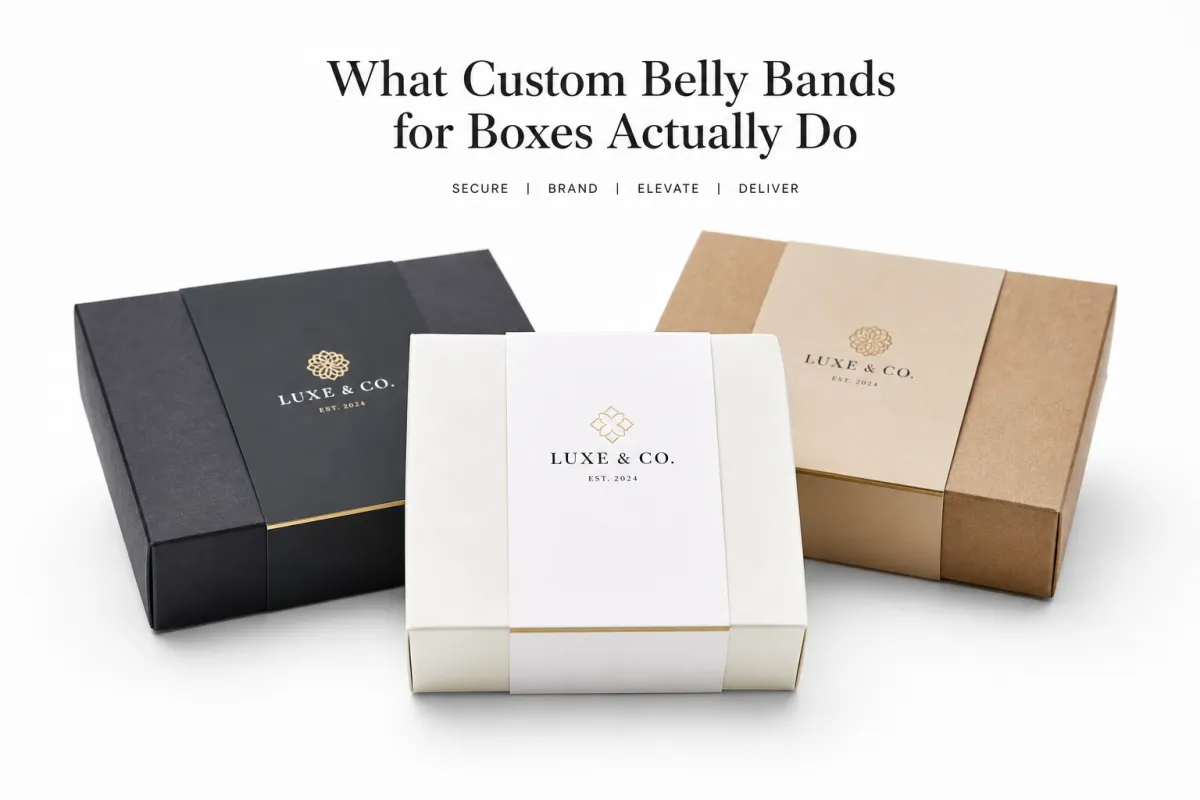
Most buyers start with a box that already performs. It closes. It ships. It protects the product. Then the box gets photographed, shelved, or handed off in a fulfillment line and suddenly looks plain. That is where custom belly bands for boxes earn their keep. One printed wrap can change the whole read of the package, and the effect is usually bigger than people expect.
In plain terms, custom belly bands for boxes are paper wraps or sleeves that go around the box. They can hold a lid in place, keep a set of components together, or sit there as a branding layer. They can carry a logo, a short message, flavor information, a QR code, a promo code, or a seasonal graphic. The nice part is the flexibility. When the artwork changes, the band changes. The box can stay the same.
That is useful for seasonal packaging, limited editions, subscription drops, press kits, and launch runs that need a fresh look without a full reprint. One month the brand wants holiday artwork. The next month it wants a product launch. Later, maybe a cleaner retail version. Custom belly bands for boxes make that kind of change less painful and less expensive than redoing the entire box. No drama. Just a smarter production path.
They tend to work best in these settings:
- Subscription boxes that need a new look every cycle
- Retail gift boxes where the shape already feels premium
- Skincare and cosmetic kits that need a clean brand lockup
- Apparel boxes where the wrap improves the opening moment
- Bakery packaging with seasonal notes or ingredient details
- Sample packs, onboarding kits, and launch-ready mailers
The tradeoff is simple. Custom belly bands for boxes are a presentation tool, not a structural fix. If the carton is flimsy, the band will not save it. If the lid sits crooked, the band may hide the problem for a second, but that is all. Good packaging starts with the box doing its job, then the band adds the branding layer on top.
That is also why belly bands are often one of the cheapest visible upgrades in branded packaging. You are printing a narrow wrap instead of every side panel. If the artwork is tight, the stock is right, and the fit is clean, the package can still look premium without paying for a full custom printed box.
I have seen brands use custom belly bands for boxes as a test bed before they commit to a full packaging overhaul. That is a smart move. You can check the visual direction, collect customer feedback, and keep the base box in circulation while the creative team sorts out the next round. Not glamorous. Very effective.
How Custom Belly Bands for Boxes Are Made and Applied
The production path for custom belly bands for boxes is usually straightforward, but the details matter more than people think. The work starts with measurements and artwork, not printing. If the dimensions are off by even a few millimeters, the overlap can land in a weird place or the band can sit loose enough to slide. If the artwork ignores the seam area, the finished band can look crooked even when the print itself is clean.
Here is the basic flow. Measure the box precisely. Define the band width, wrap path, and overlap allowance. Build print-ready artwork, usually in CMYK with bleed and trim. The vendor checks the file, sends a proof, and production starts after approval. Then come printing, cutting, and finishing. Depending on the vendor, the bands ship flat or arrive already applied.
Digital runs can move quickly once the proof is approved. A simple order may land in about 7-10 business days if the artwork is clean and the stock is on hand. Offset printing, special coatings, custom die-cuts, or exact color matching can push that to 12-18 business days or more. Proof approval usually sets the pace. Three rounds of edits and the schedule stops looking fast.
Assembly sounds minor until someone has to do it at scale. Some custom belly bands for boxes are applied by hand during packing, which works fine for small and medium runs. Others are shipped bundled for kitting lines, or pre-wrapped if the supplier offers that service. Pre-applied bands save labor, but they add handling cost and usually need tighter box consistency.
There are a few common reasons production slows down:
- Color matching across different print methods
- Die-cut requirements for unusual wrap shapes
- Special finishes like foil, spot gloss, or soft-touch
- Unclear box dimensions or inconsistent box suppliers
- Artwork changes after proofing has already started
Quantity changes the economics too. Smaller runs are easier to test and easier to adjust, but the unit cost is usually higher because setup and handling are spread across fewer pieces. Larger runs take more planning, but once production is moving, the cost per unit often improves. That is one reason custom belly bands for boxes are such a useful format for brands that want to test packaging before they commit to a bigger rebrand.
If the band needs to protect the customer experience during shipping, test the package the way it will actually be handled. A band that looks perfect on a sample table may behave differently on a packing bench, in a fulfillment line, or after carrier abuse. For packaging that has to survive real transit, the bar should be closer to what ISTA transit testing would call realistic, not what looks tidy in a photo.
One useful rule: get the band right before trying to make it fancy. A clean, well-fitted order beats an overdesigned one that fights the box every time. That lesson usually gets learned the expensive way.
Materials, Sizes, and Print Choices That Change the Result
Materials shape the whole impression. Custom belly bands for boxes can be made on coated paper, uncoated stock, kraft, premium text stock, or heavier cover stock, and each one changes the feel in hand and the final print result. Coated stock gives sharper images and richer solids. Uncoated stock feels softer and more tactile. Kraft gives a natural, earthy look, but only if the artwork has enough contrast to survive the paper tone.
Here is the practical version. If the band needs detailed graphics, small type, or photo-style imagery, choose a smoother coated stock. If the goal is a restrained logo, line art, or an organic brand tone, uncoated or kraft can look better. If the band is carrying the heavy weight of luxury branding, heavier cover stock helps it lie flatter and feel more substantial. That matters because custom belly bands for boxes are often judged in the hand before anyone studies the typography.
Size is where a lot of first-time buyers stumble. The band needs enough length for overlap, enough width to be visible, and enough tolerance to account for box variation. Too narrow and it disappears into the package. Too wide and it starts to dominate the box or gets in the way of opening. Too loose and it slides. Too tight and it curls or tears. A sloppy fit is usually what makes custom belly bands for boxes look cheap, not the stock itself.
Printing choices matter more than most teams think. A simple one-color run may be enough for logo-first branding. Full-color printing works well for campaign graphics and product storytelling. Foil adds contrast and shelf pop, but it raises cost and can extend lead time. Matte and gloss coatings change the tone immediately. Soft-touch finish gives a velvety feel, though it should be used carefully because some brands overdo it and end up with a surface that feels more fragile than premium.
| Option | Typical Unit Cost | Best For | Notes |
|---|---|---|---|
| Kraft or uncoated, one-color print | $0.12-$0.22 | Simple branding, natural product lines, short runs | Lower finish cost, strong for minimalist package branding |
| Coated stock, full-color print | $0.18-$0.35 | Retail packaging, seasonal artwork, launch kits | Good balance of appearance and budget for custom belly bands for boxes |
| Premium stock with matte, gloss, or soft-touch finish | $0.28-$0.55 | Gift boxes, beauty, premium product packaging | Stronger tactile effect, higher finishing cost, more setup time |
| Foil, specialty ink, or custom die-cut shape | $0.40-$0.85+ | Launch campaigns, luxury lines, high-impact retail packaging | Looks expensive because it is expensive, which is fine if the margin supports it |
Box compatibility changes the choice too. Smooth rigid boxes behave differently from folding cartons, and mailers bring their own quirks. A rigid box with crisp edges can handle a narrower, tighter band. A folding carton may flex more and need a little extra tolerance. A mailer usually works better with a wrap that avoids awkward placement over a crease or flap. Custom belly bands for boxes should be specified around the actual box style, not a generic width pulled from a spreadsheet.
There is also a sustainability angle that matters more than some brands want to admit. Recyclable paper choices, minimal adhesive, and a band that ships flat all Reduce Packaging Waste and make disposal easier. If the brand wants FSC sourcing or a clearer paper trail, check the paper chain and the print finish early. The FSC certification system is a useful reference point when responsibly sourced paper is part of the brief.
The best material is the one that fits the box style, the print detail, the handling environment, and the brand mood. That sounds obvious. In production, obvious is usually the first thing people forget.
Custom Belly Bands for Boxes Cost: What Affects Pricing
Pricing for custom belly bands for boxes comes down to a handful of inputs, and most of them are predictable. Quantity matters first. Then size. Then stock. Then print coverage. Then finishing. Then whether the bands ship flat or get assembled onto the box. If a quote looks too low at first glance, the real question is usually what got left out, because something usually did.
For small runs, setup costs can dominate the price. That is why 250 pieces often cost much more per unit than 5,000 pieces. The press still needs setup, the file still needs checking, and someone still has to trim, count, and pack the order. Custom belly bands for boxes are simple in concept, but print production is not charity. Fixed labor is fixed labor.
Here is a realistic budgeting frame:
- 250-500 units: often best for tests, pilots, and one-off launches
- 1,000-2,500 units: usually a solid middle ground for recurring orders
- 5,000+ units: where per-unit cost often improves enough to justify a broader rollout
If the team wants a quick budget estimate, ask for two versions of the same quote. One should be the simplest viable spec. The other should be the preferred premium spec. That makes the cost gap visible without turning the conversation into a vague debate about "value." Buyers need numbers, not packaging poetry.
Assembly and labor can add a meaningful amount too. If the vendor wraps each band onto the box, that service should be priced separately whenever possible. It is convenient. It also takes time. On some jobs, that line item is smaller than expected. On others, especially kitting-heavy work or retail packaging with exact placement, it is the cost that decides the project.
"A belly band is cheap until you ask it to do five jobs at once." That is the usual mistake. The band is for branding, identification, and presentation. If you make it act like a seal, a shipping label, and a safety component, the budget climbs for a reason.
There are also hidden extras that can catch people off guard:
- Freight and fuel surcharges
- Rush production fees
- Extra proof rounds or artwork corrections
- Color matching to a specific standard
- Sample shipping and mockup costs
For brands that use custom belly bands for boxes repeatedly, the cheapest route is not always the lowest quote. The cheaper vendor may be fine once, but if the template is unclear, the fit is inconsistent, or the proof process drags, the hidden cost shows up in labor and delay. That is why experienced buyers compare not just price, but the quality of the spec sheet, the proof process, and the ease of reordering.
For a straightforward 1,000-piece run on coated stock with simple full-color printing, pricing often lands around $0.18-$0.35 per unit. Add premium finish, tighter tolerances, or hand assembly and that number moves up fast. Add foil or a special shape and the quote climbs again. No mystery there. Just print math doing what print math does.
Step-by-Step Ordering Process for Custom Belly Bands for Boxes
The ordering process gets much easier when the buyer brings exact information. The first thing a vendor needs is the box measurement. Not a guess. Not "around six inches." Exact width, height, depth, and wrap path if the band crosses unusual geometry. Custom belly bands for boxes depend on fit, and fit depends on numbers that hold up in production, not in memory.
Start with a simple checklist:
- Final box dimensions and box style
- Wrap direction and overlap allowance
- Artwork size, bleed, and trim
- Color mode and brand color references
- Stock choice and finish
- Quantity and delivery deadline
- Whether the bands are applied by hand or by machine
Once that is in place, the proof stage gets a lot cleaner. Review every text line, barcode, legal note, and alignment detail. Check the seam area. Check the overlap. Check the placement of any logo or headline that crosses the wrap. This is the stage where expensive mistakes are still cheap to fix. Once the run starts, they are not cheap anymore.
If the fit is tight or the box is new, order a sample or blank mockup first. That is not overcautious. It is smart. A blank sample tells you whether the band lies flat, whether the overlap lands where you want it, and whether the box closes with the band in place. A printed sample helps too if the design depends on a very specific color, because screens lie and paper does not.
For new vendors, or for any job where custom belly bands for boxes will move through fulfillment, retail, or postal handling, test the package in the conditions it will actually face. Stack it. Move it. Pack it. Open it under less-than-perfect light. That is where the weak points show up, and those weak points are usually hidden by polished mockups.
The handoff from proof to production should be a freeze point. Once the proof is approved, changes should stop unless the buyer is willing to pay for the delay. That sounds strict because it is. Production schedules are built on assumptions, and every late change ripples through the queue. When custom belly bands for boxes are tied to a launch timeline, those ripples get expensive fast.
A useful timeline template looks like this:
- Measure and brief
- Send artwork or request a dieline
- Review the proof
- Approve a sample if needed
- Run production
- Ship flat or pre-applied
- Test fit on a few real boxes before full rollout
That sequence sounds basic because it is. The difference between a smooth order and a painful one is usually not talent. It is whether the buyer gives the printer enough clean information to avoid guessing.
Common Mistakes That Make Belly Bands Look Cheap
The biggest sizing mistake is also the most common: the band is too loose or too tight. Too loose and it shifts around on the box. Too tight and it curls, wrinkles, or tears near the seam. Custom belly bands for boxes should feel intentional. When they do not, people notice right away, even if they cannot explain why.
Another easy way to lose the premium feel is visual clutter. Too many fonts. Too much copy. Weak contrast. Tiny logos. If the band has to do all the talking, it still needs breathing room. Packaging design does not improve because every inch gets stuffed with information. Cleaner hierarchy usually makes the package look more expensive.
Seam placement matters more than many teams realize. If the seam lands on the front face, or the artwork ignores the overlap zone, the finished band can look misaligned. On custom belly bands for boxes, the seam should usually be treated as a design element or tucked into a place that does not fight the main visual. Pretending the seam does not exist is a classic rookie move.
Box variation is another trouble spot. Some box suppliers hold tolerances well. Others do not. If one batch is slightly wider or deeper than another, the same band spec can start behaving differently. That is why custom belly bands for boxes should be planned with a tolerance range, especially if the buyer uses more than one box supplier.
Overengineering is another common trap. A team wants foil, spot gloss, embossing, and a special stock because the mood board looked expensive. Then the schedule tightens, the budget gets squeezed, and the order takes longer than planned. Not every package needs a finish parade. Sometimes a clean printed wrap on good stock is the right answer.
There is also a testing problem that gets ignored too often. A proof on a desk is not the same as a wrapped box in daylight, under warehouse lights, or on a retail shelf next to competing products. Never approve a full run without checking real boxes, real lighting, and real assembly conditions. Custom belly bands for boxes are simple enough that people think they can skip this step. That usually costs money later.
Finally, do not choose a material that fights the brand story. Kraft looks honest and natural when the artwork supports it. Gloss looks sharp when the graphics need more pop. Soft-touch feels premium when the rest of the package is clean. If the stock and finish do not match the message, the box ends up feeling confused. Confused packaging looks expensive in the wrong way.
Expert Tips and Next Steps Before You Place the Order
Before placing an order, gather the basics: final box dimensions, target quantity, budget ceiling, brand colors, deadline, and the one person who can approve proofs quickly. That last point matters more than people like to admit. A slow approver can delay custom belly bands for boxes longer than a machine problem can.
Ask vendors for a sample of similar work, not just a price. Photos help, but they do not tell you how the band behaves around corners, seams, or lids. A real sample shows whether the stock feels right and whether the print level matches the brand's expectations. That is especially useful for custom belly bands for boxes used in retail packaging, where shelf presentation matters more than a spreadsheet does.
If the box is new, or if the band is doing double duty as a closure, start with a small test batch. The same advice applies if the package is headed through fulfillment or retail handling. A 100- or 250-piece pilot can show whether the seam holds, whether the band slides, and whether the assembly line can keep up without slowing to a crawl.
Comparing quotes only makes sense if the quotes describe the same thing. Same stock. Same finish. Same size. Same quantity. Same assembly method. Otherwise you are not comparing pricing. You are comparing packaging rumors. That is how teams end up choosing the wrong vendor and then act surprised when the result does not match the brief.
For repeat orders, save the dieline, confirm the template, and lock the file structure before the first run is even finished. Reorders get much easier when the spec is already clean. This matters for custom belly bands for boxes because the format often changes by season, campaign, or SKU. A tidy master file saves time every time the brand wants a refresh.
If the packaging program is growing, think one step ahead. Will the band need variable data later? Will it carry a QR code for a campaign? Will the artwork shift from launch to evergreen? Planning now keeps the next order from turning into a panic job. Good packaging teams do not just buy once. They build a repeatable system around the format.
My practical next step: measure the box, request two pricing tiers, and test one sample before committing to volume. That is the fastest way to find out whether custom belly bands for boxes are the right fit for your product packaging, your budget, and your timeline. Most of the time, they are. You just need to spec them properly.
For brands that want a visible upgrade without rebuilding the whole carton program, custom belly bands for boxes remain one of the smartest tools in branded packaging. They are flexible, cost-aware, and easy to adapt when the artwork needs to move faster than the box supply. That is the kind of packaging choice that saves money without looking cheap.
Put the effort into the dimensions, the seam placement, and the sample check. Do that, and custom belly bands for boxes stop being a cosmetic extra and start doing real work for the package.
FAQ
How do I size custom belly bands for boxes correctly?
Measure the exact box width or wrap path, then add overlap for a secure seam and a little tolerance for production variation. Keep the band wide enough to look intentional, but not so wide that it hides the box or gets in the way of opening. If the fit is tight, ask for a mockup on the actual box before approving the full run. That step is boring, but it is cheaper than reprinting custom belly bands for boxes that miss the mark.
Are custom belly bands for boxes cheaper than printed boxes?
Usually yes, because you are branding a flat wrap instead of printing every surface of the box. The savings shrink if you add specialty finishes, heavy stock, or manual assembly. For small runs and seasonal promotions, custom belly bands for boxes are often the smarter budget move, especially when the base box is already working well.
What material works best for custom belly bands for boxes?
Coated cover stock is a safe choice when you want sharp print and a polished finish. Kraft works well for natural or eco-forward brands, but the artwork needs strong contrast. Choose the material based on the box style, the brand feel, and how much handling the package will take. There is no single best answer for custom belly bands for boxes, which is annoying, but true.
How long does production usually take for custom belly bands for boxes?
Simple digital jobs can move quickly once the proof is approved. Offset printing, specialty finishing, and custom die-cuts add time. The fastest way to avoid delays is to send exact measurements and approve proofs without extra revision loops. When the spec is clean, custom belly bands for boxes are usually faster than a full carton reprint.
Can custom belly bands for boxes stay on during shipping?
Yes, if the band is sized correctly and the box itself closes securely. If the package will be handled roughly, add a test round with real packing conditions before the full order. If the band is acting like a seal, make sure the overlap and material choice can handle friction and movement. That is where custom belly bands for boxes either pass the test or become annoying little strips of paper in the bottom of a carton.

