Buyer Fit Snapshot
| Best fit | Reduce Packaging Waste Shipping with Custom Packaging projects where brand print, material claims, artwork control, MOQ, and repeat-order consistency need to be specified before quoting. |
|---|---|
| Quote inputs | Share finished size, material target, print colors, finish, packing count, annual reorder estimate, ship-to region, and any compliance wording. |
| Proofing check | Approve dieline scale, logo placement, barcode or warning zones, color tolerance, closure strength, and carton packing before bulk production. |
| Main risk | Vague material claims, crowded artwork, missing packing details, or unclear freight terms can make a low unit price expensive after revisions. |
Fast answer: Reduce Packaging Waste Shipping with Custom Packaging: Material, Print, Proofing, and Reorder Risk should be specified like a repeatable production item. The safest quote records material, print method, finish, artwork proof, packing count, and reorder notes in one written spec.
Production checks before approval
Compare the actual filled-product size with the drawing, then confirm tolerance on folds, seals, hang holes, label areas, and retail display edges. Reserve space for logos, QR codes, warning copy, and material claims before decorative graphics fill the panel.
Quote comparison points
Review material grade, print process, finish, sampling route, tooling charges, carton quantity, and freight assumptions side by side. A quote is only useful when the supplier can repeat the same color, closure quality, and packing count on the next order.
How to Reduce Packaging Waste Shipping with Custom Packaging
How to Reduce Packaging Waste Shipping: What It Really Means
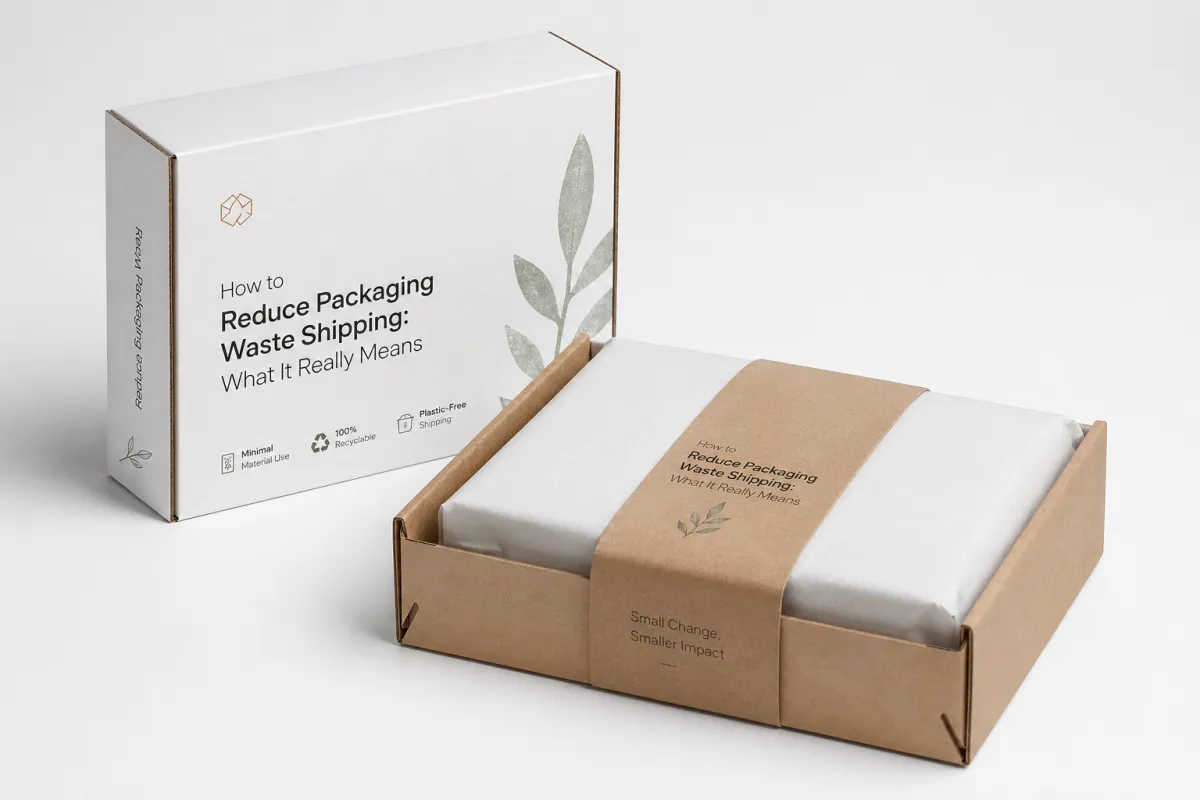
Figuring out how to Reduce Packaging Waste shipping starts with a budget reality that too many teams leave sitting in the corner: air costs money, and carriers are gonna bill for it. A carton that is only a little too large can trigger dimensional-weight charges, burn through more filler, and slow the pack-out line. In audits I have reviewed for ecommerce brands, the problem usually is not one dramatic mistake. It is a dozen small choices that repeat until they become the default.
Packaging waste is both visible and hidden. The visible part is easy to spot: too much corrugate, extra wraps, oversized inserts, redundant tape, and filler that shows up like a bad habit. The hidden part is trickier because it lives in labor time, storage density, repacks, and the decision fatigue that creeps in when staff has too many similar materials to choose from. One worker hesitating for ten seconds at a station does not sound like much. Multiply that by thousands of orders, and you have a pretty expensive pause.
This matters because packaging affects freight, damage, storage, and customer trust all at once. A shopper opening a tiny item in a huge carton often reads that as wasteful, even if the product arrives intact. A warehouse manager reads the same carton as dead space. Finance sees a dimensional-weight penalty. Same box, four different complaints. Leaner packaging is not about stripping materials until a product survives by luck. It is about finding the point where protection, speed, and fit all improve together.
How to Reduce Packaging Waste Shipping: What Goes Wrong in the Pack-Out Process?
If the real question is how to Reduce Packaging Waste shipping, the answer starts before the tape is applied. In many operations, a picker grabs the nearest carton, adds filler by instinct, and chooses whatever insert feels fastest. None of those decisions looks dramatic on its own. Across hundreds of orders, though, those habits quietly inflate the packaging footprint and push fulfillment toward avoidable cost.
SKU variation is the second driver. Different sizes, different fragilities, and mixed weight profiles make one-size thinking risky. A single catalog might include hard plastic components, glass vials, and soft textiles, yet all of them get pushed through the same station. Once staff is juggling six carton sizes, four inserts, and three cushioning options, speed becomes the fallback standard. The result is predictable: oversized boxes, extra void fill, and a shipping profile that looks like a compromise machine.
Many teams also use warehouse behavior to compensate for weak packaging design. If the carton flexes at key points, staff overbuild around weak edges. If the product shifts in transit, extra pads and paper become the default answer. If the presentation needs to feel premium, another layer gets added instead of improving fit. That is where design debt compounds. Better product packaging means less improvisation at the bench, and less improvisation usually means less waste.
Shift-to-shift variance creates its own little economy of waste. In one shift, a worker uses one strip of tape and a tight paper fold. In another, three strips and an improvised cushion bag because that is how they learned the line. That is not just preference. It is a process failure. Without shared specifications and visual standards, each station becomes a local invention. Brand teams and fulfillment teams both lose when the process starts living in habits instead of rules.
Key Factors That Change Packaging Waste and Performance
Everything begins with product behavior. A rigid metal part and a cream bottle do not share the same risk profile, and that alone should force separate packaging logic. Shape, weight distribution, fragility, and surface sensitivity determine what kind of restraint the package needs. A soft, lightweight item may need more immobilization than a dense object with low impact risk. The product sets the baseline; the package simply supports it.
Fit remains the highest-impact variable. Less dead space usually means less filler, fewer movement points, and a smaller shipping cube. Consider the comparison: a 12 x 12 x 12-inch carton gives you 1,728 cubic inches, while a 10 x 8 x 6-inch carton gives you 480. That difference is not theoretical. It changes what the carrier charges, how much material is needed, and whether the package survives handling with fewer supports. Trim three inches from a face across a high-volume item family, and the freight tier can change without changing the print or the brand story.
Material choice is where many teams either stabilize waste or make it worse. Corrugated grades, Paper Void Fill, molded pulp, and reusable components are not moral choices; they are operating variables. In many ecommerce programs, 32 ECT single-wall board is enough for standard parcels, while heavier or crush-prone SKUs may justify 44 ECT or a custom insert. Recycled content can reduce environmental impact, but only if the structure still performs to the same claim rate. A premium look does not need premium bulk if the geometry is right.
Carrier instructions and brand experience need to be solved together. Carriers optimize for compliance, weight, and dimensions. Customers optimize for feeling protected and cared for. Those goals do not fight each other when the packaging footprint is tuned correctly. A one-color print on a snug carton often feels stronger than a giant box with three cushioning layers and no clear structure. A right-sized carton can still preserve the unboxing moment, especially when inserts guide product positioning and the branding stays intentional. If you are comparing formats, browsing Custom Packaging Products helps narrow realistic options before final specs are locked.
Cost and Pricing
Packaging waste shipping shows up in the budget as a chain reaction, not a line item. Corrugate, tape, labels, filler, labor, storage, and freight all respond to the same sizing decisions. A slightly cheaper carton can look attractive until order volume multiplies and cube inefficiency starts stacking against it. The same shipment that looked inexpensive on a unit-cost sheet can become expensive once damaged units, repacks, and surcharge bands are counted.
The cleanest analysis compares material and freight together. A carton that is cheaper by a few cents can still lose money if it pushes the package into a higher dimensional-weight band or adds handling time. Conversely, a better box can pay back if it cuts filler, lowers repacks, and reduces the number of material touches per order. Teams that keep packaging and transport in separate silos usually miss the biggest levers.
| Packaging option | Typical unit cost at 5,000 units | Best fit | Waste profile | Notes |
|---|---|---|---|---|
| Stock oversized carton | $0.35-$0.70 | Mixed SKUs, low planning time | High | Easy to source, but often wastes cube and filler |
| Right-sized custom printed box | $0.22-$0.55 | Repeat SKUs, branded packaging | Low | Often the best balance of cost, protection, and presentation |
| Poly mailer | $0.08-$0.18 | Soft goods, apparel, low crush risk | Very low | Excellent for cube reduction, but not for fragile products |
| Box with molded pulp insert | $0.18-$0.45 | Fragile electronics, cosmetics, small glass items | Low | Can replace loose fill with a shape-specific protection layer |
| Reusable shipper | $1.50-$4.00+ | Closed-loop programs, repeat returns | Very low over multiple trips | Higher operating complexity, but strong where reuse is realistic |
An upfront packaging redesign can still be the right move. Imagine a new box program that raises unit cost by $0.03, trims filler by $0.07, reduces freight by $0.25, and removes one manual packing step. That math points to a much larger operational gain than the extra print spend suggests. Over 10,000 shipments, the gap can swing from a few thousand dollars to a meaningful margin improvement.
There are silent winners too. Less material means fewer shelf bins, fewer SKUs to pick from, and fewer errors under pressure. A facility carrying ten box sizes does not only spend more on inventory; it also burns labor on search and choice latency. That is where simplification and cost control meet. Lightweight apparel programs may do better with Custom Poly Mailers, while rigid or brittle products often get better economics with Custom Shipping Boxes when tested against real handling.
Timing belongs in the cost equation too. A custom run can take proof review and roughly 12 to 15 business days, depending on quantity and finishing. That can feel slow until you compare it with the ongoing freight and labor leakage from a weak default. Teams piloting new packaging often find that testing and a careful rollout cost less than the long tail of poor right-sizing decisions.
A Step-by-Step Process for Leaner Shipping
Practical improvement works better as a repeatable sequence than as a broad mission statement. The pattern That Holds Up best is audit, cluster, redesign, verify, and stage the rollout. Every step should reduce ambiguity, because ambiguity is where waste starts rebuilding itself.
-
Audit current shipments by SKU.
Start with at least 30 days of evidence: carton dimensions, filler usage, damage rate, pack time, and freight charges by product family. Mixed packing methods for the same SKU are usually a symptom, not a cause. One SKU that drives a high share of filler spend is your first redesign candidate because a small adjustment there compounds quickly.
-
Group products into packaging families.
Cluster by shape, weight, fragility, and stack behavior rather than by supplier or color. The goal is not to create hundreds of unique specs. It is to reduce noise. A cosmetics family may get one insert system; a rigid goods family may get another. With tighter families, purchasing and warehouse instructions become easier to execute consistently.
-
Redesign around the smallest practical footprint.
Start from the smallest carton that still protects the product, then add only the supports needed to limit movement. Die-cut inserts, molded pulp, or structural dividers can often replace blanket cushioning layers and scattered loose fill. A custom carton does not need a thick shell to feel well made. It needs honest geometry.
-
Test under real transit and pack-out stress.
Proofs and mockups help, but they do not replace actual handling. Compare the draft design against your existing structure under the same drop tests, compression checks, and line conditions. If possible, include lane-level stress by comparing the same SKU through the same distribution path. One of the better checkpoints is a baseline against established guidance from ISTA and packaging.org, especially for fragile lines. That said, lab results are only part of the picture; a carton that passes a formal test can still be annoying to pack if the geometry is awkward.
-
Roll out in phases and measure the change.
Launch in controlled batches, not across the full catalog. Track labor impact, damage rates, freight spend, and pack-out consistency for the highest-volume SKUs first. That phase-in protects service levels and gives teams time to absorb the new routine. The best programs are the ones that settle quietly into normal operations.
Less empty space only helps when the product still arrives stable, protected, and on time. Intentional restraint beats accidental fullness.
Common Mistakes That Quietly Increase Packaging Waste
Overboxing is the easiest one to spot and the hardest to stop. A single universal box looks simple on spreadsheets and in purchasing meetings. In the warehouse, it usually creates excess cushioning, extra filler, and higher dimensional weights. The convenience of fewer SKUs can become an operating surcharge when every item is forced into the same pattern.
Under-testing is the second silent leak. A structure that performs in a conference room often changes character after conveyors, sortation, and transfer points. If the design fails late, teams respond with extra fill and extra tape, and waste climbs again. More cushioning is not a reliable proxy for stronger protection; it can cause slippage, sidewall collapse, and a less controlled presentation. A simpler package with better immobilization usually beats a bulkier package with uncontrolled filler.
Packaging sprawl is the third trap. Too many carton sizes, too many insert variants, and too many cushioning formats create selection fatigue. The result is less control and more guesswork. Material choices like paper or recycled fiber still create waste if they are overapplied. The practical test is straightforward: does the total system use less material and fewer interventions while keeping product condition steady?
A fourth mistake shows up in change management. Teams update the box but forget to update training cards, pick lists, or station photos. The packaging spec gets approved, then the old behavior survives because nobody made the new standard visible at the bench. That is how a good design gets quietly diluted. A clean spec with poor adoption is only a partial win.
Expert Tips and Next Steps
The 80/20 rule still applies in packaging logistics. A small set of SKUs usually explains most shipping volume, most repacks, and most damage losses. Start there, not with low-volume exceptions. A one-cent reduction on a top seller creates a larger margin effect than a ten-cent reduction on an occasional order.
Standardized measurements turn good intentions into reliable outcomes. Procurement, design, and fulfillment should all use the same carton dimensions, the same product measurements, and shared test results. When teams estimate by memory, variance becomes unavoidable. When teams work from a single source of truth, packers make better first-pass decisions. Clear spec documents reduce the distance between what design promises and what fulfillment can execute.
Track only the metrics that expose the system, not the noise. Keep material per shipment, damage rate, average freight cost, pack time, and number of packaging SKUs in inventory on a visible dashboard. If materials drop but damage rises, the design is underbuilt. If freight declines but pack time rises, labor is absorbing the loss. The goal is a balanced improvement curve, not a single victory lap.
There is one more practical test I like to use: ask whether the package still makes sense after a tired worker has packed 500 units and a carrier has handled the parcel three times. If the answer is shaky, the design probably needs another round.
Frequently Asked Questions
How do I reduce packaging waste in shipping without increasing damage?
Start by right-sizing the carton to the product and then use cushioning only where it is needed to control movement. The strongest result usually comes from a package that stabilizes the item with minimal bulk. Pilot the new spec with drop tests and pack-out trials, then monitor claims by SKU and route for several weeks. Early variance usually shows up before the weekly shipping report settles.
What materials help cut packaging waste shipping for custom products?
Right-sized corrugated boxes are often the highest-impact first move because they reduce empty space and dimensional-weight exposure. For cushioning and internal support, paper-based void fill, molded pulp, and inserts often outperform loose plastic fillers when the geometry is known. Reusable components can add major savings in circular loops, but only if the reverse-flow process is actually managed. The best material does the job with fewer layers and less leftover space.
Does right-sizing boxes actually lower shipping costs?
Yes. Smaller cartons usually lower dimensional-weight charges and reduce the need for filler, tape, and extra handling steps. Savings are most visible when volume is high and when the original carton is larger than necessary. The result is usually strongest in dense shipping lanes where each cubic inch is priced directly into the tariff.
How long does it take to reduce packaging waste shipping in a warehouse?
An initial waste audit can be completed in a few days when stable data already exists. A full implementation usually takes longer because testing, approval, and training happen in sequence. For Custom Printed Boxes or an insert change, many teams still plan on 12 to 15 business days after proof approval, then phase rollouts by SKU volume. The first measurable gains often appear as soon as one high-volume item changes spec.
What should I track after changing packaging to cut waste?
Monitor material cost per order, freight cost per order, and damage rate as the baseline trio. Then include pack time and packaging SKU count so you can confirm the package is not shifting cost from materials to labor. Review by product family and carrier lane whenever possible. A design that succeeds in one flow can still underperform in another lane if handling patterns differ.
Reducing packaging waste shipping is really about treating packaging as a system decision instead of a purchasing checkbox. Once teams measure current pack-out behavior, remove excess cube, validate protection through realistic stress, and phase in standards, results compound across cost, quality, and experience. Lower material spend, fewer claims, and a clearer operation usually appear at the same time.
The first move is simple: pull your top-selling SKUs, measure the actual packed dimensions, and compare each one against the smallest carton that still passes handling tests. That one exercise shows where the waste is hiding and gives you a clean starting point for the next packaging change.


