Buyer Fit Snapshot
| Best fit | Custom Beverage Bottle Labels Wholesale for Brands projects where brand print, material claims, artwork control, MOQ, and repeat-order consistency need to be specified before quoting. |
|---|---|
| Quote inputs | Share finished size, material target, print colors, finish, packing count, annual reorder estimate, ship-to region, and any compliance wording. |
| Proofing check | Approve dieline scale, logo placement, barcode or warning zones, color tolerance, closure strength, and carton packing before bulk production. |
| Main risk | Vague material claims, crowded artwork, missing packing details, or unclear freight terms can make a low unit price expensive after revisions. |
Fast answer: Custom Beverage Bottle Labels Wholesale for Brands should be specified like a repeatable production item. The safest quote records material, print method, finish, artwork proof, packing count, and reorder notes in one written spec.
Production checks before approval
Compare the actual filled-product size with the drawing, then confirm tolerance on folds, seals, hang holes, label areas, and retail display edges. Reserve space for logos, QR codes, warning copy, and material claims before decorative graphics fill the panel.
Quote comparison points
Review material grade, print process, finish, sampling route, tooling charges, carton quantity, and freight assumptions side by side. A quote is only useful when the supplier can repeat the same color, closure quality, and packing count on the next order.
Custom beverage bottle labels wholesale can look straightforward until the bottles actually hit a cooler, a warehouse dock, or a delivery route on a humid afternoon. A label has a very short window to earn trust, and that window gets even shorter when condensation, glare, curved glass, PET, or a crowded shelf is competing with the artwork. I have seen plenty of Labels That Looked beautiful in a proof and then got a little slippery-looking the moment they met real-world moisture. That is usually the moment the project stops being about graphics and starts being about construction.
That is why custom beverage bottle labels wholesale should be treated as part of the package itself, not as a loose finishing touch. The right label build helps a brand keep one clear identity across core SKUs, seasonal flavors, private-label programs, and repeat production runs while keeping unit cost under control as volume grows. For buyers, that usually means fewer reorders, steadier color matching, easier inventory planning, and less time cleaning up label issues that should never have made it past prepress.
At Custom Logo Things, the goal is simple: custom beverage bottle labels wholesale that fit the bottle, print cleanly, and hold up in real beverage conditions. That means talking through materials, adhesives, finishes, dielines, Pricing, Lead Times, and the practical details that decide whether a label looks good in a mockup or performs well after filling. If you are comparing beverage labels with broader Custom Labels & Tags or building out a fuller line of Custom Packaging Products, the label choice should support the whole package, from retail packaging to product packaging and the rest of the branded materials on shelf.
Why Custom Beverage Bottle Labels Wholesale Win at Shelf Speed
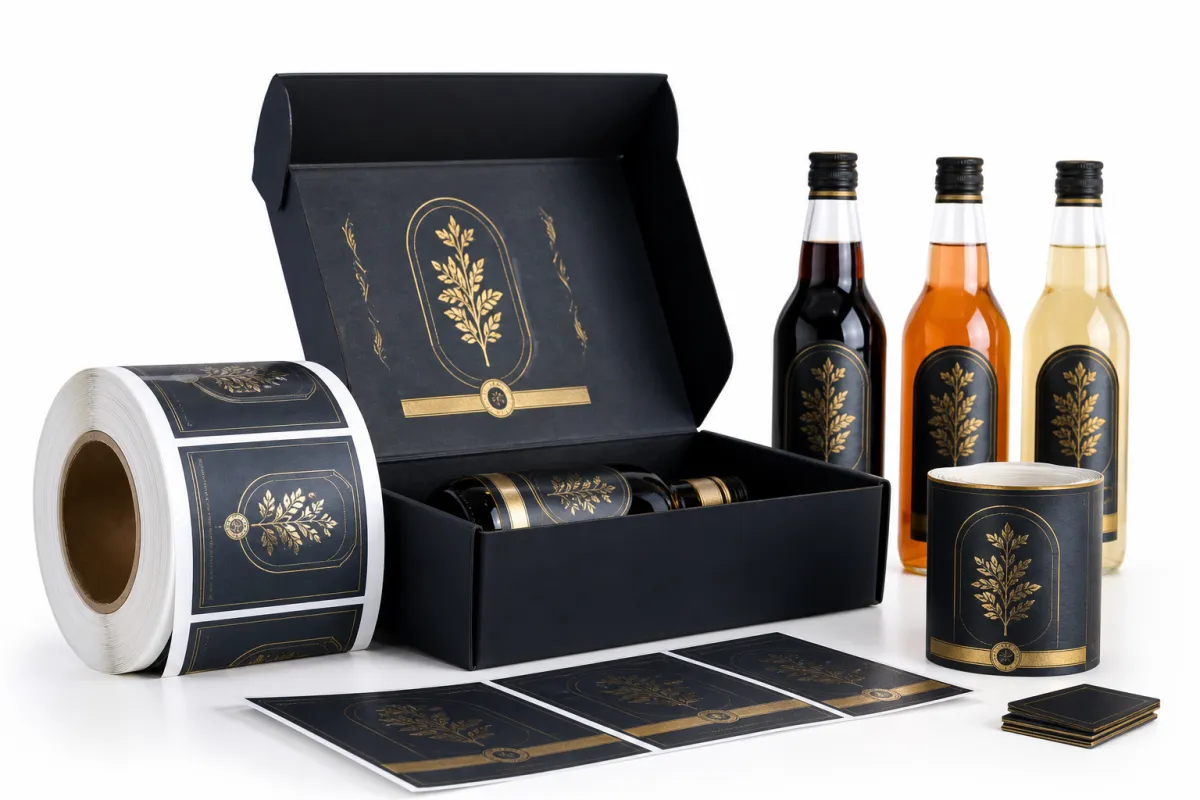
A bottle label does not have much time to explain itself. In a crowded cooler or on a retail shelf, a shopper usually notices shape, color, and contrast first, then reads the brand name, then decides whether the package feels worth picking up. In practice, that means the label has to do its job before anyone is even really reading it. Custom beverage bottle labels wholesale matter because they help a brand keep a consistent visual system across every bottle size and every production run, which makes the line easier to recognize and easier to restock.
Wholesale buying also makes production easier to manage. Instead of paying for a piecemeal short run every time a flavor or season changes, custom beverage bottle labels wholesale gives a brand a cleaner way to plan quantities, lock in repeat artwork, and keep unit pricing more predictable. A fast-moving line can often benefit from one label structure with small variation changes for flavor names, alcohol content, ingredients, or barcode data. That kind of planning saves time later, and it tends to prevent the frantic "we need these again by Friday" kind of reorder that no one enjoys.
The label is also a working surface. It has to survive handling, refrigeration, wipe-down cleaning, and shipping vibration. A paper stock that looks fine on a dry table may scuff, curl, or soften too quickly in a cooler. A film stock may stay crisp where paper would fail. Adhesive strength, facestock choice, and finish all shape how the label behaves after filling, not just how it looks in a proof. That is the part many buyers miss on the first order of custom beverage bottle labels wholesale.
A label that looks strong on a screen still has to survive ice buckets, condensation, and carton movement. If it cannot handle the package environment, it is not the right label, even when the artwork is solid.
Wholesale ordering also supports better color control. Once a label specification is documented, repeat orders can stay closer to the approved master, which matters when one bottle sits beside another and any drift becomes obvious. For beverage brands, that consistency is part of package branding, and package branding is part of the product story. If the label feels off, the bottle feels off. That is the reality on shelf, and it is why experienced buyers are so picky about proofs.
For context on broader packaging language and standards, the Institute of Packaging Professionals is a useful industry reference. Their material and terminology guidance helps frame why a label is never just decoration; it is part of a system built around visibility, handling, and saleable presentation.
That is the real advantage of custom beverage bottle labels wholesale: they combine visual speed with operational control. That combination turns a nice-looking label into a repeatable packaging asset.
Custom Beverage Bottle Labels Wholesale: Materials, Adhesives, and Finishes
Choosing the Right stock is what separates a label that holds from a label that fails in the fridge. For custom beverage bottle labels wholesale, the first decision usually starts with the face material. Paper can work well for dry shelf applications, but film stocks such as BOPP are usually better for refrigeration, moisture exposure, and bottles that will be handled often. If the bottle will be iced, misted, or wiped down, film is usually the safer path. I have had more than one job where the artwork was fine, but the environment was not kind to paper, and the label told on itself within days.
Adhesive choice matters just as much. A permanent adhesive creates a locked-in look that is difficult to remove, which works well for retail units that need to stay intact through the full chain. A removable adhesive can make sense for promotional or changing programs, but it is not always the right choice for cold bottles or curved containers. Glass, PET, and coated aluminum can all behave differently under pressure, so custom beverage bottle labels wholesale should never be ordered with a one-size-fits-all assumption.
Finish changes the personality of the package. A gloss finish often gives stronger color saturation and reflects light well, which can help bright beverage labels stand out in retail packaging. Matte softens the look and reduces glare under cooler lights. Soft-touch adds a muted, tactile feel that can make premium beverage lines feel more deliberate, though it can show wear differently than a harder gloss. Clear film can create a no-label appearance, white film improves opacity, and metalized surfaces can give a sharper premium signal for specialty product packaging.
Here is a practical way to compare common label constructions for custom beverage bottle labels wholesale:
| Label Construction | Best Use | Typical Wholesale Cost Range | Practical Notes |
|---|---|---|---|
| Paper stock | Dry shelf bottles, short promotions | $0.04-$0.09 per label at 5,000 units | Good print feel, but moisture resistance is limited |
| White BOPP | Chilled beverages, condensation, frequent handling | $0.06-$0.14 per label at 5,000 units | Strong everyday choice for durability and color opacity |
| Clear BOPP | Glass and PET bottles with a no-label appearance | $0.07-$0.16 per label at 5,000 units | Needs good artwork contrast and careful proofing |
| Metalized film | Premium lines, special editions, high shelf impact | $0.09-$0.20 per label at 5,000 units | Can elevate the look, but costs rise with coverage and finish |
Those numbers are ballpark ranges, not a quote. Size, coverage, die shape, print method, and quantity move the final price quickly. Even so, the table shows why custom beverage bottle labels wholesale should be priced as a performance decision as much as a print decision. A slightly higher-cost film can save money if it avoids rework, reprints, or damaged shelf presentation later.
For sustainability-minded buyers, paper sourcing can matter too. If a project needs a paper face stock, ask about responsible fiber sourcing and certification options such as FSC. That does not automatically make a label right for chilled beverages, but it can be a useful requirement for certain branded packaging programs.
The best material is the one matched to the bottle environment. A chilled drink in a condensation-heavy cooler needs a different build than a dry shelf tonic or a room-temperature specialty bottle. That is the real test for custom beverage bottle labels wholesale.
Bottle Sizes, Dielines, and Print Specifications That Prevent Rework
Bottle measurements matter more than many buyers expect. A label can look perfect in a PDF and still wrinkle, lift, or shift on the actual bottle if the dieline does not match the container. Curved surfaces, shoulder transitions, embossing, and taper all affect how custom beverage bottle labels wholesale will sit once the adhesive is applied. If the wrap is too wide, the seam can show too aggressively. If it is too narrow, the artwork may look compressed or off-center.
The most important specs to confirm before printing are simple, but they need to be right: bottle diameter, straight label panel height and width, wrap coverage, seam placement, and whether the label must avoid a molded ridge or embossed panel. The direction of application matters too. Some labels are applied by hand, some by semi-automatic equipment, and some by high-speed line applicators. Each method changes how much tolerance the label needs during production.
Print prep is another place where rework can creep in. A clean file package should include bleed, safe area, vector logos, high-resolution artwork, barcode data, and final copy that has already been proofread. The label may be small, but the technical file should still be built with the same discipline you would use for custom printed boxes or any other primary branded packaging. A weak file usually creates a weak press outcome, and custom beverage bottle labels wholesale are too volume-sensitive for guesswork.
For beverage programs with several flavors or varieties, the label structure should stay consistent even if the copy changes. That is where master dielines save time. One base format can support strawberry, lime, black cherry, seasonal release, or private-label versioning without forcing the entire label to be rebuilt each time. In a busy production calendar, that kind of setup is one of the most useful forms of packaging design discipline.
- Bleed: usually 0.125 in. around the edge so trimming does not expose white borders.
- Safe area: keep critical text and logos at least 0.125-0.1875 in. from the cut line.
- Resolution: 300 dpi at final size for raster images; vector preferred for logos and type.
- Color mode: CMYK for most print jobs unless the printer requests a different setup.
- Barcode clarity: leave enough quiet zone space so scanners read cleanly on pack-out.
If the job will also need shipping validation or distribution testing, ISTA guidance can be useful. The International Safe Transit Association publishes widely used protocols for package transit and handling, and those ideas matter when beverage labels must survive carton movement, pallet vibration, and temperature swings before they ever reach a shelf.
One more practical point: a clean specification sheet speeds up future orders. Once the bottle dimensions, dieline, and application notes are documented, the next custom beverage bottle labels wholesale run becomes much easier to repeat. That is a real operational advantage, not just a convenience.
Custom Beverage Bottle Labels Wholesale Pricing, MOQ, and Freight
Price is shaped by more than the printed face of the label. For custom beverage bottle labels wholesale, the biggest cost drivers are size, stock choice, finish, adhesive, number of colors, special effects, and total quantity. A small label with simple artwork and a standard stock can land in a very different price band than a large wrap label with clear film, white ink, and premium finishing. Once the spec gets more complex, the quote usually climbs for reasons that are pretty easy to explain once you have seen enough jobs go through production.
Minimum order quantity usually reflects production efficiency. Larger runs spread setup over more labels, which lowers the unit cost. Smaller runs carry a heavier share of prepress work and material waste, so the price per label rises. That does not make a smaller order bad. It only means the economics are different. A brand launching a limited seasonal drink may be better served by a tighter run of custom beverage bottle labels wholesale than by over-ordering and sitting on excess inventory.
Freight should be treated as part of the real cost. A quote that looks attractive on the print line can change after carton counts, palletization, split shipments, or expedited transit are added. Buyers should ask for the landed number whenever possible, especially if the labels will ship to a co-packer, warehouse, or multiple retail locations. For beverage programs, one hidden cost can erase the savings from a lower quote very quickly.
Here are a few common cost variables that often show up in custom beverage bottle labels wholesale pricing:
- Die shape: standard rectangles are usually easier than custom curves or complex contours.
- White ink: often needed on clear film, and it can add cost depending on coverage.
- Proof revisions: multiple rounds of artwork changes can slow production and add prepress labor.
- Special finish: gloss, matte, soft-touch, foil effects, and spot treatments all change the quote.
- Split shipments: sending inventory to more than one location usually increases handling and freight.
For a buyer comparing options, a side-by-side quote is more useful than a single sticker number. Ask for the same label in a few common quantities, such as 1,000, 5,000, and 10,000 pieces, then compare the cost per finished bottle. That gives a much clearer picture of how custom beverage bottle labels wholesale behaves as volume rises. In many programs, the 5,000-piece range becomes the sweet spot where setup is spread efficiently without creating too much inventory risk.
Below is the kind of working comparison that helps buyers make the call:
| Run Size | Typical Use Case | Price Behavior | Buyer Takeaway |
|---|---|---|---|
| 1,000-2,500 labels | Launches, sample programs, short seasonal tests | Higher per-unit cost because setup is spread over fewer pieces | Good for testing, but not always the best landed cost |
| 5,000 labels | Core beverage SKU, recurring restock | Usually better balance of price and inventory control | Often the strongest value zone for custom beverage bottle labels wholesale |
| 10,000+ labels | Established line, multi-store distribution, private label | Lower unit cost if artwork and specs are stable | Best when forecast confidence is strong |
The main thing to remember is that custom beverage bottle labels wholesale should be priced as a package of print, performance, and freight, not as a lonely unit number. A label that arrives cheap but fails in refrigeration is not cheap at all.
Production Process and Timeline for Wholesale Beverage Labels
The workflow for custom beverage bottle labels wholesale should feel orderly, not mysterious. A good production path usually starts with a quote request, then bottle specs, then dieline review, then artwork submission, then proof approval, then press production, and finally inspection and shipment. If any of those steps are rushed or skipped, the chance of error rises quickly.
Lead time depends on the complexity of the job. A repeat order with the same dieline, same stock, and no artwork changes can move faster than a first-time project with several SKUs, custom shapes, or special finishes. As a general working range, many standard wholesale runs often land around 12-15 business days after proof approval, but that can stretch if the artwork needs revisions or if the project includes special effects. Custom beverage bottle labels wholesale moves faster when the files are clean and the buyer answers questions quickly.
The proofing stage is where delays usually happen. If the label needs a barcode, nutrition panel, legal copy, ingredient statement, or multilingual content, those items should be ready before the order is submitted. The strongest wholesale label jobs are the ones where the buyer already has the finished copy package in hand. In that case, the proof acts as confirmation, not a redesign session. That is a much better place to be, and it keeps the whole schedule from drifting.
For clarity, a professional order should also include communication about pack-out format, carton count, palletization if needed, and transit expectations. That matters for receiving teams that need to book dock space or coordinate with a co-packer. A well-run custom beverage bottle labels wholesale order supports the whole operation, not just the design desk.
Here is a simple timeline framework that works well for many beverage programs:
- Day 1: quote request, bottle details, and quantity confirmation.
- Day 2-3: dieline review and artwork collection.
- Day 3-5: digital proof review and approval.
- Day 6-15: production, inspection, and packing, depending on complexity.
- Transit: add shipping time based on destination and freight method.
If speed matters, the easiest way to keep custom beverage bottle labels wholesale moving is to bring the full file set at the start: vector logo, bottle measurements, barcode data, final copy, and any color references or prior samples. Clean input usually produces clean output. That is as true on a label line as it is anywhere else in packaging.
It also helps to think beyond the label alone. If the beverage launch also needs cartons, carrier boxes, or retail-ready packaging, the label should coordinate with the larger visual system. A bottle that works with the label but clashes with the carton is still not a finished package. The best package branding keeps the whole shelf story aligned.
Why Choose Custom Logo Things for Wholesale Beverage Labels
Custom Logo Things is built to think about labels the way a packaging buyer does: as a working part of the bottle, the cooler, the warehouse, and the sales counter. That means custom beverage bottle labels wholesale is not treated like a generic print job. It is approached as a packaged product decision where material choice, adhesive behavior, and finish quality all have to fit the actual use case.
The value is in practical guidance. If a bottle will live in refrigeration, the recommendation should reflect condensation and handling. If the line is a dry shelf tonic, the advice may be different. If the brand needs a premium visual signature, the finish choice should support that goal without creating avoidable cost or performance risk. That is the kind of grounded thinking buyers need when they are comparing custom beverage bottle labels wholesale options.
There is also value in a simple ordering process. A clear quote, a clean spec review, a proof that reflects the real bottle, and repeat-order support all save time. That matters for beverage brands that reorder every month or seasonally. It also matters for private-label buyers who may need multiple SKUs managed without a lot of back-and-forth. If you already use Wholesale Programs for other items, the same disciplined approach should apply here.
Another practical benefit is consistency. Wholesale buyers often need the same design to hold across multiple batches, flavor variants, or co-packer runs. That is especially true when labels have to coordinate with custom printed boxes, outer shipper cartons, or other product packaging components. The label should not fight the rest of the system. It should belong to it.
There is no need to oversell this. The point is not to promise magic. The point is to deliver labels that fit the bottle, print cleanly, and arrive ready for production. That is what serious custom beverage bottle labels wholesale buying should expect.
And if the project grows beyond beverage labels into broader branded packaging, the same team can help keep the visual system consistent across multiple print surfaces, from labels and tags to box finishes and other related packaging items. That saves buyers from managing disconnected vendors who each understand only one piece of the job.
Next Steps for Ordering Custom Beverage Bottle Labels Wholesale
Start with the facts that affect the label most: bottle dimensions, the number of SKUs, the expected order quantity, and the storage conditions. Those four details shape nearly every part of custom beverage bottle labels wholesale, from stock choice to adhesive to production timing. A rough guess can work for a conversation, but it is not the right basis for a print order.
Choose the environment first and the material second. A dry shelf label and a chilled cooler label are not the same thing, even if the artwork looks identical. If the bottles will face frequent handling, cold storage, or moisture, choose a face stock and adhesive that are built for that real condition. That is the safest way to avoid the common mistakes that cause curling, peeling, or haze around the edge.
Gather the artwork package next. Include the logo in vector form, final text, barcode data, compliance copy, and any required color notes. If the line has multiple flavors or versions, list each one clearly so the artwork and quantity splits are easy to quote. That is how custom beverage bottle labels wholesale stays organized instead of turning into a long chain of corrections.
Use the quote to compare landed cost, lead time, and repeat-order flexibility. That comparison is especially useful if the beverage line will expand later. A label that works for one flavor today should ideally be able to scale across the range tomorrow without forcing a complete redesign. That is one reason good label planning supports both package branding and future inventory control.
For buyers who want the next step to be simple, the process is usually this: approve the proof, confirm shipping details, and release the production order. That gives the team a clean path to deliver custom beverage bottle labels wholesale that are ready for bottling, packing, and shelf placement without unnecessary delays.
Custom beverage bottle labels wholesale should feel like a practical buying decision, not a guessing game. If the materials match the bottle, the dieline fits the container, and the proof is clear, the rest of the job becomes much easier. Before you place the order, lock three things in writing: the bottle spec, the storage environment, and the approved master artwork. Those are the details that keep the labels looking right in the cooler and the numbers right on the invoice.
Frequently Asked Questions
What is the minimum order for custom beverage bottle labels wholesale?
Minimums depend on the label size, material, and printing method because setup costs are spread across the run. If you have several flavors or bottle sizes, ask whether the quantity can be combined across SKUs to improve pricing efficiency. For the most accurate answer, share your bottle dimensions and estimated annual usage so the quote reflects your real buying pattern for custom beverage bottle labels wholesale.
Which label material works best for refrigerated beverage bottles?
Film-based stocks such as BOPP are usually the safest choice for cold, damp conditions because they resist moisture better than standard paper. Pair the stock with an adhesive designed for chilled surfaces if the bottles will live in coolers, ice bins, or wet storage areas. A matte or gloss finish can work, but the key is matching the face material and adhesive to the actual bottle environment.
Can custom beverage bottle labels wholesale cover multiple flavors or varieties?
Yes, and it is common to keep the same label structure while changing flavor names, colors, or barcode data across SKUs. Using a shared format can reduce setup time and help keep a beverage line visually consistent across the shelf. When requesting a quote, list each version separately so production can account for artwork changes and quantity splits.
How long does production usually take after artwork approval?
Turnaround depends on material, quantity, and print complexity, but the clock usually starts once the proof is approved and all files are final. Simple repeat orders can move faster than first-time jobs because the dieline and setup are already established. If timing matters, ask for the lead time before approval so you can align bottling, shipping, and inventory receiving.
What file format should I send for custom beverage bottle labels wholesale?
Vector artwork is preferred when possible, because it keeps logos, type, and linework sharp at production size. Include any linked images at high resolution and provide barcode or compliance text in a final, proofread form. If you are unsure about your files, send what you have and request a prepress review before the job is released.

