Buyer Fit Snapshot
| Best fit | Branded Hang Tags Bulk projects where brand print, material claims, artwork control, MOQ, and repeat-order consistency need to be specified before quoting. |
|---|---|
| Quote inputs | Share finished size, material target, print colors, finish, packing count, annual reorder estimate, ship-to region, and any compliance wording. |
| Proofing check | Approve dieline scale, logo placement, barcode or warning zones, color tolerance, closure strength, and carton packing before bulk production. |
| Main risk | Vague material claims, crowded artwork, missing packing details, or unclear freight terms can make a low unit price expensive after revisions. |
Fast answer: Branded Hang Tags Bulk: Specs, Pricing, Lead Times should be specified like a repeatable production item. The safest quote records material, print method, finish, artwork proof, packing count, and reorder notes in one written spec.
Production checks before approval
Compare the actual filled-product size with the drawing, then confirm tolerance on folds, seals, hang holes, label areas, and retail display edges. Reserve space for logos, QR codes, warning copy, and material claims before decorative graphics fill the panel.
Quote comparison points
Review material grade, print process, finish, sampling route, tooling charges, carton quantity, and freight assumptions side by side. A quote is only useful when the supplier can repeat the same color, closure quality, and packing count on the next order.
Branded Hang Tags bulk orders sit in a practical sweet spot in packaging. The tag is small, but it shows up everywhere the customer touches the product: on the hook in a shop, during the first unboxing, and later when someone turns the item over to check size, care, or origin details. A tag that feels sturdy, prints cleanly, and arrives on time quietly lifts the whole product. A tag that curls, smudges, or looks cheap does the opposite just as quickly. That is why branded hang tags bulk is more than a search term. It is a real buying decision for teams that need presentation, repeatability, and unit cost to line up.
Across apparel, accessories, handmade goods, gift items, and retail packaging, Branded Hang Tags bulk plays the same role: it gives the product a finished edge. The tag carries the logo, the size, the barcode, the care instructions, or a short line of brand voice without taking over the package. Buyers usually want the same three things every time: crisp print, sensible pricing at volume, and a delivery schedule that fits the launch calendar instead of fighting it.
That is the real shape of the purchase. You are not buying decoration for its own sake. You are buying a packaging piece that has to support the product, stay consistent across SKUs, and keep costs under control as the order grows. Branded Hang Tags bulk should do both jobs at once: present the product well and keep operations simple.
Branded Hang Tags Bulk: The Fastest Way to Make a Product Look Finished
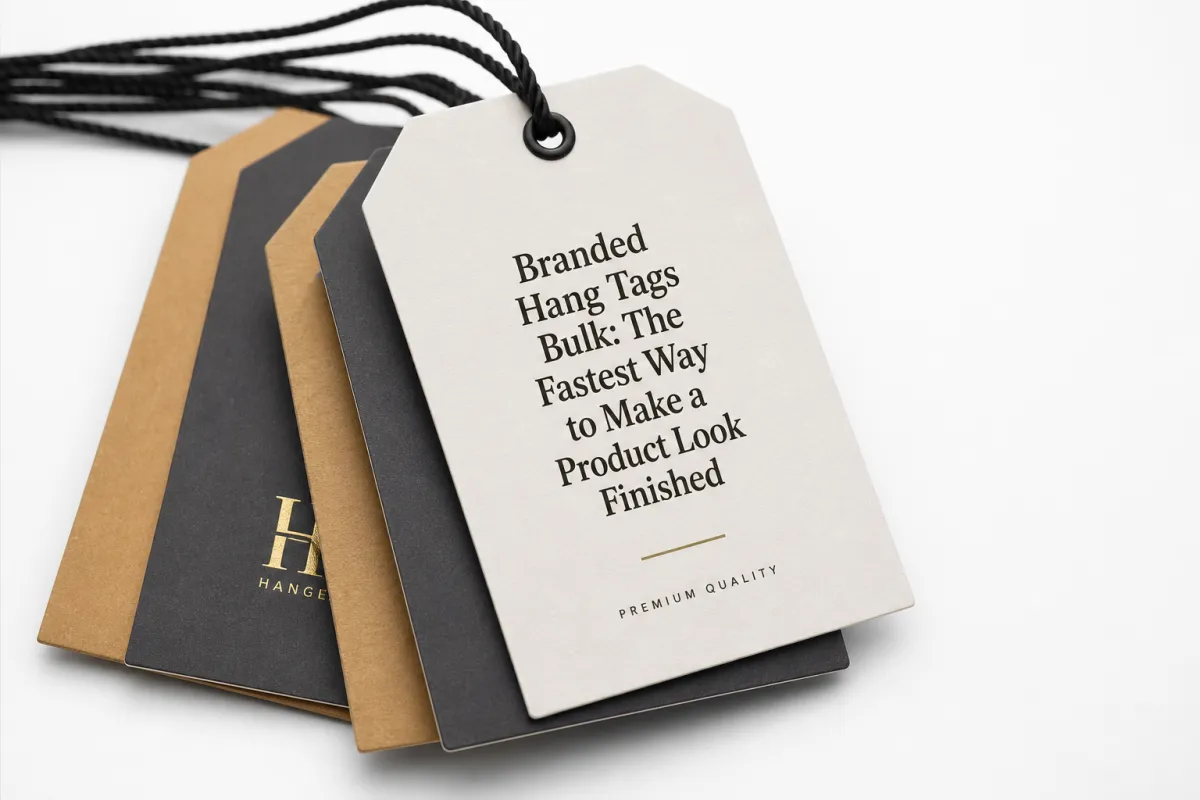
A hang tag carries more responsibility than people expect at first glance. It frames the brand, gives the shopper useful information, and helps the product feel complete instead of unfinished. A plain item can still sell, but once a well-made tag is attached, the product reads as stocked, intentional, and ready for retail. That is why branded hang tags bulk orders show up so often in apparel, jewelry, candles, stationery, and gift packaging.
Poor tags pull attention in the wrong direction. Thin stock buckles near the punch, ink coverage goes muddy, and rough trimming leaves edges that look rushed the moment a customer picks up the item. I have seen a tag with a weak punch slot make an otherwise polished product feel oddly underbuilt, and that little mismatch can be enough to soften the sale. Branded hang tags bulk reduces that risk because the setup cost is spread across the run, which usually makes it easier to choose better stock, keep print quality stable, and avoid last-minute reorders that arrive with the wrong look or the wrong feel.
Buyers tend to focus on a few practical details:
- Apparel needs tags that hang straight, feel durable, and stay readable on a rack.
- Accessories need compact tags that do not overpower the product.
- Gift items benefit from a short brand note or message that adds polish.
- Handmade goods often use branded hang tags bulk to make a small line feel retail-ready.
- Wholesale packaging needs consistent tags that can be reordered without redesigning the system.
Bulk ordering matters for more than unit price. It gives you tighter control over color, thickness, cut quality, and finishing. That matters a lot when a brand sells several SKUs or restocks through the season. One run of tags should not look warm gray while the next shifts blue because a file was handled differently or the stock changed. With branded hang tags bulk, the aim is repeatability. Same stock. Same die. Same print setup. Same result.
Hang tags also need to work with the rest of the packaging set. Labels, folding cartons, and outer shipping presentation should feel like they belong to the same brand, not a patchwork of separate decisions. Many teams coordinate hang tags with other pieces from Custom Labels & Tags or plan broader volume buying through Wholesale Programs. The goal is not ornament. The goal is consistency that makes the product feel established.
If a tag feels flimsy in hand, people often assume the product is flimsy too. They may never say that sentence out loud, but the price they assign to the item changes anyway.
That is the part buyers notice after the fact. In a store, on a countertop, or during an unboxing moment, branded hang tags bulk creates a small surface with outsized influence. The strongest tags fade into the packaging experience. The weak ones become the thing everyone remembers for the wrong reason.
Product Details: Materials, Shapes, and Finishes That Actually Matter
Paper stock changes everything. A branded hang tags bulk order for a matte fashion line should not use the same stock as a glossy promo item or a recycled craft product. Material selection affects stiffness, print sharpness, edge quality, and the way the tag feels when someone flips it over in hand. That is not marketing language. It is how the substrate behaves on press and after trimming.
Common materials
Coated paperboard is the most dependable choice for many branded hang tags bulk jobs. It prints cleanly, carries fine detail well, and gives crisp color on digital and offset setups. A 14pt to 18pt sheet works for a lot of applications. Premium products, heavier garments, and tags that need a more substantial feel often benefit from 24pt stock or thicker.
Uncoated stock gives a softer, more natural surface. It accepts pencil, pen, and stamps better than glossy paper, which makes it useful for artisan goods, eco-minded brands, and products that include handwritten notes or batch numbers. Kraft stock takes that same idea and adds a brown base that feels earthy and practical. If the brand leans natural, low-waste, or handmade, kraft branded hang tags bulk can fit the tone without forcing it.
Recycled paper works well for buyers who want a more sustainable paper choice and can live with a little texture variation. Fine lines and tiny type need more care on recycled sheets, since the surface is not always as smooth as coated board. Buyers chasing a more polished look usually land on heavier card stock or specialty coated board instead. In practice, this is one of those choices that sounds small in a quote and then becomes obvious the moment the finished tags are in hand.
| Material | Best Use | Typical Feel | Cost Impact |
|---|---|---|---|
| Coated paperboard | Apparel, retail, logo-heavy tags | Clean, sharp, structured | Usually the most efficient choice |
| Uncoated stock | Handmade goods, natural brands | Soft, writable, organic | Moderate; depends on thickness |
| Kraft | Eco-focused products, rustic branding | Textured, earthy, casual | Moderate; simple finishes work best |
| Heavier card | Luxury accessories, premium retail | Dense, rigid, high-end | Higher, especially with specialty finishing |
Shape choice affects cost, packout, and the overall feel of the tag. Standard rectangles remain the most practical route for branded hang tags bulk because they fit most identities, stack efficiently, and keep die complexity low. Rounded corners soften the look and reduce wear at the edges. Custom die-cuts can help a product stand apart, although they add tooling cost and usually stretch the timeline a bit. Foldover tags are useful when the brand needs more copy space without increasing the visible footprint. Specialty shapes can work, but only when the shape supports the product rather than distracting from it. A shape chosen just to look different often stops feeling clever very quickly.
Finishes deserve the same discipline. Matte usually gives the cleanest, most readable result. Gloss brightens color and creates a slicker surface, though it can catch light under retail fixtures. Soft-touch feels premium and works well for higher-margin goods, while also adding cost and sometimes showing wear a little sooner if the tag is handled constantly. Foil brings shine and a more elevated presence, but it works best in small, controlled areas. A border, symbol, or logo hit can look refined. Foil across every surface can look overworked.
Spot UV adds contrast on a logo or pattern without changing the full surface. Embossing and debossing add tactile depth and usually perform best on thick stock and simple graphics. If the brand already has a strong visual system, piling on every finish usually makes the tag feel crowded. In branded hang tags bulk, finish should support the product and the message, not shout over them.
Attachment choices matter just as much as print. Pre-punched holes are standard, but the punch position should be matched to the shape, the stock thickness, and the hardware used on the product. Buyers can choose string, elastic loop, safety pin, plastic fastener, or no attachment at all if assembly happens later in the chain. For branded hang tags bulk runs, deciding this early helps avoid problems with carton packing, assembly time, and shipping weight.
Durability is part of the conversation too. If the tags are moving through distribution with other packaging materials, it helps to think about how they will hold up to handling, stacking, and transit. Packaging teams often borrow the same mindset used in handling guidance from groups like ISTA: will the piece survive packing, movement, and shelf handling without scuffing or curling in a way that changes how the brand looks?
Specifications to Lock In Before You Order
Most delays in branded hang tags bulk orders come from missing information rather than printing problems. The press can only quote accurately when the size is final, the stock is known, and the artwork is ready for production. Buyers save time by locking in the core specs before they request pricing. It sounds obvious. Plenty of projects still skip that step because everyone is juggling five other launch details at the same time.
Start with the final size. A 2 x 3.5 inch tag and a 3 x 5 inch tag behave very differently in layout space, cost, and carton count. Then confirm the paper thickness. A 14pt card and an 18pt card feel different in hand and react differently at the punch and fold. After that, decide on the print sides. Single-sided printing costs less, while double-sided tags often give enough room for care instructions, UPCs, and a short brand story.
Color choice Changes the Quote as well. CMYK covers most designs well. If the brand depends on a precise identity color, Pantone matching may be the better route. That adds control, and it may also add setup time and cost. For branded hang tags bulk, the right answer depends on how strict the brand is about color fidelity and how many SKUs need to match. If you are matching to an existing package line, a slight shift in gray or black can feel bigger than it looks on screen.
File prep should be clean and unambiguous. A vector logo is better than a low-resolution image. Photos need enough resolution to hold up in print. Small type should be sized for readability, not squeezed into the corner because there was room left on the artboard. The safe area around the hole punch matters because nobody wants a fastener clipping the logo. Barcodes should stay high-contrast and clear of busy artwork. QR codes need to be tested before production. A code that does not scan is not a feature. It is a problem.
Use this checklist before approving branded hang tags bulk artwork:
- Final size and shape confirmed
- Stock type and thickness selected
- Print sides and color system approved
- Bleed and safe area verified
- Hole placement checked against the design
- Barcode or SKU data tested for readability
- Finish and attachment method confirmed
Operational details matter too. Will the tags arrive flat, boxed by count, or pre-assembled with string? How many units should go in each carton? Do they need to be banded in sets of 50, 100, or 500? These choices affect labor, packing time, and the chance of damage. Bulk buyers often discover too late that pre-assembly is not a small add-on at all; it can become a major cost line. That is the kind of thing that looks minor in a spreadsheet and then shows up everywhere in production.
Proofing is worth the attention it gets. Ask for a digital proof so the layout and content can be checked carefully. If the job depends on exact color, a physical sample or paper proof is the safer path when the schedule allows it. The extra step costs far less than reprinting thousands of tags because the logo printed too dark or the punch landed too close to the edge. A disciplined approval process is part of the value of branded hang tags bulk, not a nuisance attached to it.
If broader packaging coordination is part of the project, a review of Case Studies can help you see how similar tag setups have been handled across product categories. Buyers often care less about inspiration than they do about the actual decisions behind the result: what stock was chosen, how the print held up, and how the tags worked with the rest of the packaging stack.
Branded Hang Tags Bulk Pricing, MOQ, and Where the Real Cost Comes From
Pricing for branded hang tags bulk usually comes down to quantity, paper stock, printing method, finishing, and assembly. That is the short version. The fuller version is a bit messier. Setup cost hurts the most on small runs, while labor and finishing start to matter more as the order becomes more complex. Honest pricing is easier to read when it is itemized. If the quote is not itemized, you are comparing guesses rather than real options.
For a plain flat tag on solid cardstock, buyers may see approximate ranges around $0.08-$0.18 per unit at 5,000 pieces, depending on size, ink coverage, and whether one or both sides are printed. Add a custom shape, foil, or assembly, and the number can climb quickly. At smaller quantities, the unit cost often lands closer to $0.20-$0.45+ because setup fees have fewer pieces to spread across. Those numbers are broad, but they keep expectations grounded before the quote arrives. They also make it easier to spot when a quote is either unrealistic or missing something important.
MOQ depends on the print method, the stock, and the complexity of the die. Simple flat branded hang tags bulk orders can often start lower than specialty jobs, while custom die-cuts or foil-heavy tags usually need a larger quantity before the economics make sense. If a quote seems unusually cheap, ask what is missing. Proofing, tooling, assembly, and freight are often the pieces left out first. That is how a tidy estimate becomes a messy invoice later on.
Here is a practical comparison that usually helps buyers sort the options:
| Option | Typical MOQ | Typical Lead Time | Price Behavior | Best Fit |
|---|---|---|---|---|
| Simple flat tag | Lowest | Fastest | Lowest unit cost at scale | Basics, reorders, large SKU sets |
| Custom shape | Moderate | Longer | Tooling adds setup cost | Distinct branding, retail launch |
| Foil or emboss | Moderate to high | Longer | Higher due to finish setup | Premium product lines |
| Pre-assembled tags | Moderate | Longer | Labor pushes price up | High-volume retail packing |
The most useful way to compare branded hang tags bulk quotes is to ask six questions: What stock is included? What finish is included? Is proofing included? Is tooling included? Is assembly included? Is freight included? If any answer is “no” or “optional,” the quotes are not truly comparable. The visible price and the real price are not the same thing.
There is a tradeoff between flexibility and unit economics. Smaller runs make it easier to change the design, which helps when the product line is still evolving. Larger branded hang tags bulk orders lock in better pricing and stronger consistency, while also asking for firmer planning. That tradeoff is normal. Low cost and quick changes rarely belong to the same order.
Sustainability goals can shape cost too. FSC-certified stock, recycled board, and lower-ink coverage may nudge pricing up or down depending on the project. Buyers who need environmental proof points can use the FSC standard as a clear reference for paper sourcing. The useful part is not the label alone. The useful part is asking for the actual paper spec instead of settling for a broad green claim.
Brands that want recurring volume pricing or a wholesale buying path can pair branded hang tags bulk with a longer-term purchasing plan through Wholesale Programs. That is often where the strongest repeat economics appear, especially when the tag format stays stable from season to season and only the artwork changes.
Process and Timeline for Bulk Hang Tag Orders
A clean production flow matters more than many buyers expect. Branded hang tags bulk moves faster when the approval chain is short and the specs are settled before the quote turns into a job ticket. The standard path is simple enough: request a quote, confirm the size and material, review the proof, approve production, print, finish, inspect, and ship. Fewer handoffs usually mean fewer errors, which is nice in theory and even nicer when the freight truck is already booked.
For a straightforward digital or offset job, a realistic timeline often lands around 7-12 business days after proof approval, depending on workload and shipping destination. Custom shapes, foil, embossing, and larger quantities can move the schedule into the 12-20 business day range or beyond. Assembly adds time. Artwork revisions add time. Printing is rarely the bottleneck. Approval delays usually are.
Several things slow branded hang tags bulk production down:
- Missing final artwork files
- Unclear size or hole placement
- Color corrections after proof review
- Barcode or SKU revisions late in the process
- Approval delays from multiple stakeholders
- Freight interruptions or destination changes
A few habits keep the order moving:
- Send print-ready files up front
- Confirm quantity and stock before quoting
- Use one decision-maker for proof approval
- Check all variable data before file release
- Choose assembly only if it is truly needed
Inspection is easy to overlook and expensive to skip. A bulk run should be checked for trim accuracy, punch alignment, color consistency, and finish quality before it leaves production. That is standard work, not an upgrade. If the order is shipping into a distribution center or supporting a retail rollout, carton labeling and pack counts should be clear enough that the receiving team does not need to open every box to find out what is inside.
Shipping deserves a practical eye as well. Hang tags are light, yet they can still curl, dent, or scuff if they are packed badly with other materials. If the order is moving through mixed freight, it makes sense to ask how the cartons are protected and whether the packing method follows the same general handling expectations used across packaging distribution. Those details are not glamorous, but they keep avoidable damage out of the process.
For products that need coordinated packaging support, branded hang tags bulk works best as part of a wider package system rather than as a one-off piece. A tag, label, insert card, and outer carton should feel like they came from the same brand family, not from four unrelated vendors all making separate guesses.
Why Choose Us for Branded Hang Tags Bulk Orders
Packaging experience saves buyers from costly guesswork. We help customers choose stock, finish, and assembly based on how the product will be sold, handled, and replenished. That sounds straightforward, but the choice is rarely simple. A tag that works well for a fashion line may be the wrong fit for a candle brand, and a heavy premium tag may be wasted on an accessory that needs to stay price-sensitive.
What buyers usually want from branded hang tags bulk orders is consistency. They want the same color on reorder. They want the same die line. They want the same hole position. They do not want to explain the design from scratch every time they restock. Good vendors make reorders boring in the right way. Boring, in this case, is a compliment.
Proof accuracy matters for the same reason. A strong proof shows the real size, finish direction, hole placement, and barcode position before production starts. If there is a problem, it should show up there rather than after thousands of tags have already been printed. In bulk work, “close enough” is a fast route to paying twice. Nobody wants that kind of surprise.
Service matters in the ordinary, unglamorous ways. Clear communication. Honest estimates. QC checks that catch print drift before shipment. Straight answers about whether assembly is worth the added cost. Buyers do not need a pitch. They need facts. That is especially true on branded hang tags bulk jobs, where the smallest decision can change the whole order.
We also work well with teams that are growing. A brand may start with a small craft run and then need retail quantities. A seasonal drop may need hang tags that coordinate with boxes and labels. A product line may move into wholesale and need steady packaging across several retailers. These are normal growth shifts, and branded hang tags bulk is often one of the first places they show up.
If you want to review packaging examples before you commit, our Case Studies page is a practical place to see how different stock, size, and finish combinations behave in real product settings. The strongest lessons usually come from the details: what was specified, why it was chosen, and how the final tag worked with the rest of the packaging.
We also pay attention to sourcing and durability. Paper choice, coating choice, and assembly method should fit the product, the budget, and the distribution channel. If one of those pieces is off, the order will feel wrong no matter how sharp the artwork looks on screen.
Next Steps for Ordering Branded Hang Tags Bulk
If you want a clean branded hang tags bulk order, start by gathering the basics: tag size, quantity, stock preference, finish preference, artwork files, and the date the tags need to arrive. That is enough to build a serious quote. The rest becomes easier once those decisions are locked in.
Send the brief with the product type, target budget, shipping destination, and whether pre-assembly is needed. Those details change the quote more than most buyers expect. A 5,000-piece apparel tag order with string attached is not the same job as a 5,000-piece flat tag pack that ships loose in cartons. Same keyword. Different production reality.
Approval should stay simple: review the proof, confirm color and hole placement, and approve production only when the layout is correct. If the logo is too close to the edge, fix it before printing. If the barcode is difficult to scan on the proof, do not assume it will improve in production. It will not.
A practical buying plan for branded hang tags bulk usually follows this path:
- Pick one or two stock options that fit the product.
- Confirm whether the order needs plain tags or pre-assembled tags.
- Request an itemized quote with setup, tooling, and freight listed clearly.
- Approve the proof quickly if the launch date matters.
- Place the order early enough to leave room for a revision if needed.
One more practical point: the tag should not be the only packaging decision that gets attention. It needs to work with the rest of the presentation. A matte, understated box can feel disconnected if the tag is hyper-glossy. A premium minimal product often feels right with a thick stock and a small foil accent. An earthy handmade line usually looks better with uncoated or kraft paper. The aim is not to impress printers. The aim is to help customers understand the product faster and feel good about picking it up.
Branded hang tags bulk works best when the order is treated like a production item rather than an art project. Clear specs. Fast approvals. A realistic view of cost versus finish. Do those things well, and the tags do exactly what they should: they make the product look finished, keep the brand consistent, and keep avoidable delays out of the way. That is the point of branded hang tags bulk, and it is the part worth getting right the first time.
FAQ
What is the usual MOQ for branded hang tags bulk orders?
MOQ depends on material, print method, and whether the tag is custom-shaped. Simple flat tags can often start lower than specialty die-cut or foil jobs. Ask for the MOQ before quoting because setup costs change the economics quickly, and branded hang tags bulk pricing can look very different once tooling is included.
How long does branded hang tags bulk production usually take?
Standard jobs move faster once artwork is approved and specs are locked. Custom finishes, large quantities, and assembly add time to the schedule. The safest way to protect a launch date is to approve proofs promptly, especially when branded hang tags bulk orders include multiple SKUs or variable data.
Which material is best for branded hang tags bulk apparel orders?
Heavier card stock usually works best for apparel because it feels sturdy in hand. Kraft or uncoated stock fits natural, eco-focused branding better. Gloss or soft-touch works better when the tag needs a more premium retail feel. The right answer depends on the product, but branded hang tags bulk apparel work usually starts with a strong, clean card stock.
Can I include barcodes or SKU numbers on branded hang tags bulk runs?
Yes, if the artwork and data are prepared correctly before production. Keep barcode areas clean and high contrast so scanners read them reliably. Variable data is possible, but it needs a tighter file check and proof review. That is especially true for branded hang tags bulk Orders That Ship into retail or distribution channels.
How do I keep branded hang tags bulk pricing under control?
Keep the shape simple, the finish practical, and the print setup efficient. Increase quantity when possible because unit cost usually falls as setup gets spread out. Ask for an itemized quote so you can see what is driving the price, because branded hang tags bulk costs are usually predictable once the specs are clear.


