Buyer Fit Snapshot
| Best fit | Custom Beverage Carrier Boxes Supplier projects where brand print, material claims, artwork control, MOQ, and repeat-order consistency need to be specified before quoting. |
|---|---|
| Quote inputs | Share finished size, material target, print colors, finish, packing count, annual reorder estimate, ship-to region, and any compliance wording. |
| Proofing check | Approve dieline scale, logo placement, barcode or warning zones, color tolerance, closure strength, and carton packing before bulk production. |
| Main risk | Vague material claims, crowded artwork, missing packing details, or unclear freight terms can make a low unit price expensive after revisions. |
Fast answer: Custom Beverage Carrier Boxes Supplier: Board, Finish, Dieline, and Unit Cost should be specified like a repeatable production item. The safest quote records material, print method, finish, artwork proof, packing count, and reorder notes in one written spec.
Production checks before approval
Compare the actual filled-product size with the drawing, then confirm tolerance on folds, seals, hang holes, label areas, and retail display edges. Reserve space for logos, QR codes, warning copy, and material claims before decorative graphics fill the panel.
Quote comparison points
Review material grade, print process, finish, sampling route, tooling charges, carton quantity, and freight assumptions side by side. A quote is only useful when the supplier can repeat the same color, closure quality, and packing count on the next order.
A custom beverage carrier boxes supplier does a lot more than slap a logo on a tray and call it done. The real job is keeping filled drinks upright, secure, and presentable from the filling line to the customer handoff. A dripping six-pack at the counter is not a cute problem. It turns into rework, shrink, and a customer who may not come back. A good custom beverage carrier boxes supplier takes drink count, container shape, load weight, and branding goals and turns them into Packaging That Works in real life, not just in a mockup that looks nice under studio lights.
That difference matters. Beverage carriers sit in a messy middle between product packaging, retail packaging, and day-to-day operations. They have to hold wet bottles, survive quick packing, stack without collapsing, and still look credible in front of a customer. The right custom beverage carrier boxes supplier knows the board price is only one line in the budget. Labor, damage reduction, and fewer reboxing headaches usually decide whether the package saves money or quietly burns it.
What a custom beverage carrier boxes supplier actually does
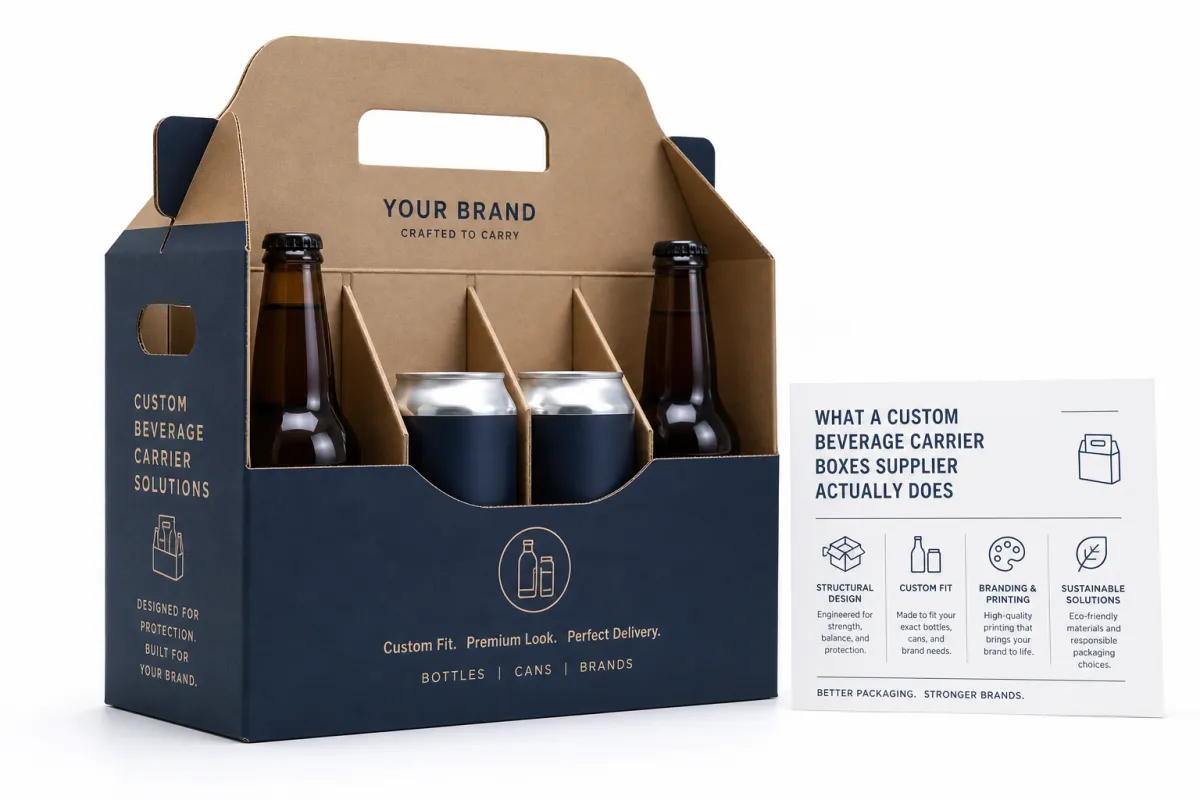
From a buyer’s point of view, a custom beverage carrier boxes supplier turns operating facts into a physical structure. How many drinks are in the pack? Glass bottles, aluminum cans, paper cups, or a mixed set? Is the carrier going into a café, a bottling line, a convenience store, or a gift station? Each answer changes the structure, the board grade, and the printing approach. A carrier for four 12 oz cans is not the same thing as one carrying two heavy glass bottles and an ice pack. Close enough is not good enough here.
This category is more operational than decorative. A custom beverage carrier boxes supplier has to think about filling, gripping, lifting, stacking, and transport, not just brand color. If the handle tears on the third carry, or the base bows when the box lands on a damp counter, the design failed. Pretty still does not equal useful. Packaging gets judged by what happens after the photo shoot.
"A carrier that looks finished on a render but fails at the counter is not finished packaging."
The best custom beverage carrier boxes supplier usually helps more buyer types than people expect. Breweries need four-, six-, and eight-packs. Beverage brands need samplers and promo bundles. Cafes and quick-service chains need order organization. Convenience retail and food service teams need takeout handoff that does not become a juggling act. Gift pack programs care about presentation, sure, but restraint still matters. In every case, the carrier has two jobs: protect the product and make the handoff less annoying.
I’ve watched teams lose a week arguing about a cleaner-looking carrier that failed the first real packout test. The board was fine. The structure was not. That happens more than people like to admit, and it usually starts with a brief that focuses on visuals before use case.
That hidden variable is where a lot of purchasing teams miss the real math. A custom beverage carrier boxes supplier may quote a board that costs a few cents more per unit, yet the total program ends up cheaper because packing is faster and damage drops. Save four or six seconds per order on a busy shift and that compounds fast. Cut breakage by even a percent or two and the packaging premium can disappear in a hurry.
I’d start here: does the custom beverage carrier boxes supplier understand the actual handling environment, or only the brand brief? The difference shows up in the questions they ask. Good suppliers ask about condensation, stacking, delivery distance, shelf display, and whether the carrier has to live in a refrigerator case. The ones who are winging it jump straight to artwork and leave the structure weak. That usually ends badly, which is somehow always surprising to people with a spreadsheet and no field experience.
How a custom beverage carrier boxes supplier builds the right box
Structure comes first
A strong custom beverage carrier boxes supplier starts with structure, not graphics. The first decisions sound simple and get complicated fast: number of bottles or cups, divider needs, handle style, and whether the carrier should be open-top, enclosed, or partly wrapped. A four-cup carrier for a coffee chain wants a different geometry than a six-bottle carrier for craft soda. A two-bottle gift carton with a die-cut window is another animal entirely. The supplier needs to map the load path so the carrier does not twist under weight.
Dimensions should follow the product, not the other way around. That sounds obvious until someone approves a drawing that looks elegant and leaves too much wobble. A bottle that rattles creates noise, scuffing, and a worse customer experience. A cup carrier that is too tight slows packing and creases the sidewall during insertion. The best custom beverage carrier boxes supplier will usually ask for finished product dimensions, not nominal label sizes, because the shoulder, cap, and rim measurements actually matter.
Material choices change behavior
Material selection is where practical packaging design shows its teeth. For lighter multi-cup carriers, paperboard or SBS can work well, especially when print quality and a clean look matter. For heavier loads, corrugated board, often E-flute or a similar light corrugation, gives better compression resistance and handle strength. Coated stocks can improve print quality and help with moisture behavior. If the carrier will be chilled or handled with condensation, a custom beverage carrier boxes supplier should talk honestly about coatings or laminations that help the board hold together longer.
There is no universal winner. A glossy coated carrier can look premium, but if it sits beside iced drinks in a delivery bag, the coating choice needs to be judged against moisture and grip, not just appearance. FSC-certified fiber is worth considering if your brand wants traceable sourcing, and the FSC system is a useful reference point for responsible paperboard procurement. A solid custom beverage carrier boxes supplier should be able to discuss that without turning the conversation into marketing fluff.
Branding and testing should be tied together
Branding matters. It just should not outrun performance. Full-bleed graphics, spot color, embossing, soft-touch coatings, matte varnish, and gloss finishes all affect cost and durability. In branded packaging, the visual layer needs to support the function, not bury it. A custom beverage carrier boxes supplier can produce Custom Printed Boxes that look polished, but the finish still has to survive handling, condensation, and repeated contact in transit or at the retail counter.
Performance checks are where the conversation gets real. Ask about compression strength, handle stress, and how the carrier behaves when stacked on a pallet or moved fast through a packing station. If the beverage program includes shipping, transit simulation matters too. The ISTA library is a useful reference for distribution test thinking, even when the supplier is not running a formal certification program. I’m not saying every carrier needs a full lab package. I am saying the supplier should know how the carton behaves under load, because that is where the money is.
Custom beverage carrier boxes supplier pricing: what drives cost
Pricing gets practical fast. A custom beverage carrier boxes supplier usually builds quotes around board type, size complexity, print coverage, finishes, inserts, tooling, and order quantity. Two carriers that look similar in a catalog can land at very different prices once they are tied to real dimensions and real use. A simple kraft carrier for a four-pack may be cheap. A high-coverage printed carrier with an insert and specialty coating will cost more. Shocking, I know.
Many buyers make the same mistake: they stare at unit price and ignore everything else. That is a narrow way to read a quote. If a cheaper carrier tears, needs extra tape, slows the packing team, or increases product damage, the “cheap” option gets expensive fast. A better custom beverage carrier boxes supplier helps you compare not just box cost, but labor, rework, waste, and freight.
Short runs and long runs behave differently. With a lower MOQ, setup cost is spread across fewer units, so the per-piece price usually rises. At larger volume, tooling and prepress costs soften and the economics improve. As a rough planning range, a straightforward beverage carrier might land near $0.18-$0.32 per unit at 5,000 pieces, while a more complex printed build can move toward $0.35-$0.65 depending on board grade, print coverage, and finishing. Those numbers are not fixed. They depend on structure, region, and how much work the custom beverage carrier boxes supplier is doing before the first sheet runs.
Freight deserves its own attention. Carrier boxes are bulky. Even flat-packed, they take cube, and cube costs money. A buyer can save on unit price and lose it back in shipping, especially if the cartons are large or the design uses extra inserts that eat pallet space. Warehousing matters too. If the package nests well and uses less pallet height, the savings may be real. If not, landed cost can surprise even experienced procurement teams.
| Board / structure option | Best fit | Typical unit cost impact | Tradeoff to watch |
|---|---|---|---|
| Kraft corrugated carrier | Utility packs, heavy loads, budget-sensitive programs | Lower | Less premium look unless the design carries the brand hard |
| SBS paperboard carrier | Retail presentation, lighter bottles or cups | Moderate | Needs moisture planning for cold drinks |
| Coated or laminated printed carrier | Brand-forward launches and gift packs | Moderate to higher | Finish choice can add cost and complicate recovery |
| Carrier with divider or insert | Glass bottles, premium sets, fragile contents | Higher | More setup and more cube in freight |
The cleanest way to compare quotes is to force each custom beverage carrier boxes supplier to quote the same spec. Ask for the board grade, caliper or flute profile, print method, finish, sample policy, tooling, and lead time. If one supplier includes structural design work and another bills it separately, the numbers are not comparable yet. Ask whether the estimate includes die-cut tooling and whether artwork proofing is part of the package. Those details can move a quote more than a small change in print coverage.
If your brand cares about recycled content or chain-of-custody claims, ask whether the stock is FSC-certified and whether printed materials need specific recycling guidance. A custom beverage carrier boxes supplier used to packaging decisions should be able to explain the tradeoff between premium finishing and end-of-life handling without hand-waving.
Step-by-step process and timeline with a custom beverage carrier boxes supplier
The process looks simple on paper and gets more detailed once production starts. A reliable custom beverage carrier boxes supplier usually begins with intake. That means product dimensions, total weight, drink count, artwork files, and any retail or shipping requirements. If the carrier will be used on a fast-moving pack line, the supplier also needs to know whether operators are loading by hand, at a station, or with automation help. Accurate intake saves expensive corrections later. Shocking how often that gets ignored.
- Share finished product dimensions, weight, and pack count.
- Confirm whether the carrier is for bottles, cans, cups, or a mixed set.
- Request a structural dieline and material recommendation.
- Review a mockup or prototype for fit and handling.
- Approve artwork, coating, and production specifications.
- Schedule production, inspection, packing, and freight.
Sampling is the stage many teams rush, and that is where small errors turn expensive. A strong custom beverage carrier boxes supplier should provide a structural mockup, a print proof, or both. Fit tests matter more than most buyers expect. A bottle that is 2 mm taller than planned can change how the flap closes. A handle that looks fine on a screen may pinch once the box is fully loaded. Before mass production starts, the carrier should be carried, set down, stacked, and ideally used by the people who will pack it every day.
Approvals should be explicit. Confirm the dieline, board grade, coating, print finish, and the test result you are accepting. If the carrier will move through distribution, ask whether the sample has been evaluated against relevant handling or transit tests, such as ISTA-style methods or comparable ASTM D4169 thinking. A custom beverage carrier boxes supplier that documents this stage well usually saves you from confusion later, especially when the order needs to be repeated under pressure.
For a simple repeat order, production might run in roughly 10 to 15 business days after approval, with freight added afterward. New structures, specialty finishes, or custom inserts can stretch that schedule. Rush freight can change the calendar more than the box itself. In practice, the timeline is not just prepress to converting. It includes tooling, print setup, converting, quality control, packing, pallet build, and shipping coordination. A custom beverage carrier boxes supplier that explains each step usually has a better grip on reality than one that only promises speed.
Common mistakes when choosing a custom beverage carrier boxes supplier
Spec creep is one of the easiest traps to fall into. A buyer starts with a simple carrier and ends up adding windows, complex folds, specialty coatings, and extra finishing because each idea sounds appealing by itself. The package gets harder to print, harder to assemble, and more expensive to ship. A good custom beverage carrier boxes supplier should be willing to push back when a feature does not help the use case. Decorative details are fine. They just need a reason to exist.
The handle is another common failure point. Many carriers fail not because the carton body is weak, but because the grip is awkward under real load. Cold beverages sweat. Glass weighs more than expected. Delivery staff move fast. In that environment, a thin handle or an unbalanced die-cut becomes a liability. The best custom beverage carrier boxes supplier will ask how many ounces the filled pack weighs, whether it will be carried one-handed, and how often it gets stacked or lifted from below.
Moisture is the quiet problem that costs the most over time. If the carrier will handle chilled drinks, iced cups, or delivery routes with temperature swings, the board needs to resist softening long enough to survive the trip. A dry shop test shows only part of the story. In actual use, condensation can soften a handle, blur print, and make the carrier feel flimsy even when the structure is technically fine. A careful custom beverage carrier boxes supplier should ask about cold chain exposure, not just shelf display.
Skipping samples is a risk that looks efficient right up until the full order arrives. A digital proof can show color and layout. It cannot fully show how the box behaves with weight, moisture, or repeated handling. A one-time prototype may feel like an extra step, but it is usually cheaper than a warehouse full of useless carrier boxes. The same logic applies to vague instructions. If the supplier does not know whether the carrier is for retail display or transport only, the design can land in the wrong place.
Communication mistakes are common and surprisingly expensive. Vague dimensions, unclear artwork expectations, and late-stage changes all slow the job. A custom beverage carrier boxes supplier works best when the brief is concrete: exact product measurements, preferred materials, target quantity, print files, and whether the carrier must coordinate with other custom printed boxes in a broader launch. Clear brief, fewer revisions. It really is that boring.
Expert tips for working with a custom beverage carrier boxes supplier
Start with a pilot run whenever the beverage program is new or changing. A pilot gives you a real look at fit, customer handling, shelf appeal, and damage rates before the bigger volume commits cash. It also shows whether the carrier makes packing easier or more annoying. In practice, a pilot is less about perfection and more about finding the failure points early. A disciplined custom beverage carrier boxes supplier should be comfortable with that, because it reduces the odds of a painful full-run correction.
Ask for testing that reflects the route, not just the artwork. If the carrier moves through a cold chain, ask about moisture testing. If it ships, ask whether load, drop, or vibration tests can be referenced. If retail staff handle it during a rush, ask for a simple stress review around the handle and the fold lines. Most buyers do not need lab drama. They need proof that the custom beverage carrier boxes supplier has thought through the daily abuse the package will face.
Design for the operator first. That means fold lines that make sense, a loading sequence that is easy to remember, and orientation cues that prevent mistakes. A packing station is not a design studio. It is loud, moving, and time-sensitive. If the carrier takes too long to assemble, labor cost creeps up. If the packer has to rotate it twice to figure out which side goes up, errors multiply. A thoughtful custom beverage carrier boxes supplier usually improves the job by reducing confusion more than by changing print.
Build a scorecard before you choose a partner. Rate communication speed, sample quality, structural guidance, price clarity, on-time delivery, and willingness to explain tradeoffs. The best supplier is rarely the cheapest quote on day one. More often, it is the one that avoids surprises on day twenty. That matters even more in branded packaging, where the package has to do real work and still support the brand story.
If you need adjacent formats, it can help to browse Custom Packaging Products for related product packaging structures and compare how carrier boxes fit into the rest of the line. A strong custom beverage carrier boxes supplier often thinks in systems, not isolated SKUs. That matters when your beverage carrier needs to coordinate with a carton, sleeve, label, or promotional shipper.
One more practical point: the best suppliers often save money by improving efficiency, not just by shaving board weight. That can mean faster loading, fewer damaged units, cleaner stacking, or less tape. A better package is not always the lightest package. Sometimes it is the one that keeps the operation calm.
Next steps after shortlisting a custom beverage carrier boxes supplier
Once you have narrowed the field, move fast but stay methodical. Send each custom beverage carrier boxes supplier the same brief: finished product dimensions, weight, pack count, artwork files, target quantity, timeline, and any moisture or shipping requirements. Ask for a quote, a prototype or sample recommendation, and a clear statement about what is included. That gives you a cleaner comparison and avoids the usual mess where one supplier quotes only print while another quotes structure, sample work, and freight assumptions too.
A simple decision matrix helps. Rank each custom beverage carrier boxes supplier on fit, durability, branding quality, operational ease, and cost transparency. If a carrier is meant for retail handoff, presentation may matter more than it would in a plain transport use. If the package will go through distribution, damage resistance and test support may matter more. The right answer depends on the use case, and the right custom beverage carrier boxes supplier should help define that instead of guessing.
Before approving a pilot order, confirm inspection criteria. What counts as an acceptable color shift? How much handle deflection is acceptable under load? Does the carrier need to pass a drop test, a moisture exposure check, or a simple fit-and-fold review? Set a reorder trigger too. If inventory drops below a threshold, the next run should already be in motion so the supply chain does not go blind. A careful custom beverage carrier boxes supplier can support that planning if you give them the volume rhythm early enough.
For buyers managing beverage launches, the right packaging partner is usually the one that reduces friction, not the one that prints the prettiest sample. If you are comparing options now, focus on structure, testing, and labor savings first. That is where the margin usually hides. The most dependable custom beverage carrier boxes supplier is the one that delivers a carrier your team can pack quickly, your customer can carry comfortably, and your finance team can justify without squinting at the spreadsheet.
My practical takeaway is simple: pick the supplier who asks the unglamorous questions first. If they want finished dimensions, handling conditions, condensation exposure, and packing speed before they start talking about finishes, you are probably in good hands. If they skip straight to a shiny render, keep looking.
What should I send a custom beverage carrier boxes supplier for an accurate quote?
Send finished product dimensions, total weight, and the exact drink count. Say whether the carrier is for bottles, cans, or cups, and include print specs, finish preferences, and target quantity. If you expect cold storage, condensation, or shipping, say that up front; those details change the material recommendation and usually the lead time too.
How long does a custom beverage carrier boxes supplier usually take to deliver?
Simple repeat orders can move faster because the structure and tooling are already approved. New designs usually take longer since they need dielines, prototypes, and fit testing before production starts. Rush schedules are possible, but they usually raise cost and can limit material or finish choices, so ask about the tradeoff before you commit.
What material is best for custom beverage carrier boxes for cold drinks?
Choose a board that can handle condensation without softening too quickly or losing handle strength. For heavier loads, a sturdier corrugated structure often performs better than a lighter paperboard build. If the carrier will be chilled or iced, ask the custom beverage carrier boxes supplier about coatings or laminations that improve moisture resistance without making the package awkward to recycle.
How do I compare two custom beverage carrier boxes supplier quotes?
Compare the full specification, not just the unit price. Board grade, print coverage, structural complexity, sampling, design support, and freight assumptions all affect value. The cheapest quote can become the most expensive one if it increases damage rates, slows packing, or forces a redesign after samples arrive.
What is the biggest mistake brands make with beverage carrier packaging?
The most common mistake is designing for appearance first and real handling second. Weak handles, poor moisture resistance, and vague sizing can turn into damaged product and unhappy customers. A small pilot test usually catches the failures that a digital proof cannot show, which is why a good custom beverage carrier boxes supplier will rarely skip that step.

