Buyer Fit Snapshot
| Best fit | Custom Biodegradable Pouches with Logo projects where brand print, material claims, artwork control, MOQ, and repeat-order consistency need to be specified before quoting. |
|---|---|
| Quote inputs | Share finished size, material target, print colors, finish, packing count, annual reorder estimate, ship-to region, and any compliance wording. |
| Proofing check | Approve dieline scale, logo placement, barcode or warning zones, color tolerance, closure strength, and carton packing before bulk production. |
| Main risk | Vague material claims, crowded artwork, missing packing details, or unclear freight terms can make a low unit price expensive after revisions. |
Fast answer: Custom Biodegradable Pouches with Logo: Film, Print, MOQ, and Carton Packing should be specified like a repeatable production item. The safest quote records material, print method, finish, artwork proof, packing count, and reorder notes in one written spec.
Production checks before approval
Compare the actual filled-product size with the drawing, then confirm tolerance on folds, seals, hang holes, label areas, and retail display edges. Reserve space for logos, QR codes, warning copy, and material claims before decorative graphics fill the panel.
Quote comparison points
Review material grade, print process, finish, sampling route, tooling charges, carton quantity, and freight assumptions side by side. A quote is only useful when the supplier can repeat the same color, closure quality, and packing count on the next order.
Custom biodegradable Pouches With Logo sound simple until the quote arrives and the language starts doing gymnastics. Biodegradable is one of those words people toss around like it explains everything. It does not. One pouch may be built for industrial composting only. Another may need strict heat and moisture conditions. A third may look green on paper and fail the actual job the second it meets grease, oxygen, or a rough warehouse floor.
That is the trap. The packaging pitch is usually cleaner than the material spec. Custom biodegradable pouches with logo can be a smart move, but only if the structure, print method, seal strength, and end-of-life claim all match the product inside. Get the mix right and you get better shelf appeal, cleaner branding, and less conventional plastic. Get it wrong and you have a pretty problem nobody can sell twice.
I have watched brands approve a pouch from a mockup, then panic when the real sample came back soft, cloudy, or weirdly fragile after a few days in a warm stock room. Packaging is rude like that. It cares about physics, not mood boards. If the material cannot handle the product, the logo is just expensive wallpaper.
This guide keeps things grounded. We will cover what custom biodegradable pouches with logo actually are, how they are produced, what pushes pricing up or down, how long the process really takes, and which mistakes turn eco packaging into an expensive headache. If you also buy Custom Packaging Products for other lines, the same rule applies: build the package around the product, not around the presentation deck.
What Custom Biodegradable Pouches With Logo Actually Are
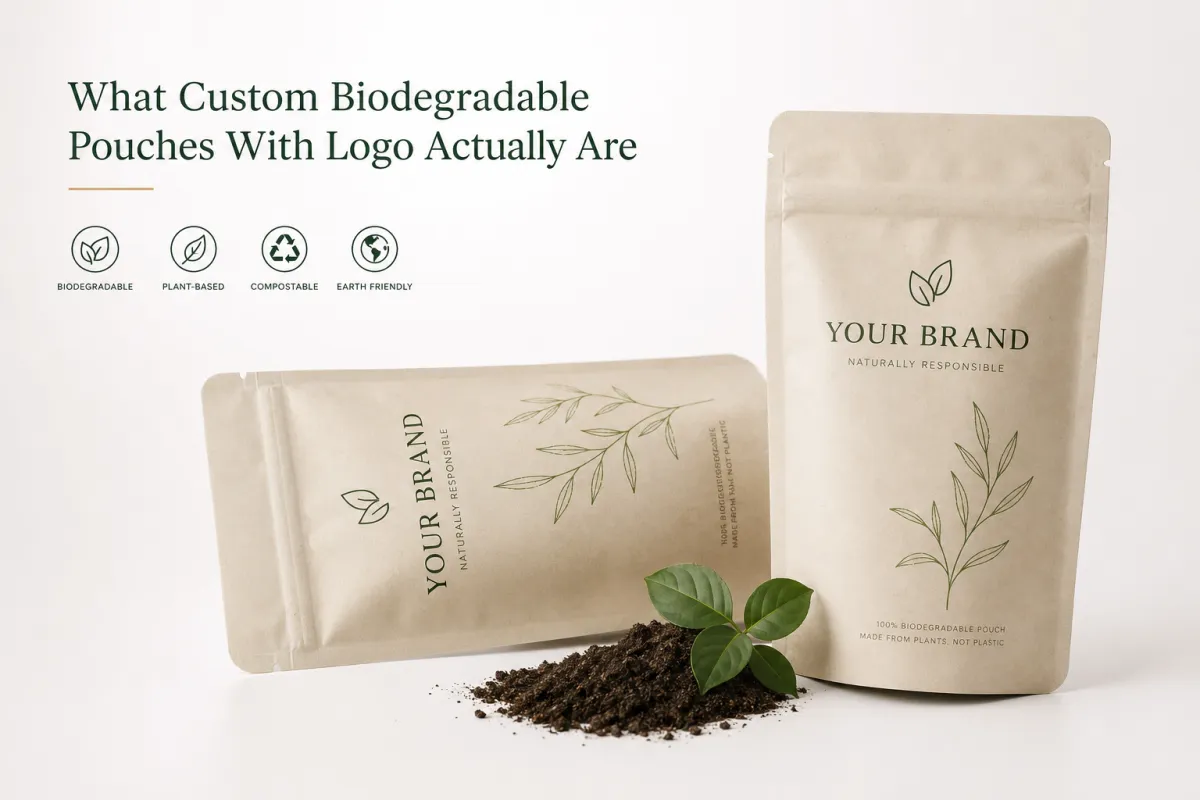
Strip away the marketing gloss and the definition is straightforward. Custom biodegradable pouches with logo are flexible packages made from materials meant to break down under specific conditions, then printed or branded for food, wellness, retail, or promotional use. That still leaves the annoying part unanswered: break down where? In compost? In an industrial facility? Under very controlled conditions only? That detail matters more than the label printed on the sales sheet.
From a buyer’s point of view, this category usually includes compostable films, cellulose-based materials, plant-derived blends, and bio-based laminations. Some are suited to dry goods. Some handle moisture better. Some are fine for lightweight sample packs and terrible for oily snacks or anything with a long shelf life. Custom biodegradable pouches with logo are not one neat material family. They are a packaging decision made up of film, barrier, print, closure, and disposal claim.
The logo is not just decoration. In production, it changes the layout. Artwork has to work around seal margins, zippers, tear notches, hang holes, barcodes, and any clear window or matte finish. A logo that looks sharp on a screen can come out muddy on a textured compostable film if the contrast is weak or the substrate eats detail. The same problem shows up in custom printed boxes: the design only works if the surface can carry it.
That is why custom biodegradable pouches with logo can look premium in one version and clumsy in another, using almost the same artwork. The material has to fit the product. The disposal claim has to fit the market. A pouch that works for tea may fall apart as a pouch for greasy granola, and a pouch that claims compostability without proof is asking for complaints, chargebacks, and awkward calls from customer service.
“A pouch does not earn points for being eco-friendly if it leaks in the warehouse. Packaging has one job before it has any story to tell: protect the product.”
If you want the short rule, here it is. Custom biodegradable pouches with logo should make the product easier to sell and safer to ship. Not harder to explain. That means the pouch has to fit the product, the shelf life, the storage conditions, and the disposal claim. Everything else is garnish.
How Custom Biodegradable Pouches With Logo Are Made
Custom biodegradable pouches with logo are built in layers, and those layers decide whether the pouch behaves like useful packaging or a delicate experiment. A typical structure may include an outer printable film, a barrier layer that controls oxygen or moisture, and a sealant layer that holds the closure together. Some builds also use coatings or liners for grease resistance and shelf stability. The exact stack depends on the product, the shelf life target, and the end-of-life claim you plan to stand behind.
Printing comes next. Flexographic printing is common for larger runs because setup cost spreads well over volume and the color consistency is usually strong once the plates are right. Digital printing works better for short runs, proofs, and artwork that changes often, though the unit cost can jump fast. Gravure can produce excellent results for large programs, but the tooling and setup make sense only when the order size is big enough to justify them. For custom biodegradable pouches with logo, the best print method is the one that fits the order size and the budget, not the one that sounds fancy in a sales call.
Here is where many buyers stumble: the logo is not being placed on a flat poster. The artwork has to respect pouch geometry, fold lines, seal zones, zipper placement, and any cutout or window. A competent prepress team will trap colors correctly, move critical text away from seals, and keep the logo from disappearing into a gusset or seam. That is basic packaging work. Basic work is often what separates polished retail packaging from something that looks rushed.
Disposal claims cause most of the confusion. Biodegradable, compostable, and recyclable are not interchangeable. They do not mean the same thing, and they should never be used that way. If a pouch is certified to a recognized standard, say so. If it is industrial compostable only, say that clearly. If disposal depends on a local system, do not pretend the answer is universal. The U.S. EPA’s composting guidance is useful background because disposal systems vary by location and material mix; see EPA composting basics for context.
Well-built pouches do not just look better. They curl less, haze less, delaminate less, and hold their shape better on the shelf. That matters even more for custom biodegradable pouches with logo that need to perform in real retail conditions instead of sitting still for a photo shoot. I have seen pouches that looked clean in a studio and then turned a little sad under fluorescent warehouse lights. Not ideal. Not subtle either.
The manufacturing sequence usually looks like this:
- Choose the material based on barrier needs and the disposal claim.
- Prepare the artwork and adjust the dieline for the pouch format.
- Set up printing, proof the design, and approve color.
- Add lamination or coating if the structure requires it.
- Slit, form, seal, and inspect the finished pouches.
- Approve samples, then move into full production.
Key Factors That Affect Performance, Branding, and Price
Custom biodegradable pouches with logo are one of those packaging buys where performance and price are tied together. Better barrier protection usually costs more. Stronger puncture resistance usually costs more. A better closure usually costs more. That is not a penalty. That is the bill for physics doing its job. Nobody is gonna bully a moisture barrier into being cheap. The smart move is spending money where the product needs it and skipping features that only look good in a quote.
Product type drives the structure
Dry snacks, coffee, powders, tea, and wellness products do not need the same pouch build. A dry herbal blend can often use a lighter compostable structure than oily granola or a powder that clumps the moment humidity rises. Coffee is its own beast because oxygen barrier matters, and aroma retention can decide whether the product gets reordered or quietly forgotten. If the product is moisture-sensitive, oxygen-sensitive, or greasy, custom biodegradable pouches with logo need a stronger barrier stack and a more careful seal spec.
The same logic applies to custom printed boxes. A box that looks premium but crushes in transit is a bad box. A pouch that looks sustainable but lets air in is bad packaging. Presentation does not cancel out failure.
Print complexity changes the brand feel
One-color logos often cost less and usually look cleaner than full-bleed artwork, especially on natural or matte compostable films. That does not mean simple is boring. A restrained logo on a matte pouch can feel more premium than a loud design trying too hard to impress. Good package branding is less about stuffing in more color and more about using contrast, spacing, and type with discipline.
High-coverage art increases ink usage, proofing time, and the chance of run-to-run variation. On rougher biodegradable materials, tiny text and thin lines can blur or fill in. If the brand wants a design-heavy pouch, the artwork should be checked against the actual film texture before anyone signs off on a bulk order. That one step saves a lot of regret later.
Certifications and compliance are not decoration
Ask for the exact standard behind the claim. Depending on the market, that may mean ASTM D6400, EN 13432, or another recognized compostability benchmark. If the pouch is industrial compostable, say industrial compostable. If it is not certified, do not let anyone dress it up like it is. For shipping performance, transit testing matters too, and the ISTA family of standards is a solid reference point for package testing practices; see ISTA testing standards for more background.
That matters because the buyer is not just buying a pouch. The buyer is buying a claim that has to survive procurement, operations, and customer service. Custom biodegradable pouches with logo can support a strong sustainability story, but only if the paperwork matches the material.
| Material option | Best for | Typical look and feel | Indicative price at 5,000 units |
|---|---|---|---|
| PLA-based compostable film | Dry snacks, tea, lightweight retail items | Smooth, clean print, often glossy or semi-matte | $0.16-$0.30 per pouch |
| Cellulose-based structure | Premium food and wellness packaging | Natural, slightly softer handfeel, good clarity in many cases | $0.22-$0.40 per pouch |
| Kraft paper with compostable barrier layer | Retail packaging with an earthy look | Matte, tactile, strong shelf presence | $0.18-$0.36 per pouch |
| Starch-blend compostable laminate | Shorter shelf-life products and promotional runs | Flexible, often best for lower-odor or dry goods | $0.20-$0.38 per pouch |
Those numbers are not promises. They are realistic buying ranges before freight, testing, artwork adjustments, and special closures get added. For custom biodegradable pouches with logo, the cheapest quote is rarely the cheapest landed cost. That part surprises people exactly once.
Closures and details quietly move the budget
Zippers, tear notches, hang holes, rounded corners, and matte finishes all add value. They also add cost. A plain three-side seal pouch usually prices lower than a stand-up pouch with a zipper and a clear window. If the brand wants custom biodegradable pouches with logo to feel premium, those details help. If the brand only needs a short promotional run, some of those extras are just expensive decoration.
The buyer’s job is not to make the pouch fancy. It is to make it fit the product and the margin. That is the difference between packaging that earns its keep and packaging that looks good in a meeting but causes grief later.
Ordering Process and Timeline for Custom Pouches
Ordering custom biodegradable pouches with logo is not difficult. It does punish vague briefs. The cleanest projects start with product dimensions, fill weight, storage conditions, target shelf life, closure preference, and logo files in a usable format. Send a screenshot and a prayer, and you will get a lot of questions back. Packaging suppliers are not going to guess your way into a production run.
Step one: define the product first
Before asking for a quote, get the basics straight. What is the product? Dry, oily, powdered, aromatic? Does it need a strong oxygen barrier? Will it sit on a shelf, in a warehouse, or inside e-commerce mailers? What fill weight are you targeting? Those details control pouch dimensions, film structure, and closure type. Custom biodegradable pouches with logo are far easier to spec when the product profile is real instead of approximate.
If the brand already sells through product packaging options or other branded packaging solutions, use those existing dimensions as the starting point. That alone can cut days of pointless revision.
Step two: sample before committing
Ask for a sample set that includes the actual structure, not just a generic mockup. Better still, request a sample printed with your logo. A blank pouch tells you very little about color, readability, or seal behavior. A finished sample tells you whether the zipper feels right, whether the pouch stands properly, and whether the logo stays legible after handling. Custom biodegradable pouches with logo should be tested with the real product, not admired in a vacuum.
Typical timing looks like this:
- Quote and initial proof: 2-5 business days.
- Artwork revisions: 3-7 business days, longer if the files need cleanup.
- Sample approval: 1-2 weeks in many cases.
- Production after approval: often 2-4 weeks, depending on material and volume.
- Freight and receiving: add transit time, customs if relevant, and warehouse intake.
Those ranges are real, not fantasy. Custom biodegradable pouches with logo can move faster if the design is simple and the supplier already stocks the right material. Complex artwork, special closures, and certification checks stretch the timeline. Most delays come from slow approvals, not from the press itself.
Step three: approve the details that actually matter
Lock in the film structure, print method, pouch dimensions, finish, closure, and disposal claim before production starts. Ask for a final proof that shows logo placement, barcode space, seal margins, and any legal copy. A common mistake is approving a pretty PDF, then discovering the nutritional panel sits too close to the edge once the pouch is formed. That is avoidable. Also annoying. Mostly annoying.
For custom biodegradable pouches with logo, good project management looks boring. That is a compliment. Boring means fewer surprises, fewer reprints, and fewer emails asking why the quote changed after the fact.
If the supplier cannot explain the process clearly, treat that as a signal. Not a disaster. Just a signal. Packaging programs with sustainability claims need structure, not improvisation dressed up as expertise.
Cost and Pricing for Custom Biodegradable Pouches With Logo
Pricing for custom biodegradable pouches with logo usually breaks into a few buckets: material cost, printing setup, pouch style, finish, certification, testing, and freight. That is the part buyers often never see because the headline number is easier to paste into a spreadsheet. Too bad the headline number is also the number most likely to leave something out.
Small runs feel expensive because setup charges are spread across fewer units. That is true for custom biodegradable pouches with logo, and it is true for most custom printed packaging. Order 2,000 units instead of 10,000 and the unit cost usually climbs because the press still has to be set up, the files still need prep, and the quality checks still happen. No supplier can wish those steps away.
Think about it this way. A basic compostable pouch with a simple one-color logo may sit near the low end of the range. Add a zipper, a stronger barrier layer, a matte finish, and certification paperwork, and the number rises. Add full-color branding, a special shape, and custom testing, and it rises again. Buyers who want the lowest number and the highest spec usually get disappointed. Physics refuses to negotiate.
| Order type | Typical MOQ behavior | Likely unit cost trend | Best use case |
|---|---|---|---|
| Short-run promotional pouch | Lower MOQ, higher setup ratio | $0.28-$0.55 | Launches, events, trial products |
| Mid-volume retail program | Moderate MOQ, balanced setup cost | $0.18-$0.36 | Core retail packaging, repeat SKUs |
| Higher-volume production | Better scale economics | $0.12-$0.28 | Stable demand, national distribution |
Use those figures as a buying compass, not a quote. Custom biodegradable pouches with logo vary by supplier, region, certification, and material availability. A supplier using a more expensive compostable film may still be the better value if the pouch performs better and cuts complaint volume.
Hidden costs matter too. Rush fees are obvious. Plate charges are sometimes obvious. Artwork cleanup, sample revisions, storage, and freight are the quiet ones that wreck budgets. The smarter move is asking for a landed cost quote. That means production, testing, and shipping are all in the same number, so you compare suppliers on reality instead of hope. If a quote leaves freight out, treat it like a half-answer.
For custom biodegradable pouches with logo, the real question is not “What is the unit price?” It is “What does the finished, shipped, approved pouch cost in my warehouse?” That question saves a lot of people from cheerful spreadsheet mistakes.
Common Mistakes Brands Make With Biodegradable Pouches
The biggest mistake is still the obvious one: choosing a pouch because the word biodegradable sounds good. That label is not a performance spec. It is not a shelf-life guarantee. It is not proof that the pouch will vanish in a backyard compost bin or disappear in a landfill like bad news. Custom biodegradable pouches with logo need more scrutiny than that.
Product mismatch comes next. Greasy, moist, oxygen-sensitive, or heavy products often need stronger barrier control than first-time buyers expect. If the pouch is underbuilt, you can end up with weak seals, fogging, swelling, brittle corners, or stale contents. Then everyone acts surprised, as if packaging were decorative. It is not. Packaging is a working part of the product.
Design mistakes cause plenty of pain too. Tiny text, low contrast, too much copy, and busy full-bleed artwork can make custom biodegradable pouches with logo look muddy once printed on a natural film. That is especially true when the material has a matte or slightly textured surface. The design may look polished on screen and fail on shelf. Packaging design is very good at punishing anyone who ignores the substrate.
“If the logo is hard to read, the pouch is not doing its job. Nice-looking packaging that confuses people is just expensive noise.”
Skipping sample testing is another expensive habit. A blank pouch can feel fine in hand and still fail once filled, dropped, stacked, or heat sealed. Real testing should check seal integrity, drop resistance, fill behavior, shelf appearance, and whether the logo stays legible after handling. If the plan is to launch custom biodegradable pouches with logo without testing them in the real product environment, that is a decision. A bad one.
Ordering too much too soon creates its own mess. Brands sometimes buy a large run because the per-piece quote looked attractive, then discover the SKU needs a packaging tweak after the first sales wave. Now they are stuck with inventory that is technically usable but visually outdated or operationally awkward. That is a slow way to lose money. Smaller validation runs are usually smarter until the structure proves itself.
There is also the compliance trap. Some buyers use one compostability claim in one market and ship the same pouch into a region with different disposal rules. That is how customer service gets buried in questions nobody wanted. Custom biodegradable pouches with logo should carry claims that match the regions where they will actually be sold.
Expert Tips and Next Steps Before You Place an Order
If you want custom biodegradable pouches with logo to work hard, start with the product, not the story. The sustainability story matters. It just cannot rescue the wrong structure. Ask for a sample filled with your actual product. A pouch that looks good empty can behave very differently once it is full, sealed, stacked, and shipped.
Use a simple test plan before you approve bulk production:
- Seal test: check for leaks after filling and heat sealing.
- Drop test: simulate warehouse handling and retail transport.
- Shelf test: leave the pouch on display and see if it stands, curls, or fades.
- Readability test: confirm the logo, barcode, and legal text stay clear.
- Disposal review: verify the claim against the actual certification and regional rules.
Ask for the spec sheet, print method, certification proof, and exact lead time before comparing quotes. If a supplier cannot give you those four things clearly, the quote is not complete. It is just a number on a screen. Good suppliers will also tell you what not to do, which is often more useful than a polished pitch.
For brands unsure about volume, start with the smallest viable run. That gives you room to test demand, adjust artwork, and confirm that the pouch survives storage and shipping. Custom biodegradable pouches with logo can scale later. Fixing a bad structure after a giant buy-in is much harder, and much more annoying.
Here is the short version of the buying checklist:
- Define the product, shelf life target, and storage conditions.
- Choose the material stack based on barrier needs and disposal claim.
- Approve artwork only after checking seal zones and pouch geometry.
- Request a printed sample with the actual logo.
- Confirm landed cost, not just base unit price.
- Test the pouch with the real product before full production.
The practical takeaway is simple: decide on the product, shelf life, and disposal claim before you approve artwork. If those three things are still fuzzy, the pouch spec is not ready. Custom biodegradable pouches with logo should protect the contents, support the brand, and give customers a clear disposal story. Anything less is packaging pretending to be strategy.
For brands building retail packaging or broader branded packaging programs, the same rule keeps winning: performance first, then visual polish, then claims that can survive scrutiny. That is how custom biodegradable pouches with logo stay useful instead of turning into a costly lesson.
FAQ
Are custom biodegradable pouches with logo the same as compostable pouches?
No. Biodegradable is a broad claim, while compostable usually refers to a specific breakdown standard under defined conditions. Custom biodegradable pouches with logo may be compostable, but you should ask for the exact certification or test standard before assuming the pouch will behave the way the sales sheet suggests. Local disposal systems also vary, which is where a lot of confusion starts.
How much do custom biodegradable pouches with logo usually cost?
Cost depends on pouch size, material stack, print coverage, closures, certification, and order volume. Small runs are usually more expensive per unit because setup costs are spread across fewer pieces. For custom biodegradable pouches with logo, ask for a landed cost that includes production, testing, and freight so you can compare suppliers on the same footing.
What products work best in custom biodegradable pouches with logo?
Dry goods, snacks, tea, powders, and some wellness products often work well if the barrier level matches the product. Anything sensitive to oxygen, moisture, grease, or aroma needs more careful testing. Custom biodegradable pouches with logo should be chosen for shelf-life needs first, then for the sustainability story.
How long does it take to produce custom biodegradable pouches with logo?
Proofing and sample approval often take a few days to two weeks, depending on artwork changes and supplier workload. Production commonly takes about 2-4 weeks after approval, though complex jobs can take longer. Shipping, customs, and warehouse receiving should be added on top of factory lead time for a realistic timeline.
What should I ask a supplier before ordering custom biodegradable pouches with logo?
Ask for the material specification, print method, certification proof, expected shelf-life performance, minimum order quantity, setup fees, sample options, and exact lead time. Request a sample printed with your logo so you can check color, readability, and seal quality on the actual pouch. Custom biodegradable pouches with logo are worth ordering only when the claim, structure, and product all line up.

