Buyer Fit Snapshot
| Best fit | custom pouches with logo cost for packaging buyers comparing material specs, print proof, MOQ, unit cost, freight, and repeat-order risk where brand print, material, artwork control, and repeat-order consistency matter. |
|---|---|
| Quote inputs | Share finished size, material target, print colors, finish, packing count, annual reorder estimate, and delivery region. |
| Proofing check | Approve dieline scale, logo placement, barcode or warning zones, color tolerance, and any recyclable or compostable wording before bulk production. |
| Main risk | Vague material claims, crowded artwork, or missing packing details can create delays even when the unit price looks attractive. |
Fast answer: Custom Pouches With Logo Cost: Pricing, MOQ, and More should be specified like a repeatable production item. The safest quote includes material, print method, finish, artwork proof, carton packing, and reorder notes in one written spec.
What to confirm before approving the packaging proof
Check the product dimensions against the actual filled item, not only the sales mockup. Ask for tolerance on folds, seals, hang holes, label areas, and retail display edges. If the package carries a logo, QR code, warning copy, or legal claim, reserve that space before decorative graphics fill the panel.
How to compare quotes without losing quality
Compare board or film grade, print process, finish, sampling route, tooling charges, carton quantity, and freight assumptions side by side. A lower quote is only useful if the supplier can repeat the same color, closure quality, and packing count on the next order.
For a buyer comparing packaging options, custom pouches with logo cost usually has less to do with the logo and more to do with the pouch itself. Material choice, print setup, sealing method, finishing, and shipping all show up in the number. A plain stock pouch can be cheap because it already exists. A branded pouch has to be built, printed, checked, and sent out without falling apart on the way there. That extra work is not invisible. It is the bill.
The real question is not, “How do I get the cheapest quote?” Cheap is easy. Cheap and usable is the part people struggle with. A better question sounds more like this: “How do I get the right pouch, with the right barrier, at a unit cost that still leaves room for margin?” That is the practical side of custom pouches with logo cost. Once the product, fill weight, shelf life, and shipping path are defined, the pricing stops feeling random and starts behaving like math.
I have watched buyers get tripped up by one tiny decision that looked harmless on a screen. A window moved three millimeters. A matte finish got swapped in. A zipper got added because “it seemed useful.” Then the quote changed. Not because the supplier was playing games, but because packaging is annoyingly physical. You can’t pretend it isn’t.
Why Custom Pouches With Logo Cost More Than Plain Stock
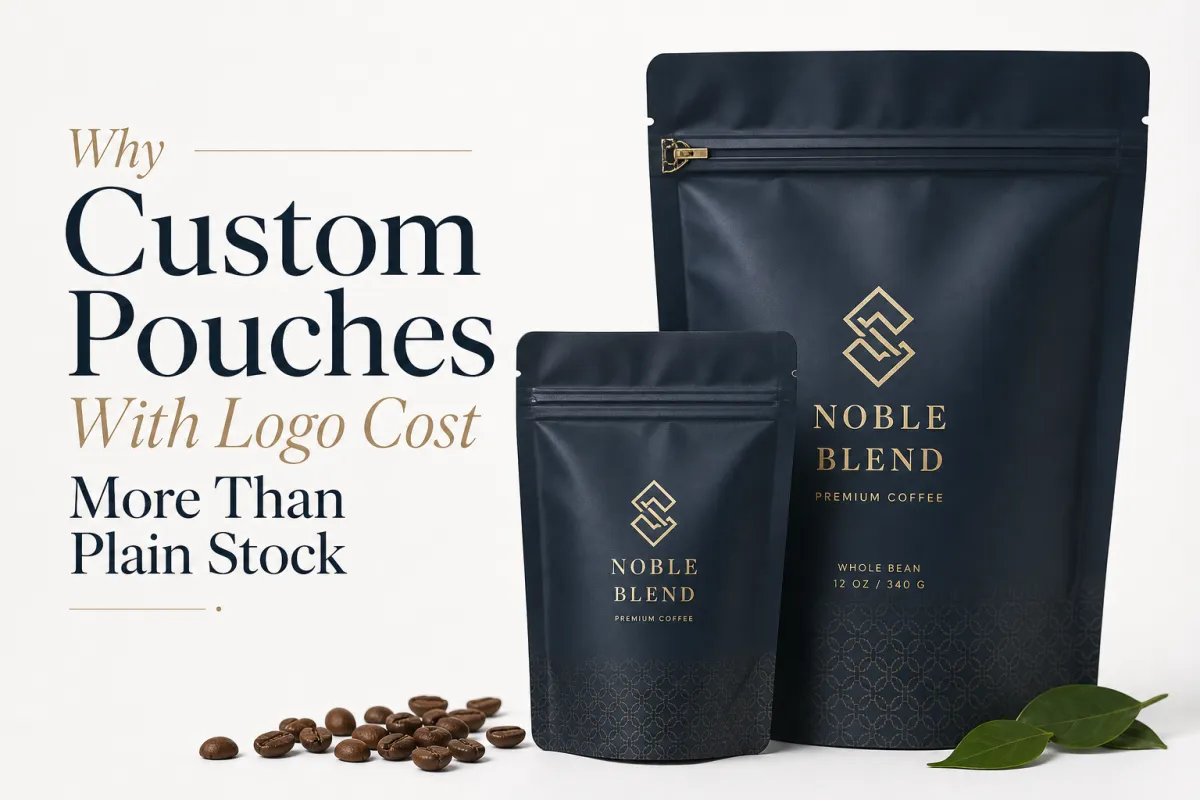
A stock pouch comes from an existing format. The supplier already has it, so the process is faster and the setup is lighter. A custom branded pouch asks for more. It usually needs a specific film structure, print files, color matching, converting, and sometimes a few rounds of proofing before anyone touches production. That is why custom pouches with logo cost more than a plain pouch, even when the logo is tiny and the artwork looks simple from a laptop screen.
Structure comes first. If the product needs moisture protection, oxygen resistance, aroma retention, or UV shielding, the film stack changes. A basic PE pouch is not the same thing as a PET/PE laminate, a foil laminate, or a high-barrier coex structure. Those materials are not expensive for fun. They do more work. They protect freshness, support shelf life, and keep the pouch from failing during transit with weak seals, pinholes, or ugly curling that makes a package look tired before it reaches the shelf.
Finishing can move the price in a way that surprises people. A matte varnish, soft-touch feel, zipper, hang hole, or clear window may change the quote more than one extra ink color. I have seen jobs where switching from gloss to matte mattered more than moving from a two-color logo to a three-color logo. Custom pouches with logo cost often shifts because of those little decisions that look cosmetic until they hit the converting floor. Packaging people know this. Casual buyers usually do not, and honestly, why would they?
The useful move is to build the quote from the product outward. Start with what is going inside the pouch, how long it needs to stay stable, and how the finished pack will be handled. Coffee, powders, pet treats, and bath salts all behave differently, so they do not get the same spec. A pouch that looks good but leaks, tastes stale, or tears in shipping is not a bargain. It is a headache with a barcode.
Cheap packaging is not a win if it fails in the real world. Good packaging prints cleanly, survives filling, ships safely, and gives the buyer a cost they can repeat without crossing their fingers.
Experienced buyers know this already. They do not just ask about artwork. They ask about the film, the closure, the finish, the run size, and the delivery terms. In branded packaging, the pouch has two jobs. It has to sell the product and protect it. If either one slips, the savings vanish fast. That is the part people sometimes learn the expensive way.
What Drives Custom Pouches With Logo Cost?
Several variables push custom pouches with logo cost up or down, and most of them are tied together. Size is one of the obvious ones. A larger pouch uses more substrate, more ink, more handling, and more converting time. Material structure matters just as much. A high-barrier laminate costs more than a simple clear film because it does more than sit there looking pretty. It protects the product. Print method, number of colors, finish, and add-ons sit on top of that base structure and keep stacking the final number.
Print method is a major fork in the road. Digital printing makes sense for shorter runs, multiple SKUs, or projects that need quick setup and low prepress overhead. Flexographic production usually works better at higher volume because the setup cost gets spread across more pieces, which brings the unit price down as the order grows. Gravure-style production can fit very large programs where throughput and consistency matter, though it usually comes with bigger commitments and more setup. The right choice depends on quantity, artwork complexity, and how fast you need the finished pouches in hand.
Artwork Changes the Quote too. A simple one-color logo on a light background is easier to manage than a full-bleed design with metallic effects, white ink, or tight gradients. If the printer needs several proof rounds to match a brand color properly, that adds time. If the logo sits on a textured or metallic surface, the result can shift again. A logo is rarely just a logo in production. It is part of a full print system, and the surface matters just as much as the file.
Logistics show up in the total too. Carton counts, pallet configuration, freight distance, and delivery timing can all change the landed price. Sometimes freight barely Moves the Needle. Sometimes it does. Heavy or fragile structures can make shipping cost enough to change which supplier looks better. Smart buyers compare the delivered price, not just the ex-factory number, because the delivered number is what hits margin. If the freight line is fuzzy, the quote is kinda useless.
If the pouch needs a zipper, spout, tear notch, hang hole, clear window, or one-way valve, those features need to be in the brief from day one. Each one serves a purpose. Each one adds material, setup, or labor. A quote built on assumptions is unstable. A quote built from the actual spec is useful.
For buyers comparing branded packaging across formats, the same logic applies to Custom Packaging Products beyond pouches as well. Clear specs produce cleaner pricing. Vague specs produce arguments.
| Production Path | Best Fit | Typical MOQ | Typical Unit Cost at Scale | Notes |
|---|---|---|---|---|
| Digital print | Short runs, test launches, multiple SKUs | 500-2,000 pcs | $0.45-$0.85 | Lower setup burden, useful when artwork changes often |
| Flexographic print | Mid-to-high volume retail packaging | 5,000-25,000 pcs | $0.18-$0.38 | Setup cost spreads over more units, so pricing improves with volume |
| Premium high-barrier laminate | Products needing stronger protection | 5,000-20,000 pcs | $0.30-$0.65 | Higher film cost, usually used for shelf-life-sensitive products |
The table above is only a guide, not a promise. It still shows the pattern clearly: the more setup and material complexity a pouch needs, the more custom pouches with logo cost tends to rise. That is not a penalty. That is the price of a pouch doing an actual job instead of merely existing on paper.
For distribution testing and transit performance, some buyers reference ISTA methods, especially if the package moves through rough handling or has to survive drop and vibration exposure. If your pouch includes paperboard components or paper-based outer elements, FSC certification may also matter to your sourcing standards. Those details can affect both the spec and the quote.
Common Pouch Styles, Materials, and Print Specs
Most buyers start by choosing the pouch format, and that decision shapes custom pouches with logo cost before the artwork even enters the conversation. Stand-up pouches are popular because they sit neatly on shelf and give the brand a wide front panel. Flat pouches are compact and efficient for single-serve or lower-volume uses. Side gusset bags suit products that need more capacity or a more traditional retail look. Specialty formats, such as spouted pouches or window panels, can work too, but they add complexity and the pricing knows it.
Material choice follows product function. PET layers help with printability and stiffness. PE layers support seal strength and flexibility. Foil layers improve oxygen, moisture, and light barrier, which matters for products that fade, oxidize, or lose aroma. High-barrier laminates are common where freshness matters. If a pouch needs to look premium and still protect the product during shipping, the film stack has to balance both goals without turning into overkill. Nobody wants a pouch that is engineered like a bunker just to hold tea.
The finish changes how the package feels in a real hand, not just on a mockup. Matte can feel upscale and cut glare, but it may soften contrast. Gloss can make color pop, though fingerprints and scuffs show differently. Soft-touch surfaces signal premium positioning, but they add cost and do not belong in every category. Metallic films create strong shelf presence, yet they demand careful artwork planning because the substrate becomes part of the design instead of staying in the background.
Buyers should lock down the production files early. Good print specs include final artwork size, bleed, safe area, color mode, font outlines, and whether PMS matching is required. A clean AI, EPS, or press-ready PDF saves time. If the file needs cleanup, proofing slows down and custom pouches with logo cost can inch up because someone has to fix the file before production can move. That is not a moral judgment. It is just how print shops work.
Features That Add Real Value
Some features are worth the money because they improve usability and retail performance. Tear notches make the pouch easier to open. Zippers support reclosure, which matters for repeat-use products. Hang holes help with peg displays. One-way valves are common in coffee and other aroma-sensitive products. Clear windows help shoppers see the contents, though they can reduce barrier performance if they are not specified correctly. Each feature changes the build, and each one can nudge custom pouches with logo cost in a measurable way.
- Stand-up pouches: best for shelf presence and broad front-panel branding.
- Flat pouches: efficient for smaller fills, sample packs, and single-use formats.
- Side gusset bags: useful when capacity and a classic retail silhouette matter.
- Window panels: good for visibility, but they need careful barrier planning.
- Zippers and tear notches: practical features that improve user experience and repeat purchase potential.
The print surface should match the brand goal instead of fighting it. A premium specialty food label may want soft-touch matte with restrained color and sharp typography. A snack brand may want bold color fields and high contrast. A wellness product may need a cleaner, calmer look. The same product can be printed in very different ways depending on audience and channel, and that choice affects custom pouches with logo cost just as much as the material does.
Packaging Design and Cost control are connected. Good design is not only about looking polished. It keeps the spec from getting bloated with extra coverage, unnecessary structure, and features that do not help the shelf story. The best specs usually do one job cleanly instead of trying to do everything and ending up mediocre at all of it.
Custom Pouches With Logo Cost: MOQ, Pricing Tiers, and Quote Logic
MOQ, or minimum order quantity, is one of the first questions buyers ask because it decides whether the project is practical. In many cases, the MOQ exists because of material sourcing, press setup, and converting efficiency. It is not random. If a supplier has to buy custom film, set up print plates, and run the finishing line, there needs to be enough volume to spread fixed costs across the order. That is why custom pouches with logo cost can look very different at 1,000 units than it does at 10,000.
Unit pricing usually falls as quantity rises. The reason is simple: setup labor does not grow at the same speed as production volume. If a job takes the same time to prep whether the run is 2,000 pieces or 20,000 pieces, the setup cost gets divided across far more units at the larger run. That lowers the unit price. It does not erase the impact of spec changes, but it explains why buyers often see sharper pricing after they cross a certain threshold.
Two quotes for what looks like the same pouch can still differ. One may include plates, testing, or color matching. Another may quote only the pouch and leave freight out of the picture. One may use a lighter film structure; another may use a heavier barrier laminate. That is why comparing custom pouches with logo cost takes more than glancing at the final number. Compare the same size, the same material stack, the same closure, the same finish, the same print coverage, and the same delivery terms. Anything less is noise.
A simple way to budget is to ask for a price ladder at several quantities. Request pricing at 1,000, 3,000, 5,000, and 10,000 pieces. That shows the break point where unit cost starts to make sense for a larger order. It also tells you whether the savings justify the cash sitting in inventory. For seasonal products or early-stage launches, a lower MOQ can be the right move. For stable products that turn quickly, a bigger run may be smarter. There is no prize for ordering more than you can actually sell.
How Buyers Should Compare Quotes
A low quote is not automatically a good quote. Cheap can get expensive once freight, corrections, and reprints enter the picture. A quote that looks higher may actually be better because it includes stronger barrier performance, better print quality, or a more stable supply path. The real question is whether the pouch will do the job without creating hidden costs later. That is why custom pouches with logo cost should be treated as a total cost conversation, not a line-item trivia contest.
- Match the dimensions exactly, including gusset depth and seal width.
- Confirm the material structure, not just the outer film name.
- Check whether zipper, notch, hole, or valve costs are included.
- Ask whether proofing, setup, plates, and freight are built in.
- Compare lead times only after the specs are aligned.
That last point matters more than most buyers admit. A shorter lead time is useful only if the pouch still meets the product requirement. Strong quote logic protects both schedule and margin, and that is the whole point. The same standard should apply to custom printed boxes, labels, and other package branding work too.
For more complex projects, split the decision in two. First choose the structure that protects the product. Then decide whether the brand can support the higher or lower unit cost. That is more honest than trying to force every project into the cheapest number available. Custom pouches with logo cost should fit the business model, not strain it until it cracks.
From Artwork to Delivery: Process and Timeline
A clean process keeps custom pouches with logo cost under control because it cuts avoidable delays. The usual flow starts with a request for quote, then moves to artwork review, proofing, production approval, manufacturing, packing, and shipment. Each step matters. Skip one, rush one, or hand over a messy file, and the risk of error climbs. Packaging errors are expensive because a bad print run is not something you casually undo with a quick apology email.
Artwork review is where timing often slips. If the file is low resolution, missing bleed, built in the wrong color mode, or not sized for the actual pouch, the prep team has to fix it before proofing can start. That is normal. It just means the project needs more front-end work. Accurate files do more than look tidy. They help hold down custom pouches with logo cost by cutting revisions and protecting the schedule from dumb delays.
Approval timing matters as much as factory timing. A job can sit for days because a proof is waiting in someone’s inbox, even though the line is ready. People love blaming production for slow projects. Sometimes production is not the problem. The approval loop is. If the launch date is fixed, say so early. That gives the supplier a real target instead of a vague wish.
Lead time should be split into two parts: approval time and production time. First orders usually take longer because tooling, setup, and sample approval add steps that repeat orders may not need. A first production run can take roughly 12-15 business days from proof approval for a straightforward spec, but complex barrier laminations, specialty finishes, or a crowded factory schedule can stretch that. Reorders are usually faster if the spec stays the same and nobody decides to “just tweak one thing.” That kind of tweak has a habit of snowballing.
Where Delays Usually Happen
- Artwork cleanup, especially when a brand file was built for screen use instead of print.
- Color matching, particularly on dark films, metallic surfaces, or soft-touch finishes.
- Material sourcing, if the pouch uses a specialty laminate or a unique closure.
- Proof revisions, when the buyer changes wording, panel layout, or logo placement.
- Transit planning, if the order must be shipped to multiple destinations or on a strict delivery date.
Distribution requirements deserve a quick look too. If the package will move through e-commerce, warehouse handling, or retail distribution, some teams ask for transit testing aligned to ISTA-style expectations. That is not always necessary, but it is a smart conversation if the product is fragile, premium, or sensitive to damage. If the pouch is part of a larger launch system, the artwork, labels, and outer cartons should be reviewed together so the package branding stays consistent across the line.
Buyers who keep the process clean usually get better results. They provide the fill weight, target shelf life, product type, desired finish, and expected order size upfront. That makes the quote easier to trust and helps control custom pouches with logo cost before production even starts. No drama. No mystery. Just fewer surprises.
Why Choose Custom Logo Things for Branded Pouches
A packaging partner should do more than echo the spec back to you. The better partner helps narrow the construction to fit the product, the channel, and the budget. That is the kind of support Custom Logo Things should bring to branded packaging: practical guidance, clear specs, and pricing logic that makes sense instead of sounding polished and saying nothing. Buyers do not need a speech. They need a pouch that fits the fill, prints correctly, and shows up on time.
That matters because custom pouches with logo cost is tied to decisions many buyers make before they ask for a quote. If the pouch is too small, too glossy, too thin, or too lightly sealed, the savings get burned up in returns, leaks, or poor shelf appeal. A good supplier helps prevent that by asking the right questions up front. What is the product? How heavy is the fill? Does it need barrier protection? Does it need to stand on shelf? Will it be shipped individually or in case packs?
The best packaging conversations stay grounded in production reality. A supplier should explain why a certain laminate is recommended, why one print method fits the order better than another, and where the quote includes real value. That kind of clarity helps with retail packaging, food, health, pet, and specialty product lines alike. It also makes comparison easier when the buyer is weighing pouches against other formats, including custom printed boxes and mixed-format product packaging programs.
Repeatability matters too. Once a pouch spec is locked, the brand wants the next run to match the first one. That means consistent film, consistent seal behavior, consistent print quality, and a predictable unit cost. A supplier who understands that can help a buyer plan reorder cadence, seasonal demand, and inventory turnover without guessing and hoping for the best. Packaging should not require luck.
A useful quote is specific enough to build from. If the number changes later, it should be because the spec changed, not because the first estimate was fuzzy.
That is the standard buyers should expect. Whether the order is for a small launch or a larger replenishment, custom pouches with logo cost should be explained in a way that makes the business decision easier, not harder. Clear communication saves time, and in packaging time is money. A lot of money.
Next Steps for a Fast, Accurate Quote
If you want a useful quote, send the details that actually shape production. Start with the pouch size, the product type, the fill weight, the material preference if you have one, the print artwork, and the quantity range. Those six items do more to control custom pouches with logo cost than any vague description ever could. “Need pouches with logo” is a start. “Need a 6 x 9 stand-up pouch for 8 ounces of snack mix with a zipper and matte finish” is the kind of input that gets real pricing back.
It helps to ask for two or three pricing scenarios. A simple spec, a mid-tier spec, and a premium barrier spec can show where the savings are real and where the performance tradeoff starts to matter. That makes the choice much easier. It also gives you room to decide whether the brand can support a matte finish, zipper, window, or higher-barrier laminate, or whether a leaner spec fits the launch better. That decision is usually more honest than pretending every product deserves the same build.
If the logo placement, finish, or barrier structure needs validation before a full run, ask about proof or sample paths early. That step can save more than it costs because it catches the expensive problems before they scale. For a branded launch, the right proof protects both presentation and budget. That is part of managing custom pouches with logo cost without turning the project into a guessing game.
Here is the cleanest way to move forward: send the pouch dimensions, artwork files, fill weight, target quantity, and any must-have features such as zipper, tear notch, or hang hole. If you are not sure about the film, ask for the supplier’s recommendation based on the product. That is often the fastest route to a workable spec.
If you are comparing suppliers, compare more than the number on the page. Compare the print method, the barrier structure, the finish, the closure, the freight terms, and the delivery timing. That is how you protect margin without torching quality. In the end, custom pouches with logo cost should reflect a package that sells well, performs well, and can be reordered without drama. That is the real win.
FAQ
What affects custom pouches with logo cost the most?
Size, material structure, and print method usually have the biggest impact on custom pouches with logo cost. Closures, windows, matte finishes, and barrier layers can also raise the quote, especially when the product needs stronger protection or a more premium shelf look. Order quantity matters too, because setup costs get spread across more units at higher volumes.
How do I estimate the cost of custom pouches with logo for a small run?
Start with the pouch dimensions, quantity, and the type of product you are packing. Choose a simple spec first, then compare it against upgraded film or finish options. That gives you a realistic view of custom pouches with logo cost without overbuilding the structure before you know how the product performs.
Does full-color printing change custom pouches with logo cost?
Yes, but the size of the change depends on the print method and how much of the pouch is covered. Artwork with metallic effects, white ink, or dense coverage often costs more to produce. A simple logo can still cost more on premium film than a full-color design on standard stock, so the substrate matters as much as the artwork.
What is a typical MOQ for custom pouches with logo?
MOQ varies by pouch style, material, and production method. Short-run digital jobs can often start lower than press-based production, while flexographic runs usually need more volume to make the setup worth it. Ask for the minimum at the exact size and finish you need, because MOQ changes with specification and it directly affects custom pouches with logo cost.
How long does it take to produce custom pouches with logo?
Lead time depends on proof approval, material availability, and the production schedule. First orders usually take longer than repeat orders because setup and approvals add steps. If you have a launch date, share it early so the timeline can be planned around it and the estimate for custom pouches with logo cost stays aligned with the delivery target.
Is the cheapest pouch quote usually the best choice?
Not usually. The cheapest number can miss freight, testing, or a material upgrade that your product actually needs. If the spec is too light, too flimsy, or poorly matched to the fill, the real cost shows up later in damage, reorders, or a product that looks off on shelf. That is not savings. That is a delayed headache.

