Buyer Fit Snapshot
| Best fit | Custom Bottle Labels for Products projects where brand print, material claims, artwork control, MOQ, and repeat-order consistency need to be specified before quoting. |
|---|---|
| Quote inputs | Share finished size, material target, print colors, finish, packing count, annual reorder estimate, ship-to region, and any compliance wording. |
| Proofing check | Approve dieline scale, logo placement, barcode or warning zones, color tolerance, closure strength, and carton packing before bulk production. |
| Main risk | Vague material claims, crowded artwork, missing packing details, or unclear freight terms can make a low unit price expensive after revisions. |
Fast answer: Custom Bottle Labels for Products: Materials, Cost, Fit should be specified like a repeatable production item. The safest quote records material, print method, finish, artwork proof, packing count, and reorder notes in one written spec.
Production checks before approval
Compare the actual filled-product size with the drawing, then confirm tolerance on folds, seals, hang holes, label areas, and retail display edges. Reserve space for logos, QR codes, warning copy, and material claims before decorative graphics fill the panel.
Quote comparison points
Review material grade, print process, finish, sampling route, tooling charges, carton quantity, and freight assumptions side by side. A quote is only useful when the supplier can repeat the same color, closure quality, and packing count on the next order.
Custom bottle labels for products do not usually fail in dramatic ways. They fail in annoyingly ordinary ways. The artwork looks clean, the proof looks polished, and then the bottle hits a cooler, a sink, a warehouse pallet, or a customer with damp hands. Suddenly the corners lift, the ink dulls, or the label slides just enough to look careless. That is the part most teams miss. A good label is not only a design decision. It is a materials decision, an adhesion decision, and a production decision.
For branded packaging, the bottle label is the piece people touch first. It is also the piece they judge fastest. Get custom bottle labels for products right and the package feels deliberate. Get them wrong and the whole line starts looking cheaper than it is. That sounds harsh because it is. Packaging is brutal like that.
If your lineup includes cartons, shippers, or Custom Packaging Products, the label has to play nice with the rest of the product packaging system. The bottle cannot feel like it came from a different brand meeting. Pressure-sensitive labels, label stock, and adhesive choice all affect the final impression. Ignore one variable and the shelf story gets muddy fast.
Custom Bottle Labels for Products: Why the First Choice Matters
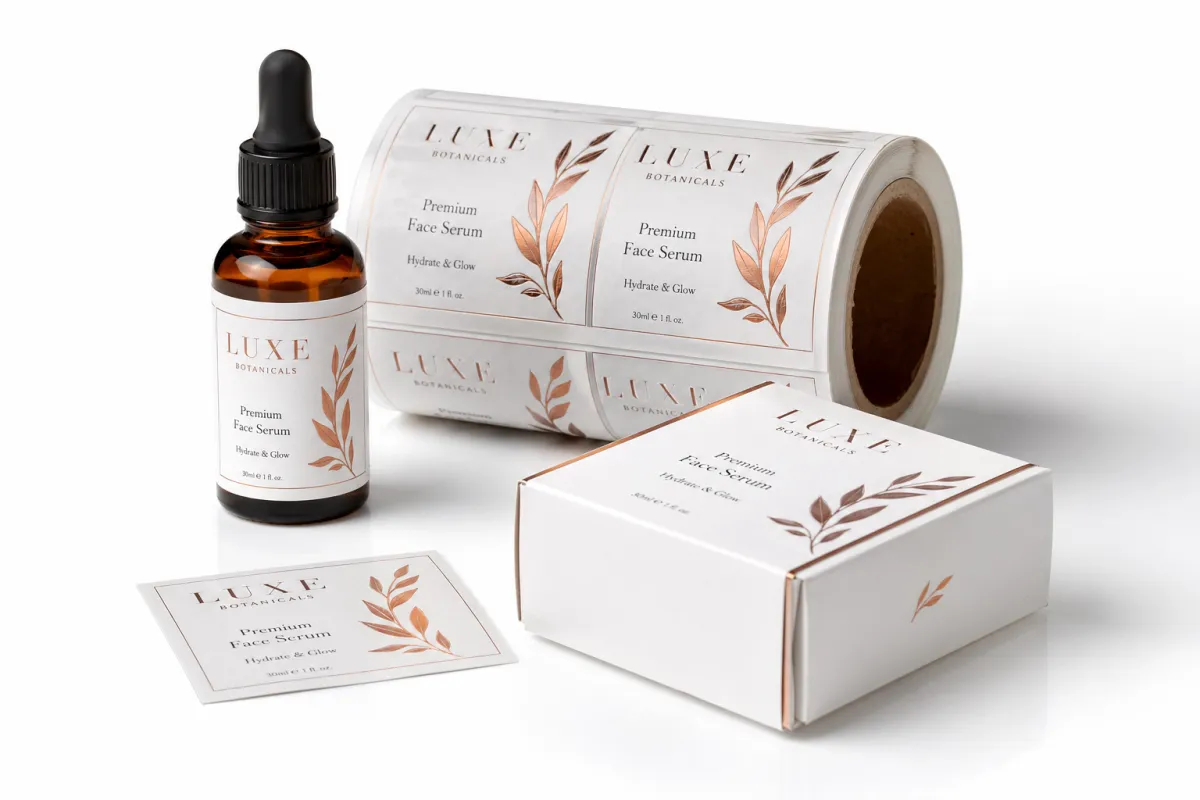
Most label problems start before the first proof. Cold storage. Condensation. Oil residue. Curves. Texture. Tapered shoulders that looked innocent in the dieline and weird in hand. Custom bottle labels for products need to survive those conditions, not just flatter a mockup. I have watched a label pass review, then fail after one night in a cooler. Not exactly thrilling, but very real.
Products with the highest risk tend to be beverages, sauces, essential oils, lotions, soaps, cleaners, and anything that sits in refrigeration or gets handled a lot. In those categories, custom bottle labels for products need a real spec: face stock, adhesive, finish, and application method. A hand soap bottle on a dry retail shelf has a different job than a juice bottle sitting in ice water. They are not even close to the same problem.
Shelf impact matters too. Wrinkles, off-center placement, bubbles, and lifting edges change how people read the brand in a split second. Buyers rarely say, “the label is crooked.” They just assume the brand is sloppy. Fair? Not really. Common? Absolutely. Good packaging design lowers that risk by treating the bottle, the label, and the fill conditions as one system.
Practical rule: if the bottle is wet, cold, oily, textured, or curved, treat custom bottle labels for products as a performance spec first and a design exercise second. That is less sexy than a mood board. It also saves reprints.
"If it lives in a cooler, near a sink, or in a hands-on retail environment, the label has to earn its spot. Pretty is nice. Stuck is better."
Material choice is where the decision gets serious. Paper can work on dry shelf goods. Film stands up better around moisture and handling. Stronger adhesives help with cold and curve. If the bottle sits inside a larger branded packaging line, keep the label spec aligned with the rest of the system instead of treating each component like a solo project. That is how brands avoid the weird shelf problem where one SKU looks like it belongs to a different company.
That choice affects reorder consistency too. Approve custom bottle labels for products without checking fill temperature, condensation, or handling, and you may end up swapping materials later. Then matching old inventory to new inventory becomes a minor headache that somehow eats half a morning. Nobody needs that.
How Custom Bottle Labels for Products Are Made
The process is practical, not mystical. It starts with the brief: bottle dimensions, product type, storage conditions, shelf life, and how the label will be applied. Then comes artwork setup, proofing, print production, finishing, die-cutting, and application planning. Custom bottle labels for products should be built around the container, not around a nice-looking render.
Digital printing and flexographic printing solve different problems. Digital printing is usually the better fit for short runs, test launches, variable data, and fast turnarounds. Flexographic printing makes more sense for larger quantities because setup costs get spread across more labels, which usually lowers the unit price. That is why custom bottle labels for products in a 500-piece pilot order often look financially different from labels in a 25,000-piece run. Same brand. Different math.
The simple version: digital gives you flexibility, flexo gives you scale efficiency. Neither one wins every time. The right choice depends on quantity, color count, finish, and whether the label needs metallic ink, specialty coating, or another effect. For a seasonal launch, digital may be the smart move. For monthly replenishment, flexo usually wins. Not glamorous, just how the numbers work.
Artwork setup matters more than buyers usually expect. Bleed, trim lines, safe areas, and dielines are not just print-shop jargon. They decide whether the label feels balanced or clipped. For custom bottle labels for products, the container should drive the layout. A curved bottle can distort type near the edge. A taper can make a wrap look crooked even when the file is technically correct. The bottle is not the canvas. The bottle is the constraint.
Application method matters just as much. A label made for hand application can allow a little more forgiveness. Roll labels for automated application need consistent spacing, unwind direction, and release performance. If the label is going onto a machine, say that early. If it is going on by hand, say that early too. Production gets messy when the format is chosen after the artwork is already locked. Seen that movie. It is boring and expensive.
In packaging terms, custom bottle labels for products should be checked against the fill line, cap height, shoulder curve, and seam placement. That is not overthinking. That is how you keep a reprint from becoming everybody’s problem.
Custom Bottle Labels for Products: Materials, Adhesives, and Finishes
Material choice drives most of the performance difference in custom bottle labels for products. Paper is the budget-friendly option for dry, low-risk environments. It prints cleanly and can feel warm, artisanal, or handmade, which works nicely for pantry goods and some cosmetics. The tradeoff is obvious: paper scuffs more easily, absorbs moisture, and can lift early if the bottle gets cold or heavily handled.
BOPP, a polypropylene film, is the workhorse for a lot of custom bottle labels for products. It handles water better than paper, holds up under handling, and comes in white, clear, or metallic finishes. Clear film can create a no-label look. White BOPP gives opacity and better contrast. Vinyl is less common for standard consumer packaging, but it can make sense in special cases where extra flex or toughness matters. For most retail bottles, BOPP does a lot of the heavy lifting.
Adhesive choice is where good labels often get sabotaged. A permanent adhesive meant for dry shelves is not the same thing as an adhesive made for refrigerated bottles or condensation. For custom bottle labels for products stored cold, look for cold-temperature or moisture-resistant adhesive systems. If the bottle will be handled often, stronger tack can help. If the bottle surface is coated, textured, or comes with residue from manufacturing, the wrong adhesive can fail even when the face stock is excellent. The label has to bond to the real surface, not the ideal one.
Surface energy matters too, especially on some plastics. HDPE and similar low-surface-energy containers can be tricky. They are not impossible. They just ask more of the adhesive. That is the sort of detail that separates a label that looks good in a proposal from one that survives the warehouse.
Finishes affect both perception and legibility. Matte can feel premium and calm. Gloss adds brightness and color punch. Soft-touch can create a higher-end feel, but it costs more and is not always the best fit for wet handling. Metallic accents grab attention fast, though they should be used with restraint unless the brand story supports them. For custom bottle labels for products, the finish should support readability first and style second. If the finish makes small text harder to read, that is a bad trade.
Curvature and texture matter more than most buyers expect. A label that looks perfect on a flat proof may start lifting on a narrow neck bottle, a tapered body, or a lightly textured glass surface. With custom bottle labels for products, the hidden variables are usually the ones that cost time. Smooth glass is easiest. Slightly textured plastic is manageable. Deep curves and oily surfaces are the ones that make labels peel early.
| Material | Best Use | Durability | Typical Cost Impact | Notes |
|---|---|---|---|---|
| Paper | Dry shelf products, craft goods, pantry items | Low to moderate | Lowest | Good print clarity, weaker against moisture and scuffing |
| White BOPP | Most beverage, bath, and personal care bottles | High | Moderate | Reliable for wet handling and chilled storage |
| Clear Film | Minimalist branding, no-label looks, premium cosmetics | High | Moderate to higher | Needs careful design so copy stays readable |
| Specialty Vinyl | Unusual shapes, extra flex, demanding conditions | Very high | Higher | Use only if the application truly needs it |
There are times to be picky, and this is one of them. If you want confidence in the spec, compare two or three versions instead of guessing. One plain BOPP option, one higher-gloss option, and one with a stronger adhesive can tell you a lot without blowing the budget. If the label sits inside a broader line of Custom Labels & Tags, consistency across the system matters just as much as the bottle itself.
Higher standards usually mean looking beyond the label. Some brands test packaging against transport stress with ISTA methods, especially when the bottle rides inside a shipped kit or boxed set. If sustainability is part of the brand promise, FSC-certified paper can support that claim. The EPA has useful guidance on recycling and material handling at epa.gov. For shipping stress tests, see ista.org. Standards do not make a label beautiful, but they do make the packaging conversation less vague.
Custom Bottle Labels for Products: Cost, Pricing, and Timeline
Cost depends on a few boring variables. Size. Material. Quantity. Finish. Color count. Shape complexity. Whether the label needs a custom die. Custom bottle labels for products get more expensive as the spec gets more specific, which is why a clean rectangle can cost less than a contour cut even when the artwork is identical.
The pricing pattern is usually predictable. Small runs cost more per label because setup gets spread across fewer pieces. Larger runs absorb that setup more efficiently. A 500-piece order may carry a much higher per-unit price than a 5,000-piece order. That does not mean the bigger order is always the right move. It means the math changes with volume. Custom bottle labels for products behave that way across the board.
As a rough working range, a simple paper label in modest quantity may land in the low cents per unit, while moisture-resistant film with a special finish or custom die can push the number up quickly. A realistic range for many custom bottle labels for products is about $0.08 to $0.30 per label depending on quantity and spec, with premium or heavily customized jobs going higher. If someone gives you one price without asking about bottle size, application method, and storage conditions, they are guessing. That is not pricing. That is a shrug with a spreadsheet attached.
Lead time changes with complexity. Simple digital jobs can move in roughly 5 to 10 business days after proof approval, assuming the artwork is clean and the stock is available. More complex custom bottle labels for products, especially those with specialty finishes, custom shapes, or larger production runs, often need 10 to 20 business days. Rush jobs exist, but rush usually means fewer revisions, fewer material choices, and a higher price. Printing does not happen by magic, even if somebody in sales sounds like it should.
Revisions can slow things down more than the press itself. Once artwork changes after proofing, the schedule starts wobbling in ways nobody enjoys. Sample orders help here. A physical sample on the actual bottle can catch a seam issue, a legibility problem, or a finish choice that looked better on a monitor than in your hand. For custom bottle labels for products, a sample is cheap insurance compared with reprinting thousands of units.
Special finishes are not free just because the label is small. Soft-touch, foil, raised effects, and high-clarity clear labels all add complexity. That is why I like seeing two versions: a practical production version and a premium retail version. Sometimes the simpler label wins because the design already does enough. Sometimes the premium version earns its price because it improves shelf presence enough to justify the extra spend. That part is judgement, not ego.
Step-by-Step Ordering Plan for Custom Bottle Labels for Products
Start with measurement, not mood. Measure the bottle circumference, the flat label panel, the shoulder curve, and any taper that changes the usable area. If there is a seam overlap, record it. If the bottle narrows toward the top, measure the smallest usable diameter. Custom bottle labels for products fit better when the container is measured like a real production part, not guessed from a catalog image.
Next, match the label spec to the environment. Dry shelf? Paper may be enough. Refrigerated? Choose film and a cold-aware adhesive. Oily contents? Pick a stock and glue that can tolerate contamination better. Tapered bottle? Give the label some flexibility and keep important copy away from the edges. Custom bottle labels for products are not about personal taste. They are about conditions.
Artwork comes after that. Use the correct dieline. Place barcodes, ingredients, directions, warnings, and any required compliance copy within the safe area. For food, cosmetics, or household chemical packaging, make room for the regulatory information early so the design does not collapse later. A layout that looks polished on a screen can become unreadable once it wraps the container. Packaging design needs production thinking from the start, not after the fact.
Then request a proof. Better yet, request a physical sample if the project is high-value or the bottle shape is unusual. A proof can catch color and layout issues. A sample can catch the rest: peeling edges, poor fit, hard-to-read typography, and awkward seam placement. For custom bottle labels for products, the sample stage is often where the real work starts.
What Should You Check Before Ordering Custom Bottle Labels for Products?
Check the bottle, the environment, and the application method before you approve anything. That sounds basic because it is. Measure the usable label area. Confirm whether the bottle will be cold, wet, oily, textured, or handled a lot. Decide whether the label will be applied by hand or with a machine. Custom bottle labels for products work best when those answers are settled first, not guessed during production.
Quick ordering checklist:
- Confirm bottle dimensions and usable label area.
- Choose material and adhesive based on storage and handling.
- Prepare artwork with the correct dieline and safe margins.
- Review a proof before full production.
- Test the label on the actual bottle under real conditions.
- Lock the spec so reorders match the first run.
Testing on real bottles matters more than most teams expect. Chill it. Wipe it. Hold it with damp hands. Put it near the sink. Stack it with other bottles. If the bottle belongs in a retail display, test it under retail lighting too. That is how custom bottle labels for products reveal their real behavior. A bench test is polite. Production is not. It will expose every weak choice you made at 3 p.m. on a Tuesday.
Once the label performs, document the approved spec. Keep the stock name, adhesive type, finish, label size, and application method in one place. That keeps reorders clean and prevents accidental drift. If you are building a broader line with Custom Printed Boxes or other secondary packaging, that spec sheet also helps the whole brand system stay consistent instead of wandering over time.
Common Mistakes With Custom Bottle Labels for Products
The first mistake is using paper labels on chilled or wet bottles and acting shocked when the corners curl. Custom bottle labels for products need to match the environment, full stop. Paper can be the right choice for dry goods, but it is a gamble in cold, damp, or heavily handled settings. If the bottle sweats, the label needs to be built for that reality.
The second mistake is ignoring curvature. A bottle can look simple and still have a radius that defeats a label. If the label is too wide for the panel, or if the seam lands in a bad spot, you get wrinkles, lifting, or a crooked look that no amount of brand story can fix. Custom bottle labels for products should be sized to the usable panel, not the full visual surface.
The third mistake is stuffing too much into the layout. Small type, weak contrast, and too many claims make the label hard to read from a normal shelf distance. That hurts retail packaging fast, because shoppers move quickly and decide even faster. Packaging design has to work at arm's length, not just zoomed in on a laptop.
The fourth mistake is skipping application testing. A label can look flawless in a proof and still behave badly on the line. Manual application, roll-fed machine application, and automatic applicators all create different stress points. Custom bottle labels for products should be tested in the actual application method, or you are guessing with money. Guessing with money is a hobby nobody needs.
The fifth mistake is overpaying for effects that do not help sell the product. A good finish matters. So does restraint. Not every bottle needs foil, soft-touch, or a dramatic clear look. If the customer is buying a cleaner, a sauce, or a basic wellness product, a crisp label that fits well often beats a flashy one. Premium should serve the product. Not the other way around.
There is also the classic "we will fix it later" trap. Later usually means after the inventory is printed. By then, you are either living with the mistake or paying to correct it. That is why custom bottle labels for products need a fit test, a sample review, and a storage check before full approval. Cheap at the start. Expensive at the end.
If the label is part of a larger shelf story, compare it against the bottle itself, the cap, any carton, and the rest of the line. Package branding works best when the pieces look deliberate. A great label on a weak bottle shape still looks weak. A solid bottle with a sloppy label still looks sloppy. Simple. Annoying. True.
Expert Tips and Next Steps for Custom Bottle Labels for Products
Keep one label spec per bottle family whenever possible. That keeps reorders cleaner, reduces confusion, and helps the production team hold consistency. If a 250 ml bottle and a 500 ml bottle share the same visual system, they still need separate specs that fit the geometry. Custom bottle labels for products work best when the rules are clear and repeatable.
Compare two or three substrate and adhesive options before you lock the job. A paper option, a film option, and a higher-tack option can reveal a lot about price and performance tradeoffs. Sometimes the lowest-cost option is fine. Sometimes it is a false economy. For custom bottle labels for products, the cheapest label is not always the cheapest outcome. That sounds obvious after the fact. It is less obvious during procurement.
Order samples on the actual bottle if the product is cold, wet, oily, or premium. That one step catches most avoidable mistakes. It also gives you a real view of contrast, reflectivity, and edge behavior. If the bottle is part of a retail set, check it beside the carton and any secondary packaging so the full presentation holds together.
If you are still deciding on the broader packaging mix, compare labels with other components like cartons, inserts, and shipper formats through Custom Labels & Tags and Custom Packaging Products. That way the bottle label supports the whole product packaging system instead of fighting it.
For brands that care about compliance, durability, and transport performance, testing pays off quickly. Moisture, abrasion, and temperature changes are the usual troublemakers. Not glamorous. Also not optional. A label that peels after one fridge cycle is a packaging mistake waiting to happen. If you sell into regulated categories, check the local labeling rules before you print. I am not your compliance department, and neither is a pretty mockup.
My practical checklist is simple: confirm dimensions, Choose the Right material, match the adhesive to the environment, request a proof, test the sample on real bottles, and approve only when it behaves the way you need. Clean process. Fewer surprises. Less reprinting. That is the boring part that saves money.
Custom bottle labels for products are not just a print order. They are a fit problem, a material choice, and a packaging decision that affects cost, shelf appeal, and durability at the same time. Handle those pieces well, and custom bottle labels for products become one of the easiest ways to make packaging look intentional instead of improvised.
If you want the shortest useful takeaway, here it is: measure the bottle, name the environment, Choose the Right face stock and adhesive, then test the label on the actual container before you print the run. Everything else is decoration.
FAQ
What materials work best for custom bottle labels for products?
Paper works for dry, low-risk bottles that will not face much moisture or handling. For refrigerated, wet, or frequently touched products, BOPP or another film stock is usually the safer move. The adhesive matters just as much as the face stock, because the wrong glue can ruin custom bottle labels for products very quickly. If you want the label to stay put, think about the whole system, not just the print surface.
How much do custom bottle labels for products usually cost?
Price depends on size, material, quantity, finish, and whether you need a custom die shape. Small runs cost more per label because setup gets spread across fewer pieces. Special finishes, clear films, and complex cuts push the cost up, so it helps to compare a plain version with a premium version before you commit to custom bottle labels for products. That comparison usually saves money, or at least prevents a bad surprise.
How long does it take to produce custom bottle labels for products?
Simple digital orders can move quickly once artwork is approved and materials are ready. Proof review, revision cycles, and sample testing usually slow things down more than press time. Custom finishes, specialty stocks, and larger runs need more lead time, so plan ahead if your custom bottle labels for products are tied to a launch date. Short timelines are possible, but they narrow your options.
Can custom bottle labels for products stay on refrigerated bottles?
Yes, if you choose a moisture-resistant film and an adhesive designed for cold, damp conditions. Apply the label to a clean, dry bottle whenever possible, because condensation is usually the real problem. Test the label after chilling, not just on the bench, so you know custom bottle labels for products will hold up in the fridge. A label that looks fine only before refrigeration is not actually fine.
How do I size custom bottle labels for products correctly?
Measure the usable label panel, bottle circumference, and any taper or curve that affects fit. Leave enough room for seams, overlap, and safe margins so copy does not wrap into a bad spot. If the bottle shape is unusual, print a test version before full production so custom bottle labels for products fit the container the way they should. Guessing is fast. Reprinting is expensive.

