Buyer Fit Snapshot
| Best fit | Custom Debossed Leather Packaging Boxes projects where brand print, material claims, artwork control, MOQ, and repeat-order consistency need to be specified before quoting. |
|---|---|
| Quote inputs | Share finished size, material target, print colors, finish, packing count, annual reorder estimate, ship-to region, and any compliance wording. |
| Proofing check | Approve dieline scale, logo placement, barcode or warning zones, color tolerance, closure strength, and carton packing before bulk production. |
| Main risk | Vague material claims, crowded artwork, missing packing details, or unclear freight terms can make a low unit price expensive after revisions. |
Fast answer: Custom Debossed Leather Packaging Boxes: Structure, Print Proof, Packing, and Reorder Risk should be specified like a repeatable production item. The safest quote records material, print method, finish, artwork proof, packing count, and reorder notes in one written spec.
Production checks before approval
Compare the actual filled-product size with the drawing, then confirm tolerance on folds, seals, hang holes, label areas, and retail display edges. Reserve space for logos, QR codes, warning copy, and material claims before decorative graphics fill the panel.
Quote comparison points
Review material grade, print process, finish, sampling route, tooling charges, carton quantity, and freight assumptions side by side. A quote is only useful when the supplier can repeat the same color, closure quality, and packing count on the next order.
Custom Debossed Leather Packaging Boxes: Buying Basics
Custom Debossed Leather Packaging boxes do one thing very well: they make a product feel expensive before anyone opens it. No loud graphics. No desperate shine. Just a quiet surface, a pressed mark, and a box that knows exactly what it is doing. That restraint is the whole point.
Buyers like these boxes because they sit in a useful lane. They feel premium without turning into costume jewelry. They photograph well. They hold up for watches, fragrance, jewelry, tech accessories, corporate gifts, and retail launches where the packaging has to do some heavy lifting without looking like it tried too hard. That is harder than it sounds. Most packaging is trying too hard.
If you are comparing branded packaging options for a premium product line, custom debossed Leather Packaging Boxes often beat a bright printed lid or a box covered in shiny foil. They carry a slower kind of confidence. Quiet works. Loud gets old fast. Blind debossing, in particular, gives the brand a clean mark without adding visual clutter.
I have seen plenty of samples that looked great on a screen and then fell apart the second the press met the wrong surface. So yes, these boxes can look elevated. They can also look cheap if the spec is sloppy. Packaging is annoyingly honest that way.
What Are Custom Debossed Leather Packaging Boxes?
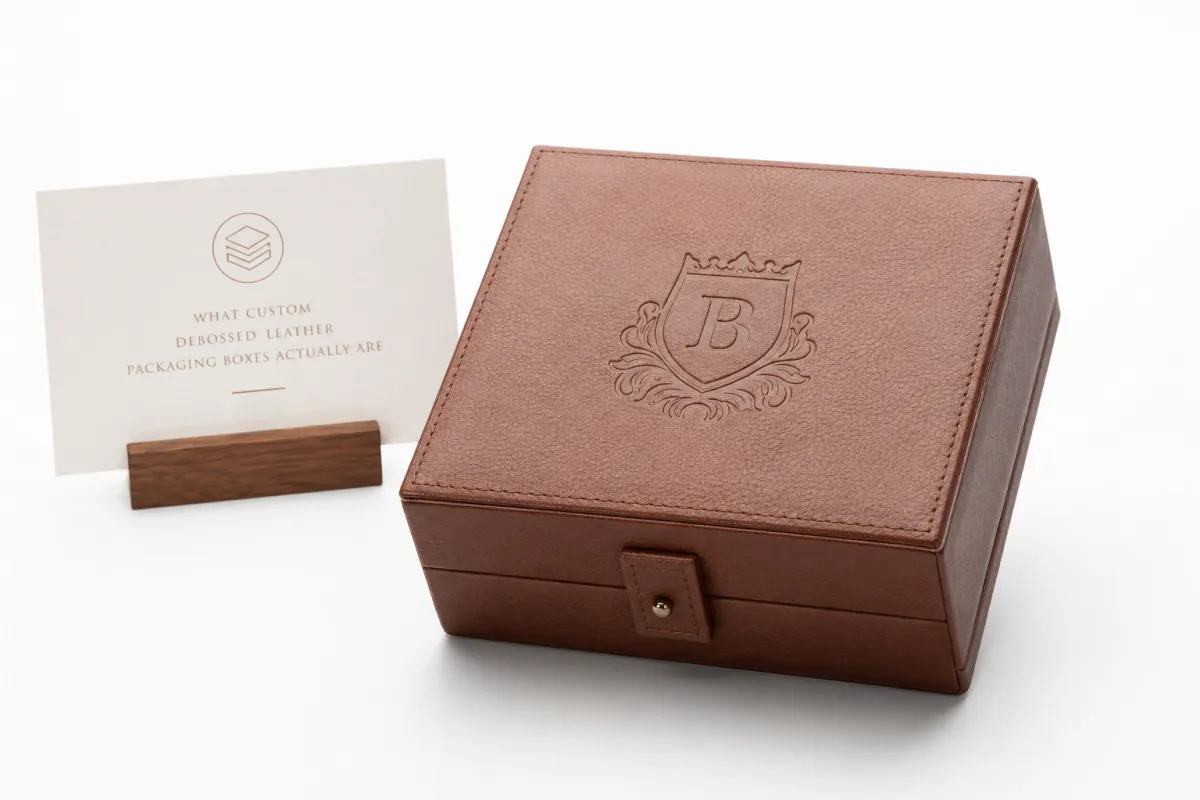
Custom debossed leather packaging boxes are rigid boxes wrapped in leather or a leather-look material, then pressed so the logo, pattern, or message sits below the surface. The design is recessed, not raised. That small detail changes everything. It gives the brand mark texture, shadow, and a tactile presence that feels intentional instead of decorative.
Picture a box with clean edges and a matte finish. Nothing flashy. Then someone runs a finger across the lid and feels the branding under the surface. That is the moment these boxes are built for. The box stops being a container and starts acting like part of the product. Custom debossed leather packaging boxes work because they reward touch. Luxury buyers notice touch fast.
That is why they show up so often for watches, cufflinks, rings, fragrance kits, earbuds, premium phone accessories, and executive gifts. The box is not just storage. It is a sales tool in plain clothes. Custom debossed leather packaging boxes can set the tone before the lid opens. Calm. Premium. Controlled. Much better than a package that looks like it is auditioning for attention.
There is a practical upside too. A deboss often ages better visually than some high-gloss finishes because it does not depend on a perfect reflective surface. On the right material, the pressed mark catches light at the edges and sinks into shadow at the center. That contrast gives the packaging depth and a handcrafted feel, even when the run is fully industrial. For brands that want Luxury Rigid Boxes without the noise, this format does the job.
"The box should feel like it belongs to the product, not like it was hired to perform." That is usually the split between decent packaging and Packaging That Actually supports the brand.
Most brands choose custom debossed leather packaging boxes when they want restraint instead of spectacle. These boxes are not trying to compete with a loud custom printed box full of graphics. They are trying to create a calm, premium object that looks serious on a shelf, in a photo, and in a customer's hands.
They are not magic, though. A premium finish can still look cheap if the structure is weak, the artwork is messy, or the material fights the press. Packaging loves to expose shortcuts. If the base spec is sloppy, the whole thing falls apart fast. I have had more than one otherwise promising project go kinda sideways because someone treated the finish as if it could rescue the structure. It cannot.
How Custom Debossed Leather Packaging Boxes Are Made
Production starts with artwork cleanup. Debossing is less forgiving than flat print, so the logo usually needs simplification before tooling begins. Thin serif lines, tiny text, and crowded icons may look fine on a screen and then turn muddy once they are pressed into texture. A good supplier will flag that early. A lazy one will nod, take the order, and let the sample do the complaining later.
After that comes the die. A custom metal die is made from the approved artwork, and that tool creates the recessed mark. Heat and pressure push the design into the wrap. For custom debossed leather packaging boxes, this step decides whether the brand mark looks sharp, shallow, or just plain awkward. If the die is off, the box shows it immediately.
The base material matters just as much. Genuine leather behaves differently from PU leather, bonded leather, or a leather-look wrap. Genuine leather has more natural character, but the variation is higher from sheet to sheet. PU leather is more consistent, which is why it shows up so often in custom debossed leather packaging boxes built for repeat orders and scale. Bonded leather and leather-look wraps can lower cost, but final feel depends heavily on the actual grade used.
Several production variables sound minor until they ruin the sample. Pressure controls how deep the mark sits. Temperature changes how the surface responds. Dwell time affects whether the impression looks crisp or mushy. Grain direction changes how the deboss catches light. Leather thickness changes how much detail survives without warping the lid. None of this is glamorous. It is just the part where premium packaging stops being pretend.
The rigid box underneath matters too. A beautiful wrap over a weak board is still a weak box. If the board flexes, the lid bows and the deboss distorts. For premium retail packaging, a rigid setup with solid board thickness is usually the safer choice. A firm structure makes the deboss look sharper and the box feel more expensive in the hand.
If you are sourcing through a packaging supplier, ask whether they test the deboss on the exact outer material, not a random substitute. That sounds basic because it is basic. Still, this is where plenty of custom printed boxes and leather-wrap projects drift off spec. A finish that looks fine in a mockup can behave very differently on real stock.
For broader box styles and add-ons, it helps to review a supplier's full range of Custom Packaging Products before locking in the structure. If the brand wants a drawer box instead of a lift-off lid, or a foam insert instead of a satin cradle, those choices change the feel of custom debossed leather packaging boxes more than most buyers expect.
Key Factors That Change the Look and Feel
Material choice is the first big variable. A smoother surface gives the deboss a cleaner edge, while a heavier grain softens the result and makes the mark feel more organic. Neither option is automatically better. It depends on the brand and the product. A technical product may look stronger with a smooth PU wrap. A gift-led brand may prefer the softer character of a grainier finish on custom debossed leather packaging boxes.
Logo size comes next, and this is where people get clever in the wrong direction. Small marks can look elegant, but they can also vanish on textured leather. Too small, and the brand disappears. Too large, and the lid starts acting like a billboard. For most custom debossed leather packaging boxes, a centered logo with breathing room is safer than cramming every detail onto the lid like the box owes you space.
Color and contrast matter too. Blind debossing, with no ink or foil, gives the quietest finish. Dark brown, black, and charcoal wraps push that feeling even further. Lighter surfaces show the mark more clearly, but they can also expose uneven pressure if the die is not tuned well. On custom debossed leather packaging boxes, the simplest setup often looks the most confident.
Structure changes the experience in a bigger way than people expect. A magnetic closure feels different from a lift-off lid. A drawer style feels slower and more deliberate. A book style creates a reveal that works well for gifting. These are not just box mechanics. They shape the whole product packaging experience. Custom debossed leather packaging boxes should be chosen around the product's weight, opening ritual, and retail setting, not around whichever structure was cheapest on the quote.
The insert and lining can raise or lower perceived value more than the outer branding does. Foam inserts create a tight, controlled fit. Velvet looks richer but can show lint and scuffs when handled a lot. Satin feels elegant but may slide depending on item weight. Molded trays work well for specific shapes, especially watches and tech accessories. For custom debossed leather packaging boxes, the inside matters because that is where the customer confirms whether the outside promise was real.
Logo placement also matters as part of package branding, not as a decorative afterthought. A deboss in the wrong spot can make the lid feel top-heavy or strangely empty. Place it where the eye naturally lands and the box feels composed. Good packaging design often looks boring in the best way. Intentional. Balanced. Hard to argue with.
Distance from the box matters too. If the packaging sits on retail shelves, the mark needs enough size to read from a few feet away. If the box is mostly gifted or shipped direct, tactile feel may matter more than shelf legibility. That difference changes how custom debossed leather packaging boxes should be specified.
Brands that want a cleaner read should always sample the actual finish. The same logo can look crisp on one surface and muddy on another. That is not a design failure. It is a material reality. Packaging is full of those little betrayals.
| Material Option | Typical Cost Impact | Deboss Clarity | Consistency | Best For |
|---|---|---|---|---|
| PU leather | Lower to mid-range | Clean and repeatable | High | Scalable custom debossed leather packaging boxes with tighter budgets |
| Genuine leather | Higher | Rich, but more variable | Medium | Luxury-led presentation where natural variation is acceptable |
| Bonded leather / leather-look wrap | Lowest to mid-range | Depends on surface quality | Medium to high | Value-focused branded packaging with a leather appearance |
If you are comparing finishes, ask for both a flat sample and a debossed sample. That reveals how deep the mark really reads and whether the edge definition survives handling. For custom debossed leather packaging boxes, a screen mockup is only a starting point. The real answer lives in the sample.
Custom Debossed Leather Packaging Boxes: Pricing, MOQ, and Tradeoffs
Pricing for custom debossed leather packaging boxes usually comes down to five things: size, material grade, deboss complexity, insert style, and hand assembly. A small rigid box with a simple blind deboss is one thing. A larger gift box with a wrapped lid, foam insert, ribbon pull, and custom closure hardware is another animal entirely. You pay for parts, labor, and the number of chances for someone to make a mistake.
The first cost to understand is tooling. A custom metal die is usually a one-time setup expense, and for many suppliers it lands somewhere around $80-$250 depending on size and complexity. Small runs feel expensive because that setup is spread across fewer units. Larger runs spread the cost more efficiently, which is why custom debossed leather packaging boxes often make the most sense once the order gets into the hundreds or low thousands.
As a rough buying range, entry-level custom debossed leather packaging boxes may sit around $1.60-$3.50 per unit at 500-1,000 pieces if the structure is simple and the insert is basic. Mid-volume orders often move closer to $1.20-$2.80 per unit if the setup is efficient and the material is standard PU leather. Premium builds with thicker board, more complex inserts, and detailed hand finishing can rise to $4.00-$8.00 or more per unit. Those numbers are not magic. They are just the kind of range that shows up once you compare similar specs across suppliers.
MOQ pressure is real. Low minimums are possible, but the unit price rises because setup, QC, and labor do not shrink just because the order is smaller. That is why custom debossed leather packaging boxes can look inexpensive in a quote and still cost more than expected once the full spec is finalized. A buyer asking for 100 boxes with a custom insert and branded closure is paying for a lot of preparation work on very few units.
Here is the blunt version: if the box has to carry the brand story, save money on gimmicks, not on structure. A cleaner outer finish with a smart insert usually beats a box overloaded with extras. Most brands get better results by choosing a solid rigid build for custom debossed leather packaging boxes and keeping the artwork focused. The simpler the design, the easier it is to scale.
Below is a simple tradeoff view that helps during sourcing.
| Order Type | Typical Qty | Estimated Unit Range | What You Usually Get | Main Tradeoff |
|---|---|---|---|---|
| Entry-level run | 200-500 | $1.80-$4.50 | Simple rigid box, standard wrap, basic deboss, simple insert | Higher per-unit cost because setup is spread thin |
| Mid-volume run | 500-2,000 | $1.20-$3.20 | Better material consistency, cleaner deboss, more insert options | Needs more planning around art approval and freight timing |
| Premium run | 2,000+ | $1.00-$2.80+ | Thicker board, custom insert, tighter QC, more refined finishing | Higher upfront commitment and longer production scheduling |
That table is not a promise. It is a buying framework. Real pricing shifts with board grade, labor rates, destination, freight mode, and whether the supplier is assembling every insert by hand. For custom debossed leather packaging boxes, the final quote should always be checked against the exact dimensions and the actual opening style.
If you want to compare specs early, ask for a quote that separates the base box, the deboss tooling, the insert, and shipping. A lump-sum quote can hide where the cost is coming from. Clear line items make better purchasing decisions, especially for custom printed boxes and premium branded packaging programs where packaging is part of the margin story.
For products that need transit protection, do not ignore shipping standards. The ISTA packaging testing standards are useful reference points if the box has to survive freight without corner crush or lid damage. If sustainability claims matter, check material sourcing against FSC certification guidance so the paperboard story is grounded in something real.
Step-by-Step Process and Timeline for Ordering
The cleanest way to order custom debossed leather packaging boxes is to treat the process like production, not shopping. Start with a brief. That brief should include box dimensions, product weight, logo file, quantity, material preference, insert type, and shipping destination. If those basics are vague, the quote will be vague too. Suppliers can guess. They just cannot guess accurately.
Once the brief is in, the supplier usually sends a quote and may ask for a dieline or a layout check. If artwork needs cleanup, that happens before tooling. Good packaging design here is mostly about simplification. Remove tiny type. Widen thin strokes. Make sure the logo sits in a zone that will survive the press. For custom debossed leather packaging boxes, a cleaner art file nearly always produces a better result than a crowded one.
After artwork approval comes die approval. This is the moment to slow down. A die is a physical tool, and once it is made, changing the mark takes time and money. Then comes sampling. Depending on the supplier, a sample can take 7-12 business days, sometimes longer if the box has a custom structure or special insert. If the first sample needs revisions, add time. Packaging almost always runs longer than the optimistic spreadsheet version.
A realistic production schedule for custom debossed leather packaging boxes is often 12-20 business days after sample approval for a straightforward build. More complex work can stretch longer. Add freight, customs if applicable, and receiving time on top of that. People tend to undercount freight because it feels like the last step. It is not. Freight is part of the timeline.
Here is the order flow in plain language:
- Send the brief and reference images.
- Get a quote with material and structure details.
- Approve artwork and die layout.
- Review the sample and request corrections if needed.
- Confirm production and QC checkpoints.
- Ship, receive, and inspect the finished order.
The biggest time slips usually come from three places: sample revisions, artwork changes after approval, and last-minute material swaps. If the supplier says the leather-look wrap you wanted is out of stock and you change to a different texture halfway through, the finish can shift. That is especially true for custom debossed leather packaging boxes because the surface changes how the logo reads.
Ask for milestone dates up front: proof approval date, sample ship date, production start, production finish, and shipping date. Those checkpoints make the process easier to manage than a vague "we will keep you posted" timeline. For premium retail packaging, clarity is not a bonus. It is how launches stay on schedule.
If your product line includes multiple box styles, compare custom debossed leather packaging boxes with other Custom Packaging Products before you place the order. Sometimes a drawer box works better for accessories. Sometimes a magnetic lid is better for gifts. The right structure saves money later because it cuts damage, returns, and awkward unboxing moments.
Common Mistakes to Avoid With Debossed Leather Boxes
The first mistake is overcomplicated artwork. Tiny copy, hairline strokes, decorative flourishes, and cramped icons often collapse once they are pressed into a textured surface. Custom debossed leather packaging boxes reward restraint. If the logo needs a magnifying glass, it is too small. If the design depends on delicate shading, it probably belongs on a printed insert, not the lid.
The second mistake is choosing the wrong surface. A material that is too soft, too thin, or too deeply grained can blur the deboss and make the box feel cheaper than it should. People often assume all leather-look wraps behave the same. They do not. A crisp mark on one material can turn muddy on another. That is why sample testing matters for custom debossed leather packaging boxes. Touching the actual surface beats guessing every time.
The third mistake is approving a mockup without checking scale and placement in real life. On screen, a centered logo can look balanced. On the actual box, it might sit too high, too low, or too close to a seam. Measure the lid. Check the viewing distance. Pretend you are the customer, not the designer. That habit saves a lot of awkward packaging design decisions.
The fourth mistake is ignoring the inside. A weak insert can make a beautiful outer shell feel cheap in five seconds. I see this a lot with retail packaging: the lid looks polished, then the product rattles around in an insert that was clearly an afterthought. If the point of custom debossed leather packaging boxes is presentation, the interior has to carry the same standard.
The fifth mistake is forgetting shipping abuse. A box that looks great on a desk can still fail in freight if the corners crush or the lid scuffs. If the packaging is built for gifting or premium e-commerce, ask about carton packing, inner protection, and transit tests. Even a strong deboss will not save a box if it arrives dented. Packaging does not forgive sloppy planning.
There is also a subtler mistake: trying to over-explain the brand on the lid. The mark should lead, not a wall of copy. A box packed with taglines and decorative clutter stops feeling premium fast. That is one reason custom debossed leather packaging boxes are popular for luxury and corporate gifting. They can carry confidence without visual noise.
From a buyer's point of view, the best approach is to review the design at three moments: digital mockup, sample photo, and physical sample. If all three match, you are in good shape. If one looks off, stop and correct it before production. Fixing a problem early costs less than fixing 1,000 boxes after they already exist.
Expert Tips and Next Steps for Custom Debossed Leather Packaging Boxes
Keep the logo clean and confident. That sounds simple because it is. A strong mark ages better than trendy decoration, especially on premium packaging. For custom debossed leather packaging boxes, a simple emblem, wordmark, or monogram often looks more expensive than a busy composition that tries to say everything at once.
Ask for a physical sample or at least a high-resolution close-up shot before approving anything. Screen mockups hide texture, depth, and edge sharpness. A photo of the actual deboss tells you more than a polished rendering ever will. If a supplier cannot show how the mark reads under light, you are still guessing.
Choose the box style around the product, not around a trend. A heavy watch needs a different interior feel than a fragrance vial. A corporate gift set needs a different opening rhythm than a jewelry piece. Custom debossed leather packaging boxes work best when the structure supports the product's weight, shape, and reveal. Pretty is not enough. The box has to function.
Prepare a complete quote package before reaching out. Include the dimensions, product weight, logo file, target quantity, material preference, insert requirements, and delivery location. If you already know whether you want a rigid setup, a magnetic closure, or a drawer style, include that too. The better the brief, the fewer surprise costs later. That is just good buying, not packaging theater.
If you are still narrowing the spec, compare two or three versions side by side. For example, one PU leather option with a blind deboss, one thicker-grain option with a deeper deboss, and one premium version with a molded insert. That comparison usually shows very quickly which custom debossed leather packaging boxes are doing real work for the brand and which ones are just adding cost.
One more practical note: ask about carton pack counts and outer shipping protection before production begins. If the boxes are going into retail packaging programs, the supplier should know how many units fit safely per master carton and how the corners are protected. A beautiful box that arrives dented is not a win. It is wasted freight.
If sustainability matters to the brand story, ask for paperboard sourcing details and whether the supplier can support FSC-aligned materials. If durability matters more, ask for compression tolerance, board thickness, and closure strength. If the packaging will travel through a rough distribution chain, reference transit testing such as ISTA methods. That is the boring part that saves money later.
Before you place the order, walk through this sequence:
- Shortlist the material and structure that fit the product.
- Compare two or three quote options for custom debossed leather packaging boxes.
- Request a sample or close-up proof.
- Confirm artwork, tooling, and production dates.
- Lock the shipping plan before production starts.
That sequence keeps the project grounded. It also helps you avoid the usual mistake of treating packaging like a last-minute accessory. Custom debossed leather packaging boxes are part of the product experience. They are not a decorative extra you toss on after the real work is done.
If you want the shortest version of the buying advice, here it is: choose a stable structure, keep the deboss simple, sample the actual material, and do not treat freight like an afterthought. That formula works better than chasing gimmicks. It is also how custom debossed leather packaging boxes stay premium without turning into expensive noise.
For brands building a premium line, custom debossed leather packaging boxes can be one of the smartest packaging investments available. They support package branding, they fit luxury and corporate use cases, and they can scale from small gift runs to larger retail packaging programs if the spec is handled properly. The box should feel quiet, precise, and worth keeping. If it does that, the packaging is doing its job.
My practical recommendation is simple: approve the real material, not just the rendering; keep the logo restrained; and make sure the box structure can survive both customer handling and freight. Do those three things, and custom debossed leather packaging boxes stop being a risky vanity purchase and start being a solid brand asset.
Frequently Asked Questions
Are custom debossed leather packaging boxes better than foil-stamped boxes?
Usually, they feel more restrained and tactile. That makes custom debossed leather packaging boxes a better Fit for Brands that want a premium look without a shiny surface. Foil stamping gives stronger visual pop, but it can scratch and often reads louder than the brand actually wants. If the goal is quiet luxury, debossing usually wins.
What material works best for custom debossed leather packaging boxes?
PU leather is often the practical choice because it is consistent, easier to scale, and usually more predictable during debossing. Genuine leather can feel more upscale, but it varies more from run to run and costs more. The best material depends on budget, brand story, and how crisp the mark needs to be on custom debossed leather packaging boxes.
How deep should the deboss be on leather packaging boxes?
Deep enough to read clearly in normal lighting, but not so deep that it distorts the grain or cracks the finish. The right depth depends on the exact surface, so sample testing is the honest answer here. If your logo has thin strokes or small text, ask for a few depth options before you approve custom debossed leather packaging boxes.
How long do custom debossed leather packaging boxes take to produce?
Simple orders can move fairly quickly, but tooling, sampling, and revisions can stretch the schedule. A straightforward run may take around 12-20 business days after sample approval, while more complex builds take longer. Freight can add extra days or weeks, so the production calendar is only part of the story for custom debossed leather packaging boxes.
What should I prepare before requesting a quote for custom debossed leather packaging boxes?
Have the box dimensions, product weight, logo file, target quantity, material preference, insert needs, and delivery location ready. If you know the closure style and the opening format, include that too. The more precise the brief, the easier it is to get an accurate quote for custom debossed leather packaging boxes and avoid surprise costs later.

