Buyer Fit Snapshot
| Best fit | Custom Bottle Labels with Matte Finish projects where brand print, material claims, artwork control, MOQ, and repeat-order consistency need to be specified before quoting. |
|---|---|
| Quote inputs | Share finished size, material target, print colors, finish, packing count, annual reorder estimate, ship-to region, and any compliance wording. |
| Proofing check | Approve dieline scale, logo placement, barcode or warning zones, color tolerance, closure strength, and carton packing before bulk production. |
| Main risk | Vague material claims, crowded artwork, missing packing details, or unclear freight terms can make a low unit price expensive after revisions. |
Fast answer: Custom Bottle Labels with Matte Finish: Material, Adhesive, Artwork, and MOQ should be specified like a repeatable production item. The safest quote records material, print method, finish, artwork proof, packing count, and reorder notes in one written spec.
Production checks before approval
Compare the actual filled-product size with the drawing, then confirm tolerance on folds, seals, hang holes, label areas, and retail display edges. Reserve space for logos, QR codes, warning copy, and material claims before decorative graphics fill the panel.
Quote comparison points
Review material grade, print process, finish, sampling route, tooling charges, carton quantity, and freight assumptions side by side. A quote is only useful when the supplier can repeat the same color, closure quality, and packing count on the next order.
Custom Bottle Labels With Matte Finish: A Practical Guide A bottle can look polished in a mockup and still behave badly in a real cooler, under fluorescent retail lighting, or in a customer’s damp hand. That gap between appearance and performance is exactly why custom bottle labels with matte finish matter. A matte surface cuts glare, softens reflections, and makes typography easier to read from a few feet away, which is often the distance that decides whether a product gets noticed at all. But a label still has to survive shipping, refrigeration, wiping, and stocking, so the paper or film underneath the finish matters just as much as the look. When the right substrate, adhesive, ink system, and topcoat are matched to the bottle, custom bottle labels with matte finish do more than look refined. They hold up where the bottle actually lives.
Matte is not a decorative afterthought. It changes the character of the package. An herbal tonic feels calmer with a matte label. A cold-brew bottle can read more cleanly in a crowded cooler. A serum or body wash often looks more considered when the surface is quiet rather than shiny. Matte also plays well with other packaging choices, from textured cartons to understated typography and Custom Printed Boxes that rely on material quality instead of flash. A finish can pull the brand closer to premium, natural, or clinical territory, but only if the build is suited to the bottle and the environment. A bad construction still fails, even when the finish looks expensive.
What Custom Bottle Labels With Matte Finish Do on Shelf
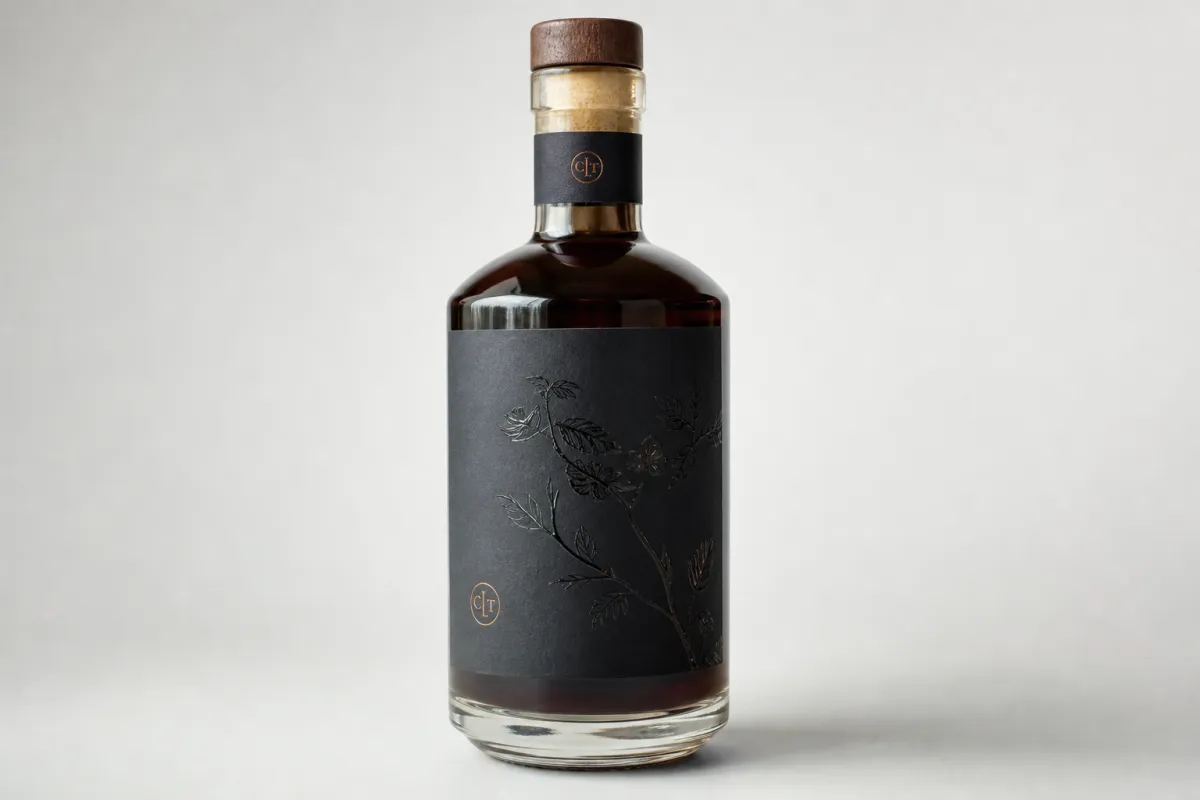
On shelf, Custom Bottle Labels with matte finish change how a product is read before a shopper gets close enough to touch it. Gloss can sparkle, and that has its place, but it also throws light back at the eye. Matte drains off that mirror effect. What remains is the artwork, the type, the spacing, and the shape of the bottle itself. That difference matters in retail packaging, where a label often gets a glance of only a second or two before the shopper moves on.
Matte does something subtle that glossy finishes rarely do: it makes the label feel settled. Black type usually reads crisper. Creams and muted tones can feel denser. Color blocks stop bouncing light and begin to look more deliberate. I have seen custom bottle labels with matte finish rescue narrow neck labels and wraparound panels that would otherwise disappear under cooler doors or bright shelf lighting. A crowded beverage aisle is a brutal test. Matte helps a package keep its composure there.
The visual effect should never be confused with durability. Custom bottle labels with matte finish are not automatically waterproof, scratchproof, or chemical resistant. The finish is only one layer of the decision. Facestock, adhesive, inks, and overlaminate all shape how the label behaves after filling and shipping. A paper matte label can look elegant on a dry shelf and fail quickly once condensation enters the picture. A matte film construction is usually the smarter path for refrigerated drinks, bath products, or oils that may encounter moisture and rubbing. The wrong build turns even the best design into a maintenance problem.
A matte label should quiet the glare, not flatten the brand. If the finish makes the package harder to read in a store, the material choice is wrong.
For brands with a clear visual point of view, custom bottle labels with matte finish can carry the story without shouting. A premium personal care line may want restraint. A natural beverage brand may want something earthy and composed. A specialty food product may want craft without looking rustic in a cliché way. The finish should support the package branding, not compete with it. That is the difference between a label that looks designed and one that merely looks expensive.
- Low glare: Easier reading under spotlights, cooler lights, and grocery aisle glare.
- Calmer color: Matte often gives artwork a denser, more grounded look.
- Tactile feel: Some matte constructions feel dry and smooth; soft-touch adds a velvety hand feel.
- Brand fit: Often better for understated retail packaging than high-gloss labels.
If the bottle is part of a wider packaging system, the label should not be designed in isolation. Coordinating it with Custom Packaging Products can make the shelf presentation feel deliberate, and if the project begins with labels, the Custom Labels & Tags page is a useful place to compare materials and formats.
Process and Timeline for Custom Bottle Labels With Matte Finish
The production flow for custom bottle labels with matte finish usually starts with the bottle, not the artwork. Measurements matter first: diameter, panel width, shoulder curve, available height, seam placement, and any recessed area that could interrupt adhesion. A label designed from the bottle outward tends to fit cleanly. One forced onto the container from a generic template tends to show the mistake later, usually after the product has been chilled or handled a few times.
The finish method changes the result more than many buyers expect. Matte varnish is often the simplest route and can be cost-effective for dry shelf applications. Matte laminate adds a layer of protection that helps against abrasion and moisture, which is why custom bottle labels with matte finish for beverages, oils, and personal care products often use film with an overlaminate. Soft-touch sits at the premium end. It has a distinct hand feel and a deeper, almost velvety character, but it can increase cost and sometimes extend lead time if the material is not already stocked.
Lead time is usually determined by the complexity of the job rather than the word “matte” in the spec. A repeat order with approved artwork and stable bottle dimensions may move through production in about 7 to 10 business days after proof approval. A new SKU with dieline work, test prints, and finish comparisons often takes 12 to 15 business days, sometimes longer if the label needs white ink, unusual die cuts, or close color matching. Custom bottle labels with matte finish are fast when the spec is simple and the approval loop is short. They slow down when the bottle shape is unusual or the artwork is still changing.
A practical order sequence keeps the project from stalling:
- Confirm bottle dimensions and the method of application.
- Choose the label construction based on moisture, handling, and shelf life.
- Prepare print-ready artwork with safe margins and accurate file setup.
- Review the digital proof or physical sample carefully.
- Approve production only after the color, finish, and fit work on the real bottle.
Teams juggling several launches at once often discover that labels are not the only moving part. A bottle can be ready while the carton is still being revised, or the fill schedule can move before final approval lands. That is where packaging programs slip. Good workflow keeps labels, secondary packaging, and fulfillment timing aligned so the finished package branding looks planned rather than pieced together.
For sustainability-minded projects, materials should also be reviewed against external guidance. Resources from the Packaging Industry Association and similar standards groups can help brands think through substrate selection, recyclability, and sourcing commitments before they lock the spec. That early check is often cheaper than redesigning after the first run.
Key Factors That Affect Matte Label Performance
If a label looks right on screen and fails on the bottle, the problem usually sits in the construction. With custom bottle labels with matte finish, the first question is shape. Straight-sided bottles are the easiest because they give the label a stable surface. Curved bottles can still work, but the facestock and adhesive need enough flexibility to follow the contour without lifting at the edges. Tapered bottles and squeezable containers raise the stakes again. Any memory in the material can show up as wrinkling, tunneling, or edge stress after application.
Material choice is the second major variable. Paper can work very well on dry shelf product packaging, but film stocks such as BOPP or polypropylene are usually a better match for chilled beverages, personal care products, and anything handled with wet hands. That is why buyers comparing custom bottle labels with matte finish often ask for both paper and film options. A matte paper label may feel more traditional. A matte film label often feels cleaner and survives scuffing and condensation with less drama. The correct answer depends on use, not taste alone.
Adhesive selection is the part many teams underestimate. A permanent adhesive sounds safe, yet cold fill, oily surfaces, textured glass, and rapid chilling can all change how well it bonds. In some cases, a high-tack adhesive gives the best initial grip on a curved container. In others, a low-temperature adhesive is needed because the bottle enters refrigeration before labeling. For custom bottle labels with matte finish, the adhesive chemistry deserves the same attention as the print surface.
Readability needs its own check. Matte reduces shine, which helps, but it also softens the tiny highlights that can make thin type pop. Pale pastels, hairline fonts, and small legal copy can disappear if the contrast is weak. Barcodes, ingredient panels, and batch information should be tested under the same lighting used in store or pantry conditions. A label that looks elegant in the proof and becomes difficult to scan in the cooler is not a good packaging design choice.
The finish itself can vary more than buyers expect. Standard matte varnish gives a quieter look without adding much thickness. Matte laminate adds a tougher protective layer and is often the better answer for bottles that pass through cold storage or rough handling. Soft-touch matte delivers the most tactile experience, but it is not always the best choice in oily environments or situations where abrasion is frequent. The phrase custom bottle labels with matte finish covers all of these constructions, which is why the specification sheet matters so much.
Distribution testing can be informed by standards such as ISTA. A lab is not required to learn something useful from that thinking. A shake test, a chilled-hold test, and a wipe test often reveal whether the label construction is ready for the real world or only for the proof table.
- Best for dry shelf: Paper matte with a clean print surface and tidy die cut.
- Best for moisture: Matte film with a protective top layer and a suitable adhesive.
- Best tactile feel: Soft-touch matte where the brand wants a velvety surface.
- Best value: Matte varnish for lower-risk applications with moderate handling.
That tension between appearance and durability is where retail packaging decisions get serious. A label can look beautiful and still be the wrong fit if it will live in a cooler, sit near oily product drips, or travel through fulfillment with plenty of carton contact. In those cases, custom bottle labels with matte finish should be specified like a performance component, not a decorative one.
Cost and Pricing for Custom Bottle Labels With Matte Finish
Pricing for custom bottle labels with matte finish depends on a small set of concrete variables. Material type leads the list. Paper usually costs less than film, but the lower number only matters if paper is suitable for the environment. Quantity comes next, because setup cost gets spread across more units as the run grows. Print coverage, number of colors, finishing method, die complexity, and special features such as variable data or white ink all move the quote as well.
As a planning reference, a simple matte paper label on a larger run can sometimes land in the $0.08-$0.18 per unit range. A matte film label with stronger moisture resistance may sit closer to $0.12-$0.24 per unit. Soft-touch or heavily protected custom bottle labels with matte finish can run higher, especially on smaller orders or with complicated artwork. Those figures are not universal promises. They are useful comparisons when the bottle size, artwork coverage, and application method stay the same across quotes.
Minimum order quantity changes the math faster than many teams expect. A 1,000-piece run can carry a much higher unit price than a 5,000-piece run because the setup work does not shrink, while the number of labels does. That is why short-run testing is common in branded packaging programs. A small launch lets the team validate the formula, the label, and the shelf response before the full scale order is placed.
Here is a practical comparison of common finish choices for custom bottle labels with matte finish:
| Finish Method | Typical Look | Durability | Typical Planning Range per Unit | Best Fit |
|---|---|---|---|---|
| Matte varnish on paper | Clean, understated, low shine | Moderate in dry settings | $0.08-$0.16 at higher quantities | Dry shelf product packaging |
| Matte film label | Smooth and professional | Better moisture and abrasion resistance | $0.12-$0.24 depending on size and run length | Chilled bottles and frequent handling |
| Soft-touch matte laminate | Velvety and premium | Strong feel, but spec dependent | $0.16-$0.32 or more for smaller runs | Premium wellness, spirits, and specialty retail packaging |
| Matte-faced specialty stock | Natural, textured, restrained | Varies by substrate and adhesive | Quote-based | Craft brands and package branding with a tactile story |
A useful quote request includes more than artwork. Send bottle dimensions, the application method, target quantity, whether the bottle will be chilled, and whether the label must survive humidity, oil, or frequent handling. If the finish is already decided, say so. If it is not, ask for pricing on matte varnish, matte laminate, and a standard gloss option so you can compare appearance and cost side by side. The clearer the brief, the more honest the pricing will be for custom bottle labels with matte finish.
Step-by-Step Guide to Ordering and Applying the Labels
The cleanest way to order custom bottle labels with matte finish is to treat the label like a production component from the start. Begin with bottle measurements, not the logo. Measure the diameter, the width of any flat panel, the height between shoulder and base, and any seam or mold line that could interfere with placement. Curves matter too. A label that spans an uneven area may look fine in a mockup and lift later, especially after refrigeration or transit.
- Gather bottle specs: Measure the container carefully and photograph it from several angles.
- Set the use case: Dry shelf, chilled display, humid storage, or direct hand contact all change the spec.
- Build the artwork: Leave safe margins, keep critical text away from edges, and make the matte finish part of the design system.
- Check proof details: Review color, barcode placement, ingredient lines, and die line alignment before approval.
- Test application: Apply a sample, chill it, wipe it, and inspect it under realistic light.
Artwork setup deserves more care than many first-time buyers expect. Matte lowers glare, but it can also mute delicate graphics. If the brand uses pale colors or fine type, contrast needs a hard look. Strong typography, careful spacing, and a clear hierarchy matter a lot in custom bottle labels with matte finish because the finish removes visual clutter. The design has to do more of the organizing. That matters even more when the label carries legal copy, nutrition information, or a barcode that must scan quickly.
Application method is just as important as print quality. The bottle surface should be clean and dry, with no oil residue, dust, or condensation. On a production line, that may mean wiping the bottle or controlling fill temperature before the label is applied. A label placed on a damp surface can seem fine at first and then fail at the edges hours later. For custom bottle labels with matte finish, a test on five or ten sample bottles often reveals more than a stack of proofs ever will.
If you want to compare the label project with other materials, reviewing the full lineup of Custom Packaging Products can help keep the bottle label, shipper, and secondary carton aligned. Brands that treat labels, cartons, and inserts as one system usually end up with a stronger result than brands that buy each part separately. That is especially true when the label finish needs to echo the texture and tone of the rest of the package branding.
Approved samples are worth the time. A physical proof or short test run confirms color, sure, but it also shows how the matte surface behaves under store lighting, refrigeration LEDs, and warehouse fixtures. If you want the easiest path through ordering, ask your supplier for custom bottle labels with matte finish, a comparable gloss sample, and a material sample if moisture is part of the use case. That side-by-side view usually tells a clearer story than a digital proof alone.
Common Mistakes to Avoid With Matte Bottle Labels
The most expensive mistake is choosing custom bottle labels with matte finish because the look feels premium, then discovering the bottle lives in a wet, rough, or oily environment. A beautiful matte paper label may be fine on a dry shelf. Put it in a cooler or into daily handling, and the finish can scuff or the edges can begin to lift. That is not a flaw in matte itself. It is a mismatch between construction and use case.
Weak contrast causes trouble too. Matte can make a design feel elegant, but it also removes reflective cues that sometimes help small type stand out. If the palette is very light, or if the letters are thin and decorative, the panel may read as muted rather than refined. In a retail aisle, that hurts shelf impact. For custom bottle labels with matte finish, calm is good. Hard to read is not.
Sizing errors show up often. Labels that are too large on curved bottles tend to wrinkle or bridge over the shoulder. Labels that are too small can look underpowered and fail to support the package branding. Bottle shape, label dimensions, and adhesive choice need to be considered together. That is one reason packaging design teams mock up several versions before moving into production.
Material confusion creates another repeat problem: assuming all matte finishes behave the same. They do not. A matte varnish on paper, a matte laminate on film, and a soft-touch overprint can feel and perform very differently. For branded packaging with a high-touch retail life, those differences are not cosmetic. They decide whether the label still looks clean after transport, stocking, and consumer handling.
Brands with paper-based sourcing goals may also want to check whether the stock is FSC-certified or otherwise documented. That does not solve durability, but it does support broader sustainability goals. A quick review of FSC guidance can help buyers understand what claims they can support and what paperwork they should request from a printer.
- Do not: Pick a finish before you know the bottle environment.
- Do not: Assume matte will fix a cluttered layout.
- Do not: Skip a test on real bottles.
- Do not: Overlook adhesive behavior on cold or curved surfaces.
The quickest way to waste money on labels is to reorder them because the first version looked right on screen and wrong in the cooler.
That mistake is avoidable. A few sample bottles, a realistic handling test, and a clear spec sheet are usually enough to keep custom bottle labels with matte finish from turning into a second run.
Expert Tips and Next Steps for Better Results
The strongest results usually come from matching the finish to the brand story before the artwork is finalized. A crisp beverage label, a wellness product with a restrained palette, or a gourmet sauce line often benefit from custom bottle labels with matte finish because the finish supports quiet confidence instead of visual noise. A playful or highly promotional brand can still use matte, but then typography and color blocking need to carry more energy. The finish should not do all the work.
My first practical tip is to test the label in the real environment. Chill the bottle, wipe it with damp hands, place it under the same light the customer will see, and check it again after ten or fifteen minutes. That small exercise reveals more than a polished mockup. With custom bottle labels with matte finish, it often exposes edge lift, smudge risk, or readability problems before a full run is printed. I have seen a gorgeous proof turn a little boring on paper and then, in the cooler, become exactly the right thing. That kind of reality check is worth the extra hour.
My second tip is to keep a simple approval checklist. It does not need to be elaborate, but it should cover bottle dimensions, substrate, finish method, adhesive, print process, quantity, and delivery date. If those items are settled before production, surprises become less likely. That matters for teams managing multiple packaging projects, because a bottle label may depend on the formula, the fill schedule, and the timing of the rest of the product packaging family.
My third tip is to ask for comparative samples whenever possible. One matte finish may feel dry and modern while another feels softer and more tactile, and both can be described as custom bottle labels with matte finish. A side-by-side sample sheet resolves debates faster than a long email thread. If cartons, inserts, or shipping materials also need to match, aligning the whole branded packaging system early can save rework later.
For teams moving quickly, the next steps are simple:
- Request a quote with bottle dimensions and quantity.
- Ask for a material recommendation based on moisture, handling, and shelf life.
- Review the proof carefully, including fine text and barcode placement.
- Approve a sample or test run before full production.
- Confirm storage and application conditions before launch.
If you want one rule to carry forward, use matte when the brand should feel composed, readable, and tactile, then match the construction to the environment the bottle will actually face. That is the core lesson with custom bottle labels with matte finish. The finish is the visible part of the decision, but the real quality comes from the full build. Get the substrate, adhesive, and finish right together, and the label can move from print to shelf to customer hands without losing its nerve.
Are custom bottle labels with matte finish waterproof?
Not automatically. Water resistance depends on the facestock, adhesive, and whether the label uses a protective laminate or coating. For chilled or wet conditions, film-based constructions usually perform better than paper, especially when condensation is part of normal use. If the bottle will be iced, refrigerated, or washed, ask for custom bottle labels with matte finish that are specified for moisture and edge lift resistance.
Do matte labels scratch more easily than gloss labels?
Sometimes they show rub marks sooner, but that depends on the finish method and topcoat. A matte laminate or protective overprint can improve durability while keeping the low-shine look. If the label will be handled often in shipping or retail, ask for abrasion testing or a sample run before committing to custom bottle labels with matte finish.
What bottles work best with custom bottle labels with matte finish?
Straight-sided bottles are the easiest because they give the label a flat, stable surface. Curved, tapered, or squeezable bottles can still work well, but they usually need a more flexible facestock and stronger adhesive. The best choice depends on the container shape, fill temperature, and how much moisture or handling the bottle will face when using custom bottle labels with matte finish.
How long does it take to produce matte bottle labels?
Timeline depends on artwork readiness, proof approval, quantity, and whether the finish is a simple matte varnish or a more specialized laminate. New setups usually take longer than repeat orders because dielines, samples, and approval steps add time before production starts. If speed matters, send bottle dimensions and final artwork early so the printer can quote accurately for custom bottle labels with matte finish.
Are custom bottle labels with matte finish more expensive than gloss labels?
Often yes, but not always. The price difference depends on material, finish method, order quantity, and whether special durability is required. A soft-touch or heavy-duty matte laminate usually costs more than a basic glossy label, while a matte varnish may be closer in price. The best comparison is to request quotes for both constructions using the same bottle size and quantity, especially if you are comparing custom bottle labels with matte finish across several product lines.
Can matte labels still look premium on simple packaging?
Yes, and that is part of the appeal. Matte is often strongest on packaging that uses clean typography, disciplined spacing, and a limited palette. If the bottle shape is simple, a matte label can make the whole package feel intentional instead of busy. The trick is not piling on effects; it's keeping the structure tight and the materials honest. A label that feels calm in the hand often reads as more expensive than one that tries too hard.

