Buyer Fit Snapshot
| Best fit | Custom Box Mockup Supplier projects where brand print, material claims, artwork control, MOQ, and repeat-order consistency need to be specified before quoting. |
|---|---|
| Quote inputs | Share finished size, material target, print colors, finish, packing count, annual reorder estimate, ship-to region, and any compliance wording. |
| Proofing check | Approve dieline scale, logo placement, barcode or warning zones, color tolerance, closure strength, and carton packing before bulk production. |
| Main risk | Vague material claims, crowded artwork, missing packing details, or unclear freight terms can make a low unit price expensive after revisions. |
Fast answer: Custom Box Mockup Supplier: Board, Finish, Dieline, and Unit Cost should be specified like a repeatable production item. The safest quote records material, print method, finish, artwork proof, packing count, and reorder notes in one written spec.
Production checks before approval
Compare the actual filled-product size with the drawing, then confirm tolerance on folds, seals, hang holes, label areas, and retail display edges. Reserve space for logos, QR codes, warning copy, and material claims before decorative graphics fill the panel.
Quote comparison points
Review material grade, print process, finish, sampling route, tooling charges, carton quantity, and freight assumptions side by side. A quote is only useful when the supplier can repeat the same color, closure quality, and packing count on the next order.
Custom Box Mockup Supplier: How to Choose the Right One
A box can look perfect on screen and still fall apart in real life. I have watched a tidy render turn into a sample with a stubborn tuck flap, a weak corner, and print that crosses a fold like nobody bothered to check the die. It happens more than brands admit. That is why a custom box mockup supplier matters. They catch the stuff a pretty mockup hides: board thickness, score quality, glue area, fit, shipping stress, and whether the artwork still looks intentional after the box is assembled.
The right custom box mockup supplier does more than make a sample. They translate a concept into something you can measure, test, open, close, and approve without guessing. Structure has to match the product. Artwork has to sit in the right place. Finishes have to behave the way the final pack is supposed to behave. If the box is meant for retail shelves, ecommerce shipping, or subscription unboxing, those details are not optional. They are the job.
What a Custom Box Mockup Supplier Actually Does
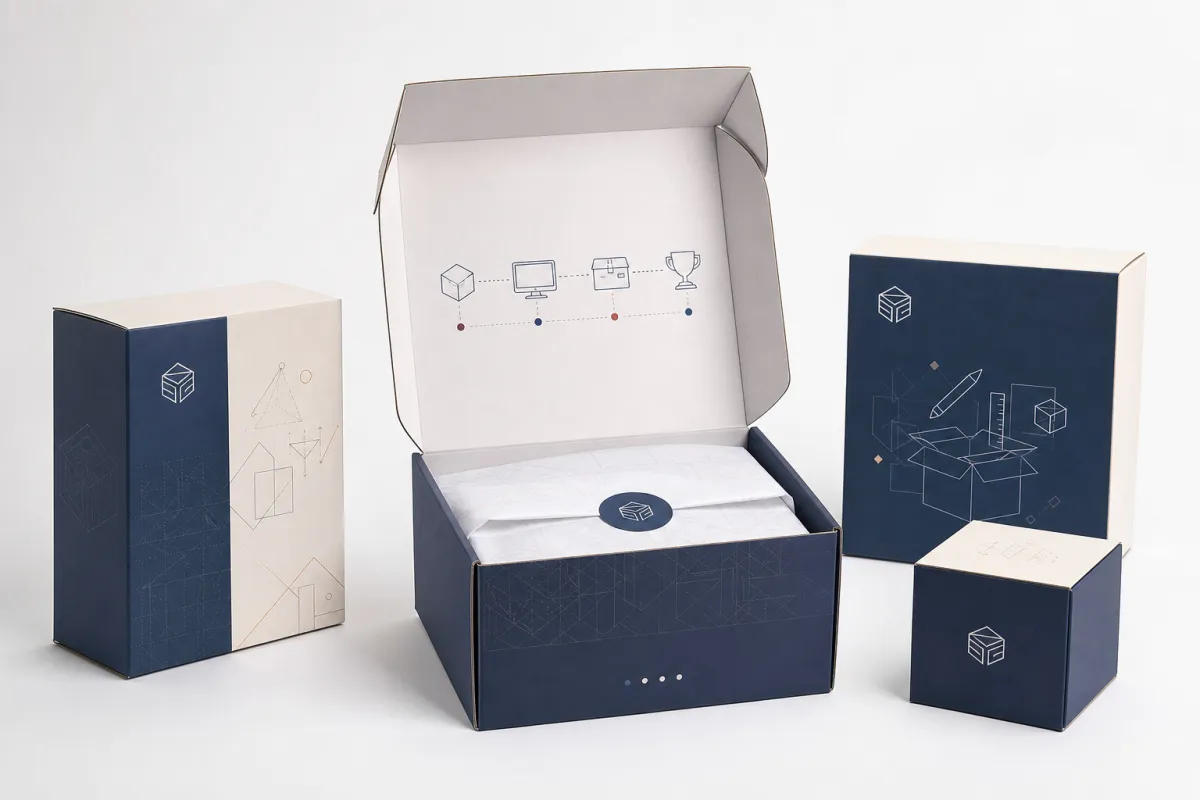
A custom box mockup supplier usually works at several levels. The lightest version is a digital mockup. That gives you a visual on the box panels with the artwork placed in roughly the right spots. Useful? Yes. Enough on its own? Not usually.
A step up from that is a dieline proof. This shows cut lines, fold lines, glue flaps, and safe areas, so the artwork is reviewed against the real structure. Then there is the physical sample, which is where theory meets cardboard. That sample tells you whether the product fits, whether the closure behaves, and whether the box survives a little handling without looking sad. Those are very different services, and buyers mix them up all the time.
Packaging has two jobs. It has to sell the product and protect it. Miss either one and the whole thing gets expensive fast. A custom box mockup supplier helps verify that the box supports the brand story while still doing ordinary box things like closing properly, shipping without crush damage, and holding the insert in the right place.
There is also a practical business reason to use a strong supplier. Better samples reduce rework, prevent art mistakes, and keep production from going sideways once a run is already booked. I have seen teams approve a lovely-looking proof, only to discover later that the insert was too loose and the product rattled around like change in a pocket. Not great. Not even kinda close.
If you are comparing suppliers, it helps to separate the sample types they can provide:
- Concept mockup - useful for early design review and internal alignment.
- Structural mockup - useful for testing fit, closure behavior, and insert layout.
- Pre-production proof - useful for confirming final artwork, finishing, and build details.
- Master sample - useful as the reference point for future repeat orders.
That progression is where a custom box mockup supplier earns their keep. The sample is not just a sample. It is a way to remove uncertainty before the expensive part starts. Brands that order custom packaging products at scale usually learn this lesson the hard way, so it is better to learn it early and cheaply.
For buyers who want a general industry reference on packaging language and standards, the Institute of Packaging Professionals is a useful starting point. It will not replace direct supplier communication, but it gives you a decent baseline.
How a Custom Box Mockup Supplier Turns a Dieline Into a Real Proof
The process usually starts with a brief. A custom box mockup supplier should ask for product dimensions, product weight, box style, artwork files, finish notes, and any shipping or assembly requirements. If the pack uses inserts, dividers, trays, or nested parts, those should be listed too. A jar, a bottle, and a wireless device all behave differently in the same carton. Tiny changes matter more than people expect.
Next comes the dieline. That is the flat map of the box, with all the cuts, folds, and glue areas laid out. On paper it looks simple. In production, it controls nearly everything. Bleed needs room to extend past the trim. Copy should stay away from folds. Coatings can behave differently on glued zones. A good custom box mockup supplier spots those issues before you lock the art.
Then comes the proof type. Digital proofs are fastest and cheapest. They are fine for early artwork checks, typo hunts, and panel placement. Flat dielines are more technical and help with layout accuracy. Physical samples go further and let you test the real object in your hands. A good custom box mockup supplier should recommend the right proof for the stage you're in instead of selling the fanciest option because it sounds impressive.
This is where projects often drift. Designers think in clean visuals. Production thinks in folds, board thickness, glue flaps, and assembly logic. Those are not the same language. If the custom box mockup supplier cannot move between both, you get beautiful files that fail in the real world. That gap is usually where delays start.
Timelines vary, but there is a rough pattern. A digital proof may take 1-3 business days if the files are ready and the brief is clean. A physical sample often takes 5-10 business days before shipping. If the structure changes, or the artwork needs another pass, the clock moves. A trustworthy custom box mockup supplier will tell you the real timing, not the fantasy version that only works if nobody edits anything.
A useful proof should answer three questions: does the box fit, does the artwork land where it should, and does the finished sample behave like the real thing? If one of those answers is fuzzy, the mockup is not ready.
For transit-focused packaging, testing knowledge matters too. The ISTA test protocols are widely used for shipping readiness, and a solid custom box mockup supplier should understand whether your box is meant for shelf display, parcel delivery, or heavier distribution handling. They do not need to run every test themselves, but they should know what the box has to survive.
What Affects Price, Quality, and Turnaround
Pricing from a custom box mockup supplier is not just about size. Structure is usually the first big driver. A simple mailer box is faster and cheaper to mock up than a rigid setup box with a magnetic closure, a foam insert, or multiple printed components. Every extra part adds time and another place where things can go slightly wrong. Because of course it can.
Material choice matters too. A lightweight folding carton sample is easier to produce than a double-wall corrugated prototype or a wrapped rigid box with cover stock. If the final pack needs to feel premium, the sample may need a closer board match and a more accurate finish. That can push cost up, but it also keeps you from approving the wrong thing and paying for it later.
Print and finishing options change the equation as well. Digital print, offset print, foil, embossing, debossing, spot UV, soft-touch lamination, and aqueous coating all affect the price and the schedule. If the sample needs to mimic a final retail finish, the custom box mockup supplier may need more specialized production steps. The cheapest quote is not automatically the cheapest decision. Approving a finish that does not translate to production is a fast way to waste money.
Quality shows up in the details. Measure the sample against spec. Check whether the folds are crisp, whether the printed panels align with the die, whether the insert actually holds the product, and whether the box closes without forcing the board. A good custom box mockup supplier should be able to deliver a sample that feels like a serious production reference, not a loose approximation.
Lead times are mostly driven by three things: file readiness, revision count, and shipping. If the artwork is clean and the team is responsive, things move faster. If the sample needs copy fixes, barcode updates, structural changes, or finish tweaks, the schedule stretches. The supplier can only go as fast as the approval chain lets them.
One thing brands miss all the time is internal routing. A proof can sit untouched for days while marketing, operations, sales, and leadership each wait for someone else to speak first. That is not the supplier's fault. It is just a slow decision process wearing a packaging label. If your review loop is messy, even the best custom box mockup supplier will look slower than they are.
If sustainability requirements matter, ask about stock sourcing early. For paper-based packaging, documentation around FSC materials can affect both timing and structure options. That matters if you are building a packaging family across several SKUs or markets.
Simple rule: the more the sample needs to behave like production, the more it costs. That is not a flaw. It is reality. The point is to match the proof to the risk level, not to overspend because the sample looks fancy in a meeting.
Custom Box Mockup Supplier Pricing: What You're Paying For
Most buyers look at the total and stop there. Bad habit. A custom box mockup supplier might quote a lower base fee but leave out freight, extra revisions, structural adjustments, or rush handling. Another supplier might look pricier up front but include more of the work that actually matters. Comparing quotes means reading the scope, not staring at the biggest number like it owes you money.
Common line items include setup, dieline development, sample production, artwork placement, structural review, and shipping. If the box needs custom tooling, a specialty insert, or revised scoring to improve the fold, the price will climb. A custom box mockup supplier may also charge for extra samples if you want side-by-side options with different materials or closure styles. That is normal. You are paying for decision support, not magic.
Here is a practical way to compare the most common proof types:
| Proof Type | Best For | Typical Cost Range | Typical Turnaround | Main Watch-Out |
|---|---|---|---|---|
| Digital mockup | Artwork review, panel placement, early concept approval | $0-$75 | 1-2 business days | Does not verify real fit or closure behavior |
| Flat dieline proof | Layout accuracy, bleed, safe zones, text placement | $25-$125 | 1-3 business days | Still not a physical test of structure |
| Physical mockup | Fit, hand feel, insert behavior, opening experience | $75-$250+ | 5-10 business days | May need freight charges and revision time |
| Production pilot sample | Final approval before full run | Varies by scope | Depends on tooling and print method | Closest to production, but harder to change late |
Those ranges are not fixed. A simple sleeve can come in lower, while a rigid box with custom inserts can land much higher. The point is to see what you are actually buying. If a custom box mockup supplier offers a low price but leaves out shipping, extra rounds, or a proper board match, the final cost can climb anyway. Cheap up front is not a strategy.
Rush fees deserve a close look too. If your launch is tight, the supplier may need to push your job ahead of others, and that can cost more. Fair enough. Just get the terms in writing. Ask whether rush work changes the revision limit, whether shipping method changes, and whether the sample still uses the intended material. A decent custom box mockup supplier will tell you straight instead of hiding behind a vague priority line item.
For brands building multiple custom printed boxes across a line, budget for at least one approval sample for each major structure family. That sounds like extra spending until you compare it with the cost of reprinting a run that does not fit the product. A mockup is cheaper than a warehouse mistake. That one is not even close.
If you are still sorting through packaging formats, our Custom Packaging Products page is a good place to compare structures and finishes before you ask a custom box mockup supplier for proofs. Better homework usually means fewer rounds of back-and-forth.
One last pricing point: stronger suppliers often save money by reducing revision loops. That is not because they are psychic. It is because they ask better questions at the start and catch structural problems before the artwork gets too comfortable.
Step-by-Step: Working With a Supplier From Brief to Signoff
The cleanest projects start with a clear brief. A custom box mockup supplier should receive exact product dimensions, product weight, box style, printing method, finish expectations, and any insert or shipping requirements. If the product is fragile, oddly shaped, or bundled with accessories, that belongs in the brief too. A missing dimension can change the fit enough to ruin the sample. Nobody wants to discover that after the first proof is already on a truck.
File prep matters more than people think. Send editable artwork if possible, a PDF proof, brand standards, and any color references that affect the final look. If you already know the retail shelf height or ecommerce carton size, include that as well. The custom box mockup supplier can then build for the channel, not just the artwork file. That small difference saves a lot of noise later.
Once the first proof lands, review the practical stuff first. Check the dimensions, product fit, insert alignment, barcode placement, closure behavior, and seal location if the box ships flat. Then check the visual side: logo position, color balance, panel breaks, and finish notes. A custom box mockup supplier should expect at least one round of comments, but the best ones make that process organized and easy to follow.
A review sequence that usually works:
- Confirm the product fits with enough clearance for the board and any insert walls.
- Check that the flaps, folds, and locks close without buckling or strain.
- Verify artwork placement against the dieline and trim areas.
- Review finish details such as matte lamination, gloss varnish, foil, or embossing.
- Approve only after the same version has been reviewed by all key stakeholders.
Version control is boring until it saves you. Keep one master file, one comment log, and one final approval record. A custom box mockup supplier can revise quickly, but if three teams are reviewing different PDFs, the process gets messy in a hurry. The classic "we thought that was final" problem usually starts there.
If the project has more than one viable structure, ask for side-by-side samples. A mailer box can be compared against a reverse tuck end carton. A standard corrugated shipper can be compared against a sleeve and tray pack. A custom box mockup supplier can show differences in protection, presentation, and assembly time far better than a spreadsheet can.
If the pack will be reordered, ask for a saved master spec sheet. Include dimensions, board type, print method, coating, insert details, tolerances, and the approved artwork version. The next time you work with the same custom box mockup supplier, that document keeps the build consistent. It also protects package branding across seasonal updates and SKU changes.
After approval, lock the record. Save the approved file, the date, sample photos, and notes about any changes made during the approval cycle. If the next production run raises a question, those records are the fastest way to answer it. Memory is helpful. Documentation is better.
Mistakes That Keep Showing Up
The first mistake is choosing only on price. A low quote from a custom box mockup supplier can look attractive, but if it excludes fit checks, revisions, or proper material matching, the sample may not tell you much. A cheap proof that leads to a bad production decision is expensive in the end. That gets extra painful with retail packaging or shipping programs that have damage risk.
The second mistake is sending a vague brief. "Make it premium" is not a useful instruction. Premium could mean heavier board, softer coating, foil detail, sharper structure, or all of the above. A custom box mockup supplier needs to know what premium means to your brand. They also need real measurements, not a guess with confidence attached. Even a 2 mm shift can matter in a tight carton or a custom insert.
The third mistake is skipping physical samples for boxes that need to do real work. Glass, electronics, cosmetics, and fragile assemblies deserve more than a screen review. A custom box mockup supplier should be able to tell you when digital is enough and when a physical build is safer. If the pack is going to ride through parcel handling, a screen-only approval is shaky at best.
The fourth mistake is ignoring the time outside the supplier's control. Shipping delays, weekend approvals, and long internal review chains can stretch the schedule even if the sample itself was finished on time. Build room for proofing before launch. A custom box mockup supplier can move fast, but they cannot speed up a buyer who takes three days to answer a one-line color question.
The fifth mistake is assuming every supplier understands your channel. A box for ecommerce fulfillment is not the same as a box for shelf display. One needs to survive parcel handling. The other needs to survive retail scrutiny. Those are not interchangeable problems. A custom box mockup supplier who understands the difference can help you avoid selecting a box that looks good in a meeting and fails in the warehouse. For heavier transit scenarios, testing logic informed by ISTA-style thinking is usually smarter than approving on looks alone.
Another risk is assuming every mockup is a production match. Some samples use substitute board or simplified finishing that looks close enough for a concept review but does not behave the same way. That is fine if the sample is labeled as such. It is not fine if you're approving a run. Ask the custom box mockup supplier what stock, coating, and build method were used, and whether the sample is meant as a visual reference or a final-match proof.
Warning signs are usually obvious once you know what to look for:
- They cannot explain the difference between a flat proof and a physical sample.
- They avoid talking about tolerances, board thickness, or closure fit.
- They will not say how many revisions are included.
- They give a price without clarifying shipping or setup terms.
- They cannot explain how the sample connects to production.
If you see one of those, slow down. The right supplier makes the work clearer, not murkier. Good packaging work is technical, but it should still be understandable.
Practical Tips for Better Results
Better results usually start with comparison. Ask at least three suppliers to quote the same brief. That gives you a fair read on communication style, technical depth, turnaround, and what each custom box mockup supplier includes in the scope. You are not only comparing prices. You are comparing how each team thinks about structure, print, and signoff discipline.
Ask for an approval checklist before you sign off. A useful checklist should cover dimensions, closure fit, artwork placement, finish, transport behavior, and any insert details. A custom box mockup supplier that already works from a checklist tends to miss fewer things because fewer details are left floating in memory. It also helps your team review custom printed boxes without turning every comment into a fuzzy opinion.
Keep one master spec sheet for every packaging family you plan to reorder. That sheet should list board grade, finish, dimensions, insert notes, print method, approved Pantone references if applicable, and a photo of the approved mockup. The next time you work with a custom box mockup supplier, that record helps preserve consistency across seasonal refreshes and volume changes. It is one of the simplest ways to protect package branding over time.
A purchasing sequence that usually works well:
- Gather the product specs and shipping goals first.
- Ask for a quote that clearly separates setup, sample build, revision cost, and freight.
- Confirm whether the supplier can produce both a digital proof and a physical sample if needed.
- Agree on the revision limit before the job starts.
- Block review time before the launch date, not after.
If you are still narrowing structure choices, our Custom Packaging Products collection can help you compare material and carton styles before you approach a custom box mockup supplier for proofs. A little homework here cuts down on avoidable revisions later.
One thing I always tell teams: do not treat the mockup like a checkbox. Treat it like the point where branding, engineering, and operations all have to agree. That is the real value of a custom box mockup supplier. They help you catch structural issues, improve the unboxing experience, and keep the launch from drifting into guesswork. A careful buyer makes that work pay off.
And yes, the sample might feel like one more step. It is. But it is also the step that prevents you from printing ten thousand boxes that look good in a deck and awkward in the hand. That is a pretty decent trade.
FAQ
What does a custom box mockup supplier actually provide?
They can provide digital mockups, dieline proofs, and physical samples, depending on the stage of the project. A strong custom box mockup supplier helps verify fit, artwork placement, and closure performance before full production begins.
How long does it take a custom box mockup supplier to make a proof?
Simple digital proofs can move quickly, sometimes in 1-3 business days, while physical samples and structural revisions usually take longer. Timing depends on file readiness, revision count, and whether the sample has to be shipped for review.
How do I compare custom box mockup supplier pricing?
Compare the full scope, including setup, revisions, material type, sample production, and freight. A higher quote can still be the better value if it includes more accurate sampling or fewer revision loops from the custom box mockup supplier.
When should I request a physical mockup instead of a digital one?
Use a physical mockup when fit, structure, protection, or the opening experience matters. Digital mockups are better for early-stage concept checks or artwork placement reviews.
What should I send my custom box mockup supplier to get a better first proof?
Send exact product dimensions, weight, box style, artwork files, finishing notes, and any insert or shipping requirements. The more complete the brief, the fewer revision rounds you usually need.

