Buyer Fit Snapshot
| Best fit | Printed Kraft Bags Supplier projects where brand print, material claims, artwork control, MOQ, and repeat-order consistency need to be specified before quoting. |
|---|---|
| Quote inputs | Share finished size, material target, print colors, finish, packing count, annual reorder estimate, ship-to region, and any compliance wording. |
| Proofing check | Approve dieline scale, logo placement, barcode or warning zones, color tolerance, closure strength, and carton packing before bulk production. |
| Main risk | Vague material claims, crowded artwork, missing packing details, or unclear freight terms can make a low unit price expensive after revisions. |
Fast answer: Printed Kraft Bags Supplier: Film, Print, MOQ, and Carton Packing should be specified like a repeatable production item. The safest quote records material, print method, finish, artwork proof, packing count, and reorder notes in one written spec.
Production checks before approval
Compare the actual filled-product size with the drawing, then confirm tolerance on folds, seals, hang holes, label areas, and retail display edges. Reserve space for logos, QR codes, warning copy, and material claims before decorative graphics fill the panel.
Quote comparison points
Review material grade, print process, finish, sampling route, tooling charges, carton quantity, and freight assumptions side by side. A quote is only useful when the supplier can repeat the same color, closure quality, and packing count on the next order.
A printed kraft bags supplier can make a bag look simple and still botch the details. The failure usually shows up later. A handle stretches. Ink rubs off against another carton. The gusset splits right when the customer loads the bag with more than it was built to hold. I have seen all three, sometimes in the same shipment. Not fun.
Buying from a printed kraft bags supplier is not just about putting a logo on paper. Paper strength matters. Bag construction matters. Print control matters. Finishing, packing, and delivery discipline matter too. All of it has to work together if the bag needs to survive a retail floor, a trade show, or a restaurant pickup order without looking tired halfway through the day.
From a packaging buyer’s point of view, the best orders are boring in the right way. The proof matches the bag. The bag matches the spec. The shipment arrives on time. No drama. That usually comes from choosing the right printed kraft bags supplier, not the cheapest quote with the loudest promise.
What a printed kraft bags supplier really does
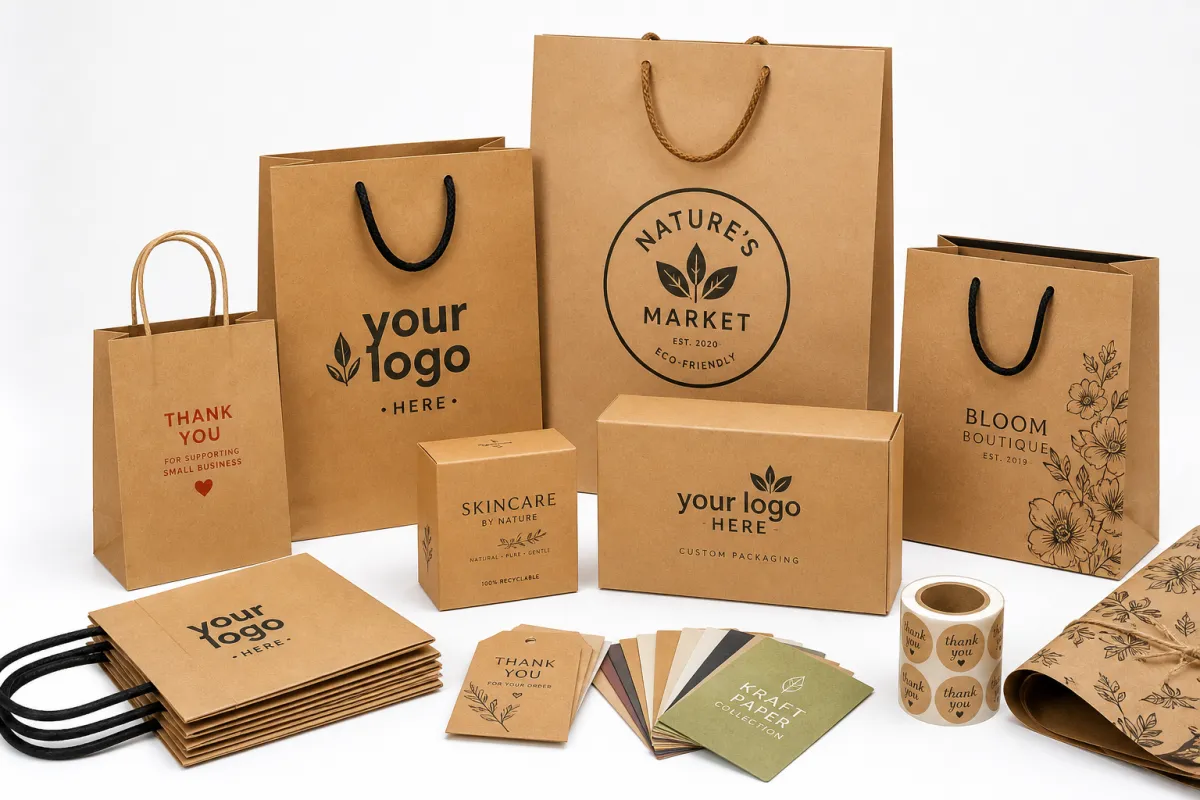
People often think a printed kraft bags supplier is just a print shop that also sells paper bags. That misses the real job. The supplier has to balance paper grade, bag size, handle style, print coverage, and cost so the finished bag works in daily use, not only in a mockup or a flat PDF.
Material choice comes first. Kraft paper is not one thing. A 120 gsm bag may be fine for apparel or bakery items. A 170 gsm or 200 gsm build makes more sense for heavier retail products, gift sets, or anything with sharp corners. A good printed kraft bags supplier should ask what the bag is carrying, how far it travels, and whether it needs to hold up through repeated handoffs. If they do not ask, that is a warning sign, not a quirk.
Construction comes next. A small twist handle bag, a flat handle bag, and a rope handle bag all behave differently. So do bags with reinforced top rims, side gussets, or extra bottom boards. A careful printed kraft bags supplier knows how seam loads change when a bag is filled unevenly, because that is usually where problems show up first. The weak point is rarely the part buyers talk about. It is the part nobody thought to test.
Print method matters too. Flexographic printing is common for repeat runs and can be cost-effective for one or two colors. Offset printing gives strong detail for more complex artwork. Digital works for shorter runs and faster proofing, though it is not always the cheapest path at scale. The right printed kraft bags supplier matches the method to the artwork instead of forcing every job through the same setup.
Finishing is another part of the job that gets ignored too often. Matte or gloss coating, hot stamping, spot varnish, or no coating at all changes the feel of the bag and the way the ink sits on the surface. Some brands want the natural kraft fiber visible. Others want a cleaner retail look with sharper color blocks. A reliable printed kraft bags supplier will tell you what those choices do to cost, lead time, and durability.
The sourcing model matters as well. A factory-direct supplier usually gives tighter control over the build, clearer access to production details, and better visibility into the real lead time. A broker can help if you need coordination across multiple items, but the communication chain is longer. A trade printer may be faster for standard jobs, but not every trade printer controls the whole bag-making process. If you are comparing quotes, ask what kind of printed kraft bags supplier you are actually dealing with, because pricing and accountability change with the setup.
A cheap bag is not a cheap order if it tears, smears, or arrives late. The real cost shows up in returns, repacking, and the brand damage that follows a bad first impression.
That is the buying mindset I recommend. When you evaluate a printed kraft bags supplier, do not ask only, “What is the unit price?” Ask, “Will this bag hold weight, print clearly, and show up on time with the finish I approved?” That is the line between a procurement exercise and a packaging decision.
For buyers who want broader packaging and sustainability context, the ISTA site is useful for shipping and distribution testing, and the FSC site is a solid reference for certified fiber sourcing. Those resources will not pick the bag for you, but they help frame the questions a serious printed kraft bags supplier should answer.
How a printed kraft bags supplier manages process and timeline
The easiest way to understand a printed kraft bags supplier is to trace an order from quote request to shipment. A clean process usually starts with a spec sheet that lists bag dimensions, paper weight, handle type, quantity, print colors, delivery location, and intended use. If the supplier has to chase all of that later, the timeline starts slipping before production even begins.
After the quote, artwork review comes next. This is where a good printed kraft bags supplier checks dielines, bleed, safe zones, logo placement, and color expectations. Send a loose file and ask them to “make it work,” and you have created avoidable revision time. A crisp vector file with fonts outlined and clear PMS or CMYK guidance usually saves a few rounds of back-and-forth.
Proofing is the next gate. Simple one-color runs may move quickly, especially when the bag size is standard and the print area is straightforward. Jobs with multiple colors, metallic ink, custom sizing, or special finishes take more coordination. A careful printed kraft bags supplier will not rush that step if color match matters, because the proof is where expensive surprises get prevented.
Then comes setup. In flexographic work, plate making or plate adjustment can add time. In offset work, press setup may be more involved, especially when the artwork has fine screens or tightly registered elements. Handle style matters too. A rope handle or reinforced patch handle may require different assembly steps than a flat handle bag. A practical printed kraft bags supplier flags those variables early instead of burying them in a quote line nobody reads.
Production time depends heavily on complexity. A simple one-color run in a standard size can move in roughly 10 to 15 business days after proof approval. A more customized order with multiple print colors, special coatings, or a nonstandard die line may need 15 to 25 business days or more. Add freight time on top of that, and the most careful buyers build a buffer. A dependable printed kraft bags supplier should give you a timeline that separates proofing, production, packing, and transit so you know where the time is going.
These bottlenecks cause delays more often than they should:
- Artwork corrections that require a revised dieline or a fresh proof.
- Color matching on textured kraft, which may need an adjusted ink formula.
- Special handles that require a different assembly line or extra reinforcement.
- Freight scheduling when the shipment must connect with a tight receiving window.
- Internal approval delays on the buyer side, which often run longer than the factory step itself.
A smart planner treats the whole order as a sequence, not a single lead-time number. Ask your printed kraft bags supplier how long proofing will take, how many days production usually needs after approval, and whether the freight method is air, sea, or domestic ground. If the bags are tied to a store opening, seasonal launch, or event, add at least one extra week whenever possible. A little buffer now is a lot better than a late-night scramble later.
For buyers who follow shipping test standards, it also helps to think in terms of distribution stress. The printed kraft bags supplier may not run the same tests as a corrugated shipper, but the logic is similar: the package has to handle stacking, movement, and transit without losing function. Standards and realistic timing need to work together.
Printed kraft bags supplier pricing: what drives the cost
Pricing from a printed kraft bags supplier looks simple on the surface, but the quote is built from several moving parts. The unit price is only one line. Setup fees, plate charges, sample costs, freight, and any special finishing can change the real landed cost quite a lot.
At a practical level, the biggest cost drivers are bag size, paper weight, handle style, print colors, coating, and order quantity. A larger bag uses more paper and more material in the handles and reinforcement. Thicker kraft raises the raw material cost. More colors increase setup complexity. A printed kraft bags supplier will usually quote a lower per-bag price at higher volume because setup gets spread across more units, but the total order value still rises with heavier materials and more decoration.
Here is a useful rule of thumb. For a medium retail bag at around 5,000 pieces, a simple one-color print on standard kraft may land around $0.18 to $0.28 per unit before freight. A more premium build with multiple colors, stronger handles, or added finishing can move into the $0.32 to $0.55 range. Smaller runs often cost more per piece because setup is not diluted. These numbers are directional, not a promise. A printed kraft bags supplier should be able to explain that without hiding behind vague wording.
Another pricing wrinkle is that two bags can look almost identical from ten feet away and still cost very different amounts. One might use 120 gsm kraft with a basic flat handle. The other may use 160 gsm or 170 gsm paper, a reinforced top rim, and a better color match on a textured surface. The second quote may look higher, but the bag could be stronger, cleaner, and a better fit for a premium product line. That is why a careful buyer compares value, not just the lowest number from a printed kraft bags supplier.
| Supplier option | Typical fit | Illustrative unit price at 5,000 pcs | Setup and extra charges | Main tradeoff |
|---|---|---|---|---|
| Factory-direct printed kraft bags supplier | Standard to custom production, better control over specs | $0.18-$0.35 | Plate or setup fees, freight, sample charge if requested | Usually the best balance of cost and control, but technical coordination takes more effort |
| Broker or sourcing agent | Multi-item programs or buyers who want one point of contact | $0.22-$0.42 | May include service markup inside the quote | Communication is simpler, but the supply chain is less direct |
| Trade printer | Simple artwork, shorter runs, standard bag formats | $0.20-$0.40 | Artwork setup, color matching, rush fees if timing is tight | Fast for common jobs, but less flexible on unusual structures |
| Premium custom printed kraft bags supplier | Retail branding where finish and feel matter | $0.32-$0.55+ | Higher setup, special coating, custom handles, tighter QC | Stronger brand presentation, higher spend per unit |
When comparing quotes, ask what is included and what is not. Is the art setup free, or is there a plate charge per color? Are samples included, or billed separately? Is freight quoted to your warehouse, or only to the port? A good printed kraft bags supplier will spell that out so you can compare landed cost across vendors instead of chasing a headline price that changes later.
One more thing buyers forget is the hidden cost of failure. If a bag tears, that cost shows up in replacements, extra labor, and sometimes a damaged customer experience. From a packaging buyer’s point of view, paying a little more for a stronger handle or better color control is often cheaper than scrambling after a weak run. A dependable printed kraft bags supplier should help you weigh those risks before the order goes live.
Key factors to compare before you choose a supplier
When I compare one printed kraft bags supplier with another, I start with material quality. Kraft grade, recycled content, finish, and surface consistency all matter because they affect both print appearance and bag performance. A bag that looks fine on a spec sheet may still feel flimsy if the paper is too light for the intended load.
Print quality is the next filter. You want sharp edges, even coverage, and color consistency from one batch to the next. Kraft paper is textured, so fine type can fill in or soften if the ink laydown is not controlled well. A good printed kraft bags supplier will tell you which artwork elements are safe on kraft and which ones need to be simplified for legibility.
Structural details deserve real attention. Check gusset depth, bottom construction, seam strength, handle attachment, and whether the top rim is reinforced. A bag may hold up on a light gift item and fail on a bottle, a box, or a product with uneven weight distribution. Ask the printed kraft bags supplier what the bag is rated for in real use, not just in theory, because usable load depends on the whole build, not one isolated part.
Communication quality tells you a lot about the supplier’s internal discipline. Fast replies help, but accurate replies matter more. A strong printed kraft bags supplier should answer technical questions clearly, send proofs that match the spec, and give lead times that sound believable rather than optimistic. If the story keeps changing, that usually shows up later in production too.
Sustainability can also shape the decision, especially if the bags support a retail brand with a public environmental position. Ask about recycled fiber content, FSC options, and water-based inks. The EPA's sustainable materials guidance for paper and paper products is a useful reference if you want to understand the broader recycling and fiber-use conversation. A responsible printed kraft bags supplier should be able to explain whether a greener spec changes strength, appearance, or cost.
There is also the plain reality of packaging testing and handling. If your bags travel inside cartons, on pallets, or through multiple distribution points, ask whether the supplier has experience with transport-related stress. A printed kraft bags supplier that understands packaging logistics will think about handling damage, stack pressure, and transit scuffing instead of staring only at print aesthetics. That part gets overlooked way too often.
Here is a simple comparison mindset that helps:
- Material: Does the paper match the load and brand feel?
- Print: Will the artwork stay crisp on kraft texture?
- Structure: Are the seams and handles built for real use?
- Communication: Are proofing and lead times clear?
- Sustainability: Are FSC, recycled content, or water-based ink options available?
If a printed kraft bags supplier checks all five boxes, that supplier is usually worth a closer look even if the quote is not the lowest. If they miss two or three of those areas, the cheaper price starts looking like a trap.
Step-by-step: ordering from a printed kraft bags supplier
The cleanest orders start with a precise spec sheet. Before you contact a printed kraft bags supplier, gather the bag dimensions, handle type, paper weight, print colors, quantity, intended product, and delivery address. If the bag needs to carry anything with sharp edges, mention that too. The more complete the spec, the less room there is for misunderstanding.
Once the brief is ready, request quotes from two or three suppliers using the same information. That way you can compare like for like. A fair comparison from a printed kraft bags supplier should include unit price, setup charges, proofing costs, freight assumptions, and estimated lead time. If one quote looks much lower, check whether it quietly removed a handle upgrade, a thicker paper grade, or an included sample. That trick is older than the internet.
Next comes the dieline and proof. This is where the most costly mistakes get prevented, so do not rush it. Check that the logo sits in the right place, that bleed is included, and that nothing important falls too close to a fold or gusset. If the printed kraft bags supplier gives you a proof with a color reference, review it against your brand standard and your physical expectations, not just the screen view.
If the bag is going to a retail launch, a food service use, or a premium gift program, I strongly recommend asking for a sample or sample run. Paper texture, handle feel, and print clarity are easier to judge in hand than in a PDF. A serious printed kraft bags supplier should understand that and should be able to provide a production-like sample or a close comparable example from a similar job.
Before final approval, verify the production schedule, carton pack count, and shipping method. Ask how the bags will be packed to avoid corner crush, scuffing, or moisture exposure. For heavier orders, also ask whether cartons will be palletized and wrapped. A disciplined printed kraft bags supplier should have a clear answer because packing is part of product quality, not an afterthought.
Here is a practical order sequence that works well in real buying cycles:
- Send a complete specification sheet.
- Collect matched quotes from the same baseline.
- Review the dieline and art proof carefully.
- Approve a sample or comparable reference if needed.
- Confirm production, packing, and shipping details.
- Inspect the first delivery immediately and document any issues.
The first shipment matters. Open a few cartons, check the print, examine the handles, and test the bag with the intended product weight. If you find a problem, report it while the order details are still fresh. A good printed kraft bags supplier will want that feedback because it helps lock in the next run.
One more detail: always keep a record of the approved proof, the final spec, and any written changes. That paper trail protects you if the next order is placed months later by a different buyer on your team. In packaging, the small things you document are often the things that save the whole program.
Common mistakes when working with a supplier
The most common mistake is vague communication. Buyers send a logo, say they need “a nice kraft bag,” and expect the printed kraft bags supplier to fill in the rest. That usually creates a quote that needs revision later, or a finished product that does not match the expectation in anyone’s head.
Another frequent error is choosing only on price. A low quote can hide thinner paper, weaker handles, loose print control, or a finish that makes the brand look less polished. A printed kraft bags supplier who is honest about structure and print limits may cost a little more, but that honesty often saves money and stress over the life of the program.
Skipping proof approval is a mistake I see more often than people admit. On kraft paper, color can shift, fine type can blur, and artwork placement can look different once the bag is folded and glued. A careful printed kraft bags supplier will push for proof signoff because that step catches the real-world issues before production starts.
Lead times are another trap. Buyers sometimes count only the factory run and forget about revisions, sample approval, transit, customs, or internal procurement signoff. The result is a rushed reorder and a lot of unnecessary pressure on both sides. A solid printed kraft bags supplier should explain the full timing chain, but buyers still need to plan the internal steps on their side.
Overcomplicated artwork can also create trouble. Too many colors, too much fine detail, and too many effects can increase cost and raise the chance of poor registration or muddy print on textured kraft. If your brand can live with a simpler build, a leaner design is often the smarter move. A practical printed kraft bags supplier will usually tell you where simplification improves quality without hurting the look.
There is one more issue worth calling out: buyers sometimes ignore the real use case. A bag for a candle set is not the same as a bag for a soft T-shirt, and neither is the same as a takeaway bag for a heavy meal container. If the load, shape, or customer handling changes, the spec should change too. A competent printed kraft bags supplier will ask those questions because the bag has to work in the hand, not just on paper.
Expert tips and next steps for a smoother order
If budget matters, keep the design efficient. Fewer print colors, standard sizes, and simpler coverage usually lower the risk of defects and keep the order more predictable. A strong printed kraft bags supplier can still make a simple bag look refined if the material, ink, and construction are chosen well.
Ask for a comparable sample whenever you can. Even if it is not the exact bag, a photo or physical example from a similar run will tell you a lot about paper feel, handle strength, and print clarity. A good printed kraft bags supplier should not resist that request, because similar jobs often reveal more than a spec sheet ever will.
Create a vendor scorecard and use it consistently. I like to compare price, communication, proof quality, lead time, structural confidence, and sustainability options. You do not need a complex spreadsheet. A simple 1-to-5 score for each category is enough to show which printed kraft bags supplier is actually the best fit for the job.
Think ahead about reorders. If a bag will be used regularly, a small safety stock is often cheaper than a rush reorder with expensive freight. Many buyers learn this only after the first run lands a little late or sales move faster than expected. A reliable printed kraft bags supplier can usually support repeat ordering more smoothly if the first run was documented well.
My practical advice is simple: build the spec first, ask matched questions, and compare more than price. That is how you find the printed kraft bags supplier who can protect both the product and the brand story behind it.
Here is the shortest path to a better order:
- Write the spec before you ask for quotes.
- Review the proof like it is the finished bag.
- Check the sample if weight, color, or finish matters.
- Compare landed cost, not only the per-unit line.
- Plan the reorder before the first shipment is gone.
If you follow those steps, you will spend less time reacting and more time building a bag program that actually supports the brand. Pick the right printed kraft bags supplier, lock the spec, and treat landed cost plus real-world performance as the decision. Everything else is just noise.
Frequently Asked Questions
What should I ask a printed kraft bags supplier before I request a quote?
Start with the basics: bag size, paper weight, handle type, print colors, quantity, and delivery location. Then ask about minimum order quantity, sample availability, artwork setup fees, and whether the quote includes freight or only factory pricing. A thorough printed kraft bags supplier should answer those questions clearly before you move to proofing.
How much does a printed kraft bags supplier usually charge for custom bags?
Pricing depends on bag size, paper grade, print complexity, quantity, and any special finish or handle upgrade. A simple run may sit near the lower end of the range, while premium builds cost more because of thicker paper, more setup, or tighter color control. When you compare a printed kraft bags supplier quote, focus on landed cost, not just the headline unit price.
How long does a printed kraft bags supplier take to produce an order?
Timing usually includes artwork review, proof approval, production, packing, and shipping. Simple jobs can move faster, while custom sizes, multiple colors, or specialty handles take longer. A reliable printed kraft bags supplier should give you a realistic timeline that separates each stage so you can plan inventory with a buffer.
What artwork file should I send to a printed kraft bags supplier?
Vector files are usually the safest choice because they stay sharp at print size and are easier to place on a dieline. Outline fonts, include bleed, and label your colors clearly. If the printed kraft bags supplier provides a dieline, build your artwork directly on it and check every fold, seam, and safe zone before approving the proof.
Can a printed kraft bags supplier help with more sustainable options?
Yes, many can offer recycled kraft, FSC options, and water-based inks depending on the project. You can also reduce waste by keeping the design efficient and avoiding unnecessary coatings or heavy finishes. A thoughtful printed kraft bags supplier should be able to explain how sustainability choices affect strength, appearance, and total cost before you approve the final spec.
Choosing a printed kraft bags supplier is really about matching the right material, print method, timeline, and communication style to the job in front of you. Get those pieces aligned, and the bag feels easy to buy, easy to use, and easy to reorder. That is the kind of result that actually holds up once the first cartons are opened and the customers start carrying them out the door.
Related packaging resources
Use these related guides to compare specs, costs, quality checks, and buyer decisions before making the final call.

