Buyer Fit Snapshot
| Best fit | Custom Box Pricing by Size projects where brand print, material claims, artwork control, MOQ, and repeat-order consistency need to be specified before quoting. |
|---|---|
| Quote inputs | Share finished size, material target, print colors, finish, packing count, annual reorder estimate, ship-to region, and any compliance wording. |
| Proofing check | Approve dieline scale, logo placement, barcode or warning zones, color tolerance, closure strength, and carton packing before bulk production. |
| Main risk | Vague material claims, crowded artwork, missing packing details, or unclear freight terms can make a low unit price expensive after revisions. |
Fast answer: Custom Box Pricing by Size: Board, Finish, Dieline, and Unit Cost should be specified like a repeatable production item. The safest quote records material, print method, finish, artwork proof, packing count, and reorder notes in one written spec.
Production checks before approval
Compare the actual filled-product size with the drawing, then confirm tolerance on folds, seals, hang holes, label areas, and retail display edges. Reserve space for logos, QR codes, warning copy, and material claims before decorative graphics fill the panel.
Quote comparison points
Review material grade, print process, finish, sampling route, tooling charges, carton quantity, and freight assumptions side by side. A quote is only useful when the supplier can repeat the same color, closure quality, and packing count on the next order.
Custom box pricing by size can look simple on the surface, then a box gains half an inch and the quote jumps enough to make you blink twice. That jump usually is not random. A small change in footprint can alter board usage, sheet yield, cutting efficiency, print setup, freight weight, and even how a carton stacks on a pallet. Once you understand how custom box pricing by size is built, you stop treating quotes like a mystery and start comparing them on equal terms.
That matters whether you are buying custom printed boxes, retail packaging, shipping mailers, or branded cartons for a launch that has to look polished on day one. A serious quote is more than a number on a page. It is a cost map tied to dimensions, structure, material, finish, and the way the box will actually run in production. Once those pieces are visible, custom box pricing by size gets a lot less hazy and a lot easier to manage.
Why custom box pricing by size catches brands off guard
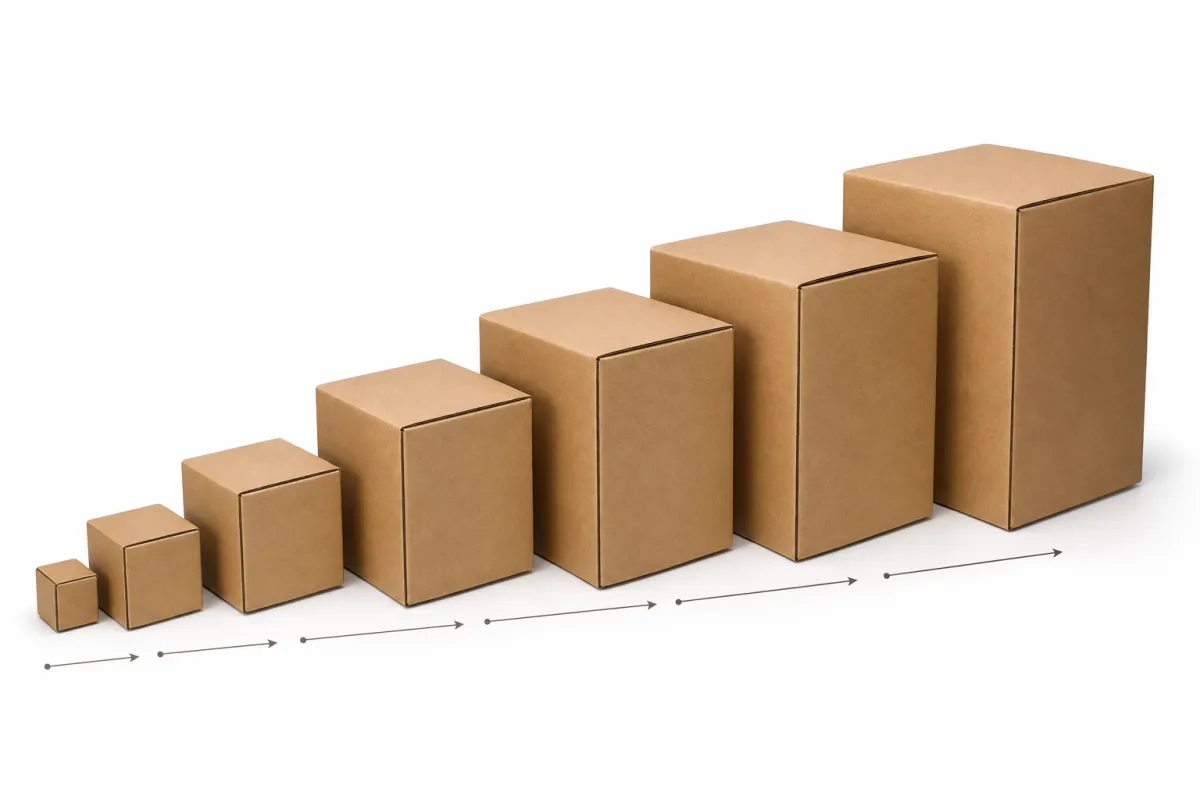
The frustrating part shows up fast: a box that is only a little wider can force a new sheet layout, create more waste, or push the job into a different cutting pattern. That is why custom box pricing by size can change sharply even when the artwork and quantity stay exactly the same. Most buyers expect price to rise in a smooth line. Packaging does not work that way. It follows yield, not wishful thinking.
Picture a folding carton that fits 12-up on a press sheet at one dimension, then falls to 8-up after a modest width increase. The unit price can rise without a single ink color changing. Corrugated mailers behave the same way when a larger footprint uses more board per blank and leaves bigger offcuts behind. In plain language, custom box pricing by size is driven by manufacturing efficiency first, and the ruler only second.
Buyers usually get caught when they approve the same print, same insert, same quantity, then move the product by a quarter inch and wonder why the quote lands higher. The answer is usually very plain, even if it is not exciting: more board, less nesting efficiency, extra setup, or heavier freight. None of that sounds dramatic. All of it affects custom box pricing by size.
The smarter move is to treat a size change like a production change rather than a cosmetic tweak. Once the carton footprint changes, the economics often change with it. That holds true for retail packaging, subscription mailers, and Product Boxes That rely on inserts or dividers. Seen that way, custom box pricing by size stops looking random and starts looking like a manufacturing equation you can actually work with.
I’ve sat through enough quoting conversations to know the same mistake keeps repeating: teams optimize the wrong inch. They’ll shave a panel for weeks, then discover the real cost hit came from the structure choice or the way the blank nested on the sheet. That kind of thing is why a good packaging quote needs context, not just dimensions.
Keep one simple idea in mind: if you know which variables move with size, you can compare apples to apples instead of comparing a clean estimate to a padded one. Most of the savings live there. Not in forcing every carton to be as small as possible, but in understanding how custom box pricing by size is assembled.
What custom box pricing by size actually includes
Custom box pricing by size is never just one line item. It is a stack of costs layered together. The main pieces are board usage, converting labor, print setup, finishing, and freight assumptions tied to the finished dimensions. A supplier who quotes honestly is mentally moving through each of those pieces before sending over a number. Size is only the first trigger.
Board usage is the obvious piece, yet the more useful story is how the size affects sheet yield. A box that nests efficiently can cost less per unit than a smaller box that wastes more board. That is why custom box pricing by size has to be read with the box style beside it. A mailer, folding carton, and rigid setup do not behave the same way, and a quote that ignores structure is kinda missing the whole point.
Measurement gets people in trouble too. Structural size, inside dimensions, and shipping dimensions are not interchangeable. Inside dimensions tell you what the product fits. Outside dimensions tell you what the finished box measures. Shipping dimensions determine freight and dimensional weight. Once those get mixed together, custom box pricing by size becomes much harder to interpret.
For a clean mental model, I usually separate the measurements like this:
- Structural size: the blank or die-cut geometry that drives production.
- Inside size: the usable space for the product and insert.
- Outside size: the finished carton size after board thickness is added.
- Shipping size: the number that affects carton freight and pallet density.
That distinction matters because the same artwork can be quoted on two different structures and still land at two different price points. A 350gsm SBS folding carton does not share the same material logic as a 32 ECT corrugated mailer. Single-wall corrugated and rigid packaging follow their own rules as well. Custom box pricing by size is really a cost map, not a single number.
If you want a dependable baseline, ask which board grade, thickness, and construction method the quote assumes. For sustainable packaging, ask whether the paperboard is FSC certified too. The certification does not automatically lower price, but it can affect sourcing and supplier selection. The FSC site is a useful reference for what that label means in practice.
A useful disclaimer here: there is no universal price formula that works for every packaging program. A cosmetics carton, a subscription mailer, and a high-end rigid box all behave differently, and anyone pretending otherwise is glossing over the real production details. Honest pricing starts with honest specs.
How custom box pricing by size is calculated from quote to ship
The pricing sequence usually begins the same way: gather dimensions, choose the box style, estimate material usage, apply setup costs, then add finishing and freight. That is the core of custom box pricing by size. The supplier may use software, a spreadsheet, or a quoting platform, but the logic rarely changes.
First comes size and structure. A good estimator wants exact dimensions, plus product weight and whether an insert, divider, or void space is needed. From there, they check whether the blank can fit efficiently on a sheet or move through a converter with acceptable waste. Custom box pricing by size often shifts more here than buyers expect, because the blank layout usually tells the truth long before the sales quote does.
Setup charges come next. Print plates, dies, and tooling behave like fixed costs. On a small run, those fixed costs hit harder per unit. On a larger run, they spread out. That is why custom box pricing by size often improves sharply once quantity crosses a breakpoint. The box did not get cheaper on its own. The setup just got diluted across more units.
Finishing adds another layer. Gloss or matte lamination, foil stamping, embossing, debossing, soft-touch coating, spot UV, aqueous coating, and window patches all bring extra time and material into the job. A modest carton with rich finishing can cost more than a larger plain box. That only feels unfair until you remember that finishing is labor and process time, not decoration at no cost. Custom box pricing by size has to absorb that work somewhere.
Timeline plays a part too. A straightforward quote with clear dimensions can come back in a day or two. A structural change, custom insert, or special finish often adds several more business days. Samples can stretch the schedule by a week or more, especially if dielines need revision. If the launch date is fixed, say so early. Rushed packaging usually costs more and leaves less room to catch mistakes. That is scheduling, not drama.
Box size also changes freight in two ways. Heavier cartons cost more to ship. Larger cartons may trigger worse dimensional weight or lower pallet density. For shipping packages, that can be the hidden reason a bigger box hurts landed cost more than the packaging quote itself suggests. If the mailer has to survive parcel transit, it makes sense to check test references such as ISTA testing protocols and, where relevant, ASTM distribution testing methods.
From quote to warehouse, the moving parts are practical, not mystical. Custom box pricing by size starts with board, moves through setup, and ends with freight and finish. Miss one layer and the budget can slide off course fast.
The biggest pricing variables: size, material, and print setup
Size is the most obvious lever, yet it rarely acts alone. In real quoting, custom box pricing by size is shaped by the interaction between dimensions, board grade, wall thickness, and how much print work the box needs. Change one variable and leave the rest untouched, and the result can still surprise you.
Material choice shows that clearly. Kraft board, SBS, CCNB, E-flute, B-flute, and rigid greyboard all price differently. A cleaner-looking board may cost more. A thicker board may improve crush resistance but also increase board consumption and shipping weight. For product packaging, the cheapest material is not always the right one. Good packaging design starts with protection, then brand presentation, then cost. Reversing that order usually gets expensive later.
Print setup behaves like a fixed charge. The same print job can look expensive on a 500-unit order and much more reasonable on a 5,000-unit order. If the box size still fits the sheet efficiently, larger runs often win on per-unit price. That is one reason custom box pricing by size should be compared across quantity breakpoints, not just one quantity.
Finishing can outweigh size changes in some cases. A plain box with no coating is one thing. Add foil, embossing, soft-touch lamination, and a custom insert, and you are in a different cost bracket entirely. I have seen buyers focus on a 1/8-inch dimension change while overlooking the fact that a new finish added more cost than the size adjustment ever would. Packaging math has a way of punishing assumptions.
The construction method matters too. A mailer box, a tuck-end carton, a sleeve, and a rigid setup do not price the same way. A rigid box usually carries a higher labor component. A folding carton can be fast and efficient, provided the size works well on press sheets. Corrugated packaging may be cheaper per unit at larger sizes, yet less efficient when overbuilt. All of that feeds into custom box pricing by size.
Minimum order quantity matters as well, and buyers sometimes underestimate it. A plant may be happy to make a very specialized box, but the setup still has to be justified somehow. If the quantity is tiny, the per-unit cost can climb fast no matter how modest the dimensions look on paper. That is not a sales trick; it is just how the math lands.
Here is a practical comparison to keep close:
| Box type | Typical use | Common price range per unit | Main size-related cost driver |
|---|---|---|---|
| Folding carton | Retail packaging, cosmetics, small goods | $0.18-$0.55 at mid to higher quantities | Sheet yield and print setup |
| Corrugated mailer | Shipping, subscription, e-commerce | $0.45-$1.25 depending on flute and print | Board usage and freight density |
| Rigid box | Premium presentation, gift sets | $1.10-$4.50+ based on finish | Labor, wrap coverage, and finishing |
| Large corrugated shipper | Bulk product transport | $1.25-$3.50+ depending on grade | Board strength and dimensional weight |
Those numbers are not universal. Quantity, print coverage, and structure change them every time. Even so, the pattern is clear: custom box pricing by size moves fastest when size changes sheet efficiency or shipping density. That is the lever to watch first.
Step-by-step process for getting a reliable box quote
Good quotes do not happen by luck. They happen because the buyer gives clean inputs. If you want custom box pricing by size that actually supports a decision, start with the exact packed dimensions, not the product dimensions alone. A box for a bottle, jar, or electronics item often needs clearance for inserts, wrap, or retailer shelf requirements.
Here is the minimum spec set I would send to a supplier:
- Finished inside dimensions.
- Approximate outside dimensions if you already have them.
- Quantity by run.
- Box style, such as mailer, folding carton, sleeve, or rigid.
- Board type, thickness, and any strength target.
- Print sides, color count, and finish.
- Whether inserts, dividers, or windows are needed.
- Target delivery date.
The cleaner the inputs, the less padding in the quote. Vague specs force the supplier to assume worst-case material or extra labor, and that pushes custom box pricing by size upward. Nobody likes surprise padding except, maybe, the person trying to protect margin.
After that, compare quotes only after normalizing the specs. If one vendor quotes a 10% thicker board, a matte coating, and a proofed insert while another quotes bare board and no insert, those are not comparable numbers. They are different products wearing the same label. Many buyers lose time here. They compare totals instead of comparing what the totals include.
A cleaner workflow looks like this:
- Send one agreed spec sheet for the quote.
- Review the dieline before sampling.
- Approve a physical or digital sample if the structure is new.
- Lock the final size before print plates or dies are made.
- Move to production only after the approved version matches the order.
If you need a starting point for box styles, material options, or printed packaging formats, browse our Custom Packaging Products page. Seeing the range first helps, because custom box pricing by size depends heavily on what kind of box you are actually buying.
On the technical side, ask whether the supplier is quoting by blank size, finished size, or packed size. That small distinction carries a lot of weight. I have seen teams approve an order based on the wrong measurement and then spend the next week wondering why the cartons do not fit the product cleanly. Custom box pricing by size only works when everyone speaks the same measurement language.
If the project includes retail packaging, set the shelf-facing panels and hanging requirements before quote approval. Packaging choices that seem tiny, like a thumb cut, display window, or reinforced lip, can affect die complexity and labor. The size itself is only part of the answer. The real quote reflects the whole system.
One more thing that saves a lot of back-and-forth: ask for the assumed board caliper and the make-ready details up front. Those details are not flashy, but they tell you whether the supplier is quoting from a realistic production plan or just from a rough estimate. That kind of clarity makes a quote useful instead of just tidy.
Common mistakes that inflate box quotes for no reason
The quickest way to make custom box pricing by size ugly is to measure the product instead of the finished packed unit. That mistake leads to oversized cartons, extra board, and sloppy insert assumptions. It also weakens presentation. A product rattling inside a box does not feel premium. It feels like waste with branding on it.
Vague spec language causes the next round of trouble. If you say “standard white box” or “nice finish,” the quote will be built on assumptions. Assumptions are expensive. A supplier who does not know whether you want SBS, kraft, or corrugated will usually quote conservatively. That protects them. It does not protect your budget. Clear specs make custom box pricing by size more predictable.
Changing dimensions after sampling is another easy way to burn cash. Once a dieline is created and a sample is approved, a size change can force a new layout, new tooling assumptions, and new material yield calculations. A minor edit can ripple through the whole job. If the dimensions need revision, do it before the project gets too far downstream.
Comparing a plain sample to a finished production box is just as misleading. A bare board sample with no coating, no inserts, and no shipping setup is not the same thing as a completed order ready for fulfillment. Yet people compare them constantly. Then they decide the production quote is “too high.” It is usually just complete. Custom box pricing by size should be compared on identical spec sets, or the exercise has no real value.
Here are a few other traps that quietly raise cost:
- Using the product’s maximum dimension instead of the true packed dimension.
- Adding extra internal clearance “just in case” without testing fit.
- Specifying premium finishes on every panel when one side would do.
- Ordering a tiny quantity for a highly customized structure.
- Ignoring shipping density until after the packaging is approved.
For shipping cartons, test expectations matter too. If a package has to survive parcel distribution, ask whether it should be designed against ISTA methods or similar transit testing assumptions. That does not mean every carton needs a formal lab program, but the reference point keeps the structure honest. The difference between a box that looks sturdy and one that actually performs is not academic. It shows up in returns, damage claims, and replacement cost. That is how custom box pricing by size becomes expensive after the fact.
Expert ways to lower cost without shrinking the box
You do not always need a smaller box. You often need a smarter one. The best cost reductions in custom box pricing by size usually come from better layout, simpler finishing, and cleaner quantity planning, not from forcing the product into an awkward carton that hurts the brand or the contents.
Standardizing around efficient sheet sizes is a good place to start. If a small size change lets the box fit a better yield pattern, that can lower material waste without making the package feel cheaper. Experienced packaging buyers look for efficient dimensions first. Exact fit sounds elegant. Efficient fit pays the bills. In practice, that is the more useful standard for custom box pricing by size.
Another strong move is simplifying print coverage. Full-bleed ink on every panel, heavy metallic accents, and multiple embellishments all raise cost. If the brand can be expressed with a cleaner front panel, a restrained side panel, or one strong inside print, the packaging can still feel premium without turning into a budget problem. Good package branding is not about piling on effects. It is about choosing the few that matter.
Quantity planning matters more than most teams want to admit. A larger run can improve unit cost sharply, but only if storage and forecast risk are manageable. Three tiny orders often cost more than one planned run because setup gets charged three times. That is not efficient. It is a habit. Custom box pricing by size rewards thoughtful ordering.
If you need a practical cost control checklist, use this:
- Lock the product dimensions and insert requirements first.
- Check whether a small size shift improves sheet yield.
- Reduce specialty finishing to the panels that actually sell the product.
- Confirm if FSC paperboard or another material spec is required before quoting.
- Ask for quantity breakpoints so you can see where unit pricing drops.
- Compare two quotes built on the exact same spec sheet.
There is also room to manage material choice without hurting the box. A shift from a premium board to a more efficient board grade may save more than shaving a few millimeters from the footprint. A move from rigid packaging to a well-built folding carton may preserve the presentation while lowering labor. That depends on the product, the channel, and how much brand theater you actually need. Not every box has to behave like luxury jewelry packaging.
For buyers managing branded packaging across multiple SKUs, a small dimension library helps a lot. A handful of standardized sizes can cover a surprising amount of product variation. That cuts quote noise and makes reordering easier. It also gives you more control over custom box pricing by size because every new project does not have to start from zero.
One more practical note: the cheapest box is not always the best box. A slightly more expensive carton that protects better, packs faster, and ships more efficiently can save money somewhere else. Spreadsheet-only thinking misses that part. Packaging is a system, not a line item. If the box performs well, custom box pricing by size becomes a managed cost instead of a recurring headache.
Custom box pricing by size rewards clear specs, smart sizing, and realistic finishes. Treat the quote like a system instead of a guess, and you can control cost without damaging the product presentation. That is the real win: a box that fits, sells, and ships without paying for avoidable extras. If you’re making one decision from all of this, make it the measurements first; everything else gets easier after that.
How does custom box pricing by size change between small and large runs?
Small runs usually cost more per box because setup, cutting, and print preparation are spread across fewer units. Larger runs lower the per-unit price, but only if the box size still fits the same sheet layout and production method. Ask suppliers for quantity breakpoints so you can see where custom box pricing by size drops most sharply.
Why does a slightly bigger box cost so much more?
A small size increase can reduce how many boxes fit on a sheet, which raises material waste and labor per unit. The new dimensions may also force a different die layout, carton style, or freight class. That is why even a tiny change can move custom box pricing by size more than buyers expect.
What details do I need for accurate custom box pricing by size?
Provide finished product dimensions, required internal clearance, quantity, box style, board type, and print or finish needs. Include whether the box must fit an insert, retailer shelf, or shipping carton, since each one changes the usable size. If you already have a dieline, send it; that cuts down on guesswork and quote padding in custom box pricing by size.
How long does the quoting and sampling process usually take?
A straightforward quote can come back quickly if the dimensions and specs are clear. Sampling adds time, especially if the supplier needs to revise structure, print setup, or finishing details. If your deadline matters, say so early; rushed packaging often costs more and leaves less room for revisions. That applies directly to custom box pricing by size.
Can I reduce box cost without changing the box size?
Yes. Simplify the print, reduce specialty finishes, and choose a more efficient board or construction where possible. You can also improve the unit price by increasing quantity or adjusting dimensions slightly to better fit production sheets. The cheapest box is not always the best box, so compare savings against protection and brand presentation before you lock in custom box pricing by size.

