Buyer Fit Snapshot
| Best fit | custom box printing services choose the for packaging buyers comparing material specs, print proof, MOQ, unit cost, freight, and repeat-order risk where brand print, material, artwork control, and repeat-order consistency matter. |
|---|---|
| Quote inputs | Share finished size, material target, print colors, finish, packing count, annual reorder estimate, and delivery region. |
| Proofing check | Approve dieline scale, logo placement, barcode or warning zones, color tolerance, and any recyclable or compostable wording before bulk production. |
| Main risk | Vague material claims, crowded artwork, or missing packing details can create delays even when the unit price looks attractive. |
Fast answer: Custom Box Printing Services Choose The: Dieline, Finish, Proof, and Buyer Review should be specified like a repeatable production item. The safest quote includes material, print method, finish, artwork proof, carton packing, and reorder notes in one written spec.
What to confirm before approving the packaging proof
Check the product dimensions against the actual filled item, not only the sales mockup. Ask for tolerance on folds, seals, hang holes, label areas, and retail display edges. If the package carries a logo, QR code, warning copy, or legal claim, reserve that space before decorative graphics fill the panel.
How to compare quotes without losing quality
Compare board or film grade, print process, finish, sampling route, tooling charges, carton quantity, and freight assumptions side by side. A lower quote is only useful if the supplier can repeat the same color, closure quality, and packing count on the next order.
Two products can match on size, weight, and formula and still land very differently once they leave the warehouse. Put one in a plain carton and the other in a box built through custom box printing services, and the customer starts making judgments before the tape is even peeled back. That is not decoration. That is package branding doing real work.
From a packaging buyer's angle, the box is never just a box. It ships the product, carries the brand, slows down fulfillment when it is badly designed, and creates a first impression in one shot. Good custom box printing services turn all of that into a controlled outcome by matching the artwork, board, structure, and finish to the product and the route it has to survive.
Most brands do not need more ornamentation. They need packaging that supports the product, survives handling, and looks deliberate on arrival. The better custom box printing services keep the process practical instead of forcing your team to become part-time print engineers. Nobody asked for that burden.
A plain box protects the product. A well-printed box sells the expectation.
Custom Box Printing Services: What They Really Do
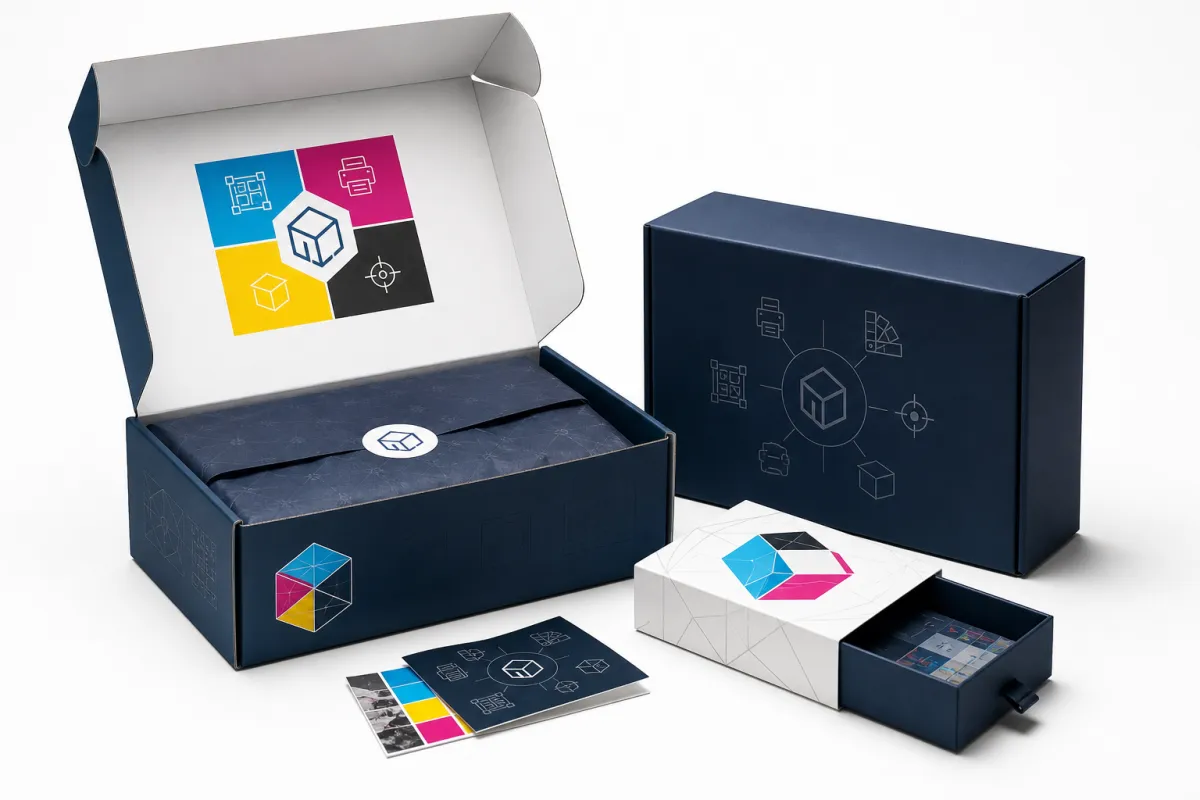
Custom box printing services cover more packaging formats than many buyers expect. They can include printed cartons, mailer boxes, sleeves, inserts, trays, and structural pieces that are matched to the product, the shipping method, and the brand story. In practice, that often means a corrugated mailer for e-commerce, a folding carton for retail packaging, or a rigid presentation box for a premium launch.
The value is not only visual. Custom box printing services help a brand control how the package opens, how it stacks, how it scans, and how it reads from three feet away on a shelf or at the doorstep. A box with a logo, a product message, and a consistent color system does more than look polished. It makes the whole purchase feel intentional.
That matters because buyers use packaging as shorthand for product quality. People outside the packaging industry still act surprised by this, which is cute, but the pattern is old. If the outside of the box looks deliberate, the contents are often assumed to be better, safer, or more premium. That is why custom box printing services show up everywhere in e-commerce, subscription boxes, retail launches, seasonal campaigns, and direct-to-consumer brands trying to build recognition fast.
There is a practical side too. Branded packaging can reduce confusion in fulfillment, make it easier to separate products in a warehouse, and support repeat purchases by making the package memorable. A clean logo placement, a barcode panel that actually scans, and a sensible box size all belong in the same conversation. Strong custom box printing services handle all three without making a mess of the rest.
For teams comparing formats, the scope usually starts with the product itself:
- Mailer boxes for subscription, apparel, beauty, and small electronics.
- Folding cartons for retail shelves, counter displays, and lightweight products.
- Corrugated shippers for transit protection and warehouse-to-home delivery.
- Sleeves and inserts for promotions, seasonal kits, or multi-pack presentation.
If you want to see how packaging formats fit together, our Custom Packaging Products page is a useful starting point. If you need structural support or production detail, our Manufacturing Capabilities page lays out the basics without the usual soup of jargon.
One more thing people miss: custom box printing services are not only for large brands with giant runs. Small businesses use them too, especially when they want a tighter brand presence, a cleaner unboxing experience, or packaging that can survive the uglier math of online retail. The scale changes. The logic does not.
How Custom Box Printing Services Work
The process behind custom box printing services is not mysterious, but it does have a sequence. It starts with a brief, moves into dieline development, then artwork setup, proofing, printing, finishing, assembly, and delivery. Each step adds a decision point, and each decision touches the final box.
A standard workflow looks something like this:
- Brief - Share product dimensions, quantity, shipping method, brand goals, and launch date.
- Dieline - Confirm the structural template so the box folds correctly and leaves room for graphics.
- Artwork setup - Place logos, copy, imagery, barcodes, and compliance text in the correct zones.
- Proofing - Review a digital proof or hard sample for layout, color, and fold placement.
- Printing - Run the approved files through digital printing, offset printing, or flexographic printing.
- Finishing - Apply coatings, foil, embossing, lamination, or die-cut features if specified.
- Delivery - Ship flat, assembled, or kitted depending on the packaging plan.
That workflow sounds simple until an artwork file shows up without a dieline, a barcode lands too close to a fold, or the brand color drifts because nobody defined a color standard. This is where custom box printing services earn their keep. They translate creative intent into something that can actually be manufactured at speed, in quantity, and without looking like a compromise.
The print method matters too. Digital printing is usually the most flexible for shorter runs, personalization, and faster turnaround. It trims setup overhead and works well for pilot programs or seasonal packaging. Offset printing tends to win on sharpness and consistency for mid-to-larger runs, especially when image quality matters. Flexographic printing is often the volume-friendly choice for corrugated packaging, where speed and efficiency matter more than photo-level detail.
| Print Method | Best Fit | Typical Setup | Typical Unit Cost | Main Strength | Main Trade-Off |
|---|---|---|---|---|---|
| Digital printing | Short runs, test launches, variable data | Low to moderate | $0.60-$2.20 depending on size and coverage | Fast setup and flexible artwork changes | Per-unit cost rises as volume grows |
| Offset printing | Mid-range and higher-volume custom printed boxes | Higher due to plates and press setup | $0.18-$0.75 at larger quantities | Sharp image quality and color consistency | Less economical for very small orders |
| Flexographic printing | Corrugated shippers and repeat-volume programs | Moderate to high | $0.10-$0.45 at volume | Efficient for large production runs | Not always ideal for highly detailed art |
File prep is where projects either stay calm or start drifting sideways. Custom box printing services usually require a print-ready PDF, vector logos, embedded fonts, proper bleed, and safe zones that keep text away from folds and cuts. A barcode that scans in proof but sits too close to a crease on the dieline is not a tiny issue. It becomes an expensive problem after production.
Color control is another place where precision matters. A buyer might specify Pantone colors, CMYK builds, or a target match to an existing retail packaging program. If that language is missing, the result can vary box to box, especially across reorders. Good custom box printing services will call that out early, because color drift is one of the quickest ways to make branded packaging look cheap.
For shipping-heavy products, testing matters too. If the box will move through parcel networks, ask about ISTA testing or ASTM D4169. ISTA's methods are widely used for package testing, and their standards are worth reviewing at ista.org. For fiber sourcing, recycled content, or chain-of-custody questions, FSC often enters the conversation; see fsc.org. These standards do not guarantee perfection, but they help separate serious vendors from casual ones.
What Drives Cost in Custom Box Printing Services
Pricing in custom box printing services gets a lot easier to understand once you split it into variables. The headline number often hides the real drivers: size, board grade, print coverage, number of colors, finishing, insert complexity, and order quantity. A small box with a one-color logo can be dramatically cheaper than a larger, full-coverage design with foil and a custom insert set. Shocking, I know. Packaging is not magic.
Quantity is the biggest economic lever. Setup work, plate charges, tooling, and proofing do not disappear just because the order is small. That means a run of 500 boxes usually costs much more per unit than a run of 5,000, even if the physical box looks similar. This is why many buyers of custom box printing services end up choosing a slightly larger first run than they planned. The math usually wins the argument.
Here is a realistic range many packaging teams see for printed packaging, though actual pricing depends on the structure and market conditions:
- Short-run digital mailers: often $0.60-$2.20 per unit.
- Mid-volume offset cartons: often $0.18-$0.75 per unit once volume rises.
- High-volume corrugated shippers: often $0.10-$0.45 per unit at scale.
Those numbers are only part of the story. The real landed cost includes freight, inserts, sample runs, plates, tooling, and any special handling for premium finishes. I have seen buyers compare two quotes and choose the lower line item only to discover that freight, sampling, and rework wipe out the savings. That is one reason custom box printing services should always be judged on delivered cost, not just print price.
Board selection can shift the budget quickly. A simple SBS folding carton for lightweight retail packaging is not priced the same way as a corrugated mailer or rigid chipboard presentation box. Even within corrugated, an E-flute mailer behaves differently than a B-flute shipper. The thicker board improves crush resistance, but it changes fold behavior, print appearance, and shipping weight. Custom box printing services should explain those trade-offs before the order is locked.
Finishing is another budget trigger. Matte aqueous coating, gloss varnish, soft-touch lamination, foil stamping, embossing, and spot UV all add appeal, but they also add cost and time. A soft-touch finish can make a cosmetics box feel premium, yet it may not survive the same handling conditions as a simpler coat. The best custom box printing services providers will tell you whether a finish is decorative, protective, or both.
Structural complexity matters more than new buyers expect. A straight tuck carton is faster and cheaper to produce than a box with locking tabs, multiple partitions, a magnetic closure, or a custom insert. If the product does not truly need the extra structure, paying for it is bad packaging design. If the product does need it, cutting corners can create returns, damage, or a weak unboxing moment. The right answer depends on what the box has to do after it leaves the press.
Here is a useful rule: the cheapest quote is not automatically the best quote. Sometimes it is the quote that weakens board strength, color control, or print fidelity. A brand that wants Premium Product Packaging should weigh the cost of a box against the cost of looking generic. In many categories, that difference shows up faster than people think.
If your team is comparing suppliers, ask for an itemized quote that separates the box structure, print method, finish, insert, proofing, tooling, and freight. That makes it easier to compare like for like. It also helps you spot the gap between the quote and the actual custom box printing services spend.
Step-by-Step Ordering Process for Custom Box Printing Services
A clean ordering process saves money, but it also reduces friction between design, operations, and fulfillment. Custom box printing services work best when the buyer brings a clear brief instead of a vague request for "something nicer." The sharper the brief, the fewer revision rounds later.
Start with the product itself. Measure length, width, height, weight, and any irregular features such as pumps, jars, inserts, or fragile parts. Then add shipping conditions: parcel, pallet, retail shelf, subscription kit, or direct-to-consumer fulfillment. A box for a lightweight serum does not need the same structure as one for a dense consumer electronics item. Good custom box printing services teams will ask these questions immediately, which is reassuring because chaos is not a strategy.
The next step is the comparison quote. Keep every supplier on the same spec sheet. If one quote assumes 1,000 units on C1S board and another assumes 2,500 units on corrugated with full-coverage print, the numbers are not comparable. This is one of the most common mistakes in custom box printing services: buyers compare different assumptions and then call it a pricing issue.
Once the supplier has the brief, proofing begins. Proofs should show the dieline, artwork placement, folds, finish callouts, barcode location, and any notes about color standards. If the brand depends on a precise shade, ask for a color target or a press-approved sample. Proofs are not decoration. They are the last practical chance to catch a layout error before production gets expensive.
Sample approval is worth the time, especially for first-time programs. A pilot run can reveal whether the box is too tight, whether the insert holds the product properly, or whether the finish behaves differently under warehouse handling. For custom box printing services, the sample stage is often the difference between a confident launch and a pile of avoidable complaints.
- Write the brief - Include dimensions, quantity, product weight, shipping method, and brand goals.
- Align the artwork - Use a print-ready PDF, embedded fonts, and a separate dieline layer if possible.
- Review the proof - Check folds, cut lines, legal copy, barcodes, and color references.
- Approve a sample - Confirm fit, finish, and structural performance before mass production.
- Lock the schedule - Reserve time for printing, finishing, packing, and freight.
For a new product launch, I would not skip the sample. The same is true if the box will sit on a retail shelf or carry a premium price point. The sample lets you inspect the package branding from the customer's angle, not just from the designer's screen. That distinction matters in custom box printing services because good artwork can still fail if the structure feels flimsy or the color lands wrong.
One final point on communication: document every change. A revised logo file, a new insert height, or a different shipping label position should be written down and re-approved. The strongest custom box printing services providers are the ones who keep a clean record trail. Reorders get much easier when the original spec is not buried in email threads and vague recollections.
Custom Box Printing Services Timelines: What to Expect
Lead times vary, but the timeline itself is usually predictable. Custom box printing services move through quoting, prepress, proofing, printing, finishing, assembly, and freight. Each stage can add a day or several days depending on revisions and production load. A project that looks simple on paper can still stretch if one step stalls.
Quoting is usually the fastest part, though it still depends on how complete the brief is. If the supplier has to guess at dimensions, finish, or quantity, the quote turns into a rough estimate. Prepress can take longer than buyers expect because the artwork has to be checked against the dieline, the fold pattern, and the print method. That is where many custom box printing services projects lose time without noticing it.
For simple digital runs, some suppliers can move from approved proof to production quickly. More complex offset or flexographic projects usually need more planning time, especially if plates, finishing dies, or custom inserts are involved. A reasonable planning window for many printed packaging jobs is often 10-20 business days after proof approval, but that can stretch fast if the project is large or highly customized. The point is not to memorize one number; it is to respect the sequence.
Three timeline risks show up constantly. First, artwork revisions. Second, material shortages or scheduling conflicts. Third, seasonal demand spikes that push production slots out. If a brand waits until the last week before launch to start custom box printing services, the odds of paying rush freight or accepting a weaker result go up sharply.
Rush orders are not always bad, but they compress the proofing window. That means less time to catch a barcode issue, a color mismatch, or a bad dieline assumption. I have seen teams ask for urgency and then regret the reduced review time more than the premium itself. In packaging, speed has a habit of exposing whatever nobody checked.
Inventory planning is the other side of the timeline question. Packaging should arrive before the product does. That sounds obvious until a warehouse is ready to receive finished goods and the printed boxes are still in transit. Good custom box printing services providers can help sequence the order, but the brand still has to set the launch date with some breathing room.
If you are building a launch calendar, add time for three things that are easy to underestimate: proofing, freight, and internal approvals. Those are the quiet delays. They rarely look dramatic in a project plan, but they cause a lot of late packaging.
Common Mistakes When Buying Custom Box Printing Services
Most packaging problems are not mysterious. They are small mistakes that pile up. With custom box printing services, the most common one is artwork prepared for a screen instead of a press. Low-resolution images, missing dielines, or text placed too close to a fold line can all create ugly surprises. On a monitor, the file looks fine. On a box, it can look careless.
A second mistake is buying finish before confirming substrate. Buyers sometimes request foil, embossing, or a soft-touch feel before they know whether the selected board and print method can support it cleanly. The result can be adhesion problems, inconsistent detail, or a cost structure that makes no sense for the run size. The smarter move is to align the structure first, then add finishes only if they support the final use case. That is a basic lesson in custom box printing services, and somehow it still gets skipped.
Another common error is ignoring performance requirements. If the box must survive parcel drops, stacking, humidity, or shelf handling, those conditions should shape the packaging design from the start. A pretty box that collapses in transit is not premium packaging. It is a return. This is where standards like ISTA 3A or ASTM D4169 can help define the testing plan instead of leaving durability to guesswork.
Logistics mistakes are just as costly. Some brands forget to account for shipping weight limits, pallet configuration, or the warehouse's need for flat-packed cartons. Others choose a dimension that looks elegant but wastes freight space. Custom box printing services should support the whole supply chain, not just the visual side of the launch.
Timing mistakes create a different kind of pain. Ordering too late forces rushed approvals, compressed proofing, and often higher freight costs. It also reduces the chance of catching a print or structural issue before boxes are in the building. A bad schedule can make a good package look like a bad decision.
Then there is the "lowest quote wins" trap. In packaging, the cheapest vendor is not always the least expensive option overall. If the box arrives with weak board, color variance, or finish that scratches too easily, the brand pays later through reprints, damaged goods, or weaker retail packaging performance. That is why experienced buyers treat custom box printing services as a total cost conversation, not a simple procurement exercise.
One more subtle mistake: not planning for reorder consistency. If the first run is approved but the spec sheet is incomplete, the next run can drift. Keep the chosen board, finish, dimensions, color standard, and delivery terms documented. That way, future custom box printing services reorders do not depend on memory, which is a terrible supply chain system.
Expert Tips and Next Steps for Custom Box Printing Services
The best results usually come from matching the print method to the job rather than chasing the lowest headline price. For a short promotional launch, digital printing may be the cleanest fit. For a stable, recurring program with stronger volume, offset printing may deliver better color consistency and economics. For high-volume corrugated programs, flexographic printing often keeps production efficient. The trick is not picking the "best" method in the abstract. It is picking the method that fits the run size, the art, and the use case for custom box printing services.
Ask for a written spec sheet before production starts. It should include the material, dimensions, finish, quantity, color standard, delivery terms, and any special handling notes. That document becomes the anchor for reorders, disputes, and internal sign-off. Without it, custom box printing services can drift from one order to the next.
Use a sample or pilot order for new launches, premium relaunches, or any project with a changed visual identity. That small extra step gives your team a chance to inspect fit, print quality, and unboxing flow before the entire budget is committed. It is a modest insurance policy, and in packaging, modest insurance usually costs less than a reprint.
Think about the box as part of the product, not a wrapper around it. That shift changes the conversation. Suddenly you are not just choosing a carton; you are deciding how the brand enters the customer's space, how it survives distribution, and how it performs on a shelf or doorstep. That is where custom box printing services move from decorative to strategic.
Three practical next steps usually make the biggest difference:
- Create a packaging brief with dimensions, quantity, materials, and launch timing.
- Compare at least three suppliers using the same spec sheet and the same print assumptions.
- Approve one proof and one sample before full production if the box is new or premium.
For brands trying to build stronger package branding, that checklist is usually enough to avoid the expensive mistakes. It also gives your vendor a cleaner path to success. Good suppliers do better work when they get precise inputs instead of guesswork dressed up as direction.
If you are scaling a product line, set a reorder reminder now. That may sound almost too basic, but it prevents the common scramble where the warehouse discovers the last carton is already spoken for. Brands that treat custom box printing services like an ongoing supply decision, not a one-time art project, usually get better consistency and fewer surprises.
Choose the box spec that fits the product, verify it with a sample, and lock the documentation before the first run ships. That is the cleanest way to get predictable results from custom box printing services without paying for avoidable drama later. Pretty simple. Also weirdly rare.
FAQ
What do custom box printing services usually include?
Most custom box printing services include dieline review, artwork setup, proofing, printing, finishing, and delivery coordination. Some providers also help with structural design, sample boxes, barcode placement, and compliance checks so the final box is ready for production and fulfillment.
How much do custom box printing services cost?
Pricing for custom box printing services usually depends on box size, material, quantity, number of colors, and finish options like coatings or foil. Ask for an itemized quote so you can separate the box price, setup costs, proofing, inserts, and freight before comparing suppliers.
How long do custom box printing services take?
Simple digital orders can move faster, while larger or more complex custom box printing services projects need extra time for proofing, plates, finishing, and shipping. Revisions and sample approvals often add days, so it helps to build a buffer into the launch plan.
What file format works best for custom box printing services?
A print-ready PDF is often the safest starting point for custom box printing services, with fonts embedded and a separate dieline layer. Vector logos, proper bleed, and high-resolution images reduce the risk of blurry graphics, misaligned folds, or production delays.
How do I choose the right custom box printing services provider?
Look for clear specs, responsive proofing, and proven experience with products similar to yours. Compare sample quality, turnaround time, and delivered cost instead of choosing only the lowest headline quote, because the right custom box printing services partner usually saves more than it costs.

