Buyer Fit Snapshot
| Best fit | Premium Product Packaging Boxes Bulk projects where brand print, material claims, artwork control, MOQ, and repeat-order consistency need to be specified before quoting. |
|---|---|
| Quote inputs | Share finished size, material target, print colors, finish, packing count, annual reorder estimate, ship-to region, and any compliance wording. |
| Proofing check | Approve dieline scale, logo placement, barcode or warning zones, color tolerance, closure strength, and carton packing before bulk production. |
| Main risk | Vague material claims, crowded artwork, missing packing details, or unclear freight terms can make a low unit price expensive after revisions. |
Fast answer: Premium Product Packaging Boxes Bulk: Pricing & Specs should be specified like a repeatable production item. The safest quote records material, print method, finish, artwork proof, packing count, and reorder notes in one written spec.
Production checks before approval
Compare the actual filled-product size with the drawing, then confirm tolerance on folds, seals, hang holes, label areas, and retail display edges. Reserve space for logos, QR codes, warning copy, and material claims before decorative graphics fill the panel.
Quote comparison points
Review material grade, print process, finish, sampling route, tooling charges, carton quantity, and freight assumptions side by side. A quote is only useful when the supplier can repeat the same color, closure quality, and packing count on the next order.
Premium Product Packaging Boxes Bulk: Pricing & Specs
Premium product packaging boxes bulk are not the place to hunt for the lowest quote and hope the math sorts itself out later. It usually does not. A box that looks cheap on paper can turn expensive the moment the corners crush, the closure fails, or freight jumps because somebody guessed on the carton size. For brands shipping fragile, high-value, or presentation-sensitive goods, premium product packaging boxes bulk are a logistics decision first and a brand statement second.
Bulk buying changes the equation in a real way. Better board, cleaner print, and a tighter fit can reduce returns, cut breakage, and keep the unboxing consistent without driving unit cost into the stratosphere. The trick is knowing which specs actually matter and which ones are just decoration wearing a business suit. Premium product packaging boxes bulk should earn their keep in the warehouse, on the truck, and on the shelf.
If you are comparing options for cosmetics, electronics, subscription kits, gifts, or retail packaging, the practical details matter more than the render. Box style, board grade, finish, pricing, MOQ, and lead time all shape the final result. Get those wrong and the pretty sample turns into a very expensive headache.
I have seen brands approve gorgeous boxes that collapsed after the first courier run. The print was lovely. The structure was not. That kind of mismatch is common, and it is exactly why premium product packaging boxes bulk need a specs-first approach.
Why Premium Product Packaging Boxes Bulk Cut Costly Damage
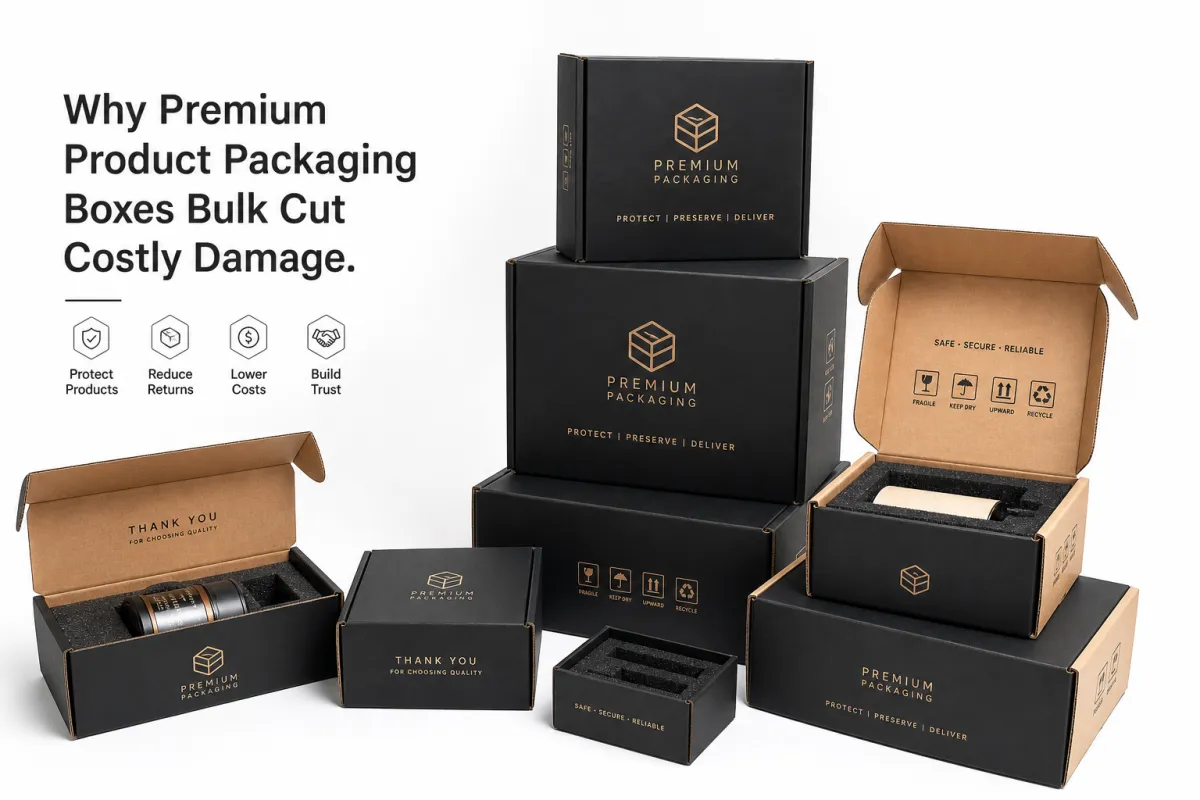
The cheapest box is rarely the cheapest option. Buyers still fall for it because the savings look real right up until the first damaged shipment lands on the receiving dock. A light carton might shave a few cents off the quote, then cost far more in crushed corners, scuffed product, failed inserts, and replacement orders. Premium product packaging boxes bulk reduce that risk because setup costs spread across volume while the structure gets stronger.
The biggest savings usually come from removing failure points. Stronger board, better locking tabs, and a fit that keeps the product from rattling around all help. Fragile goods, subscription kits with multiple components, glass cosmetic bottles, electronics with accessories, and gift packaging all benefit from that kind of control. Nobody wants a box that arrives with the personality of a wrecked suitcase.
Think of premium product packaging boxes bulk as margin protection. If damage drops from 4% to 1%, the savings can swamp the small bump in unit cost. Same thing with reprints. A run that prints cleanly and holds shape across the full order saves time, labor, and a lot of bad conversations in fulfillment. That is not theory. It is the difference between a clean launch and a warehouse team spending Friday afternoon sorting broken inventory.
A box that looks premium but collapses in transit is not premium. It is a refund with corners.
Product risk should drive the conversation, not artwork. Premium product packaging boxes bulk usually make sense when you need one or more of these outcomes:
- Better crush resistance for shipping and storage.
- Tighter product fit for inserts, tissue, or accessory packs.
- Cleaner shelf appearance for retail packaging.
- More consistent branded packaging across repeat orders.
- Lower rework and return costs after fulfillment starts.
This is not about spending more just to feel serious. It is about choosing packaging that protects margin instead of quietly draining it. Premium product packaging boxes bulk tend to win when the product value is high enough that a few cents in box cost protects dollars in inventory.
There is also a practical shipping angle that people overlook. If the box is gonna move through parcel networks, it needs to survive compression, vibration, and the occasional rough handoff. That means board strength, closure design, and insert fit matter more than a fancy finish you can barely see once tape is on the carton.
Product Details Buyers Should Compare Before Ordering
Not all premium product packaging boxes bulk are built the same. Buyers often throw mailer boxes, folding cartons, rigid boxes, sleeves, and corrugated shippers into one bucket. That is how bad specs end up in a quote. The box style needs to match product weight, shipping method, and presentation goal. Anything else is paying for a look that does not survive use.
Mailer boxes work well for e-commerce kits and direct-to-consumer shipping because they are strong, flat-packed, and easy to assemble. Folding cartons fit retail packaging, lighter goods, and products that need crisp print quality without a heavy structure. Rigid boxes suit luxury presentation, gift sets, and higher-value items where the box itself is part of the experience. Corrugated shippers are the practical choice for transit strength. Sleeve boxes add a branded outer layer without turning the whole package into a luxury build.
The mistake buyers make is assuming a pretty presentation box can survive courier handling. Sometimes it can. Often it cannot. A rigid setup with no transit protection works for shelf presentation and fails fast in shipping. A corrugated shipper may do a better job for dimensional weight, but it will not feel like a gift if the unboxing matters. That tradeoff exists whether the quote admits it or not.
Box details matter just as much as style. Check closure type, dust flaps, insert compatibility, coating, and how the box stores flat before use. For premium product packaging boxes bulk, those details affect assembly speed and warehouse space. A box that nests neatly is worth more than one that looks elegant and eats half a pallet per thousand units.
Branding choices change the economics too. Outside print only is usually the easiest way to keep budget under control. Inside print adds another layer of brand expression, but it also adds ink coverage, setup complexity, and proofing time. Full-wrap graphics can look strong for branded packaging, while one-color minimal branding can keep cost in line without making the box feel bland. That is a better use of packaging design than smearing ink over every square inch just because the file can handle it.
Common mistakes show up fast. Buyers choose a presentation box that cannot handle the courier network. Or they pick a shipper that is strong enough but oversized enough to inflate dimensional weight and freight charges. They also forget to ask whether the insert is paperboard, foam, molded pulp, or a simple die-cut tray. That one detail can swing both cost and product protection.
If you are still narrowing options, our Custom Packaging Products page is a good place to compare box families before you request quotes. For larger reorder programs, our Wholesale Programs page is the better fit because bulk planning changes the unit economics fast.
Specs for Premium Product Packaging Boxes Bulk
Before you ask for a quote, get the specs straight. Premium product packaging boxes bulk are priced from details, not from the mood board. The first number that matters is inside dimensions, not outside dimensions. If the product needs tissue, a tray, an insert, or a small accessory pack, the inner cavity has to account for that space. A box that is one or two millimeters off can create fit issues, crushed edges, or a sloppy presentation.
Here are the core specs I would want on the table before pricing premium product Packaging Boxes Bulk:
- Internal dimensions: length, width, and depth measured after inserts if needed.
- Board grade: SBS, kraft board, corrugated, or rigid board.
- Thickness: for example, 300gsm, 350gsm, E-flute, B-flute, or 2mm rigid board.
- Finish: matte, gloss, soft-touch lamination, aqueous coating, spot UV, foil, embossing.
- Print coverage: one-color, full color, inside print, or full wrap.
- Insert type: none, paperboard, molded pulp, foam, or custom die-cut tray.
- Tolerance: allow for small production variance, especially on tight-fit packaging.
Material choice depends on the job. SBS gives crisp print and a clean retail look, so it shows up often in cosmetics and consumer goods. Kraft creates a natural look and fits sustainability programs well, especially when buyers want recycled content or low-ink branding. Corrugated is the safer choice for shipping strength. Rigid board is the premium option for gift boxes and luxury presentation, though it costs more and usually needs more careful handling in transit.
No single board does everything. The right compromise depends on the product and the route it takes to the customer. A candle set shipped through parcel networks does not need the same box as a display set handed across a retail counter. That sounds basic, yet packaging rooms are full of orders that were chosen because the render looked nice.
For regulated or sustainability-sensitive projects, ask about recycled content, FSC-certified board, and ink or coating restrictions. FSC rules are documented at fsc.org. If you want transit testing language that buyers, warehouses, and retailers recognize, ISTA publishes test families at ista.org. Those references matter because premium product packaging boxes bulk should hold up in the real supply chain, not just in a sample photo.
For cosmetics, food-adjacent packaging, and premium personal care, I also recommend asking about odor, ink migration, and shelf-life compatibility. Those checks are not glamorous, but they prevent ugly surprises later. A coating that feels great in hand can still be the wrong call if it interacts badly with the product or the insert.
For buyers comparing packaging design options, exact fit beats dramatic extras. A neat, measured box with the right insert often looks more premium than a larger box stuffed with filler. That is especially true for custom printed boxes used in retail packaging. The cleaner the fit, the stronger the package branding.
One more practical note: ask for the expected production tolerance before you approve anything. On custom product packaging, a slight variance is normal. For tight-tolerance projects, especially irregular bottles or devices, build a little cushion into the cavity instead of forcing a perfect mathematical fit that turns into a production headache.
The finishing line of a spec sheet is where a lot of teams get lazy. They approve "premium" without saying whether that means soft-touch, foil, matte lamination, or just better artwork. Those are not interchangeable. One looks expensive. One protects the surface. One does both, sometimes kinda. Your quote changes depending on which outcome you actually need.
Pricing, MOQ, and Premium Product Packaging Boxes Bulk Cost Drivers
Pricing for premium product packaging boxes bulk depends on more than size. Quantity matters, yes, but so do print coverage, die complexity, material grade, inserts, and finish. If someone sends a quote without asking those questions, they are either guessing or planning to fix the price later. Neither option is fun for the buyer.
MOQ usually ties back to setup cost and production efficiency. That is not a mystery. Running a press, cutting dies, setting up finishing, and packing the order all take time. A vendor needs enough units to spread that setup across the run. For simple custom printed boxes, MOQ often starts around 500 to 1,000 units. For rigid boxes or more complex builds, the practical starting point is often higher because labor and tooling are heavier.
Here is a useful way to think about premium product packaging boxes bulk pricing. Lower quantities carry more setup burden per unit. Larger runs lower unit cost, but freight and storage become more important. If you are buying 5,000 or 10,000 units, the per-box savings can be meaningful, but only if the box style, material, and shipping plan make sense. Bulk savings disappear fast when the warehouse gets stuffed with the wrong carton size.
| Box style | Typical MOQ | Common unit price range | Best use | Main tradeoff |
|---|---|---|---|---|
| Folding carton | 500-1,000+ | $0.18-$0.55 | Light retail packaging, cosmetics, small consumer goods | Less shipping strength than corrugated |
| Mailer box | 500-1,000+ | $0.85-$2.40 | E-commerce kits, subscription boxes, direct mail packs | Can get bulky if oversized |
| Corrugated shipper | 500-2,000+ | $0.75-$2.20 | Transit protection, heavier products, fulfillment use | Less premium shelf appearance |
| Rigid box | 300-1,000+ | $2.50-$8.00 | Luxury presentation, gift sets, high-value items | Higher labor and freight cost |
| Sleeve box | 1,000-3,000+ | $0.25-$0.70 | Brand layer over an existing tray or carton | Less protection on its own |
Those numbers are not a promise. They are a realistic planning range, and actual quotes depend on size, artwork coverage, material availability, and the country of production. Still, they are better than the vague nonsense some buyers get handed. If a quote lands far outside these ranges, ask what is driving it. Usually the answer is one of these: custom inserts, multiple print sides, foil or embossing, special dies, rush production, or split shipments.
Finishing choices are another big driver. Soft-touch lamination feels upscale, but it adds cost and can show scuffing differently. Foil and embossing add strong shelf appeal, yet they increase setup and may need extra proofing. Full-color inside print looks great for premium product packaging boxes bulk, but it is not a free bonus. Every extra printed surface increases complexity.
Freight and storage matter too. Flat-packed cartons are easier to store and cheaper to move than assembled boxes. Pallet freight is often the smarter choice for heavy board, but it can add receiving requirements on the buyer side. If your warehouse charges for pallet handling, factor that into landed cost before you celebrate a low unit price.
Buyers comparing premium product packaging boxes bulk should ask for a quote that clearly states what is included: tooling, proofing, sample fees, packing method, and shipping terms. If inserts are separate, make sure that is written down. If the price assumes one delivery point and you need split shipments, that needs to be obvious too. Hidden costs are usually not hidden. They were just ignored.
A useful rule: compare landed cost, not quote cost. I have watched teams choose the cheaper box and then pay more in freight, extra warehouse labor, and damage claims. The first invoice looked nice. The full program did not. Packaging only looks simple on a spreadsheet until the spreadsheet grows a second page.
Process and Timeline From Quote to Delivery
A clean order process saves time and avoids the back-and-forth that turns a simple packaging buy into a small administrative mess. Premium product packaging boxes bulk usually move through the same stages: specs review, quote, dieline or artwork setup, proof approval, sample production, mass production, packing, and freight booking. Skip one of those steps and someone pays for it later.
Timing depends on the box style and how prepared the buyer is. A simple folding carton with ready artwork can move fairly quickly. A rigid box with inserts and specialty finishes needs more time. In many bulk packaging jobs, the full cycle often lands somewhere in the range of 12-20 business days after proof approval for simpler runs, and longer for premium builds with more finishing steps. If a supplier gives you a lead time without asking for dimensions, print coverage, or shipping destination, that lead time is more sales pitch than fact.
What speeds things up? Complete dimensions. Print-ready files. Fast proof approvals. Clear quantity targets. Flexible shipping windows. What slows things down? Missing specs. Artwork changes after proofing. Samples that come back with fit issues. Materials that need to be sourced in a specific grade or color. Packaging only looks simple from far away.
Shipping deserves attention too. Premium product packaging boxes bulk often ship flat, which helps with storage and freight. Still, you need to know carton count, pallet count, and whether the receiving dock wants labeled pallets or case-packed cartons. If the boxes arrive assembled, plan for more volume and higher freight cost. If they arrive flat, plan for assembly labor before launch. There is no free lunch in packaging. Just different invoices.
For launches with a hard deadline, work backward from the in-stock date, not the order date. Build in time for proofing, one sample loop if needed, production, transit, and warehouse receiving. That is the difference between a calm launch and a warehouse team asking where the missing packaging is while product sits ready to ship.
One simple operating rule: the more fragile or expensive the product, the more likely you should request a sample or prototype before approving the full run. Premium product packaging boxes bulk are too expensive to "hope" into success. Fit checks, closure checks, and drop testing on a sample save much more than they cost.
From a packaging professional’s point of view, the best projects are the boring ones. Clean specs. Fast sign-off. One revision, not eight. Good premium product packaging boxes bulk do not need drama. They need discipline.
And yes, a sample can feel like an annoying extra step when everybody wants launch speed. I get that. But the five minutes spent checking a cavity, closure, and finish under real light can save a week of cleanup later. That is a trade I will take every time.
Why Choose Us for Premium Product Packaging Boxes Bulk
Buyers do not keep coming back because a sales pitch sounded polished. They come back because the boxes arrived on spec, on time, and consistent from the first pallet to the last. That is the real standard for premium product packaging boxes bulk. If the packaging does not hold up during production, fulfillment, and reorders, the brand promise starts looking thin.
Custom Logo Things is built around that practical side of the job. We pay attention to the boring details that matter: fit, print consistency, carton configuration, palletization, and how the order gets handled once it leaves the press. Premium product packaging boxes bulk should not force your team to improvise. They should arrive ready for production or fulfillment with minimal rework.
Quote transparency matters too. Buyers Should Know why a box costs what it costs. If a finish adds $0.18 per unit, say that. If a rigid insert adds labor, say that. If freight changes the landed price, say that too. The packaging business gets messy when estimates are vague and everybody pretends to be surprised later. Clear pricing is not special. It is just professional.
We also keep pre-production checks in the process because bulk runs punish lazy approvals. A sample or prototype helps catch the issues people forget to ask about: a locking tab that sits too tight, an insert that crushes a product label, or a coating that looks good in a render but wrong under store lighting. That is why premium product packaging boxes bulk deserve more than a fast yes.
Operational support matters for repeat buys. A first order can survive on enthusiasm. The second order survives on consistency. That is where bulk buyers need dependable packaging suppliers who understand how reorders, shelf timing, and warehouse receiving actually work. We can help with package branding that stays consistent from run to run, not just one pretty sample that never gets repeated correctly.
If you need support across broader lines of custom printed boxes, or you are planning a replenishment program with standard sizing and repeat runs, our process is set up for that kind of work. Premium product packaging boxes bulk are easier to manage when the supplier understands both branding and logistics, instead of treating them like separate worlds.
That also includes practical guidance on shipping configuration. Flat-packed cartons usually reduce cube. Palletized freight can be smarter for large quantities. Carton labels should match your receiving workflow. None of that is glamorous, and that is exactly why it matters.
Honestly, most packaging failures are not design failures. They are coordination failures. The box was fine. The quote was not. The specs were incomplete. The freight plan was guessed. Premium product packaging boxes bulk are only premium if the whole chain works.
I've also seen teams spend extra on finishes because they wanted a luxury feel, then discover the warehouse hated the surface because it scuffed during packing. That is the kind of detail nobody wants to explain to finance. Ask about handling, not just appearance.
Next Steps to Order Premium Product Packaging Boxes Bulk
If you are ready to move, start with the basic facts. Product dimensions. Quantity target. Box style. Print goals. Delivery deadline. If you have those five pieces, premium product packaging boxes bulk become much easier to price and produce. If you do not, the quote will be loose and probably annoying.
My advice is simple: request pricing with one primary size and one backup size if you are still choosing between options. That gives you a cleaner comparison and helps you see how much the dimensions are really costing you. It also helps if you are deciding between retail packaging and a stronger transit-style build. For bulk orders, a small dimensional change can move the price more than people expect.
If the product is fragile, expensive, or oddly shaped, ask for a sample or prototype before the full run. That is not overkill. That is common sense. Premium product packaging boxes bulk can save money only if the final fit is right, and sample approval is the easiest way to avoid expensive surprises. It is cheaper to catch a bad cavity size on one sample than after 5,000 boxes are already in transit.
Then compare freight and storage together, not separately. A lower unit price means nothing if the boxes arrive in a shipping format your warehouse hates. Flat-packed delivery is usually easier on storage. Assembled packaging uses more room but can simplify fulfillment. Choose based on how your team actually works, not on a spreadsheet fantasy.
Here is the clean decision path:
- Confirm the product dimensions and box style.
- Define the print, coating, and insert requirements.
- Request a quote with the landed shipping destination.
- Review the proof and approve a sample if the fit is tight.
- Lock production, palletization, and delivery dates.
That process is not flashy. It is just how premium product packaging boxes bulk stay profitable instead of turning into a problem you keep explaining internally. If you are buying for a launch, a reorder, or a subscription program, send the specs early and keep the revisions tight.
Bottom line: premium product packaging boxes bulk work best when the box style, material, insert, and freight plan all match the product. Get those parts right, and the order supports the brand instead of fighting it. The smartest next move is to lock your inside dimensions, board grade, and shipping format before you compare quotes, because that is where the real money gets decided.
What is the usual MOQ for premium product packaging boxes bulk?
MOQ depends on box style, board type, and print complexity. A common starting point is 500 to 1,000 units for simpler runs, while rigid boxes or highly customized builds often need more. Ask whether the limit comes from printing, die-cutting, or insert production so you know where flexibility exists.
Which materials are best for premium product packaging boxes bulk?
Corrugated is the safer choice when shipping strength matters most. SBS or premium paperboard works well for retail packaging with sharp graphics and a cleaner finish. Rigid board is the stronger option for luxury presentation, gift sets, and high-value products that need structure. If the product is sensitive to odor or coating transfer, ask for compatibility details before you approve the final spec.
How long does production take for premium product packaging boxes bulk?
Timelines depend on proof approval, sampling, material availability, and finishing. Bulk runs often take several weeks end to end, with simpler jobs moving faster than rigid or highly finished projects. Fast approvals and finalized artwork are the quickest way to avoid delays.
Can I get a sample before ordering premium product packaging boxes bulk?
Yes, and you should if the box is custom or the product fit is tight. A sample lets you check size, material feel, print quality, and closure performance before mass production. For fragile products, a prototype is far cheaper than finding out the fit is wrong after the full run ships.
How do shipping and storage affect the cost of bulk packaging boxes?
Flat-packed boxes usually save storage space and cut freight cost compared with assembled cartons. Heavy board, oversized cartons, and palletized freight raise shipping cost fast. Plan warehouse space before you order so the savings from bulk pricing are not swallowed by storage headaches.


