Buyer Fit Snapshot
| Best fit | Custom Box Sleeves Price projects where brand print, material claims, artwork control, MOQ, and repeat-order consistency need to be specified before quoting. |
|---|---|
| Quote inputs | Share finished size, material target, print colors, finish, packing count, annual reorder estimate, ship-to region, and any compliance wording. |
| Proofing check | Approve dieline scale, logo placement, barcode or warning zones, color tolerance, closure strength, and carton packing before bulk production. |
| Main risk | Vague material claims, crowded artwork, missing packing details, or unclear freight terms can make a low unit price expensive after revisions. |
Fast answer: Custom Box Sleeves Price: What Shapes the Final Quote should be specified like a repeatable production item. The safest quote records material, print method, finish, artwork proof, packing count, and reorder notes in one written spec.
Production checks before approval
Compare the actual filled-product size with the drawing, then confirm tolerance on folds, seals, hang holes, label areas, and retail display edges. Reserve space for logos, QR codes, warning copy, and material claims before decorative graphics fill the panel.
Quote comparison points
Review material grade, print process, finish, sampling route, tooling charges, carton quantity, and freight assumptions side by side. A quote is only useful when the supplier can repeat the same color, closure quality, and packing count on the next order.
Custom Box Sleeves Price: What Shapes the Final Quote
A plain carton can look like retail packaging the second a sleeve slides over it. That is why custom box sleeves price often comes in lower than buyers expect. The base box stays put. The sleeve does the visual work. For brands trying to protect margin, that difference matters a lot.
The quote usually comes down to three things first: material, print coverage, and quantity. Everything else hangs off those levers. That is why custom box sleeves price can move more from a stock change than from a small artwork tweak.
The cheapest sleeve is not always the least expensive option once line speed, waste, and rework are counted.
The goal is not to chase the lowest number on the page. It is to pick a sleeve that fits the shelf, fits the pack-out process, and protects margin without stuffing the warehouse with dead inventory. That is the practical side of custom box sleeves price, and it is where a lot of buying decisions get won or quietly torched.
Why Custom Box Sleeves Price Can Be a Smart Shortcut
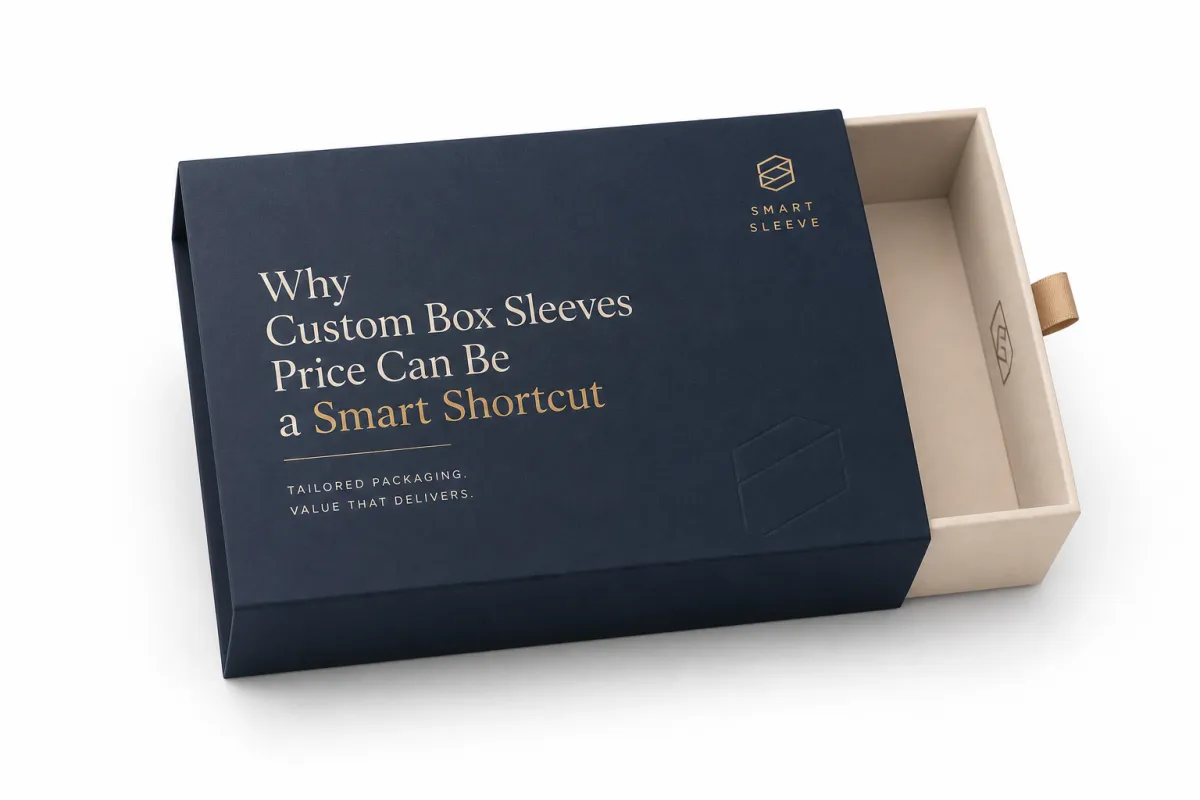
People hear custom packaging and immediately picture a full redesign, new tooling, and a budget that starts bleeding before samples even show up. That is not always the reality. A sleeve changes the visible face of the pack without replacing the whole carton, which is why custom box sleeves price can be a smart shortcut for launches, seasonal promos, and SKU refreshes.
That setup helps in two obvious ways. The structure you already trust stays in place. The branding changes without rebuilding the line. If the base carton already stacks well, ships well, and survives distribution, a sleeve can add shelf appeal at a fraction of the cost of a full printed box change. Finance likes that. So do operations teams that are tired of being dragged into drama by marketing deadlines.
I have watched brands save more money by standardizing one sleeve format across several SKUs than by chasing tiny print discounts. That sounds boring. It is also how real budgets stay intact.
The mistake is assuming every sleeve quote is basically the same. It is not. custom box sleeves price changes with board grade, coverage, finish, and quantity, but it also changes with how the pack behaves on the line. A sleeve that slows pack-out or creates extra handwork can cost more in labor than it saves in print. That is how a cheap-looking number turns into an expensive mess.
Three levers usually move the number more than buyers expect:
- Material choice - a standard SBS or coated board usually prices differently from kraft or specialty stock.
- Print coverage - one-color brand marks and a restrained layout cost less than full-coverage graphics with heavy ink laydown.
- Order quantity - once setup is absorbed, custom box sleeves price usually becomes much more efficient per unit.
The lowest quote is not always the best value if the sleeve scuffs easily, ships badly, or causes rework on the line. That part gets ignored all the time. A clean-looking sleeve that performs poorly can turn cheap upfront pricing into expensive downstream headaches. That matters even more in retail packaging, where a small defect is visible the second the product hits the shelf.
If you already have a functional base pack, sleeves can also reduce waste. Instead of reprinting a full carton for every campaign, the brand updates the outer message and leaves the structural package alone. That makes custom box sleeves price easier to defend for limited-edition art, regional versions, or frequent copy changes. It is a practical form of product packaging flexibility, not a theoretical one.
If you want to compare formats early, our Custom Packaging Products page is a useful place to start. It helps buyers see where sleeves sit next to other carton-and-wrap options, and it keeps the conversation grounded in structure instead of wishful thinking.
What a Box Sleeve Is and What It Does
A box sleeve is a printed wrap that slides over an existing carton, tray, or bundle. It is not a full printed box, and it is not just a belly band with a logo slapped on it. The sleeve carries the design, the hierarchy, and often the product story while the base container does the structural work. That split is a big reason custom box sleeves price is easier to keep under control than a full custom box program.
The sleeve is often the fastest way to change how a product is perceived. A plain white carton can look premium with the right sleeve. A kraft tray can look seasonal with a strong graphic system. The sleeve becomes the visual layer that supports branded packaging without forcing the buyer to restart the whole structure.
The sleeve can do several jobs at once:
- Branding - reinforce logo, color, and message consistency across SKUs.
- Differentiation - separate flavors, scents, sizes, or bundles on shelf.
- Regulatory messaging - add barcodes, claims, ingredient callouts, or compliance text.
- Promotions - support limited runs, holiday art, or retailer exclusives.
- Shelf blocking - create a more visible face in a crowded retail bay.
That flexibility is why sleeves show up so often in bakery, cosmetics, apparel, candles, and subscription kits. The base box stays consistent, but the outer message changes with the campaign. In those categories, custom box sleeves price is not just a print cost; it is a planning tool. A brand can move quickly without overcommitting to carton inventory that may sit in a warehouse longer than anyone wants to admit.
From an operational standpoint, sleeves help teams keep proven pack formats while changing the face of the package. That matters when the primary carton already performs well under compression, transit, or display requirements. The sleeve handles the commercial message. The carton handles protection. Clean split. Less nonsense. Better odds that custom box sleeves price stays sane instead of ballooning because the job tries to do too much at once.
There is a waste angle here too. For multi-product programs, sleeves can reduce the number of full cartons sitting in inventory. A brand may keep one common base box and use different sleeves to distinguish flavor, size, or region. That simplifies inventory control, which is why procurement teams keep circling back to sleeves when they compare product packaging options.
Picture a carton that already ships well. If the only change needed is campaign copy, the sleeve can carry the update while the base structure stays in rotation. In that kind of program, custom box sleeves price is often easier to defend to finance than a complete box redesign.
Custom Box Sleeves Price Factors: Specs That Move Costs
Once the structure is clear, the real pricing conversation starts. custom box sleeves price is built from specs, and the cleanest way to control it is to lock those specs before you request quotes. If one supplier is pricing a 350gsm SBS sleeve and another is quoting a lighter kraft stock, the numbers are not comparable even if the artwork looks identical.
Size comes first. A larger sleeve uses more board, more ink, and often a wider sheet layout. Tight tolerances can also affect production because the sleeve needs to slide cleanly without binding or rattling. If the fit is too loose, it looks careless. If it is too tight, it can scuff or slow the line. Either way, custom box sleeves price gets pulled by how exact the dimensional spec needs to be.
Stock selection matters just as much. Common choices include SBS, C1S, kraft, and coated paperboard. A standard 14pt or 18pt sheet may work well for a retail sleeve, while heavier stock can improve stiffness and perceived value. If the job needs a premium feel, soft-touch lamination or a denser board can help, but both move the quote. The same is true if you want a textured paper or a recycled-content sheet that carries a more natural appearance.
Print and finish are where many buyers lose budget discipline. Full-coverage CMYK, spot colors, foil stamping, embossing, debossing, spot UV, and aqueous coating all change the production path. Even one extra finishing step can alter make-ready time and the price per thousand. For that reason, custom box sleeves price is easier to manage when the artwork is designed with the production method in mind, not just the visual idea.
Converting details matter too. A sleeve may need a die-cut, perforation, glue zone, locking tab, or window opening. Each feature adds setup or complexity. If the sleeve must fold in a specific direction to fit a production workflow, that can affect nesting and sheet efficiency. The more complex the converting path, the more likely you will see custom box sleeves price climb.
Here is a practical comparison of common options. These are market-style ranges, not fixed quotes, but they show how the structure of the job changes the number.
| Option | Typical Run | Indicative Unit Price | Best Fit | Tradeoff |
|---|---|---|---|---|
| Simple kraft sleeve, one or two colors | 5,000+ pieces | $0.10-$0.18 | Natural, restrained retail packaging | Less visual impact than a premium finish |
| Full-color SBS sleeve with matte coating | 5,000+ pieces | $0.16-$0.28 | Mainstream branded packaging | Higher press and prep cost than simple print |
| Premium sleeve with foil or embossing | 5,000+ pieces | $0.30-$0.60 | Cosmetics, gifting, and upscale product packaging | Strong shelf appeal, higher custom box sleeves price |
| Short-run prototype or digital sample batch | 250-1,000 pieces | $0.35-$0.90 | Pilots, testing, and new SKU approvals | Fast, but the unit price is less efficient |
The table makes one thing obvious: finish level and quantity are tied together. A premium sleeve can be the right move if it helps sell through the product, but it should be treated as a commercial choice, not just a design preference. That is the real art behind custom box sleeves price. Compare apples to apples, and compare them using the same stock, the same finish, and the same count.
If sustainability is part of the brief, ask whether the stock can come from FSC-certified mills. That does not automatically lower the quote, but it can support a procurement policy or retailer requirement. The same logic applies to transit performance: for shipping checks, many teams use ISTA methods to see how the finished pack behaves under handling and distribution stress. Those standards do not set custom box sleeves price by themselves, but they help define the spec the price is supposed to meet.
One more thing buyers should not ignore: prepress time. Cleaner artwork means fewer proof cycles, fewer file fixes, and fewer production delays. A clean dieline, correct bleed, embedded fonts, and proper image resolution can save time before the press even starts. It looks minor until it is not. Then it becomes part of the total custom box sleeves price.
Custom Box Sleeves Price, MOQ, and Volume Breaks
Minimum order quantity exists for a reason. Plates, dies, sheet setup, and press calibration all cost money before the first finished sleeve comes off the line. That fixed cost gets spread across every unit in the run, which is why custom box sleeves price usually improves as quantity increases. A short run can make sense for a launch; a larger run usually wins on unit economics once demand is proven.
The pattern is predictable. A small order often carries the highest per-unit cost because the setup is divided across fewer pieces. A mid-size order usually finds the best balance between cash outlay and unit economics. A larger order can bring the unit price down further, but only if the inventory moves fast enough to justify it. That is where custom box sleeves price meets storage, cash flow, and forecast discipline.
Volume breaks are not always linear. Going from 1,000 pieces to 3,000 may cut the unit cost sharply. Going from 5,000 to 10,000 may deliver a smaller percentage gain because setup is already amortized. The best way to judge the offer is to ask for multiple breakpoints on the same spec sheet. If one quote is for kraft and another is for coated board, the numbers do not tell you much about custom box sleeves price in the real world.
There are a few practical ways to improve the quote without touching the core artwork:
- Standardize the sleeve dimensions across SKUs so the same die can be used longer.
- Cut finishing steps that do not add measurable shelf value.
- Combine flavors, sizes, or seasonal versions into one production window.
- Use a stock that runs efficiently on the chosen press and converting line.
- Ask for a quote on a slightly larger quantity if you know the extra inventory will move.
That last point gets missed constantly. Buying a little more can sometimes produce a better net result than reordering repeatedly at a higher unit price. But that only works if demand is predictable. Otherwise, the warehouse becomes the problem. custom box sleeves price is not just a printing issue; it is an inventory planning issue too.
For multi-SKU programs, batching can create another layer of savings. If the art is similar and the die line is shared, a supplier may be able to run several versions in a single production sequence. That does not erase setup, but it can improve efficiency. Buyers often discover that the biggest reduction in custom box sleeves price comes from smarter SKU planning rather than squeezing the supplier on one quote.
Ask what is included. Some quotes cover the sleeve only. Others include plates, dies, proofing, or freight; some do not. A quote that looks low may become expensive once line items are added back in. So the comparison should never stop at the headline number. It should test the total landed cost, because that is where custom box sleeves price either supports margin or chips away at it.
Process and Timeline for Ordering Custom Box Sleeves
The order flow is straightforward if the inputs are complete. Share the dimensions, request a dieline, upload artwork, review the proof, approve the sample if one is needed, and move into production. Every missing detail creates more back-and-forth, and every round of revision can push both time and custom box sleeves price in the wrong direction.
The most common delays come from a few places: unclear dimensions, incomplete artwork files, late changes to finish selection, and decision-makers who review the proof at the end instead of the start. None of those problems are unusual. They are just expensive. The quicker the team aligns on fit, board, ink, and finish, the smoother the path from quote to shipment, and the cleaner the resulting custom box sleeves price.
A realistic timeline for a simple sleeve can often be 10-15 business days from final approval to production completion, depending on workload and quantity. Add foil, embossing, windowing, or multiple versions, and the schedule grows. For complex retail packaging programs, it is smart to build in extra time for proofing and quality checks. That does not mean the project is slow; it means the project has more moving parts.
To keep the process under control, send suppliers the details they actually need:
- Exact product dimensions and sleeve fit requirements.
- Quantity, including any planned repeat order volume.
- Stock preference, finish preference, and whether sustainability requirements apply.
- Artwork status, file format, and whether the design is final.
- Delivery window, ship-to location, and any launch date that cannot move.
That list sounds basic, but basic information is what sharpens custom box sleeves price. A supplier can only quote what is known. If the dimensions are vague, the response will be padded for risk. If the delivery date is tight, the quote may include rush handling. If the stock is undefined, the estimate will likely assume a safer, more expensive option.
For brands running new SKUs, sampling is worth the extra step. A physical sample answers questions that screen proofs cannot. Does the sleeve glide easily over the carton? Does the ink hold up to rubbing? Does the window line up with the product? Those answers can save the cost of rework later. In practical terms, that means a small sample investment can protect the larger custom box sleeves price from hidden problems.
Documentation matters on the quality side too. If a buyer wants a program to behave consistently across reorder cycles, the spec sheet should be precise enough to reproduce the same sleeve months later. That includes board grade, coating, color references, and tolerances. Consistency is a commercial advantage. In packaging terms, it is the difference between a one-off purchase and a repeatable product packaging program.
Why Choose Us for Custom Box Sleeves
From a buyer's point of view, the best supplier is not the one that talks the loudest. It is the one that makes the quote easier to trust. At Custom Logo Things, the focus is on repeatable measurements, dependable color, and sleeves that arrive ready to fit without slowing the line. That matters because a low custom box sleeves price is useless if the pack-out team has to wrestle with the sleeve every shift.
Prepress support is where a good partner earns its keep. A clean dieline, a quick artwork check, and a clear proofing process cut surprises before production begins. Catching a fold issue or a missing bleed at that stage is far cheaper than catching it after the job is printed. That is one of the fastest ways to protect custom box sleeves price without changing the design itself.
Transparency matters just as much. Buyers should be able to see what is driving the quote: board grade, print complexity, finish, tooling, and order quantity. Vague bundled pricing makes comparison difficult. Clear pricing makes it possible to judge alternatives side by side, which is how a real sourcing decision gets made. That is the point where custom box sleeves price stops being a guess and starts being a useful business tool.
If the program is new, sampling and production oversight reduce risk. If the program is recurring, consistency becomes the priority. If the program is tied to a retailer launch, timing matters as much as appearance. Those three realities cover most buyer scenarios, and they are why many teams want a partner that can support sleeves as part of broader custom packaging product options. The sleeve is one piece of the job, but the supplier should understand the whole packaging strategy.
That broader view matters because sleeves rarely live alone. They are usually part of a carton, tray, insert, or kit. When the supplier understands how the pieces work together, the quote becomes more accurate and the production run becomes more predictable. Better predictability tends to lower the real cost of custom box sleeves price, even when the headline number stays the same.
There is also a margin argument. Fewer errors mean less waste. Less waste means fewer reprints. Fewer reprints mean better cash control. That chain is simple, but it gets ignored until a bad run happens. If a packaging team wants branded packaging that looks polished and moves through the line cleanly, the sleeve program should be built with that chain in mind. I have seen more than one launch go sideways because the team saved pennies on the quote and paid for it in rework. Not ideal. Our approach to custom box sleeves price stays focused on the boring stuff that actually saves money: fit, timing, and consistency.
Next Steps to Lock in the Best Custom Box Sleeves Price
If you want a cleaner quote, start with cleaner inputs. Gather the exact dimensions, quantity, stock preference, print coverage, finish, and required delivery window before you request pricing. That one step removes most of the uncertainty that inflates custom box sleeves price.
Then ask for at least two scenarios. A baseline option shows the lowest practical version of the sleeve. A premium option shows what happens if you add finish or upgrade stock. The spread between those two numbers is often more useful than the individual quotes themselves, because it shows where the real cost pressure sits. That kind of detail helps buyers control custom box sleeves price without guessing.
Ask for a sample image, dieline, or comparable project if you can. A quote is easier to evaluate when you can see the structure behind it. It is also smart to ask whether the quote includes tooling, plates, proofing, freight, and any special handling. The total matters more than the first number you see, and that habit alone can make custom box sleeves price more predictable from one project to the next.
Use the conversation to prioritize value drivers, not just unit cost. Shelf impact, pack-out speed, inventory control, and retailer requirements often matter more than saving a few cents on the sleeve itself. That does not mean price is irrelevant. It means the best custom box sleeves price is the one that supports the business outcome the pack is supposed to deliver.
If you are comparing suppliers, compare the same specification every time. Same size. Same stock. Same finish. Same quantity. Same shipping assumptions. Only then does the quote become meaningful. Without that discipline, a low number can look attractive while hiding a weaker board, a slower lead time, or a setup that forces extra labor later. That is how buyers protect custom box sleeves price and protect margin at the same time.
Keep the decision practical. If the sleeve is for a launch, speed may matter more than premium finishing. If it is for a flagship product, shelf presence may justify the higher quote. If it is for a retailer program, compliance and timing may be non-negotiable. The right choice depends on the job, but the method stays the same: compare the same spec, measure the true cost, and approve the version that best fits budget and launch timing. If you want the short version, it is this: lock the spec first, then judge the number. That is how to turn custom box sleeves price into a sourcing advantage instead of a guess.
Frequently Asked Questions
What affects custom box sleeves pricing the most?
Size and material usually drive the base cost because they determine how much board is used and how the sleeve runs on press. Print complexity, coatings, foil, embossing, and die-cuts can raise the quote quickly if they add setup or finishing steps. Quantity matters too, because setup costs are spread across more units as the run gets larger. That is why custom box sleeves price should always be reviewed against the same specs, not just the same artwork.
Is there a minimum order for custom box sleeves?
Most suppliers set an MOQ because plate, die, and press setup costs must be recovered. Smaller runs are possible, but the per-unit price is usually higher when the quantity is low. If you need several SKUs, batching artwork or standardizing dimensions can make the MOQ easier to manage. In many programs, that is the difference between a workable custom box sleeves price and a quote that feels too heavy for the launch.
How can I lower custom box sleeves price without changing the artwork?
Use a standard stock instead of a specialty board if the sleeve does not need extra stiffness or texture. Reduce finishing steps such as foil, spot coating, or embossing when the design can work without them. Order in a larger run or combine orders so setup costs are spread across more units. Those are the fastest levers for reducing custom box sleeves price while keeping the visual design intact.
Are custom box sleeves cheaper than printed cartons?
Often yes, especially when the base carton can stay unprinted and the sleeve carries the branding. The savings depend on size, print coverage, and finishing, so a full comparison needs the same specifications on both options. Sleeves are especially cost-effective when you need a fast visual refresh or multiple SKU variations. That flexibility is why many teams use sleeves as a measured way to control custom box sleeves price while still improving shelf presence.
How fast can custom box sleeves be produced after approval?
Turnaround depends on artwork readiness, finish complexity, and whether the proof is approved quickly. Simple sleeves usually move faster than jobs with foil, windows, or multiple production steps. The fastest path is to submit final dimensions, print-ready files, a clear finish brief, and a delivery deadline with the quote request. Do that, and custom box sleeves price is easier to compare, easier to approve, and easier to align with the launch schedule.

