Buyer Fit Snapshot
| Best fit | Custom Boxes Supplier projects where brand print, material claims, artwork control, MOQ, and repeat-order consistency need to be specified before quoting. |
|---|---|
| Quote inputs | Share finished size, material target, print colors, finish, packing count, annual reorder estimate, ship-to region, and any compliance wording. |
| Proofing check | Approve dieline scale, logo placement, barcode or warning zones, color tolerance, closure strength, and carton packing before bulk production. |
| Main risk | Vague material claims, crowded artwork, missing packing details, or unclear freight terms can make a low unit price expensive after revisions. |
Fast answer: Custom Boxes Supplier: Quote Scope should be specified like a repeatable production item. The safest quote records material, print method, finish, artwork proof, packing count, and reorder notes in one written spec.
Production checks before approval
Compare the actual filled-product size with the drawing, then confirm tolerance on folds, seals, hang holes, label areas, and retail display edges. Reserve space for logos, QR codes, warning copy, and material claims before decorative graphics fill the panel.
Quote comparison points
Review material grade, print process, finish, sampling route, tooling charges, carton quantity, and freight assumptions side by side. A quote is only useful when the supplier can repeat the same color, closure quality, and packing count on the next order.
Custom Boxes Supplier Guide: How to Choose the Right One
A custom boxes supplier guide starts with the part people try to ignore: the cheapest quote can turn into the most expensive purchase once dielines, artwork fixes, freight, and reprints land on the invoice. I have watched that happen more times than I care to count. A supplier looks cheaper on paper, then the real cost shows up in structural changes, file cleanup, extra proofs, or a shipment that was never included in the first place. If you are comparing Custom Printed Boxes for retail packaging, shipping, or branded packaging, the goal is not a tiny unit price. The goal is a partner that can turn your packaging needs into a box that fits, prints cleanly, and shows up on time.
That is why this custom boxes supplier guide puts capability, consistency, and communication ahead of price. A good supplier should handle structural design, board selection, print method, finishing, inserts, kitting, packing, and delivery coordination without making every step feel like a different emergency. Packaging is not just a container. It protects the product, supports shelf appeal, and shapes the first impression before the box is even opened. In plain terms, the right supplier helps your package branding feel intentional instead of patched together, whether you are ordering folding cartons, mailer boxes, or rigid presentation packaging.
Custom Boxes Supplier Guide: What It Really Covers
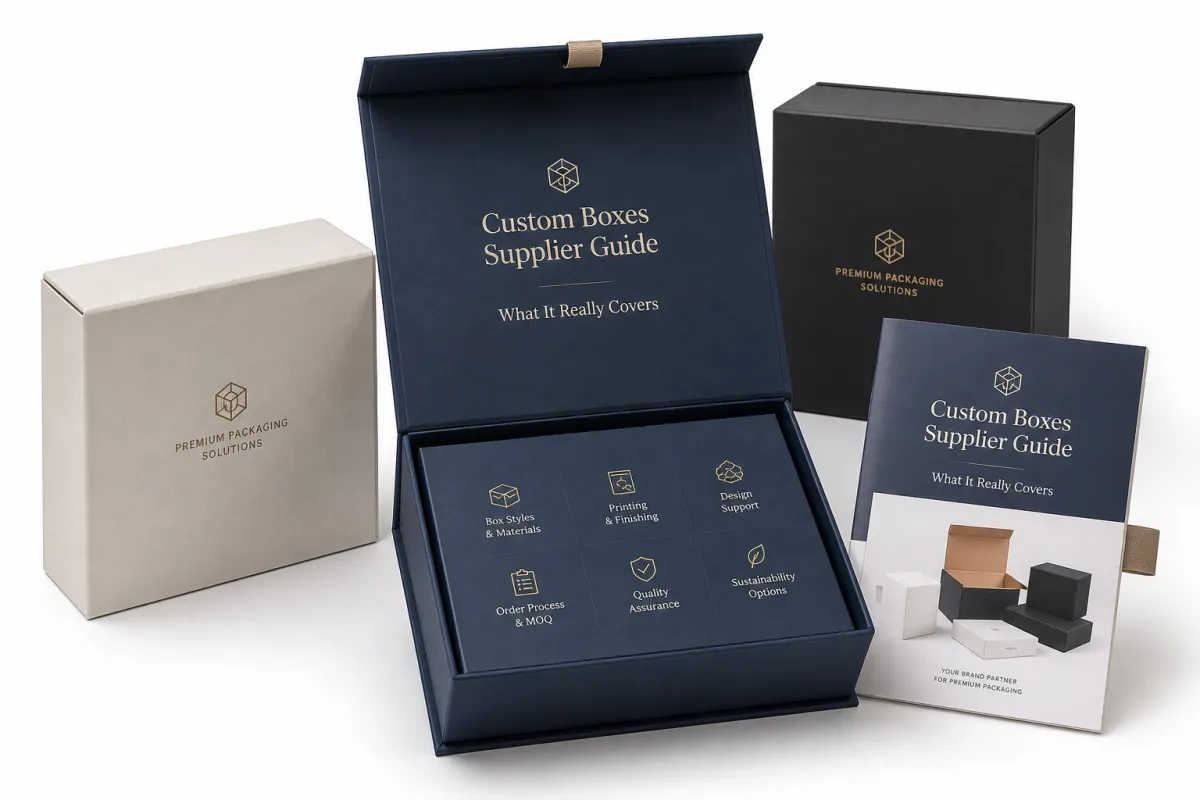
A solid custom boxes supplier guide starts by defining the job properly. A custom boxes supplier does more than print a logo on cardboard and send it out the door. In most real production runs, the supplier is responsible for several linked decisions: structure, material, decoration, finishing, and the way the finished pack is boxed and delivered. Miss one of those, and the whole job feels off. The box can look great on a screen and still fail in hand because the board is too light, the insert is loose, or the closure does not protect the contents during transit.
From a packaging buyer's point of view, the supplier should be able to advise on packaging design as well as production. That means knowing whether your item needs an SBS folding carton, an E-flute mailer, a 24pt rigid setup box, or a heavier corrugated shipper. It also means understanding where the print lives: outside only, inside and out, full bleed coverage, spot color, or a clean one-color mark. A good custom boxes supplier guide also helps you separate a box that looks premium from a box that actually supports the product packaging requirements on the line, in storage, and during delivery.
The cheapest quote is not always the cheapest project. Add structural changes, color fixes, or freight, and the number moves fast.
I keep seeing buyers get caught by that one. They compare a supplier on a single unit price, then discover that one vendor included dieline support while another excluded sample charges and pallet freight. Another vendor may have quoted a nice-looking custom boxes supplier guide number, but only for a board grade that is too light for the product. The useful question is not, "Who is cheapest?" It is, "Who can deliver the same box, the same print, and the same quality every time?"
A practical custom boxes supplier guide also covers what happens before and after production. Before production, there is artwork prep, proofing, and sample review. After production, there is packing method, carton count, palletization, and transit protection. If you are building retail packaging, that end-to-end view matters because the customer may judge the entire brand based on the box, not the product alone. That is package branding in action. The container is doing quiet work for your marketing, your logistics, and your margins all at once.
For a useful starting point on box styles and material options, the Custom Packaging Products page can help you match structure to use case before you ask for quotes. That makes every custom boxes supplier guide conversation sharper, because you are not asking suppliers to guess at the basics.
How a Custom Boxes Supplier Works From Quote to Delivery
A clear custom boxes supplier guide should show the full workflow, because delays usually happen at the handoff points. The process normally starts with an inquiry. You send product dimensions, quantity, print goals, finishing preferences, and shipping needs. The supplier reviews those specs and prepares a quotation. If the supplier is experienced, they may also recommend a structural adjustment or a better board grade before pricing is locked. That early feedback saves time later.
- Inquiry and spec review - share product dimensions, product weight, target quantity, and preferred box style.
- Quotation - the supplier prices board, print method, finish, inserts, setup, and freight assumptions.
- Dieline creation - a structural template is prepared or adjusted to fit the product.
- Artwork proofing - print files are checked for bleed, safe zones, trapping, and color limits.
- Sampling - a physical sample or preproduction proof is reviewed for fit and appearance.
- Production - approved files move into print, die-cutting, folding, gluing, and finishing.
- Quality checks - the boxes are inspected for registration, color variation, glue accuracy, and assembly quality.
- Packing and shipment - finished goods are counted, packed, palletized if needed, and sent out.
That flow sounds simple, but the weak points hide in the details. Missing dimensions are a common problem. So is vague print coverage. A buyer may say "full color," but not explain whether the inside of the box is also printing, whether a white underlayer is needed on Kraft, or whether the art has several spot colors that raise plate or setup costs. A good custom boxes supplier guide tells you to define those details before you ask for final numbers. The tighter the brief, the more accurate the quote.
There is also a real difference between short-run work and production work. A 250-piece test run with digital printing may move quickly, but a 10,000-piece offset job with foil stamping and a custom insert needs more setup, more approval time, and more careful scheduling. Minimum order quantities, tooling, and print method all shape the timeline. In many cases, a short-run project can be done in a few business days after proof approval, while a larger custom packaging order may take 10 to 20 business days in production alone, depending on the finishing steps and the printer's queue. That is the kind of detail a useful custom boxes supplier guide should spell out clearly.
Projects usually slip in a few predictable places. Late artwork is one. A buyer may approve a structure and then change the copy after the sample is already built. Proof confusion is another. If no one marks changes clearly on the PDF, the supplier may print the wrong panel or miss a late-edit instruction. A disciplined custom boxes supplier guide will tell you to freeze the structure first, then the graphics, then the final production approval. That order matters more than most teams realize.
For brands shipping fragile items, transit expectations should be part of the brief too. If the box has to survive parcel handling, you are gonna want to ask about compression strength, tuck integrity, and test methods such as ISTA procedures or ASTM D4169 distribution testing. Those standards help buyers move beyond guesswork. A supplier who understands those tests can recommend the right corrugated strength or insert style before a problem reaches the customer.
Custom Boxes Supplier Guide: Pricing Factors That Change the Quote
A useful custom boxes supplier guide needs to get specific about pricing, because "cheap" does not mean much until the specs are lined up side by side. The biggest cost drivers are board grade, box style, print method, coatings, inserts, window patches, embossing, and special finishes. A simple mailer in 18pt SBS with one-color print is not in the same cost class as a rigid box with soft-touch lamination, foil stamping, and a molded insert. Even when the outside dimensions look similar, the production path can be very different.
Setup charges matter too. The first run often costs more because the supplier may need a dieline adjustment, plate creation, die cutting tools, setup time, or color calibration. Repeat orders are often cheaper because much of that setup is already done. That is one reason a custom boxes supplier guide should separate first-order price from reorder price. A supplier that looks expensive on the first run may become competitive on the second and third runs if the structure is stable and the files are locked.
Here is a practical way to think about custom boxes supplier guide pricing. Compare landed cost, not just unit price. Landed cost includes freight, palletization, warehousing if the supplier offers it, split-shipment charges, and rush fees if the project is compressed. A $0.78 box that ships for another $180 may cost less than a $0.70 box that requires a second freight bill or a costly reprint. The more cartons you order, the more those hidden pieces matter.
| Box Type | Typical Use | Approx. Unit Price at 1,000 Units | Notes |
|---|---|---|---|
| Folding carton, 18pt SBS | Cosmetics, small retail goods, lightweight product packaging | $0.45 - $1.10 | Price rises with full coverage, foil, and specialty coatings |
| Mailer box, E-flute corrugated | E-commerce, subscription, branded packaging | $0.85 - $1.90 | Good balance of print surface and shipping strength |
| Rigid setup box | Premium retail packaging, gift sets, electronics | $2.25 - $6.50 | Higher labor and board cost, especially with inserts or wrap paper |
| Corrugated shipping box | Transit protection, warehouse shipping, subscription fulfillment | $0.60 - $1.75 | Depends heavily on flute profile, print coverage, and board strength |
Those numbers are only ballpark ranges, but they show why a good custom boxes supplier guide always asks for identical specifications before comparing suppliers. If one quote is based on 500 units, kraft liner, one-color print, and no insert, while another uses 2,000 units, coated board, four-color print, and a custom tray, the numbers are not rivals. They are different jobs. To compare suppliers fairly, the size, material, print coverage, quantity, and finishing details must match.
There are also subtle costs that buyers overlook. Window patching adds labor and film. Embossing or debossing needs tooling. Metallic foil can slow the line if the artwork is large or dense. Spot UV usually wants careful setup so the gloss hits the right area without registration drift. A detailed custom boxes supplier guide should make those trade-offs visible before you commit to a run.
If sustainability is part of your purchase decision, ask whether the board is FSC-certified and whether the print system supports lower-VOC inks or recyclable construction. The FSC certification standards are useful when you need a paper sourcing signal that buyers and retailers recognize. A thoughtful custom boxes supplier guide keeps those questions practical, not performative: does the material fit your supply chain, your compliance needs, and your budget?
Step-by-Step Process and Timeline for Choosing a Supplier
A clear custom boxes supplier guide should give you a repeatable method, because supplier selection gets messy when teams rush. Start with a packaging brief that includes the exact product dimensions, the product weight, how the item will be handled, and what experience you want the box to create. A boxed candle, a folded garment, and a glass skincare jar do not need the same structure. They should not be quoted as if they do.
The next step is shortlisting suppliers by capability, not by price alone. If you need luxury packaging, look for rigid construction, foil competence, and consistent wrapping quality. If you need e-commerce mailers, look for corrugated strength, shipping tests, and a clean folding line. If you need retail packaging, look for print clarity, shelf impact, and efficient pack-out. A focused custom boxes supplier guide helps you ask the right supplier the right questions instead of sending the same generic brief to everyone and hoping the answers make sense later.
A realistic timeline often looks something like this:
- Day 1-2: send the brief, product sample, artwork, and target quantity.
- Day 2-5: receive the first quote and basic structural feedback.
- Day 4-8: review dielines and initial proofs.
- Day 7-14: inspect samples or preproduction proofs.
- Day 10-20: complete production after approvals, depending on finish complexity and queue timing.
- Transit: add shipping time based on destination and shipping method.
That timeline changes fast if the artwork is not ready or the structure keeps shifting. A strong custom boxes supplier guide should tell you to build in one review cycle for structural fit and one for print accuracy. If your team can approve a sample quickly, the project moves faster. If five people need to sign off on color, coating, and messaging, you need more calendar room. That is not a failure. It is just the reality of branded packaging work in a business environment.
Decision checkpoints matter. Before full production, confirm three things: the box fits the product, the print meets expectations, and the lead time still works for launch. If any one of those fails, pause the order. Rushing ahead usually costs more. A careful custom boxes supplier guide treats the sample like a gate, not a formality. That sample is your best chance to catch a tight tuck, a wrong board thickness, a color shift, or a logo that sits too close to a fold.
This also helps internal coordination. If you are sourcing packaging for a new SKU family, align marketing, operations, and procurement before approval. Marketing may want a heavier finish. Operations may need easier assembly. Procurement may be watching landed cost and pallet count. A smart custom boxes supplier guide turns those competing priorities into a controlled decision instead of a last-minute argument.
Common Mistakes When Evaluating a Custom Boxes Supplier
A lot of problems are avoidable if you know what to watch for. The first mistake is approving artwork before the structural dieline and internal fit are confirmed. That sounds minor, but it can create expensive rework or unusable inventory. A logo may land too close to a fold, or the inner cavity may be just loose enough for the product to shift. Any strong custom boxes supplier guide should warn about that early.
The second mistake is comparing quotes that are not built from the same specs. One supplier may quote a 1,000-piece run on 24pt board with no coating, while another quotes 1,000 pieces on 18pt board with soft-touch lamination and a separate insert. Of course the numbers will differ. They should. The real problem is treating those quotes as equal. A disciplined custom boxes supplier guide always forces spec alignment before price comparison.
Another common miss is ignoring performance in transit. Products that ride in parcel networks need more than good looks. They need crush resistance, corner strength, and protection against moisture or abrasion. If the item is valuable or fragile, ask whether the supplier can work to ISTA-based shipping tests or similar distribution standards. The ISTA transport testing methods are useful because they turn shipping claims into measurable behavior. That is a practical step in any custom boxes supplier guide, especially for e-commerce and subscription brands.
Communication speed matters just as much as production skill. If a supplier takes three days to answer a basic question during quoting, that same slow response will probably show up again when you need proof approval or a change order. In packaging, small delays compound. A late response on Monday can become a missed ship date by Friday. A good custom boxes supplier guide does not treat communication as a soft factor. It is part of delivery reliability.
Here are a few warning signs worth watching:
- The supplier cannot explain the difference between unit price and landed cost.
- The sample arrives without clear notes on board grade or finish.
- Proof revisions are handled casually, with no record of what changed.
- The vendor avoids talking about tolerances, inserts, or transit testing.
- Lead time is quoted vaguely, without room for approval or shipping steps.
None of those issues mean a supplier is automatically wrong for your job. They do tell you where the risk sits. A practical custom boxes supplier guide does not just chase the lowest quote. It identifies where the project could wobble and asks for proof that those weak spots are under control.
Expert Tips for Getting Better Results From a Supplier
If you want better output from a supplier, give better input. That sounds simple, but it changes everything. Bring real product samples if you can, not only rough dimensions. A supplier can measure the item, test fit, and recommend a more realistic tolerance when they have the actual object in hand. A product with rounded corners, a pump top, or a fragile insert will behave differently than a tidy rectangular sample on a spec sheet. That is one of the most useful lessons in any custom boxes supplier guide.
Ask for print proofs, swatches, and finish samples before committing to a large order. Color on paper is rarely identical to color on a monitor. A matte black ink on Kraft behaves differently than the same ink on coated white board. Soft-touch lamination feels very different from a gloss varnish. If the box is part of your package branding, those details matter because the customer touches them before the product is fully revealed. A careful custom boxes supplier guide helps you test those choices in hand, not just on screen.
A simple scorecard can keep decision-making grounded. Rate each supplier on price, lead time, sample quality, communication, and repeat-order confidence. Give each category a weight based on what matters most to the job. For example, a launch box for a premium skincare line might put more weight on print finish and structural consistency. A warehouse shipping carton might weight lead time and transit strength more heavily. That sort of scorecard makes a custom boxes supplier guide usable for real procurement decisions instead of reading like a memo nobody revisits.
Plan for reorders now, not later. The first run is only part of the story. A box that is easy to approve once but hard to repeat becomes a headache when the SKU gains traction. Keep the dieline, art files, print specs, and approved sample together. If your business has seasonal spikes, tell the supplier early so material and production slots can be reserved in advance. A well-run custom boxes supplier guide thinks about scale, not just first delivery.
There is also value in choosing a structure that can grow with the product line. If you expect new sizes or variants, ask whether the same packaging family can handle them with minor changes. That might mean keeping one print layout and changing only the insert, or using a carton system that accepts multiple product sizes. The more flexible the system, the easier it is to keep costs under control while the product line expands. A little planning here saves a lot of back-and-forth later.
For teams comparing styles, material options, or finish levels, the Custom Packaging Products page is a practical reference point. It can help you match the box format to the actual use case before you spend time on a quote round. That alone makes the custom boxes supplier guide process cleaner.
Next Steps to Put This Custom Boxes Supplier Guide to Work
The fastest way to use a custom boxes supplier guide is to turn it into a short sourcing checklist. Gather your current packaging specs, pain points, artwork files, and any transit or retail requirements before you contact suppliers. If you already know the box has been failing in one corner, say so. If the retail team wants a stronger shelf presence, say that too. Clear input leads to better quotes and fewer revisions.
Then send the same brief to each shortlisted supplier. That sounds obvious, but it is the only honest way to compare price, timeline, sample quality, and communication on equal terms. Ask every supplier the same questions about board grade, print method, finish options, minimum order quantity, and proofing process. A strong custom boxes supplier guide depends on consistency in the questions, not just consistency in the answers.
Before you approve a full production run, review the final sample, the quote scope, and the lead time together. If anything looks vague, ask for clarification in writing. A pilot run is often the smartest move when the product is new, fragile, or premium. One smaller order can teach you more than a dozen confident conversations. That is especially true for custom printed boxes that carry both product and brand expectations.
Use this custom boxes supplier guide as a repeatable process, not a one-time read. The more often you compare suppliers on fit, print quality, landed cost, and reliability, the easier future orders become. That is how packaging sourcing gets calmer, cleaner, and far less expensive over time.
Used well, this custom boxes supplier guide helps you choose a partner that fits your packaging goals, protects the product, and supports the brand without surprise costs hiding in the fine print.
Frequently Asked Questions
What should I ask in a custom boxes supplier guide comparison?
Ask for exact material specs, print method, finish options, minimum order quantity, proofing process, and estimated lead time. In a serious custom boxes supplier guide comparison, I would also confirm whether the quote includes dieline support, sample charges, freight, and any setup fees so the total cost is visible before you approve the job.
How do I know if a custom boxes supplier quote is accurate?
Check whether the quote matches the same box size, board grade, print coverage, insert needs, and finish details across suppliers. If one price is much lower, ask what was excluded, because missing freight, tooling, or revision costs often change the real total. A careful custom boxes supplier guide treats apples-to-apples spec matching as non-negotiable.
How long does a custom boxes supplier order usually take?
Timing depends on sampling, proof approvals, production capacity, and shipping distance, so a clear timeline should be part of the quote. Projects move faster when artwork is ready, specifications are final, and there is one decision-maker for approvals. That is why any useful custom boxes supplier guide should build in time for review, not only production.
What is the biggest mistake people make with a custom boxes supplier?
They focus only on unit price and overlook fit, print quality, lead time, and communication, which can create more cost later. A better approach is to compare landed cost, sample quality, and reliability together before choosing a partner. That approach keeps the custom boxes supplier guide focused on the full picture instead of one number.
When should I request samples from a custom boxes supplier?
Request samples before final approval whenever the product is fragile, the finish is premium, or the box has a complex structure. Samples help you verify fit, print clarity, material feel, and assembly before you commit to a full production order. In practice, that is one of the most valuable steps in a custom boxes supplier guide because it catches problems while they are still inexpensive to fix.
Final takeaway: lock the product dimensions, quantity, board grade, and finish before you compare suppliers, then judge every quote on landed cost, sample quality, and reliability. If a vendor cannot explain those four pieces clearly, the quote is not ready, and neither is the project.

