Waterproof Candle Labels for Beauty Gift Sets: Materials, Safety Copy, and MOQ
Buyer Fit Snapshot
Use this page when a cosmetics or beauty brand needs candle labels that survive oils, wax, gifting, and retail handling without looking like a generic sticker.
| Decision point | What to specify before quoting |
|---|---|
| Label material | Film, paper, adhesive, moisture resistance, and candle-jar surface. |
| Brand finish | Matte, gloss, foil, embossing, white ink, or varnish details. |
| Production control | Artwork dieline, batch-code space, MOQ, sampling, lead time, and packing method. |
For cosmetics brands, a candle label is not decoration. It is packaging, branding, compliance support, and the first thing that looks wrong when the spec sheet is sloppy. The custom Candle Labels for Cosmetics Brands supplier quote checklist exists for one practical reason: to stop suppliers from pricing guesses. Leave out jar dimensions, finish, adhesive, or artwork status, and the quote you get back is just an estimate wearing a tie.
That matters more than a lot of teams want to admit. Candles live in warm rooms, get picked up by customers, sit next to oils and creams, and often spend time in bathrooms where humidity is not exactly low. A label can look perfect on screen and still curl, wrinkle, smear, or lift once it meets heat and handling. Cosmetics buyers already know packaging has to sell and survive. The tricky part is doing both without wasting money on a reprint.
The smarter move is to treat the supplier quote like a spec review, not a price chase. That gets even more important when the candle line sits beside serums, bath items, gift sets, or retail packaging that has to speak the same brand language across multiple SKUs. A good brief reduces back-and-forth, lowers reprint risk, and keeps the brand from paying twice for one avoidable mistake.
The goal is simple. Get one clear quote. Compare it against another supplier on the same basis. Make sure the label build matches the jar, the use case, and the rest of the branded packaging. Strange concept, I know. Precision usually costs less than chaos.
Why Candle Labels Fail on Cosmetics Packaging Fast
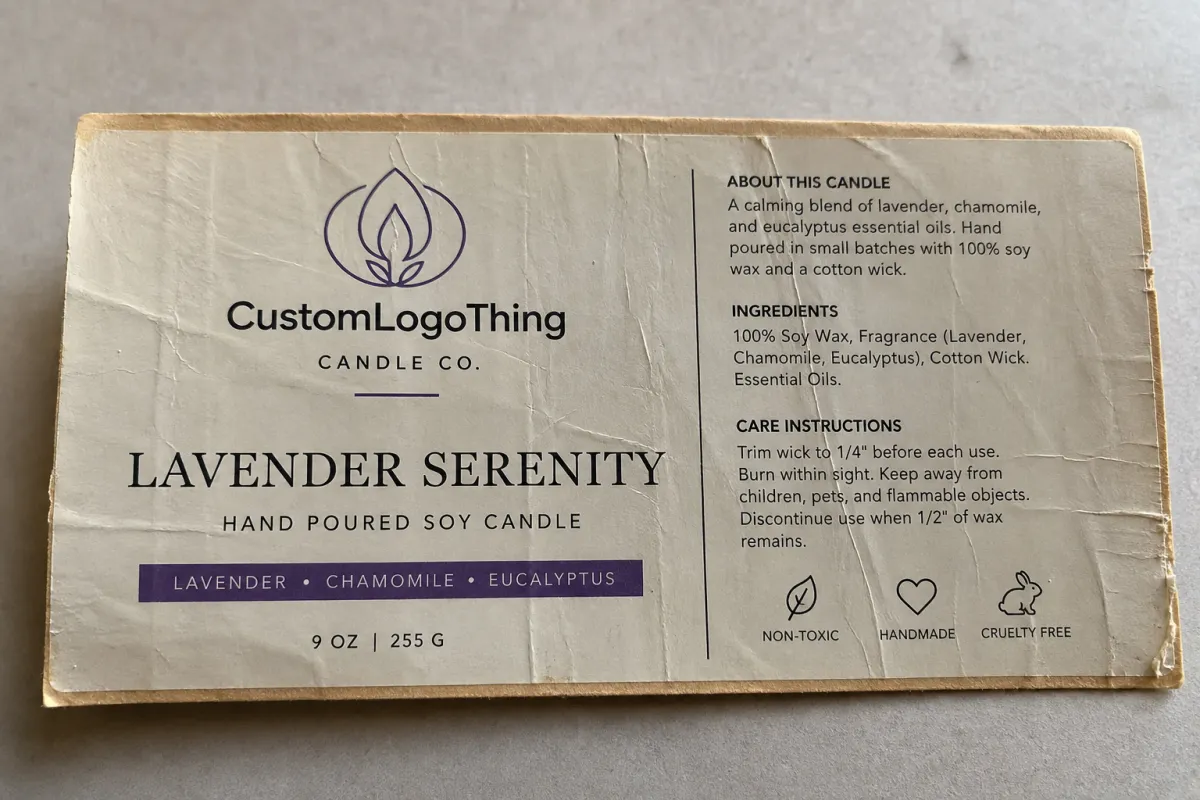
Most candle labels do not fail because the design is weak. They fail because the stock, adhesive, or finish was chosen without enough respect for heat, oil, and handling. That is the part teams skip while they are busy approving artwork. The result shows up later as curled corners, smudged ink, or labels that peel after a week on shelf.
Cosmetics brands usually want candles to feel like a natural extension of the line, not some side project that wandered in from another meeting. Fair enough. But the candle jar behaves differently from a carton or a tube. Glass can be smooth, frosted, curved, or slightly greasy from handling. Some jars are rounded enough that a flat label wants to fight the surface. Some sit close to a wick. Some are stored in warmer warehouses than anyone planned. All of that matters.
Guessing is expensive. Order the wrong size and the label crowds the print area or crosses a seam. Choose the wrong finish and the candle looks cheap in photos even if the artwork is strong. Pick paper where a moisture-resistant film would have been smarter, and the product starts looking tired before it even ships. If the candle is part of a seasonal set or bundled with custom printed boxes, one bad label choice can pull down the whole presentation.
That is why the supplier quote should start with risk, not just price. A supplier that asks for diameter, surface type, and application environment is doing actual work. A supplier that drops a low number without those basics is probably selling a temporary answer and hoping nobody notices until the reorder.
A quote only means something if every supplier is pricing the same jar, same adhesive, same finish, and same freight terms.
That sounds obvious. It also happens to be where a lot of teams lose money.
For cosmetics brands, the candle is often judged beside skincare, fragrance, or spa items. That means the label cannot read like an afterthought. It has to support package branding, match the line architecture, and hold up during customer use. In practice, the label is part of the shelf story. If it fails visually or physically, the brand looks less careful than it is.
For a broader look at label durability and transport risk, trade references such as ISTA are useful, especially when a candle travels with jars, cartons, inserts, or shipping packs. You do not need to become a packaging engineer. You do need to stop assuming a pretty mockup equals a reliable label.
Product Details That Shape the Right Label Build
A supplier cannot quote accurately without the physical details. Not the vibe. The actual jar. If you want a serious number, send the dimensions first and the artwork second. That keeps the conversation grounded in product packaging, not in a pretty file that still needs interpretation.
The core details are basic, and they matter more than people think:
- Jar diameter and height, measured in millimeters or inches
- Label application area, including any taper, seam, ridge, or embossing
- Surface material, such as clear glass, frosted glass, coated paperboard, or painted metal
- Lid style, because some lids change how the front panel is seen
- Placement, such as front panel, wrap label, neck label, or bottom label
- Quantity per SKU and how many SKUs are in the run
That is the starting point. If the jar has a curved face, say so. If the candle will be displayed in a bathroom set, say so. If the label has to sit beside a soap bottle and a lotion jar in a coordinated retail packaging display, the supplier should know that too. The line needs to hold together visually across every item, not just on one sample.
It also helps to define the role of the candle in the brand lineup. Is it a gift-with-purchase item, a retail add-on, a spa counter product, or a promotional bundle? A candle used as part of a seasonal gift set can justify a different finish or stock than a candle sold every day beside moisturizers and fragrance oils. That changes the spend. You do not need a premium build for a volume item if a simpler spec delivers the same shelf impact.
Label format matters too. Common options include front labels, full wrap labels, neck labels, and bottom labels. Some brands choose a two-piece set: one front label for branding and one smaller compliance or batch label on the bottom. Others want multi-panel setups so the candle coordinates with bottle labels, gift tags, or inserts in the same collection. That is where consistent package branding pays off. The line looks planned instead of patched together.
Artwork details change the quote as well. A simple one-color design on a matte stock is a different job from a multi-color file with foil, embossing, and a die-cut shape that wraps around a curved jar. If the candle line needs to match other SKUs in the cosmetics range, tell the supplier what has to stay consistent: logo size, brand color, finish, or type treatment. If the candle has to sit beside tubes and jars in a unified branded packaging system, the label should support that system, not compete with it.
One rule keeps the brief tight: the more specific the product brief, the fewer surprises in production. That is not sales talk. It is how you avoid back-and-forth, dieline edits, and the awkward moment where a good-looking design turns into a poor fit on the actual jar.
If you need to organize the broader packaging mix, it helps to review related formats at Custom Labels & Tags or compare label projects with other Custom Packaging Products. A candle label rarely stands alone in a cosmetics brand. It usually sits inside a larger system that has to behave.
Materials, Finishes, and Print Specs That Hold Up
Material selection is where a lot of candle projects get quietly underquoted. The cheapest stock is not always the cheapest outcome. If the label fails on glass, the brand pays for reprints, rush freight, customer complaints, and possibly a retail relaunch. That is not a bargain. That is a fancy invoice for a preventable mistake.
Here is the plain-language version of the common material choices:
| Material | Best Use | Durability | Typical MOQ Impact | Cost Tendency |
|---|---|---|---|---|
| Paper label stock | Dry, low-handling candle lines with a classic look | Moderate; can scuff or soften with moisture | Often lower barrier to entry | Lowest unit cost |
| BOPP film | Glass jars, bathroom sets, and moisture-prone environments | High; resists water and oil better than paper | Usually easy to scale in mid-volume runs | Mid-range |
| Vinyl | Highly durable applications, curved surfaces, or harsher handling | Very high; good for wear and moisture | Can raise minimums depending on print method | Higher than paper, often above BOPP |
| Specialty stock | Premium positioning, texture, or coordinated cosmetic collections | Varies by coating and adhesive | May require more setup or testing | Highest when special finishes are added |
Paper can work if the candle stays dry, the brand wants a softer feel, and the jar is unlikely to be handled heavily. BOPP is the safer default for many cosmetics brands because it handles moisture and scuffing better. Vinyl is stronger again, but the price climbs, and not every candle needs that level of durability. If the candle will sit near showers, sinks, or warm retail displays, BOPP usually makes more sense than paper. If the brand is targeting a luxury gift set and wants a more tactile feel, specialty stocks can earn their place.
Finish matters just as much. Matte gives a quieter, more premium look and hides small imperfections better. Gloss brings contrast and color pop, and it tends to wipe clean more easily. Soft-touch can feel upscale in hand, but it adds cost and may not be the best choice if the candle is likely to be handled frequently or stored with other cosmetics that can rub against it. That is the tradeoff. More sensory appeal usually means more spend. Packaging, like most things, insists on payment.
Adhesive selection is not glamorous, but it is one of the biggest reasons labels succeed or fail. A label on smooth glass does not need the same adhesive behavior as one on frosted glass or a slightly curved jar. If the environment gets warm, cold, or humid, the adhesive has to tolerate that movement without edge lift. Ask the supplier what adhesive they recommend for your jar surface and use case. If they say "standard" and stop there, keep asking.
Print specs also move the result. Resolution matters for fine text and thin line art. Color mode affects how close the printed candle label looks to the approved artwork. Bleed and cut lines decide whether the finished label looks precise or a little sloppy around the edge. Varnish can add scuff resistance, and it can also change how the finish reads under retail lighting. Digital printing is usually better for shorter runs, variable artwork, and faster turnaround. Flexo can make sense at higher volumes, especially if the same artwork will be repeated across larger orders.
If your brand uses FSC-certified paper or wants to prioritize lower-impact materials across the line, check the supplier's options carefully and ask for documentation. FSC is worth considering if your broader packaging strategy includes sustainability claims. Just do not treat a certification logo like decoration. If the paperwork is not there, the claim is not there.
Before full production, ask for a practical test. Put the sample on the actual jar. Let it sit. Wipe it. Handle it. Watch for scuffing, edge lift, and color shift. If possible, place it near a warm surface for a short evaluation and compare it to the approved sample. A label that passes a desk review is not automatically ready for shelf life.
For brands that sell across cosmetics and gift categories, a consistent spec language also helps keep future orders clean. The same finish and adhesive logic can be applied to jars, sleeves, and related custom printed boxes so the line feels intentional across formats rather than pieced together by whoever answered the phone first.
One more useful detail: if the project includes a folded insert, hang tag, or rigid presentation card, a common spec is 350gsm C1S artboard with matte or gloss aqueous coating. That is not a candle label stock itself, but it often sits in the same packaging system and affects the quote conversation. If your supplier cannot talk cleanly about both flexible labels and companion components, the brief is probably too thin.
Pricing, MOQ, and Quote Details That Change the Number
Price is the headline, but it is not the whole story. The number on the quote moves with every spec decision: quantity, stock, size, finish, print method, adhesive, and artwork complexity. Leave out one of those details and the quote usually comes back with a range so wide it is barely useful.
MOQ deserves straight talk. Lower minimums help with launches, testing, and seasonal programs, but they almost always come with a higher per-label cost. That is normal. Setup work still exists whether you print 1,000 labels or 50,000. The difference is that the setup gets spread over more pieces as volume increases. A launch run of 1,000 labels may cost far more per unit than a 10,000-piece reorder, but if you are still validating the scent, the jar, or the retail response, the smaller run can still be the right move.
Here is a realistic pricing framework many buyers use as a starting point for comparison. These are not universal prices, because no honest supplier will pretend they are, but they are useful for thinking about tradeoffs:
| Run Size | Paper Labels | BOPP Labels | Vinyl or Specialty | What Usually Changes |
|---|---|---|---|---|
| 1,000-2,500 pcs | $0.12-$0.28 each | $0.16-$0.35 each | $0.22-$0.48 each | Setup costs weigh heavily on the unit price |
| 5,000 pcs | $0.07-$0.16 each | $0.10-$0.22 each | $0.16-$0.34 each | Better spread on setup and more room for price breaks |
| 10,000+ pcs | $0.05-$0.12 each | $0.08-$0.18 each | $0.12-$0.28 each | Volume and repeatability start to matter more than setup |
Those ranges move with size and print coverage, so do not quote them blindly to your finance team. A tiny minimalist label with a single color is not priced like a full-bleed wrap label with metallic accents. A larger die-cut shape also uses more material. If the label has complex finishing, the cost can climb faster than the base print would suggest. That is the part people discover right after the budget meeting. Great timing.
Watch the quote line items. Ask whether there is a setup fee, plate charge, proof fee, shipping charge, and remake policy. Some suppliers keep the unit price low and make up for it in add-ons. Others present a cleaner all-in figure. Compare them on equal terms. If you do not ask for freight, you are not comparing landed cost. You are comparing half a quote to a full one.
Tiered pricing should be explicit. Ask for breakpoints at 1,000, 3,000, 5,000, and 10,000 pieces if those volumes make sense for your line. That shows where the real savings begin and whether it is worth buying ahead for a full season. Cosmetics teams often underestimate how much they can save by planning a reorder earlier, especially if the candle supports a broader retail packaging push or a gift program.
One more thing: ask for a quote based on one exact spec sheet, not a vague estimate from a sample photo. A vague estimate creates false confidence. A tight spec sheet gives you a number you can actually use in a launch budget. For a common mid-volume candle order, a supplier may land around $0.15-$0.24 per unit for 5,000 pieces, depending on label size, print coverage, stock choice, and finish. That is the kind of range that helps a buyer think clearly instead of pretending every project prints itself.
If you want a cleaner comparison across packaging suppliers, ask for samples and documentation through Case Studies and use the same logic you would apply to cartons, labels, and shipping packs. Good package branding is rarely one lucky item. It is a controlled system.
Process, Timeline, and Turnaround for Supplier Quotes
A fast quote is useful only if it is also accurate. There is no prize for receiving a bad estimate in two hours. For candle labels, the smarter approach is to understand the normal workflow and send the supplier enough information to cut the back-and-forth.
The process usually looks like this:
- Brief review - Supplier checks the jar details, quantity, material preference, and artwork status.
- Material recommendation - Supplier suggests stock, adhesive, and finish based on the surface and environment.
- Artwork check - Files are reviewed for bleed, fonts, die lines, and print readiness.
- Proof creation - A digital proof or sample proof is prepared for approval.
- Approval - Buyer confirms spec, layout, and print details.
- Production - Labels are printed, cut, and inspected.
- Packing and shipment - Orders are packed and sent to the destination.
Quote turnaround is often one to three business days if the supplier gets a complete brief on the first pass. If the spec is vague, the quote slows down because the supplier has to ask follow-up questions before giving a number that means anything. Production lead time is separate. Do not let a vendor blur those two. A quick quote does not mean a quick delivery.
Typical production timing depends on quantity, finish, and print method, but many label orders fall into a 7-15 business day manufacturing window after proof approval. In a lot of cases, the real-world answer is often 12-15 business days from proof approval for a standard digital or flexo run with normal finishing. Add shipping time on top of that. If you are importing or using a longer freight lane, transit can matter more than production. If you are planning a launch tied to a retail calendar, build in margin. The launch date is rarely the same thing as the order date, no matter how much everyone wishes otherwise.
The fastest way to speed up the quote is to send a complete file packet:
- Jar diameter, height, and shape notes
- Label dimensions or a rough dieline if one exists
- Material preference, if you already have one
- Finish preference: matte, gloss, soft-touch, or specialty
- Quantity tiers and which SKU count applies
- Artwork files in editable format if available
- Ship-to address and deadline
- Any compliance or sustainability requirements
If the candle will be shipped with other cosmetics items, say so. A label can be perfect on paper and still fail if the carton, insert, or outer shipping pack causes rubbing or heat exposure in transit. Transit testing does not need to be complicated. Packaging groups such as ISTA publish transport standards that help you think about vibration, compression, and handling without guessing.
That is why the best quote process does not start with "How cheap can you get this?" It starts with "What spec keeps this label stable from production to shelf?" The second question saves more money.
Why Choose Us for Custom Candle Labels
Buyers do not need a supplier who only knows how to print stickers. They need a partner who understands how candle labels behave on actual jars, in real retail conditions, next to other branded packaging items that have to hold together visually and physically. That is the baseline.
At Custom Logo Things, the value is in the details that reduce friction. That means practical material guidance, clean proofing, and consistent print quality when you reorder. If you are managing cosmetics packaging across several SKUs, the last thing you need is one vendor quoting paper, another quoting film, and neither one explaining the tradeoff clearly. A good supplier should help you choose, not push you into the cheapest answer and hope it works out.
Useful support usually looks like this:
- Spec review that checks size, shape, and label placement before pricing
- Honest MOQ guidance so you do not buy more than the launch needs
- Color and finish advice that keeps the label aligned with the rest of the line
- Adhesive recommendations matched to glass, frosted jars, or curved surfaces
- Quality control for cut accuracy, color consistency, and final inspection
That matters especially for cosmetics brands that build collections across seasons. A candle might start as a side item, then become part of a holiday gift set, then turn into a repeat retail item, then get bundled with soaps or body care. If the label system is sloppy, every expansion looks improvised. If the label system is disciplined, the whole line feels more valuable.
We see the same pattern across categories: the strongest brands are rarely the ones that spend the most on a single label. They are the ones that keep their packaging design consistent across jars, cartons, inserts, and shipping formats. That includes the candle label. It also includes the way your other items appear in display trays, sleeves, and custom printed boxes.
If you need a broader packaging conversation, start with Contact Us. If you need to compare candle labels against other retail packaging projects, use the same spec discipline across the whole order. That is how you avoid random results and keep the brand looking deliberate.
For buyers who want proof that the process holds up after the first run, repeat orders matter more than one polished mockup. That is where practical case studies earn their place. They show whether a supplier can keep the same color, adhesive, and cut quality after the first batch is gone and the reorder lands months later.
Next Steps to Request a Better Supplier Quote
If you want a better quote, stop sending half-formed requests. Build one clean spec sheet, send it to every supplier on the same basis, and compare total landed cost. That means unit price, setup, freight, and any extra charges. Do not compare a polished quote against a rough estimate and pretend they are equal. They are not.
Here is the buyer workflow that actually works:
- Build the spec sheet - Include dimensions, material preference, finish, quantity, deadline, and destination.
- Request multiple quotes - Use the same details for every supplier so the comparison is fair.
- Check samples or photo proof - Before approving production, confirm the label color, cut, and adhesion on the real jar.
- Set reorder points - Base them on lead time plus safety stock, not last-minute panic.
That last part matters. A reorder point should reflect how long it takes to quote, proof, print, pack, and ship. If your lead time is two weeks and you sell through 30% faster than planned, the stock-out is self-inflicted. Planning beats speed every time.
A short buyer checklist keeps the process tidy:
- Jar dimensions and shape
- Label size and placement
- Stock choice and adhesive type
- Finish preference
- Quantity by SKU
- Budget range
- Timeline and ship-to location
- Compliance or sustainability requirements
If you already know the candle line will expand into sets or bundles, think ahead about the rest of the system. Matching labels, inserts, and boxes are easier to manage when the first order is built with the future in mind. That is true for custom printed boxes, too. It is also true for every other piece of product packaging that touches the shelf.
Do the basics well, and the supplier quote becomes a tool instead of a headache. That is the whole point of the custom candle labels for cosmetics brands supplier quote checklist: make the first quote accurate enough to buy from, not merely fast enough to admire. Use the right specs, ask the right questions, compare quotes on the same terms, and the result is cleaner pricing, fewer surprises, and a candle label that actually holds up in the real world.
FAQ
What should be on a custom candle labels for cosmetics brands supplier quote checklist?
Include jar dimensions, label size, material, finish, adhesive, quantity, artwork status, and ship-to location. Add special requirements like water resistance, heat tolerance, foil, or unusual cut shapes so the supplier is pricing the real job, not a rough guess. The more exact the checklist, the less room there is for nonsense later.
How do I compare custom candle labels for cosmetics brands quotes fairly?
Use the same specs across every supplier: size, stock, finish, print method, and freight terms. Watch for hidden costs like setup charges, proof fees, plate charges, and remake policy. The cheapest quote can turn expensive fast if those lines are buried or left out. Same job, same terms, same math.
What MOQ is normal for custom candle labels for cosmetics brands?
MOQ depends on size, material, and print process, but smaller runs usually cost more per label. If you are launching a new line, ask for tiered pricing so you can compare a test run against a larger production order without guessing. That gives you a clearer view of the real breakpoints instead of a single number tossed into the air.
Which material works best for candle labels in a cosmetics brand lineup?
BOPP or vinyl works best when you need better moisture resistance and durability on glass jars. Paper stocks can work if the candle stays dry and the brand wants a softer, more traditional look. The right choice depends on handling, shelf life, and where the candle will sit in the range. Pretty is fine. Pretty that peels is not.
How long does a custom candle labels for cosmetics brands quote usually take?
A complete quote can come back in one to three business days if the supplier has all the specs. Production timing varies by volume and finish, so ask separately for proof time, manufacturing lead time, and shipping time. Those are three different clocks, and vendors often blur them if you let them. For many standard runs, production is often 12-15 business days from proof approval.
Should candle labels be tested on the actual jar before production?
Yes. A label can look fine on a flat proof and still fail on a curved jar or a warm surface. Test the sample on the real container, let it sit, wipe it, and check for edge lift, scuffing, or color shift. That is cheaper than learning the hard way after the full run ships.


