Corporate Gifting Pom Pom Beanies Unit Cost Review
The first mistake buyers make with a corporate gifting Pom Pom Beanies Unit Cost review is assuming two hats that look similar should price out the same. They usually do not. Pom style, knit density, logo method, lining, and even the way the item is packed can shift the number enough to wreck a budget before procurement sees the final version.
That happens because winter gifts look simple from a distance. Then artwork lands, the brand team asks for tighter color matching, and somebody wants gift-ready packaging. The order that looked tidy on a spreadsheet starts collecting add-ons. A proper corporate gifting Pom Pom Beanies Unit Cost review is not about chasing the lowest headline price. It is about separating base cost from optional upgrades so nobody gets surprised later.
“Show me the breakdown before you show me the total.” That is the right instinct for branded winter headwear. A usable quote explains what drives the cost instead of hiding everything in one nice-looking number.
For onboarding kits, holiday giveaways, client gifts, or event swag, vague specs get expensive fast. If the supplier has to guess at yarn color, logo size, lining, or packaging, they will pad the quote to protect themselves. That is not a scam. It is what quoting looks like when the buyer leaves too much open. The cleanest approach is blunt: lock the must-haves, treat the nice-to-haves as options, and ask where the factory is spending labor.
What a branded pom pom beanie actually includes
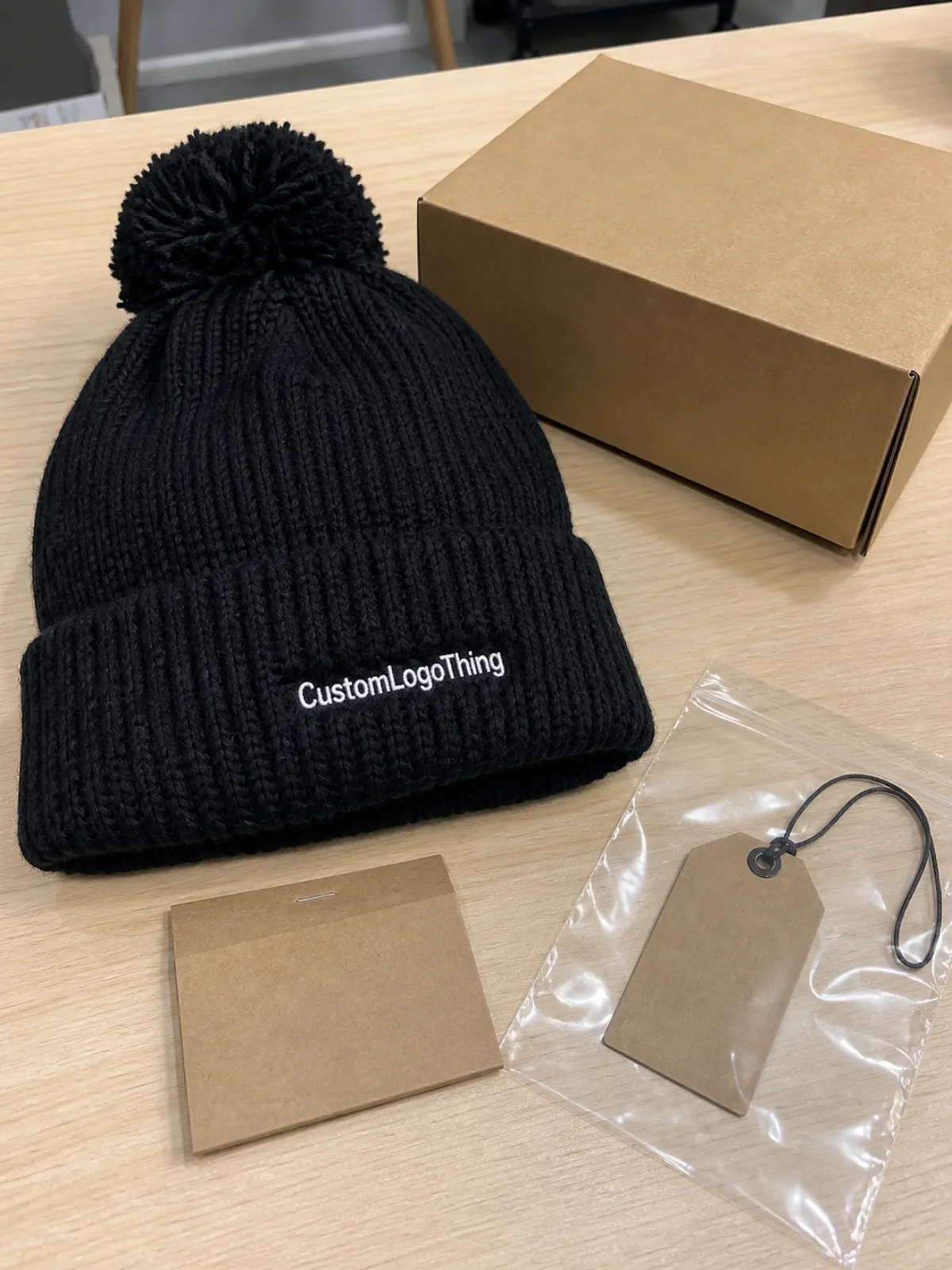
A branded pom pom beanie looks like one product, but the quote usually covers several parts. The crown knit, cuff, pom construction, lining, and decoration area all affect the final unit cost. If one supplier is quoting a dense rib knit with a sewn patch and another is quoting a lighter stock acrylic cap with embroidery only, you are not comparing the same hat. You are comparing two different builds dressed in the same product photo.
Here is the breakdown buyers should ask for:
- Crown knit: rib knit, cable knit, or a smoother jersey-style knit.
- Cuff: single fold, deep cuff, or rolled edge for more logo space.
- Pom: yarn pom, faux fur pom, single color, or two-tone.
- Lining: unlined, fleece-lined, or thermal brushed lining.
- Decoration: embroidery, woven label, patch, or heat-applied emblem.
- Packaging: bulk packed, belly band, polybag, gift box, or insert card.
Decoration is where a lot of quotes stop being comparable. Embroidery looks clean on a beanie when the logo is simple and the stitch count stays reasonable. A woven label works better for small type and fine detail. A leather-style patch can feel premium, but it also introduces tooling fees or setup charges if the patch is custom die-cut. If the logo is tiny, full-color, or overloaded with detail, the decoration method may need to change just to keep the mark readable.
Style matters too. Rib knit is common because it stretches well and holds shape. Cable knit looks more giftable, but it takes longer to produce and usually costs more. Slouch fits feel relaxed and contemporary, though they can create more variation in fit and logo placement. Two-tone builds add visual interest, but they add complexity as well, and factories charge for that complexity. They are not sentimental about it.
Sample photos can also mislead. A hand-picked showroom sample may use softer yarn, a tighter knit, or more careful finishing than the standard production run. Once the supplier normalizes the order, the hat may be functionally identical but not identical in hand feel or finish. Ask for the spec sheet, not just the pretty picture.
Specs that affect fit, comfort, and repeat orders
Material blend is the first spec I look at. Acrylic is common because it is affordable, warm enough for most corporate use, and easy to knit in volume. Recycled acrylic can support sustainability claims, though the price may edge up depending on supply and certification requirements. Wool blends feel warmer and more premium, but they are less forgiving on price and sometimes on care. Fleece lining adds comfort and winter performance, yet it also adds labor and bulk.
Fit comes next. A good unisex beanie should stretch across mixed head sizes without feeling sloppy. That means checking cuff depth, body height, and stretch range before approval. If the beanie is too shallow, it sits high and feels cheap. If the cuff is too deep, the logo can sink too low and look awkward in photos. Buyers who need one size for broad employee distribution should ask for measured specs, not “one size fits most” as if that settles anything.
Decoration-specific specs deserve the same attention. Embroidery field size limits how much detail the logo can carry. Patch placement changes depending on cuff height and knit tension. Thread color matching has a tolerance range, and that range matters if your brand uses strict Pantone references. On repeat orders, a supplier should keep the approved yarn code, patch material, stitch count, and artwork version on file. If they do not, the next run can drift in color or finish, and everybody will swear it was “basically the same.” Sure.
For buyers with packaging requirements, sustainability can matter too. If you want recycled content or FSC-certified inserts, check the standards first instead of asking for vague “eco” claims. The useful references are plain enough: fsc.org for responsible paper sourcing and ista.org for transit testing guidance when you are shipping kits or retail-ready cartons. Practical standards beat marketing language every time.
There is also a quiet quality issue that only shows up after wear. Cheap knit can relax too fast, which means the cuff loses shape and the logo starts sitting crooked. Soft yarn that feels great out of the box can pill early if the fiber blend is weak. That does not mean you need luxury materials. It means you need to ask the boring questions: what is the fiber mix, how dense is the knit, what is the stretch recovery, and how does the decoration hold after folding and unpacking. Those are the details that keep a giveaway from looking tired after one winter.
Pricing, MOQ, and unit-cost bands for corporate runs
Let us talk numbers. A proper corporate gifting pom pom Beanies Unit Cost Review should show how price changes with quantity, decoration, and packing. Small orders always look expensive because setup is spread across fewer pieces. Bigger orders pull the cost per piece down, but only if the spec stays sane.
| Order size | Typical build | Estimated unit cost | What usually changes the price |
|---|---|---|---|
| 100-250 pcs | Stock acrylic, single-color embroidery, bulk packed | $5.50-$9.00 | Setup charges, small-run labor, and freight share |
| 500-1,000 pcs | Stock knit, woven label or embroidery, optional polybag | $3.80-$6.25 | Pom type, logo size, and minimum color counts |
| 2,500-5,000 pcs | More controlled spec, cleaner logo placement, better bulk pricing | $2.65-$4.60 | Yarn blend, packaging format, and shipping lane |
| 10,000+ pcs | Fully defined spec, repeat production, tighter QC | $2.10-$3.60 | Tooling fees, custom finishing, and freight planning |
Those ranges are not promises. They reflect what usually happens when the spec is clean enough to quote without guesswork and the order is not being rushed into a holiday wall. Add fleece lining, faux fur poms, leather patches, or gift boxes and the price moves up. Fast. A prettier product is rarely cheaper.
MOQ is another point buyers underestimate. Some factories set minimums by color, by logo version, or by packing style. You may be able to order 300 hats total, but if you want three colorways and two packaging types, the factory may treat that as six production tracks. That changes the quote in a hurry. Ask for MOQ by color and by decoration version, not just one overall minimum, or you will compare quotes that are not actually comparable.
When I review a quote, I look for these line items first:
- Sample charge: often refundable only if the order moves forward.
- Setup charges: logo prep, patch tooling, or embroidery digitizing.
- Packaging: bulk pack, retail polybag, insert card, or gift box.
- Freight: air, ocean, or domestic distribution from a warehouse.
- Rush fee: usually attached to compressed production windows.
If a supplier sends one tidy total with no breakdown, that is not convenience. It is a warning label. A clean quote should tell you what the factory is charging for the hat itself, what they are charging to prepare it, and what changes if you want a different finish. Otherwise you are guessing at your own budget.
There is one more cost trap: “free” revisions. Some suppliers fold one proof into the quote, then charge extra every time the artwork changes after the first approval. That can be fair if the buyer keeps moving the goalposts. It is not fair if the supplier never told you the revision limit up front. Ask how many proof rounds are included before approval, and whether color changes, logo repositioning, or packaging edits trigger extra fees. Those details are small until they are not.
Production steps, proofing, and lead time
The process should be boring. Boring is good. Inquiry, artwork review, spec confirmation, digital proof, sample approval, production, packing, and dispatch. That is the sequence. The faster a supplier can move a buyer through those steps without confusion, the less likely the order is to drift into delay or accidental scope creep.
Standard lead times for branded pom pom beanies often land in the 12-20 business day range after proof approval, depending on stock availability and finishing complexity. Simple embroidery on a stock knit can move faster. A custom patch, special yarn color, or gift-style packaging can push the calendar longer. If a holiday event is involved, assume the factory is already busy and build in a cushion. Nobody enjoys discovering that your “easy” winter order is waiting behind forty other winter orders.
Buyer-side delays are common. Marketing wants to tweak the logo. Procurement wants one more comparison quote. The event team wants to see a physical sample. Finance wants the total landed cost, not just the manufacturing price. All of those are fair asks, but they can chew up days. That is why the best practice is to gather final artwork, quantity, color target, and delivery deadline before you ask for production confirmation.
A practical schedule looks like this:
- Day 1-2: send artwork, quantity, target colors, and delivery address.
- Day 2-4: receive quote, mockup, and any setup charge notes.
- Day 4-6: approve proof or request one revision.
- Day 6-10: sample or pre-production check, if needed.
- Day 10-20: production, packing, and dispatch.
For shipments with stricter handling needs, ask whether the cartons are packed for transit stress or tested for distribution damage. If the beanies are part of a larger gift set, that question matters. A hat that survives production but arrives crushed in a kit box is not a win. That is just an expensive mess with a logo on it.
Lead time also depends on seasonality. October through December is not the same as March. Factories get crowded, freight options tighten, and samples can slow down if yarn or packaging stock is backordered. If the order must arrive before a company event, the useful planning window is longer than buyers want it to be. Build the schedule around the event date, not around an optimistic factory promise.
Quality-control checks that save a winter program
QC sounds dull until one box lands with the wrong color cuff and a logo that sits half an inch off-center. Then it suddenly becomes the main plot.
For pom pom beanies, the checks that matter most are straightforward: yarn color consistency, stitch density, cuff height, logo placement, thread tension, pom symmetry, and pack-out count. A supplier can get six of those right and still miss the one that makes the whole batch look off. The logo does not need to be perfect in the abstract. It needs to be centered, readable, and consistent from hat to hat.
I also like to see the same checks applied at two points: during pre-production and during final packing. Pre-production catches the spec drift. Final packing catches count errors, label swaps, and box mix-ups. If a supplier only checks at the end, they are asking the warehouse to clean up manufacturing mistakes. That is lazy, and it is expensive.
Useful QC checkpoints include:
- Logo placement: confirm distance from cuff edge and center point.
- Color match: approve yarn and thread against the chosen reference.
- Pom quality: check fullness, attachment, and trimming.
- Stretch recovery: confirm the beanie returns to shape after pull testing.
- Pack accuracy: verify counts, inserts, and outer carton labels.
For premium corporate gifts, I also ask whether the decoration can survive folding, bagging, and shipping vibration. Some patches look great in a still photo and start lifting at the edge after the first rough carton ride. Embroidery usually holds up better, but it still needs proper thread tension. None of this is glamorous. All of it matters.
And yes, a supplier who talks about QC in plain language is usually easier to work with than one who tosses around vague quality claims. “We check everything” means nothing. “We confirm placement against the approved sample, inspect every carton count, and photograph the first production piece” means something.
How to handle samples, approvals, and reorders
A supplier makes your life easier when they act like a supplier, not a brochure. One point of contact. Clear line-item pricing. Fast proof revisions. Honest answers on MOQ, decoration limits, and shipping windows. That is the difference between a project that gets approved and one that gets trapped in email threads nobody wants to own.
For repeat corporate orders, consistency is everything. The first run should lock the yarn spec, logo placement, patch material, thread colors, and packaging format. Once that is documented, reorders become simple. Without that spec sheet, a “same as last time” request can turn into a color mismatch, a different pom construction, or a changed label type. Nobody wants that fight after the budget is signed.
Here is what practical communication looks like on a good order:
- One quote, broken out clearly: unit cost, setup charges, sample cost, and freight shown separately.
- One proof route: fewer approvals, fewer edits, fewer delays.
- One approved reference: final artwork, Pantone targets, and packed sample photos saved together.
- One reorder record: notes on what worked, what changed, and what must stay fixed.
That process also helps finance and procurement. They can compare suppliers on the same basis instead of trying to decode three different quote formats. If one supplier looks cheaper only because they buried packaging or digitizing in the background, the line-item version will expose it. That is not being difficult. That is buying responsibly.
I also recommend asking for a sample or mockup when any of these matter: color accuracy, embroidery placement, tactile finish, or gift presentation. If the beanies are going to executives, clients, or event VIPs, presentation is part of the product. A clean sample can save a lot of awkward explaining later. A rushed approval can save two days and cost two weeks. Choose wisely.
What to send for a usable quote
If you want a quote you can actually compare, send four things first: quantity, logo file, target color, and delivery deadline. That gets the supplier out of guesswork mode. If you leave out one of those, the quote may still come back, but it will probably be padded to protect against missing details.
Then ask for a line-item breakdown. You want to see the unit cost, setup charges, sample charges, and freight separately. If you are comparing more than one supplier, ask each one to quote the same decoration method, the same yarn blend, and the same packaging format. Otherwise you are comparing apples, pears, and whatever else the factory felt like tossing into the basket.
Use this short checklist before approval:
- Confirm the exact beanie style and pom type.
- Lock the decoration method and logo size.
- Approve the spec sheet and color target.
- Check MOQ by color and by logo version.
- Verify the production slot against your event date.
If color accuracy, embroidery clarity, or presentation matters, request a mockup or sample before production. If speed matters more than perfection, choose a stock build and keep the artwork simple. That tradeoff is normal. The mistake is pretending you can have premium finishing, tight timing, and the lowest price all at once. Usually you get to pick two.
For a clean buying decision, ask for a corporate gifting pom pom Beanies Unit Cost Review against the exact order size before you approve the run. That is how you spot hidden cost drivers, protect the budget, and place a bulk order without guessing.
What affects corporate gifting pom pom beanies unit cost the most?
Decoration method, yarn blend, and pom construction usually move the price first. MOQ, packaging, and rush shipping can add more than buyers expect, especially on smaller corporate runs. Small proof changes can also create extra charges if they happen after the first approval.
What is a realistic MOQ for branded pom pom beanies?
MOQ often depends on color count, decoration style, and whether the factory is knitting from stock or building to a custom spec. Ask for MOQ by color and by logo version so you can compare quotes fairly. One overall minimum is not enough if you want a real apples-to-apples review.
How long does production usually take for corporate beanie orders?
Standard production often takes 12-20 business days after proof approval, and the full calendar gets longer once sampling, packaging, and shipping are included. Rush orders are possible, but they usually cost more and leave less room for revisions.
Which decoration method looks best on pom pom beanies?
Embroidery works well for simple logos with strong contrast and a clean finish. Woven labels or patches can look more premium when the logo has fine detail or needs a larger brand presence. The best method depends on stitch count, logo size, and how much texture you want.
What should buyers send first to get an accurate quote?
Send quantity, target colors, logo artwork, packing preference, and delivery deadline in one message. If you want a clean comparison, ask for sample, setup, and freight charges to be shown separately from unit cost. Then keep that same format for every supplier you compare.

