Buyer Fit Snapshot
| Best fit | Custom Candle Labels Price projects where brand print, material claims, artwork control, MOQ, and repeat-order consistency need to be specified before quoting. |
|---|---|
| Quote inputs | Share finished size, material target, print colors, finish, packing count, annual reorder estimate, ship-to region, and any compliance wording. |
| Proofing check | Approve dieline scale, logo placement, barcode or warning zones, color tolerance, closure strength, and carton packing before bulk production. |
| Main risk | Vague material claims, crowded artwork, missing packing details, or unclear freight terms can make a low unit price expensive after revisions. |
Fast answer: Custom Candle Labels Price: What Affects the Cost Most should be specified like a repeatable production item. The safest quote records material, print method, finish, artwork proof, packing count, and reorder notes in one written spec.
Production checks before approval
Compare the actual filled-product size with the drawing, then confirm tolerance on folds, seals, hang holes, label areas, and retail display edges. Reserve space for logos, QR codes, warning copy, and material claims before decorative graphics fill the panel.
Quote comparison points
Review material grade, print process, finish, sampling route, tooling charges, carton quantity, and freight assumptions side by side. A quote is only useful when the supplier can repeat the same color, closure quality, and packing count on the next order.
Custom Candle Labels Price: What Affects the Cost Most
If you are comparing custom candle labels price quotes, the first surprise is usually how one small change can move the total. Swap paper for a moisture-resistant film, ask for soft-touch instead of matte, or specify a stronger adhesive for a curved glass jar, and the number can shift faster than a redesign of the artwork itself. Packaging does that a lot. The quiet details carry the loudest price tag.
Candle labels live a harder life than people think. They sit on glass, tins, and coated vessels; they move through filling lines, warm warehouses, and freight trucks; then they get handled again on the shelf. I have seen a label look lovely under studio lights and still fail on the jar because the adhesive was tuned for a flat carton, not a slightly oily candle vessel. That is why the real question behind custom candle labels price is not just how the label looks. It is how it behaves after it leaves the printer.
Buyers usually want a fast number, and that makes sense. Fast numbers are only useful, though, when the request includes enough detail to support them. A label sized for a standard jar, printed on the right stock, and placed in a clear zone is far easier to price than a vague request for “premium candle labels.” Private-label brands feel this especially hard because they often manage several fragrance lines, multiple jar styles, and repeat orders that need to match across product packaging and retail packaging.
Candle labels sit where design and production keep bumping into each other. A file can look elegant on screen and still become expensive if it needs tight registration, specialty cutting, or extra resistance to oil, condensation, or heat. A lot of pricing conversations miss that collision. The answer to custom candle labels price usually lives in the technical details, not in a simple rate chart.
Why custom candle labels price can change faster than you expect
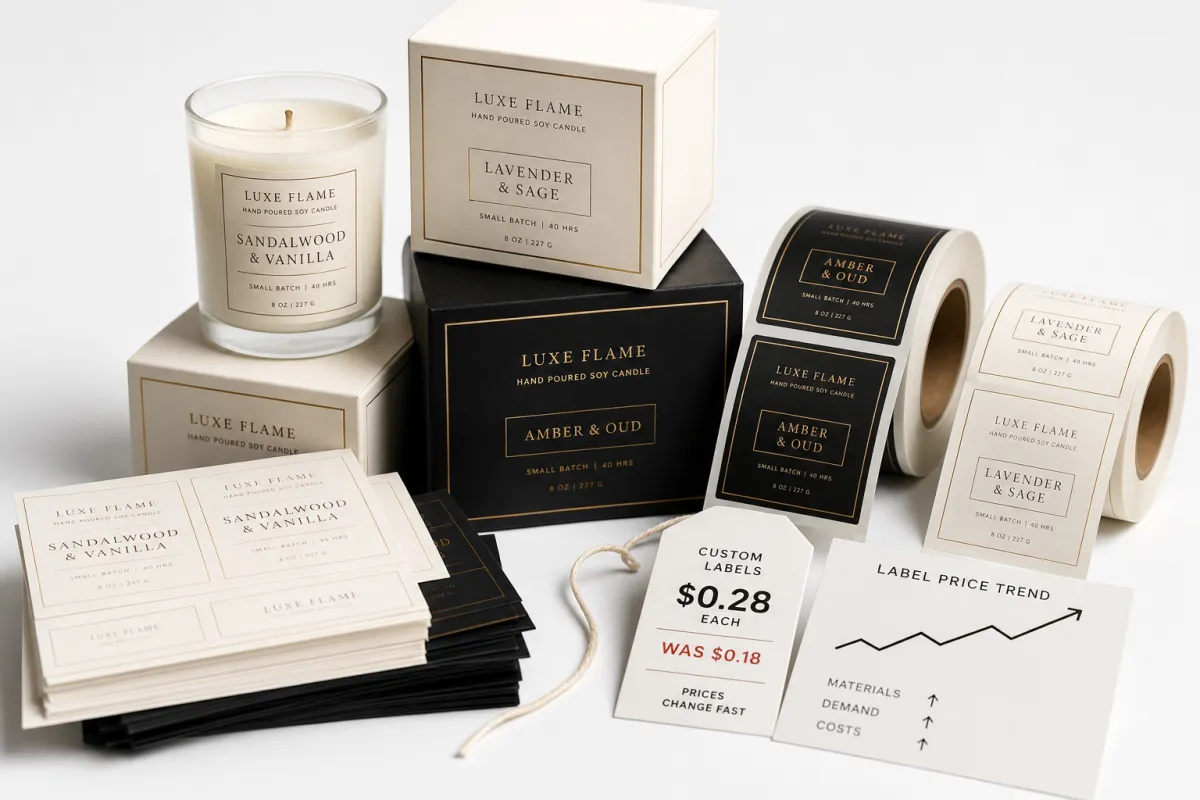
Custom candle labels price shifts quickly because labels are one of those packaging parts where tiny choices have outsized consequences. A change in adhesive performance can matter as much as a bigger artwork update when the label needs to hold on glass that may carry a trace of oil, dust, or condensation. On paper, two labels can look nearly identical. On the vessel, one may stay put while the other lifts at the corners after a week.
The application surface matters more than many buyers expect. Smooth glass jars, matte tins, painted vessels, and amber bottles do not behave the same way. A label for a polished luxury jar may need a different adhesive profile than one designed for a craft line in a powder-coated tin. That is why custom candle labels price is tied to how the label will be applied, not only to the visual mockup.
Storage and transit add their own pressure. Candle products often move through warm rooms, cooler trucks, and packing tables where labels get brushed, rubbed, and stacked against each other. A label that needs to stay sharp through those conditions may need a film stock or coated face stock instead of ordinary paper, and the quote reflects that shift. The extra cost is not about decoration. It is about avoiding returns, rework, and the dull expense of labels that fail after launch.
A label that saves a few cents on paper can become the most expensive line item if it peels, smears, or wrinkles after the candles are already on shelves.
Volume changes the math too. Setup, proofing, and die preparation are fixed tasks, so a small order carries more of that cost per unit. Larger runs often lower the price per label, but only when the specifications stay stable. Change the size, stock, or finish, and the numbers move again. That is why custom candle labels price can look steady in one quote and jump in the next.
For a candle brand building a new collection, the cheapest quote is not always the smartest one. The better question is whether the label will stay attractive on the jar, survive packing, and match the rest of the line. A label that supports the larger packaging design usually protects the brand better than one that trims a few cents now and creates problems later.
If your line includes cartons, inserts, or hang tags, treat the order as a system instead of a stack of separate items. A shared finish family, consistent adhesive choice, and repeatable print method can make the shelf presentation feel deliberate. That applies whether you are ordering simple candle wraps or coordinating with Custom Labels & Tags and other Custom Packaging Products.
Label materials, finishes, and formats that shape the quote
The fastest route to understanding custom candle labels price starts with the stock. Paper usually sits at the low end, especially for dry indoor shelves and short promotional runs. BOPP film, a common polypropylene material, costs more but resists moisture and oil better. Vinyl and specialty films cost more still because they are built for tougher handling and longer service life. The face stock is not just the background for the artwork; it defines part of the label’s job.
Finish shifts the look and the budget in equal measure. Matte reads quiet and handmade. Gloss brings reflection and stronger shelf pop. Soft-touch creates a muted, tactile feel that suggests a more premium line. Metallic and foil effects add visual weight and often show up in gift sets or higher-end seasonal candles. Those upgrades are not simply decorative. They change press setup, material selection, and sometimes the way the label sits against the vessel, so they affect custom candle labels price directly.
Format matters too. Roll labels are often the best fit for machine application or for teams applying labels quickly by hand. Cut sheets work well for smaller orders, short runs, and businesses that label in-house without high-volume equipment. Individually cut labels solve specific needs, but they can add handling time. Every extra manual step tends to show up in the unit cost.
| Material / Format | Best Use | Durability | Typical Price Impact |
|---|---|---|---|
| Paper stock | Dry indoor candles, craft lines, short shelf life promotions | Moderate in dry conditions | Lowest; often about $0.03-$0.07 per label on larger runs |
| BOPP film | Glass jars, handled candles, lines exposed to oil or humidity | High | Mid-range; often about $0.05-$0.11 per label |
| Vinyl or specialty film | Premium candles, heavy-touch retail packaging, difficult surfaces | Very high | Higher; often about $0.08-$0.16 per label |
| Clear stock | Minimal branding, modern glass jars, see-through effects | High, but registration needs to be precise | Mid to higher; often about $0.06-$0.14 per label |
| Foil or textured specialty stock | Gift sets, premium collections, elevated shelf presence | Varies by construction | Highest; often about $0.09-$0.20 per label |
Those figures are not a universal rate card. They do show the pattern buyers see in real quoting. The more durable or decorative the construction, the higher the price tends to rise. For a candle line that sits in a humid bathroom, near a kitchen, or under hot retail lighting, a stronger material can be smarter than a cheaper stock that needs replacement or apology emails later. That is where custom candle labels price and long-term value meet.
Finish and stock also shape how the brand feels at the shelf. A label with soft-touch coating and careful ink control can read more deliberate than a bright white paper label with heavy coverage, even if the second option is cheaper. Buyers looking at branded packaging should ask whether the label supports the full line, including cartons, inserts, and outer shipping packs. Packaging usually fails as a system, not as one isolated piece.
Clear labels bring their own complications. Registration has to stay sharp because white ink, metallic detail, and small text show misalignment immediately. Foil can push the cost higher if the design uses broad coverage or very tight detail. Textured stocks may call for a different print approach to keep fine type readable. The material is never neutral; it steers the whole production path and the final custom candle labels price.
Specifications that influence custom candle labels price
The biggest quote drivers are usually size, shape, ink coverage, and cut style. A simple rectangle with moderate color coverage costs less to produce than a contour cut with a precise edge radius and a tight border around the candle logo. Exact geometry takes more setup attention, and that pushes custom candle labels price upward in ways that are easy to miss until the first estimate lands.
Dimensions affect more than material use. They also affect how the labels fit on the press sheet or roll. A wider label may consume more stock, while a taller label can reduce how efficiently pieces nest during production. Buyers should have the jar diameter, label placement area, and preferred orientation ready before asking for a quote. A detailed spec sheet saves time and cuts down on the back-and-forth that turns a clean quote into a revised one.
Ink coverage adds another layer. Full-bleed art, deep black backgrounds, and metallic-heavy designs need more press control than a simple two-color layout. White ink, clear stock, and layered effects make the process more complex again. Those choices often pay off in the finished look, but they are not free. The link between design ambition and custom candle labels price shows up very fast here.
Performance requirements matter just as much as aesthetics. Some candle makers need oil resistance for fragrance oils, others need moisture resistance for bath-and-body crossover products, and some need labels that tolerate warmer storage without curling at the edges. A label for a tin with wax residue risk may need a different adhesive behavior than a label for a rigid glass vessel. The best quoting conversations are direct. Say whether the candle is hand-poured, stored warm, shipped long distance, or displayed where people will keep touching the jar.
Artwork readiness Changes the Quote more than many first-time buyers realize. Vector files, correct bleed, and a clear dieline reduce prepress time. Blurry images, missing fonts, and repeated proof changes add labor before production starts. That extra work is one reason custom candle labels price may include setup or prepress fees. It is not padding; it is the actual work required to prepare the file for print.
There is a strong packaging logic behind that. Shipping stress does not show up in the artwork file, but it can still ruin a label. The ISTA test methods are useful for thinking about vibration, handling, and transit conditions, even when the label is only one part of the pack. For broader packaging insight, the Institute of Packaging Professionals offers resources that match real production decisions rather well.
Buyers usually get better pricing conversations when they answer a few practical questions first: What vessel is the label going on? How hot will the product get in storage? Does the line need water resistance, oil resistance, or both? How precise is the trim? Once those details are clear, custom candle labels price becomes much easier to estimate with confidence.
Custom candle labels price: pricing, MOQ, and volume breaks
Custom candle labels price usually falls as quantity rises because setup costs are spread across more units. That is simple math, and it applies across most print jobs. The complication is that the lowest per-label price does not always come from the biggest order if the stock, finishing, or art requirements are more elaborate than the brand needs. A sensible MOQ is the one that fits production planning, storage space, and cash flow without leaving you buried in inventory.
For smaller candle brands, digital production can keep lower quantities practical. Some projects work well in the few-hundred range, while others make more sense at 1,000 pieces or more. Larger candle lines often gain the most from volume breaks, especially when the same label is reused across several fragrance batches. That is where custom candle labels price gets more efficient, because repeated runs keep the artwork and setup familiar.
Comparing quotes can go wrong when each supplier includes different items. One may bundle proofing and standard shipping into the total, while another lists those separately. Some quotes include only the finished label, while others add sampling, file cleanup, or specialty finishing. If the line items are not comparable, the lower price may be the most misleading one on the page.
Here is a practical way to compare offers:
- Material grade: paper, BOPP, vinyl, clear film, or specialty stock.
- Adhesive type: standard permanent, high-tack, or performance adhesive for harder surfaces.
- Print method: digital, flexographic, or hybrid production.
- Finish: matte, gloss, soft-touch, foil, or laminated protection.
- Included services: proofing, dieline setup, revisions, and shipping.
Once those points line up, the quote becomes much easier to read. A slightly higher custom candle labels price can be the better choice if it includes stronger adhesive, cleaner proof support, and a finish that protects the label during handling. A lower figure that leaves those items out may be cheap only on paper.
Buyers should also separate raw stock pricing from finished label pricing. Raw stock looks attractive if you are comparing material cost alone, but finished labels include the converted shape, cut method, and quality control needed to make the labels ready for application. Candle brands need finished product, not a stack of material. That distinction changes how you read custom candle labels price.
For many candle businesses, the sweet spot sits between unit savings and inventory risk. Seasonal scents and limited-edition launches make that balance even more delicate. A good supplier should help you choose a quantity that supports the line without forcing overbuying. That kind of planning keeps custom candle labels price tied to actual sell-through instead of guesswork.
From quote to delivery: process and timeline for candle labels
The order flow is usually straightforward, but each step matters. Inquiry comes first, then quote, then artwork review, proof approval, production, quality check, packing, and shipment. Clear dimensions and file details at the start keep things moving. Incomplete files slow the process and often force adjustments to custom candle labels price because of extra prepress work.
Standard production time often lands around 10-15 business days after proof approval, though specialty finishes or sourced materials can extend that window. Foil, textured stock, and custom adhesive setups usually need more time. Brands planning a seasonal launch should build in a buffer rather than assuming the first estimate is also the final delivery date. That caution matters even when the label itself seems simple.
Clean artwork shortens the process in a real way. Vector logos, outlined fonts, correct bleed, and one clearly marked dieline help the prepress team move without repeated questions. The effect grows when a candle line has multiple scent variants, since each variation adds coordination work. Good file prep does not just save time. It keeps custom candle labels price from creeping up because of avoidable revisions.
Shipping deserves its own planning. Candle brands often order labels close to launch, but a safer method is to work backward from the fill date, not the sale date. If labels need to arrive before assembly, packing, and distributor shipping, the lead time should include every one of those steps. Delays usually happen in the spaces between approval and production, not in the press itself.
The rest of the packaging mix matters too. If labels are being ordered with cartons, inserts, or promotional tags, the production calendar should account for every item’s lead time. Coordinating those pieces keeps product packaging and retail packaging aligned, especially during a brand refresh. That kind of planning protects both the schedule and the shelf presentation.
Short deadlines reward clarity, not wishful thinking. A complete file package, a realistic timeline, and a well-written quote request usually solve more problems than a rush promise. That is the honest side of custom candle labels price: the final number reflects ink and film, yes, but also the amount of friction in the path from concept to packed shipment.
Why buyers choose Custom Logo Things for candle labels
Custom Logo Things fits candle brands that want more than a printed sticker. The value is in the packaging knowledge behind the quote: material guidance, print readiness, and label construction that fits the vessel instead of fighting it. For buyers trying to pin down custom candle labels price, that support matters because it turns a vague request into a usable production spec.
A packaging-focused supplier starts with function as well as appearance. A candle jar label is not only a graphic panel; it has to hold, read clearly, and work within the production method you use. A careful look at adhesive, finish, and cut style can prevent trouble later. You do not always need the flashiest option. You need the one that matches the vessel and the application method.
Consistency matters just as much. A fragrance line can look disjointed quickly if the white point shifts, the finish changes, or the adhesive behaves differently from one reorder to the next. Shelf presence depends on repetition. It keeps the label aligned with the rest of the package branding, especially when the line also includes cartons, tags, or subscription shipper packaging.
Quote clarity is another reason buyers return. When the supplier explains what is included, what is optional, and what can affect setup or production, the buyer can make a cleaner decision. That kind of service helps private-label sellers, boutique candle makers, and growing brands avoid surprises. From the buyer’s side, the best custom candle labels price is the one that arrives with clear specs and no mystery fees.
When a candle brand needs a wider packaging lineup, the same attention to detail should apply across formats. The label on the jar should feel related to the box, insert, or outer pack. That is where custom printed boxes, tags, and labels all need to share the same visual language. A coordinated set of materials gives the product line a more finished look without depending on excess decoration.
Brands that want a supplier who speaks in practical terms, not marketing fog, usually notice the difference fast. A label recommendation should explain how it will behave on glass, whether the finish will show fingerprints, and what kind of unit economics the run size supports. Those questions drive real buying decisions, and they are the same questions that keep custom candle labels price predictable across repeat orders.
Next steps to get an accurate custom candle labels price
If you want a sharper quote, gather the details that matter before you send the request. Jar dimensions, shape, label placement area, quantity, material preference, finish, artwork files, and durability requirements should all be in one place. The more complete the brief, the more accurate the custom candle labels price estimate will be on the first pass.
- Measure the vessel: outer diameter, label height, and usable flat area.
- Define the material: paper, BOPP, clear film, or a specialty stock.
- Choose the finish: matte, gloss, soft-touch, foil, or textured.
- State the performance need: moisture resistance, oil resistance, or higher heat tolerance.
- Send clean artwork: vector files, fonts outlined, and a clear dieline if available.
Thinking in total value helps more than staring at the unit price alone. A quote that lands a few cents higher can still be the smarter business choice if it gives stronger adhesion, a cleaner finish, or a faster proof cycle. For candle makers, the label is part of the buying experience, not a side item. It sits beside the jar finish, wick trim, and outer packaging as part of the whole presentation.
When you compare suppliers, ask whether the price covers finished labels, what adhesive is being used, and whether proof support is included. If you are ordering several scent labels, confirm whether pricing stays consistent across variants or whether each design needs separate setup. Those details usually explain the gap between two quotes that look similar at first glance. They are also the details that make custom candle labels price easier to manage as the line grows.
If your candle brand is standardizing other pieces too, keep the same discipline across the rest of the line. Branded packaging works best when the label, box, and insert feel like they belong to the same system. That is where planning with Custom Labels & Tags and other Custom Packaging Products can support a cleaner launch and a stronger retail impression.
The most accurate custom candle labels price comes from complete specs, realistic quantity planning, and a supplier that understands how candle labels behave on the shelf and in the warehouse. Send the full details, ask for a quote that spells out the material and finish, and you will get a number that is easier to trust.
What affects custom candle labels price the most?
Material choice, label size, quantity, finish, and durability requirements usually have the biggest effect on custom candle labels price. Artwork complexity and setup needs can also change the quote, especially if the label needs a special die cut, white ink, or extra proof revisions.
Are waterproof candle labels more expensive?
Yes, waterproof or moisture-resistant labels usually cost more because the stock and adhesive are selected for better performance. That extra cost is often worth it for candles that may be handled often, stored in warm spaces, or displayed in retail environments where condensation and oil can become a problem.
What is the minimum order for custom candle labels?
MOQ depends on the print method, material, and finishing details, so the minimum can vary by project. Lower quantities are often possible with digital production, while larger runs usually bring the best unit price and a more favorable custom candle labels price on repeat orders.
How long does it take to produce custom candle labels?
Lead time depends on proof approval, production method, and whether the artwork is ready to print. Clean files and a fast approval process usually shorten the timeline, while specialty finishes, sourcing, or extra revisions can add time before shipment.
Do I need a dieline before requesting a candle label quote?
A dieline helps, but it is not always required to start a quote. Providing jar dimensions, placement area, and label shape preferences is usually enough for the team to guide the setup and estimate custom candle labels price more accurately.
For candle brands, the smartest buying move is simple: measure the vessel, Choose the Right label stock, and ask for a detailed quote that reflects the actual production needs. That is how you turn custom candle labels price from a vague number into a practical planning tool, and it is the cleanest way to order labels that look good, stay put, and support the sale. Start there, not with the cheapest line on the page, and the rest of the project gets a lot less messy.

