Buyer Fit Snapshot
| Best fit | Custom Cardboard Dividers for Boxes projects where brand print, material claims, artwork control, MOQ, and repeat-order consistency need to be specified before quoting. |
|---|---|
| Quote inputs | Share finished size, material target, print colors, finish, packing count, annual reorder estimate, ship-to region, and any compliance wording. |
| Proofing check | Approve dieline scale, logo placement, barcode or warning zones, color tolerance, closure strength, and carton packing before bulk production. |
| Main risk | Vague material claims, crowded artwork, missing packing details, or unclear freight terms can make a low unit price expensive after revisions. |
Fast answer: Custom Cardboard Dividers for Boxes: Production Review should be specified like a repeatable production item. The safest quote records material, print method, finish, artwork proof, packing count, and reorder notes in one written spec.
Production checks before approval
Compare the actual filled-product size with the drawing, then confirm tolerance on folds, seals, hang holes, label areas, and retail display edges. Reserve space for logos, QR codes, warning copy, and material claims before decorative graphics fill the panel.
Quote comparison points
Review material grade, print process, finish, sampling route, tooling charges, carton quantity, and freight assumptions side by side. A quote is only useful when the supplier can repeat the same color, closure quality, and packing count on the next order.
Custom Cardboard Dividers for Boxes: Practical Guide
One broken bottle is annoying. Ten broken bottles are a margin problem, a customer service mess, and a pretty blunt reminder that custom cardboard dividers for boxes are doing real work. They are not decoration. They keep products from knocking into each other, reduce scuffs, and save you from stuffing every carton with a ridiculous amount of void fill just to feel safe.
Buyers usually treat custom cardboard dividers for boxes as a control tool, not an accessory. That instinct is right. Used well, they separate fragile items, stabilize mixed SKUs, and make the package feel deliberate instead of improvised. Used badly, they add cost and solve almost nothing. Packaging has a way of exposing lazy thinking.
What Are Custom Cardboard Dividers for Boxes?
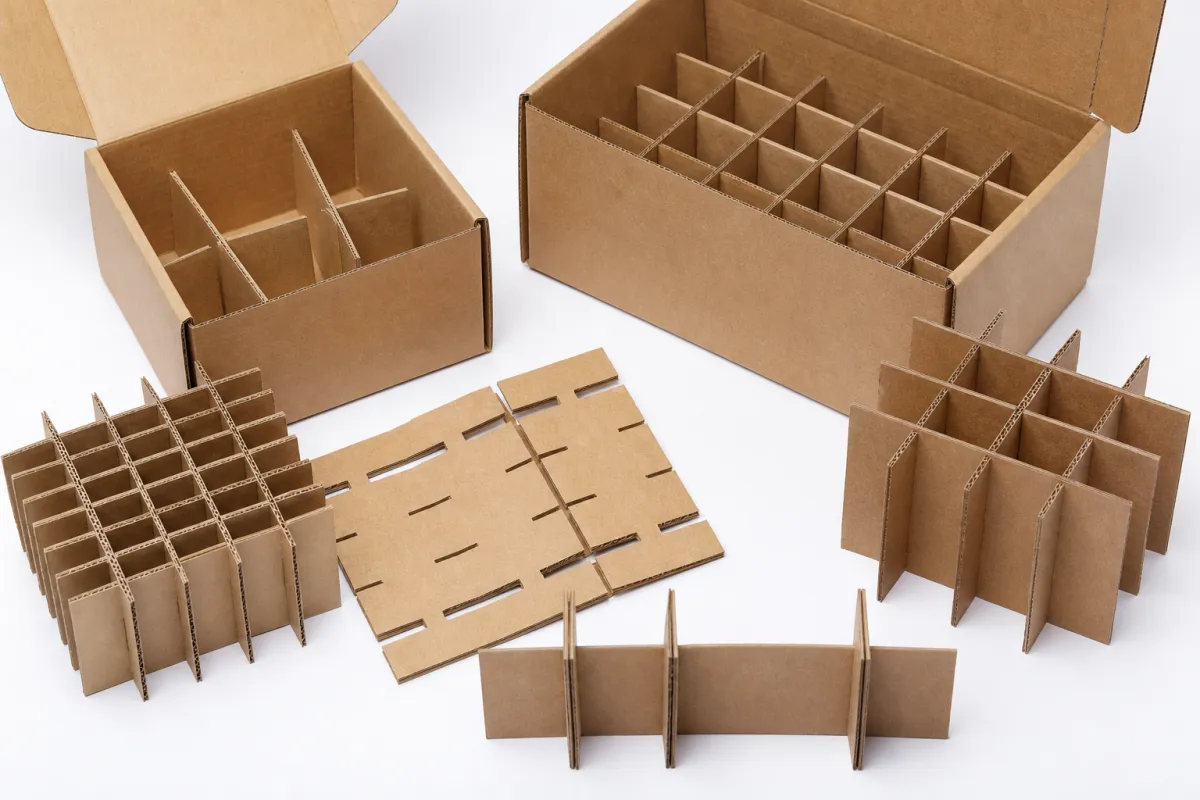
Custom cardboard dividers for boxes are sheet-based or die-cut partitions that keep products separated inside a carton, tray, or mailer. Think of them as a simple physical system that gives each item its own lane. The divider grid can be made from corrugated board, paperboard, or recycled board, depending on product weight, fragility, and how rough the shipment is likely to get.
Picture the trip a box takes after it leaves the warehouse. It gets stacked, shifted, dropped, and bounced around by people who are not thinking about your product. One loose item hits another. Maybe it is glass. Maybe it is a cosmetic jar with a cap that should not be tested by gravity. Maybe it is a small electronic part that hates movement. That is where custom cardboard dividers for boxes start earning their keep. They reduce contact, cut scratches, and keep products from smashing together in transit.
The use cases are wide. I see divider inserts used for glass bottles, candles, cosmetics, food jars, telecom parts, subscription kit contents, and mixed-item e-commerce boxes. They also improve presentation for branded packaging. A box with clean internal partitions feels intentional. A carton full of loose fill does not. Customers notice structure even when they never say it out loud.
There is a cost angle that gets ignored too often. Custom cardboard dividers for boxes can reduce your need for void fill, foam, or oversized cartons. That lowers material spend, sure. It can also improve cube utilization, which affects freight efficiency. If you ship at scale, a divider that saves a few cubic inches per order starts turning into real money fast.
A divider is not "just cardboard." It changes damage rates, pack speed, freight density, and unboxing quality in one move.
If you are building a complete packaging system, the divider is one piece of the larger packaging design. It should work with the box, the product, and the print strategy. That is why many brands pair Custom Packaging Products with Custom Shipping Boxes instead of treating inserts like an afterthought.
How Custom Cardboard Dividers for Boxes Work
The basic structure is not complicated. Most custom cardboard dividers for boxes use intersecting slots cut into flat sheets. The slots lock the sheets together and form cells, usually in a grid. A 2 x 3 layout gives you six compartments. A 4 x 4 layout gives you sixteen. The goal is simple: keep items separated without wasting packing space.
Fit is where the real work happens. Dividers need enough clearance for fast packing, but not so much room that items rattle around. If the cell is too tight, operators are gonna fight the insert and risk damaging the product during loading. If it is too loose, the whole idea falls apart. In practice, I usually expect the cell to leave a small buffer around the product, often around 1 mm to 3 mm per side for rigid items, and more for irregular shapes. That tolerance depends on the carton style, the product finish, and whether the shipment is local or long-haul.
There are a few common formats. Full-grid inserts divide the entire box interior into equal cells. Half-depth inserts support taller products without wasting material. Removable panels help with mixed sets. Modular layouts can be adjusted for odd shapes like bottles with shoulders, jars with lids, or electronics with protrusions. The better custom cardboard dividers for boxes are built around the actual product footprint, not a nice-looking drawing that falls apart the minute real product shows up.
For shipping performance, the payoff is clear. Less movement means less abrasion and lower crush risk. It also means better stack stability. A carton with a solid divider structure holds its shape more consistently than one that depends on loose void fill alone. That matters for warehouse handling, freight stacking, and the customer's first impression after opening the box.
Packaging engineers care about divider layout for a reason. Geometry does as much work as material. A smart layout can allow lighter board. A sloppy layout can ruin a heavy board. Custom cardboard dividers for boxes are a structural solution first and a material choice second. That distinction matters more than most spec sheets admit.
Key Factors That Affect Performance and Cost
Material choice is the first cost lever. Single-wall corrugated is common for everyday shipping, especially for lighter products or short transit lanes. Paperboard works for lighter retail kits, presentation packaging, and lower-load applications. Recycled board can be a smart option when sustainability matters, but stiffness and crush resistance still need to hold up. For heavier or fragile goods, custom cardboard dividers for boxes may need a stronger corrugated spec, especially if the carton is stacked in a warehouse or shipped cross-country.
Cheap material is not cheap if it fails. Saving two cents on a divider that drives breakage, customer complaints, and replacement shipments is a classic false economy. I have seen buyers chase the lowest unit price, then pay for it through a spike in returns. That is not savings. That is a later invoice, just wearing different shoes.
| Divider Material | Best For | Typical Thickness | Cost Signal | Practical Notes |
|---|---|---|---|---|
| Single-wall corrugated | General shipping, medium-weight items | About 1/16 in. to 1/8 in. | Usually the lowest mid-volume option | Good balance of protection and price for many custom cardboard dividers for boxes |
| Paperboard / chipboard | Light products, retail kits, presentation sets | Roughly 14 pt. to 28 pt. | Low material cost, but less crush resistance | Works best when the box is not carrying much vertical load |
| Recycled rigid board | Sustainability-focused programs | Varies by supplier | Moderate, depending on fiber content and finish | Can be a strong fit for recyclable product packaging |
| Heavy corrugated or reinforced board | Fragile, heavy, or stacked shipments | 1/8 in. and up | Higher unit cost, better protection | Useful for glass, jars, and electronics with extra movement risk |
Design complexity also changes price. More cells mean more cutting, more waste, and more labor. Irregular die-cut shapes push tooling costs up. Print can change the equation too. If you need logos, instructions, or color coding, the divider becomes part of the broader packaging design system. That can make sense for branded packaging, but it should earn its place. Not every internal insert needs to look like a billboard.
Order quantity matters a lot. At 1,000 units, the per-piece price can look annoyingly high because setup, tooling, and proofing are spread across fewer parts. At 5,000 or 10,000 units, unit cost usually improves. For a simple divider set, rough production pricing often lands around $0.18-$0.35 per unit at moderate volumes, while more complex die-cut or thick-board builds can run higher. That is a range, not a promise. Print coverage, board grade, and shipping location all move the number.
Transit conditions should not be ignored. Humidity can soften lighter board. Long-distance freight increases the chance of compression and vibration damage. Temperature swings can affect glue lines and paper behavior in mixed-material systems. If your product travels through hot trailers, damp warehouses, or multiple handoffs, custom cardboard dividers for boxes need a sturdier spec than a local-delivery kit would.
There is also a standards angle. For distribution testing, teams often look at ISTA protocols, such as drop and vibration procedures, to confirm packaging performance. For compression, ASTM methods like D642 are often referenced in packaging testing workflows. If sustainability is part of the brief, FSC-certified fiber options can support sourcing goals, and the FSC system is documented at fsc.org.
Ordering Custom Cardboard Dividers for Boxes: Process and Timeline
The ordering process is usually simple, but only if you hand over the right inputs. A supplier will typically need the product dimensions, the box interior dimensions, product weight, item count per carton, expected shipping environment, and target quantity. If you want custom cardboard dividers for boxes that actually fit, send interior measurements, not the outer carton size. That mistake still shows up all the time, and it wastes days.
Sampling should happen early. A flat dieline is useful, but a physical prototype tells you more. Does the product slide in cleanly? Does the operator have to wrestle the insert? Does the carton close without bulging? A prototype can answer those questions before production starts. For fragile items, I would test with real filled product, not empty mockups. Real weight changes everything.
Lead time depends on complexity. Straightforward custom cardboard dividers for boxes with simple slotting can move from proof to production faster than custom die-cut layouts with print or special board requirements. A clean project might take roughly 7 to 12 business days from approval to shipment. More custom projects, or jobs that need revisions and tooling, can stretch to 2 to 4 weeks. Freight is separate. If you are on a tight launch schedule, build that in before you promise a ship date to the customer.
Here is the usual production sequence:
- Gather specifications and confirm measurements.
- Review structural options and board grades.
- Create a dieline or prototype.
- Test fit with actual product samples.
- Approve the final version.
- Run production, pack, and ship.
That sounds basic because it is basic. The hard part sits in the details. Packaging buyers often assume the first drawing is the final drawing. It usually is not. One small adjustment in cell width can change pack speed, carton fit, and product protection. That is why custom cardboard dividers for boxes benefit from a sample review instead of a purely digital sign-off.
If the divider is part of a wider packaging program, ask how it fits with custom printed boxes, inserts, and outer shipper sizing. A package branding system works best when the inside and outside are designed together. If the box is too large, the divider has to work harder. If the box is too tight, the whole pack slows down. That is where Custom Packaging Products and Custom Shipping Boxes often get specified together.
From a buying standpoint, compare quotes carefully. One supplier may offer a lower unit price but charge more for setup or revision work. Another may include sample support but require a larger minimum order. A fair comparison looks at board grade, tooling, lead time, minimums, and whether the supplier actually helps with fit testing. That is the difference between a quote and a useful quote.
Common Mistakes When Specifying Box Dividers
The biggest mistake is measuring the product and forgetting the box. Custom cardboard dividers for boxes must fit the inside dimensions of the carton, including board thickness, fold lines, and any internal clearance needed for loading. Buyers often send a product size only, then wonder why the finished divider is too tight. The carton does not care what the product measures on a spreadsheet.
The second mistake is choosing the wrong board grade. Too thin, and the divider collapses or bows under load. Too thick, and the pack becomes hard to load, or the box loses usable interior space. A heavier board can help with crush resistance, but only if the carton can still close correctly. This is where realistic product testing matters more than theory.
Another trap is overcomplicated cell layouts. More cells are not automatically better. If the product is bulky, asymmetrical, or easy to scuff, a dense grid can create packing friction without adding much protection. In some cases, a simpler divider with wider cells works better than a fancy layout that slows operators down. Custom cardboard dividers for boxes should help the packing line, not annoy the people running it.
Environmental conditions get ignored too often. A divider sample that looks perfect in an air-conditioned office can behave differently in a humid warehouse or a long-haul truck. Paper-based materials are not magic. They absorb moisture, lose stiffness, and change behavior under pressure. If your shipment routes through mixed climates, ask for testing that reflects those conditions.
Then there is the classic "we will add void fill later" habit. Maybe. But void fill is not the same as structure. Loose fill can stop minor movement, but it does not create the same cell-by-cell control that custom cardboard dividers for boxes provide. If breakage is expensive, relying on filler alone is a gamble dressed up as cost control.
Some teams approve a design without checking pack speed. A divider that performs perfectly but takes twice as long to load can still hurt your operation. Packaging is not only about protection. It is about labor, throughput, and consistency. If the insert slows the line, the math may still fail. No one likes that answer, but there it is.
Expert Tips for Better Protection and Lower Waste
Test with actual filled product. That is the rule I trust most. CAD drawings help, but they do not show how labels snag, how caps press against board, or how much a product shifts once it has weight. With custom cardboard dividers for boxes, the real world always gets a vote. It usually speaks louder than the drawing.
Standardize where you can. If three SKUs can share one divider footprint with only a small insert change, you reduce tooling complexity and inventory headaches. A little design discipline can save a surprising amount of money over time. It also helps if your team is trying to simplify branded packaging across multiple product lines.
Sustainability should be practical, not performative. Choose recyclable board where it makes sense. Avoid mixing plastic and paper components unless the product really needs it. Keep the structure flat-pack friendly when possible. Flat shipments reduce freight volume and warehouse space. For most buyers, that matters more than a glossy sustainability claim on a spec sheet.
Run a few real checks before you lock the design:
- Drop testing: confirm the divider protects products at the drop heights that match your distribution profile.
- Compression checks: make sure the carton and divider can handle stacking pressure.
- Packing-speed tests: time how long one worker takes to load a full carton.
- Inspection checks: review edge crush, cut quality, and slot fit before a large run.
Those checks are not glamorous. Good packaging rarely is. But they help you avoid expensive surprises. A design that passes a fit test and fails under load is not a success. It is a postponed problem. Same bill, later date.
Another practical move: ask for board specs in plain language. If someone offers custom cardboard dividers for boxes, ask what the caliper, basis weight, or fluting style actually is. Ask whether the board has recycled content. Ask whether the cut edges are clean enough for frequent hand packing. The answers tell you more than a vague promise about "premium quality."
One more thing. Do not design the divider in isolation. The box, product, and insert should be developed as a set. If the outer shipper is overbuilt, you may be able to reduce divider thickness. If the product is fragile and high-value, you may need a stronger divider plus a better outer carton. The best result usually comes from balancing all three parts instead of treating each one as separate.
What to Do Before You Order Custom Cardboard Dividers for Boxes
Before you place an order for custom cardboard dividers for boxes, gather the basics: box interior dimensions, product dimensions, product weight, number of items per carton, fragility level, and the shipping environment. If the product is glass, liquid-filled, coated, or otherwise delicate, say so early. That tells the supplier what level of protection the divider needs to deliver.
Then define the business target. Are you trying to cut breakage, improve presentation, lower void fill usage, or simplify pack-out? A divider can do all four, but not equally well in every case. If you know the goal, you can make better tradeoffs. If not, you will end up arguing about board thickness without solving the actual problem.
Send clear questions to the supplier. Ask about expected unit cost at your volume, minimum order quantity, sample availability, lead time, storage conditions, and whether the design can be reused for other SKUs. If you are buying custom cardboard dividers for boxes for a multi-SKU program, mention that. A good supplier will look for standardization opportunities instead of forcing every SKU into a unique setup.
Use quote comparison as a quality filter, not just a price hunt. The lowest number may exclude samples, revision support, or a stronger board grade. A slightly higher quote may save you from reorders and damage claims. That is why the real comparison is not unit price alone. It is unit price, lead time, material spec, and whether the supplier can deliver a fit That Actually Works.
It also helps to connect the divider project to the rest of your packaging plan. If you need product packaging that supports retail presentation, shipping efficiency, and package branding, the divider should be part of the same brief. That may mean combining inserts with Custom Packaging Products or tying the spec to Custom Shipping Boxes so everything fits together instead of fighting each other.
My practical recommendation is simple. Measure carefully, request a prototype, test it with real product, and only then approve full production. Custom cardboard dividers for boxes are not hard to buy, but they are easy to spec badly. The difference between a solid divider and an expensive mistake is usually just a few careful steps at the start.
Custom cardboard dividers for boxes work best when they are treated as a structural part of the package, not a last-minute insert. Get the size right, Choose the Right board, test the fit, and check performance under real shipping conditions. If you do that, custom cardboard dividers for boxes can reduce damage, improve presentation, and keep your packaging system lean instead of padded with extra filler. That is the point.
FAQ
How do I choose the right size for custom cardboard dividers for boxes?
Measure the inside of the box, not the outer carton. Then leave just enough clearance for easy loading without giving the product room to shift. For fragile goods, test the fit with actual samples before approving the final custom cardboard dividers for boxes.
What affects the price of custom cardboard dividers for boxes?
Material grade, divider thickness, cell count, and die-cut complexity are the main drivers. Print requirements can push the price higher, too. Larger order volumes usually lower the unit cost for custom cardboard dividers for boxes, especially when the design is simple and repeatable.
How long do custom cardboard dividers for boxes take to produce?
Simple designs can move faster than heavily customized layouts. Sampling, revisions, tooling, and approval all add time. A straightforward run of custom cardboard dividers for boxes may move in about 7 to 12 business days after approval, while more complex jobs often need a longer schedule.
Are custom cardboard dividers for boxes recyclable?
Yes, if they are made from paper-based board without heavy plastic coatings or mixed materials. Recycled and mono-material options are usually the easiest to recycle. If recyclability matters, keep the structure of custom cardboard dividers for boxes as simple as possible.
Can custom cardboard dividers for boxes handle fragile products like glass or cosmetics?
Yes, but the divider thickness and cell fit need to match the product weight, shape, and shipping route. Fragile items usually need tighter tolerances and stronger board. For glass, cosmetics, or premium retail kits, prototype and drop-test custom cardboard dividers for boxes before you scale up.

