Custom Care Labels for Clothing: Order Durable Labels
Custom care Labels for Clothing do more than state washing instructions. They sit inside the garment long enough for a customer to notice whether the brand paid attention to detail. If the label is scratchy, twists after washing, or uses cramped text that becomes unreadable once sewn, the clothing starts to feel less finished.
For brands that care about presentation, the care label should be treated as part of the product itself, not as a late-stage compliance item. It sits alongside hangtags, folding, tissue, and cartons in the customer’s first impression. If you are also ordering Custom Labels & Tags or pairing them with Custom Packaging Products, the label needs to match the same visual and quality standard as the rest of the line.
Why care labels matter more than most brands expect
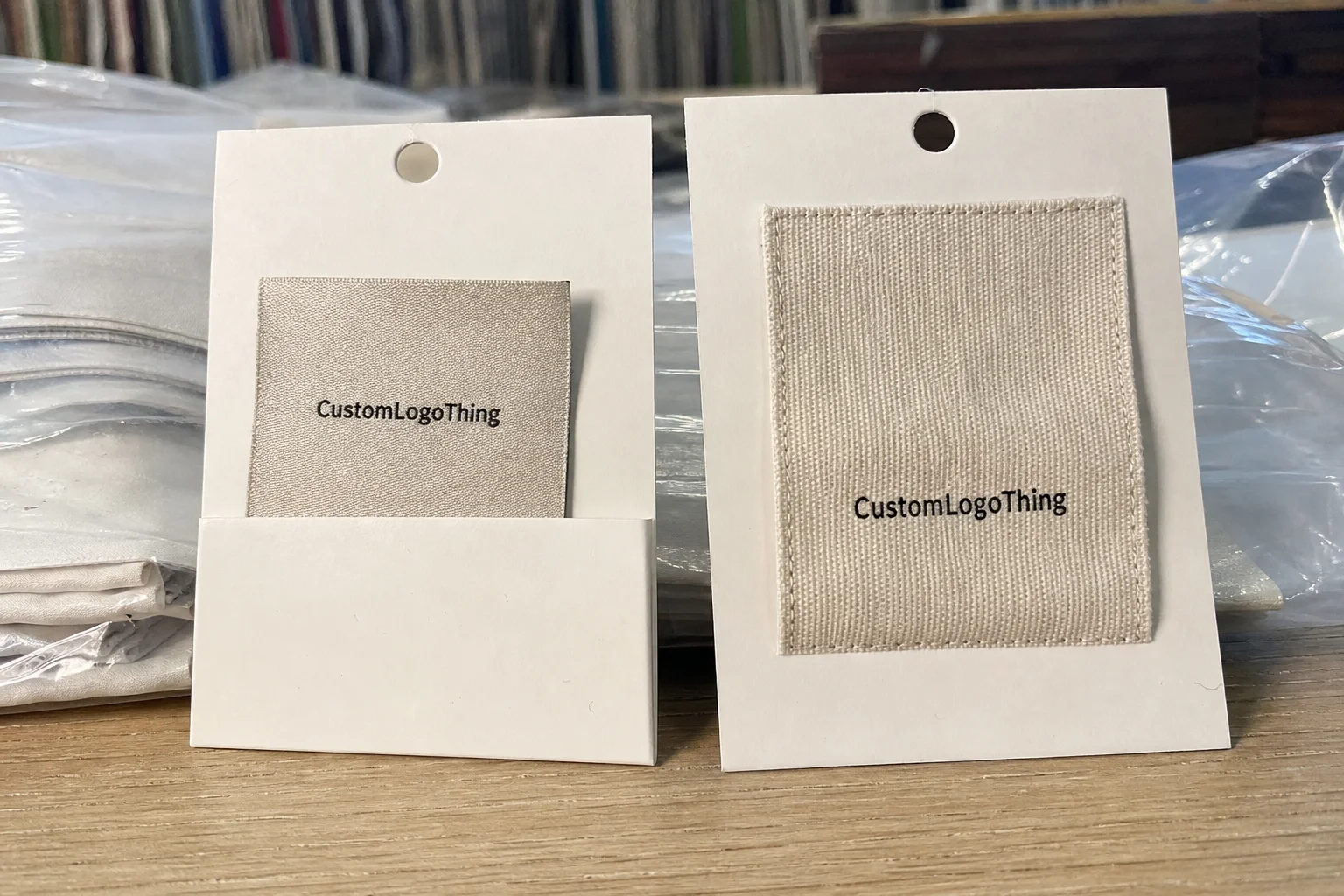
The smallest sewn-in component often gets the least attention, yet it is one of the first things a customer feels against the skin. A soft tee can still seem poorly made if the label is stiff or noisy. A premium hoodie can lose value if the care instructions rub the neck or curl after one wash cycle.
Custom care Labels for Clothing also carry real functional weight. They tell customers how to wash the item, what the fiber content is, where it was made, and, in many markets, what regulatory language must appear. In the United States, fiber content and origin information need to be accurate. Many brands also use ISO 3758-style care symbols because they reduce confusion across regions and customer groups.
The label is not the hero of the product, but it is a key proof point. A garment can have good fabric and clean stitching, yet still feel unfinished if the interior details look improvised. That is why buyers should treat the care label as a product decision, not an afterthought.
How custom care labels for clothing are made
The process starts with content, not production. Before anyone chooses material, the artwork needs a clean review: fiber content, care symbols, country of origin, brand name, size details, and any required legal copy. If the information is incomplete, the order slows immediately.
After the content check, the next step is material selection. Woven labels are built from yarns and feel more dimensional. They tend to suit premium apparel and brands that want a refined interior finish. Printed satin gives a smoother face and is common on softer garments. Nylon is a practical option for durability and price control. Cotton feels natural and fits heritage or organic positioning. Heat-transfer labels sit directly on the fabric and are often chosen when the brand wants the cleanest possible interior without a folded edge.
Cutting and folding come next. Labels are usually finished to size and then folded to match placement. A center fold works well in a neck seam. End folds are common for side seams or hems. Loop folds give more visible label surface in a tighter space. Straight-cut labels are often sewn on all sides or used where the edge will be enclosed.
Attachment method matters just as much as material. Sewn-in labels remain the most common choice because they survive repeated laundering and work on most garment weights. Heat-applied options can speed application on some product lines, but they are not right for every fabric. Stretch knits, brushed fleece, heavily textured fabrics, and washed-down garments all behave differently, so the attachment should match the textile rather than the artwork.
Materials, finishes, and attachment choices that change the result
The key question is not which label type is best in general. It is which one fits the garment, the customer, and the wash cycle the product will face. A premium fleece hoodie, a toddler tee, and a performance legging need different answers. The wrong label may survive laundry, but if it scratches, bunches, or twists, customers will cut it out.
Here is a practical comparison of the options buyers ask about most often:
| Label type | Hand feel | Wash durability | Best fit | Typical unit cost at 5,000 pieces |
|---|---|---|---|---|
| Woven damask | Soft but structured | Very high | Premium apparel, denim, outerwear | $0.18-$0.35 |
| Printed satin | Smooth and light | High | Fashion basics, soft knits, interior branding | $0.10-$0.22 |
| Nylon | Light, slightly crisp | High | Uniforms, kidswear, value lines | $0.08-$0.18 |
| Cotton | Natural, matte | Medium to high | Organic, heritage, lifestyle apparel | $0.12-$0.28 |
| Heat transfer | No sewn edge | High when applied correctly | Activewear, minimalist interiors, lightweight garments | $0.12-$0.30 |
Fold style changes both usability and appearance. A center fold is compact and clean, which is why it shows up often in neck seams. End folds are easier to secure where the label should sit flat on the seam allowance. Loop folds give more label surface in a tighter space. Straight-cut labels can work well on outerwear or when the edge is hidden inside the construction.
Print clarity is another place where production and design can diverge. Fine text on a black label may look sharp on screen and turn muddy in production if contrast is too low. A woven label can feel more premium, but the weave cannot carry tiny legal text as cleanly as a printed format. Heat transfer solves some of that, but it depends on the fabric surface and how much stretch the garment has.
For activewear and children’s apparel, comfort usually matters more than decoration. For premium fashion, finish and feel often carry more weight. The best suppliers will talk in those terms because that is how the garment will be judged in the real world.
Production steps and turnaround: from proof to delivery
The production path is standard, but delays usually show up at the handoff points. It starts with artwork review and content verification. Then comes digital proofing, where the supplier confirms size, folds, spacing, type placement, and any legal copy. If the proof is clean, sample approval can move quickly. If the buyer has to chase wording, measurements, or symbol placement, the schedule slips before the run even begins.
Once the proof is approved, production moves into printing or weaving, followed by cutting, folding, inspection, packing, and shipping. Simple runs with straightforward copy are often completed in about 12 to 15 business days after proof approval. Larger quantities, specialty folds, metallic threads, custom edge treatments, or multi-language layouts can add several more days.
The fastest orders are the ones where the buyer has already answered the hard questions. Is the fiber content final? Are care symbols required? Does the brand want the same label for every colorway, or does each style need its own line? A clear spec sheet shortens every step because the production team is not guessing.
Quality checks should happen before shipping, not after a customer finds a problem. Reputable suppliers inspect text alignment, cut accuracy, fold consistency, and color repeat. If a supplier offers sample runs, use them to test actual wear behavior. Sewing one label into a real garment tells you more than a flat proof ever will.
Cost, pricing, and MOQ: what changes your quote
Most buyers want the same thing here: a price that makes sense without cutting corners on comfort or compliance. The main drivers are straightforward. Quantity matters first, because setup costs are spread across the run. Material choice comes next. Woven damask typically costs more than printed nylon. Number of colors matters too, especially for woven construction. Fold style, edge finish, and attachment method all change labor time and tooling.
Minimum order quantity, or MOQ, is another point that catches people off guard. Smaller runs almost always carry a higher unit price because the setup time does not shrink just because the order is small. A label that costs $0.12-$0.18 at scale may land closer to $0.22-$0.35 in a low-quantity test run. That is normal.
Compliance-heavy copy can also affect pricing. If the artwork needs multi-language care instructions, region-specific fiber statements, or revisions to meet a particular market, expect more proofing time and sometimes a setup fee. Reprints are much more expensive than careful prepress work.
When comparing quotes, ask exactly what is included. Some suppliers quote only the label itself. Others include proofs, standard shipping, and one round of revisions. A useful comparison should cover all of these:
- Setup or plate charges
- Proof count and revision policy
- Label material and fold type
- Shipping method and destination
- Reorder pricing and art file retention
That same discipline helps when comparing custom packaging products and other brand components. If the quote is vague, the final bill usually is too. A cheap headline price can hide added charges for proofs, freight, or artwork changes.
For smaller brands, the tradeoff is often between inventory risk and per-unit cost. Ordering too few labels can leave you reworking the artwork for the next batch. Ordering too many can lock cash into a design that changes next season. The sensible middle ground depends on how stable your sizing, fiber content, and compliance language are over time.
Common mistakes that cause reprints or customer complaints
The most expensive mistakes are usually the simplest ones. Wrong fiber content. Missing care symbols. Misspelled brand names. A typo in the country of origin. These are all preventable, and they all get more expensive once production starts. If a brand is moving quickly, someone needs to own the final content check instead of assuming the factory will catch everything.
Another common mistake is choosing a label that is durable on paper but unpleasant in hand. A label can pass a wash test and still fail the product because it feels scratchy enough that customers cut it out. That is especially painful on soft tees, underwear, babywear, and anything that sits close to skin.
Readability fails in smaller ways too. Tiny type, low-contrast color, and crowded layouts all become harder to read after sewing, folding, and washing. What looks fine in a mockup may look too busy on the actual garment. Good production files leave enough margin for thread, seam allowance, and the way fabric moves once it is worn.
Testing on the actual garment is not optional if the line is new. The same label can behave differently on a rib knit, a brushed fleece, a woven shirt, or a stretch blend. It can twist, curl, shrink, or sit awkwardly in the seam. A one-piece sample sewn into the real fabric tells you more than a flat proof ever will.
“If a label only looks good on the proof, it is not finished yet.”
There is one more failure mode that gets overlooked: inconsistency across reorders. A label approved in spring can come back slightly different in the fall if the supplier changes thread, print density, or trim stock. Reorder files should preserve the exact size, fold, color reference, and placement notes.
Next steps before you place your order
Start with a clean spec sheet. Include garment type, label size, placement, fiber content, wash instructions, language requirements, fold preference, and any branding notes. If the line has multiple colors or versions, make that clear from the beginning.
Ask for a proof that shows the exact layout, not just the wording. You want to see where the fold lands, how much space the text uses, and whether the label will sit properly in the seam. If the supplier offers a sample material pack, request one before locking the order, especially if you are deciding between softness and durability.
Save approved artwork, approved measurements, and color references in one place so future runs stay stable across seasons. Compare suppliers on process, not just headline price. Material range, proofing discipline, turnaround, MOQ, and reprint policy matter more than a small difference in unit cost.
What information should custom care labels for clothing include?
At minimum, include fiber content, care instructions, and the brand name. Depending on the market, you may also need country of origin, size details, and specific regulatory language. The layout should stay readable after sewing and washing, not just look good on a proof.
Which material is best for soft garments and activewear?
Printed satin, soft nylon, and heat-transfer labels are common choices when comfort matters most. Woven labels can still work well, but the texture should not feel scratchy against the skin. The best option depends on the fabric stretch, wash cycle, and where the label will be placed.
How long does production usually take for care labels?
Simple runs often move in about 12 to 15 business days after proof approval, provided the artwork is complete. Special folds, custom finishes, and larger quantities usually add time. The fastest way to avoid delay is to approve a clean proof and confirm placement before production starts.
What affects the cost of custom care labels for clothing the most?
Quantity, material, print or weave method, and fold style are the biggest pricing drivers. Setup, proofing, and shipping can also affect the final quote. Smaller orders usually cost more per unit because fixed production steps are spread across fewer labels.
How do I avoid mistakes before ordering care labels?
Check the garment content, care symbols, and spelling before proof approval. Test one sample on the actual garment fabric to confirm comfort and visibility. Make sure the label size and fold work with the seam location you plan to use.


