Custom Care Labels are small, but they are carrying three jobs at once: compliance, comfort, and brand presentation. That is a lot to ask from a strip of woven tape or printed satin, which is why bad labels are so easy to notice and so hard to ignore. A scratchy label can make a well-made garment feel unfinished. A clear, soft, well-placed one does the opposite. It disappears in use, which is usually the point.
For buyers, the label is not an accessory. It is part of the garment’s working system, alongside the stitching, the fabric weight, and the retail packaging. If the inside label feels careless, customers often assume the rest of the product was handled the same way. That judgment happens fast, and it is rarely generous.
The practical side matters just as much as the brand side. A poor spec can slow production, trigger reprints, or create compliance problems after the run has already started. Most of those headaches are avoidable with tighter artwork, clearer copy, and a better sense of what the material actually needs to survive.
What custom care labels actually do on a garment
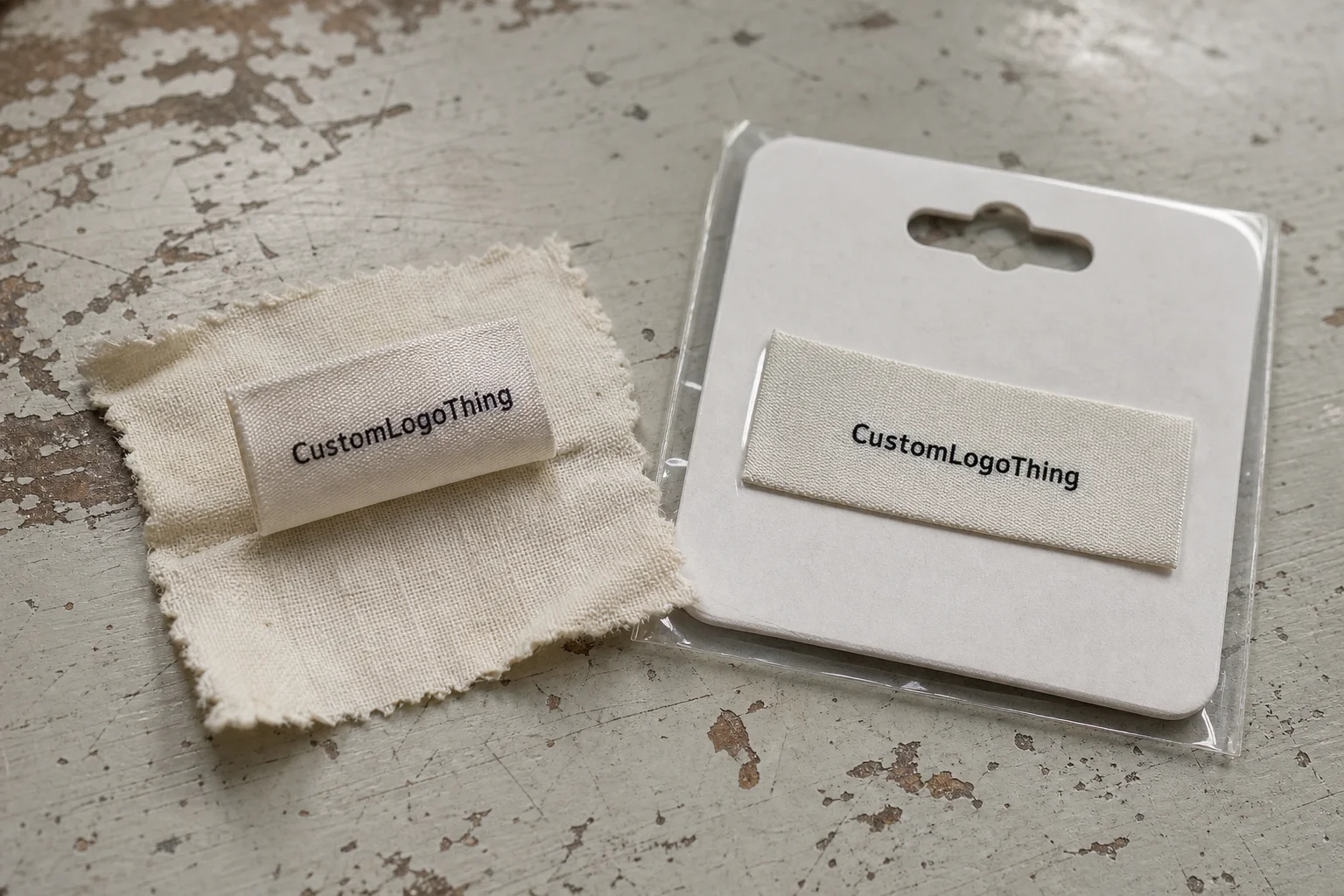
Custom Care Labels do more than sit inside a seam and list washing instructions. They identify the brand, state fiber content, show care symbols or text instructions, and often include country of origin. In some markets, they also need importer details, multilingual copy, or product codes. That means the label is a legal object and a user-experience object at the same time.
A garment can be cut and sewn well, yet still feel cheap if the label is stiff, noisy, or badly positioned. The reverse is also true. A basic tee can feel more considered when the label is soft, legible, and matched to the brand tone. Customers do not separate “label quality” from “garment quality” very neatly. They just experience the result.
- Brand ID: the label signals who made the product and how it should be perceived.
- Compliance: fiber content, care instructions, and origin data keep the item saleable in the intended market.
- Comfort: substrate choice, edge finish, and placement influence whether the label gets cut out.
- Care support: clear instructions reduce avoidable damage and returns.
A label that looks clean in a mockup can still fail in hand. The customer does not wash the proof file.
That is why labels should be treated as part of the broader packaging system, not a separate task. The tone should match your hangtags, your Custom Labels & Tags, and any Custom Packaging Products used for retail presentation. If the outer package says premium and the inside label looks like a rushed afterthought, the brand story loses credibility.
There is also a supply-chain angle. A missing fiber content line or a late compliance edit can hold a shipment, and a bad seam placement can force rework on the sewing line. In other words, the label affects operations before the customer ever sees it. That is one reason experienced apparel buyers spend more time on specs than on visual mockups alone.
Production steps: from spec sheet to sewn-in label
The cleanest orders start with a complete brief. A supplier needs the label size, material, print method, fold type, placement, quantity, and exact text. “Make it soft” is not a spec. It is a preference, and preferences are not enough to generate a repeatable production run.
The typical workflow is straightforward: brief, artwork cleanup, digital proof, sample approval, production, finishing, and shipment. The weakest point is the handoff between design and manufacturing. That is where missing compliance copy, unclear dimensions, or unreadable type sizes usually surface.
What happens between brief and delivery
A digital mockup shows layout and wording. It does not prove hand-feel, wash durability, or how the fold behaves once sewn into a seam. A physical sample is the first real test of texture and finish. A pre-production approval sample is the final checkpoint before the full run, and it should match the planned substrate and construction as closely as possible.
Lead times vary more than buyers like to admit. Straight reorders can move in roughly 5 to 8 business days after approval. New custom care labels usually take 10 to 18 business days, and more complex weaving, folding, or edge finishing can extend that further. Shipping time is separate. That sounds obvious until a launch timeline depends on it.
The most common bottlenecks are repetitive because they are predictable:
- Artwork arrives with missing compliance text.
- The content is correct, but the file is not production-ready.
- The buyer approves the mockup without testing the label on the actual fabric.
- The size, fold, or placement changes after the sample stage.
Speed comes from reducing surprises. Suppliers can handle normal revisions. What slows things down is finding out late that the substrate is wrong for the garment or that the copy needs a market-specific correction. That is especially common on multi-country launches, where one generic label is supposed to work everywhere and, unsurprisingly, does not.
There is a buyer-side habit worth breaking: approving a beautiful mockup and assuming the job is done. Apparel is physical. Fabric stretch, seam density, and wash cycles all change how a label performs. The proof file cannot tell you that. The sample can.
Materials, size, and print method tradeoffs
The right material depends on the garment category, not on what looks expensive in a sample book. A heavyweight hoodie can tolerate more structure than a thin jersey tee. Babywear needs softness first. Activewear usually needs low bulk and a surface that survives repeated laundering. Workwear needs durability more than delicacy. One substrate rarely serves all four well.
| Option | Hand-feel | Durability | Typical use | Rough unit cost at moderate volume |
|---|---|---|---|---|
| Woven damask | Soft to medium, depending on weave density | Very good | Brand-forward apparel, outerwear, premium basics | $0.08-$0.16 |
| Satin printed | Smooth and light | Good | T-shirts, fashion tops, linings | $0.04-$0.09 |
| Cotton printed | Natural, soft, slightly textured | Good to very good | Eco-minded brands, casualwear, children’s apparel | $0.06-$0.12 |
| Tyvek | Flat, light, slightly paper-like | Excellent | Workwear, outdoor gear, utility items | $0.05-$0.11 |
| Heat-transfer style label | Lowest bulk | Good if the inks and process are solid | Babywear, activewear, skin-sensitive garments | $0.07-$0.15 |
Printed Care Labels are usually the softest and thinnest, which makes them a strong fit for lightweight garments and skin-sensitive products. Woven labels tend to read as more premium and hold their structure well, but they add bulk. Tyvek is the functional choice when durability matters more than softness. It is not glamorous. Neither is a label that frays or fades after a few wash cycles.
Size and readability
Too small, and the label becomes a squint test. Too large, and it turns into a stiff flap inside the garment. Many care labels fall between 0.5 inches and 1 inch in height and 2 to 4 inches in length, depending on how much information has to fit. If the text drops below about 6 pt equivalent, readability starts to degrade quickly.
Size should also track the garment category. A lightweight tee does not need the same label structure as a heavyweight sweatshirt. Baby items should prioritize softness and low irritation. Technical outerwear can tolerate a more durable substrate. That is why custom care labels should be specified alongside the garment itself, not after the collection has already been approved.
Print method matters, but not in the abstract. Buyers should care about contrast, ink stability, and wash resistance more than the catalog name of the process. If the label will be washed repeatedly, ask for wash testing rather than trusting a polished sample sheet. A label can look crisp on day one and fail after five cycles if the process or substrate is wrong.
For brands that also use recycled paper stock or paper-based inserts, keep the sustainability story consistent. If claims are being made, they need to be supportable. References such as Packaging and the broader packaging industry and FSC can help frame material choices, but they do not replace product-level verification.
The label should also sit comfortably inside the wider package system. If the hangtag, garment bag, and custom printed boxes all follow one visual language, the care label should not break the rhythm. A brand loses polish surprisingly fast when the inside details feel disconnected from the outside presentation.
Cost, MOQ, and unit price: what drives the quote
Label pricing is usually driven by material, print complexity, size, finishing, quantity, and handling. Folding, cutting, heat sealing, sewing, and special edge treatments all add labor. More labor means more cost. That is the unromantic part of the business, but it is also the part that determines whether the quote is realistic.
The mistake many buyers make is comparing only unit price. A cheap number on paper can hide setup charges, artwork cleanup, freight, or rework. A quote that looks 20% lower may be more expensive once the supplier adds the items that should have been disclosed from the beginning.
MOQ ranges are usually straightforward. Simple printed labels may start around 500 to 1,000 pieces. Woven or more customized labels often sit closer to 1,000 to 3,000 pieces. Higher quantities usually lower the unit price because setup cost gets spread across more pieces, but they also increase inventory risk if the artwork changes later.
For custom care labels, it is better to think in tiers than to chase one perfect unit cost.
| Spec tier | What changes | Best for | Typical risk |
|---|---|---|---|
| Basic printed | Single or two-color print, standard fold, limited finishing | Fast replenishment, tight budgets | Lower perceived value if the garment is premium |
| Mid-tier branded | Better substrate, cleaner finishing, stronger print contrast | Most retail apparel | Needs careful proofing to avoid copy errors |
| Premium comfort-focused | Soft material, low-bulk construction, refined edge finish | Babywear, athleisure, skin-sensitive apparel | Higher unit cost and longer lead time |
There is a simple test for quote quality. If one supplier is a few cents cheaper but hides setup or testing charges, the quote is not actually cheaper. The label may also cost more later through returns, relabeling, or damaged perception. At apparel scale, three cents feels tiny until it is multiplied by 50,000 units and tied to a customer complaint rate. Then it stops being tiny.
Common mistakes that create scratchy tags and reprints
The usual mistakes are ordinary, which is why they keep happening. The first is choosing the wrong hand-feel. The second is using artwork that reads clearly on a monitor but turns muddy in print. The third is forgetting compliance copy until the production window is already tight. None of these are exotic failures. They are process failures.
Here is the short list that comes up most often:
- Wrong fabric feel: a stiff label stitched into a lightweight tee will get cut out.
- Unreadable text: tiny copy and weak contrast make the label hard to use.
- Missing compliance data: fiber content, origin, or required language is incomplete.
- Bad placement: a technically correct label still feels awful in the wrong seam.
- No sample approval: the buyer assumes the proof is enough and skips the physical test.
Regional requirements add another layer. If garments ship into multiple markets, label copy often needs to change by destination. Fiber content wording, country-of-origin lines, language formatting, and importer details can all vary. That is the kind of issue that appears late, usually after the launch calendar is locked and the team is least prepared to absorb a change.
A label can pass art approval and still fail on the body. If the stitch point lands in a sensitive seam, the customer notices immediately.
Skipping sample approval is expensive in a quiet way. It looks efficient until the first wash test or first customer complaint. Buyers who run cleaner apparel programs usually test custom care labels on the actual fabric, not just as a flat layout. The garment matters. The mockup does not get worn.
There is also a packaging-side mistake that shows up a lot: making the outer package feel intentional while leaving the inner label generic. That disconnect is easy to spot once you know to look for it. The customer may not name it, but they feel it.
Expert tips for cleaner specs and faster approvals
Build one page for the label brief and keep it complete. Include size, placement, material, print method, fold or cut style, quantity, exact copy, and whether the label should be soft-edge, tear-away, or sewn-in. If that sounds basic, good. Basic is what keeps production moving.
Approve the text before you obsess over layout. A typo in fiber content is worse than a color mismatch. A missing country of origin line is worse than slightly off logo spacing. Content errors are the ones that trigger slow, expensive revisions.
Order a small test run whenever you change fabric, finish, or garment category. A label that works on a structured hoodie may feel wrong on a thin tee. A substrate that behaves well in isolation can become irritating once it is sewn into a lightweight seam. That gap between “looks fine” and “feels fine” is where many label problems hide.
For brands building a wider package system, keep the label aligned with the rest of the presentation. That means the same copy discipline used in packaging design, the same tone used on retail packaging, and the same overall quality standard you expect from hangtags or branded inserts. If you need both labels and packaging in the same program, it is easier to manage the process through one coordinated brief than to assemble pieces from different sources later.
That is where Custom Labels & Tags and the rest of the packaging stack should speak to each other. If the box feels premium, the label should not feel like an afterthought.
The fastest approval path is usually the least dramatic one: send clean artwork, confirm compliance copy, and ask for the proof type that matches the risk. A digital proof is fine for layout. A physical sample is the safer route for anything that will be worn against skin or washed often. Custom care labels are small, but they punish sloppy spec work more than larger packaging components do.
Next steps: build a brief, request samples, and compare quotes
Start with the garment details. Pull together fiber content, target market, brand artwork, label placement, and any required legal copy before asking for pricing. If that work happens first, the quote will be useful. If it happens later, the number is mostly guesswork.
Then ask for two versions of the order: the target spec and a fallback spec. That gives you a real cost comparison instead of a fake one. Maybe the premium woven version is the right fit for the main line, while the softer printed version makes more sense for the entry-level tier. You will not know until the tradeoff is visible.
If the product will be worn against skin or washed frequently, request a physical sample or swatch set. If the brand is expanding into coordinated retail packaging, keep the label brief aligned with your broader Custom Packaging Products so the whole presentation feels deliberate rather than patched together.
A practical execution checklist:
- Gather garment specs and compliance copy.
- Choose the first-round material based on feel and wash needs.
- Confirm size, fold, and placement before proofing.
- Request a digital proof and, if needed, a physical sample.
- Compare at least two quotes with setup, freight, and finishing shown separately.
If you do those five things, you avoid most of the expensive mistakes. That is the point. Custom care labels should support the product, not become the reason a run stalls, an approval drifts, or a customer reaches for scissors before the first wash.
What information do custom care labels need to include?
Usually the essentials are brand name, fiber content, care instructions or symbols, and country of origin. Some markets also require importer details, business identifiers, or specific language formatting. If you sell internationally, the copy should be checked for each destination market before production starts.
Are woven or printed custom care labels better?
Woven labels feel more premium and hold up well for branding-heavy applications, but they are usually more expensive. Printed labels are thinner, often softer, and can be better for lightweight or skin-sensitive garments. The right choice depends on garment weight, wash frequency, and how visible the label needs to be.
How long does it take to produce custom care labels?
Simple reorders can be quick, but first-time jobs usually take longer because of proofing and sample approval. Lead time changes with quantity, material, finishing, and whether the artwork needs cleanup or compliance edits. If the labels are tied to a launch date, build in extra time for revisions and shipping delays.
What affects custom care label pricing the most?
Quantity is the biggest lever, followed by material, print complexity, fold or cut style, and finishing requirements. More colors, special coatings, or custom shapes usually increase cost and can extend production time. A quote should separate setup costs from per-piece pricing so you can compare suppliers honestly.
How do I avoid itchy or uncomfortable care labels?
Choose softer materials, reduce label size where possible, and avoid thick seams or stiff backing. Test the label on the actual garment fabric, because a soft label on paper can still feel rough once sewn in. If skin comfort matters, start with softer printed or satin custom care labels and test them on the actual fabric before placing the full order.