Buyer Fit Snapshot
| Best fit | Custom Carry Bags with Embossing projects where brand print, material claims, artwork control, MOQ, and repeat-order consistency need to be specified before quoting. |
|---|---|
| Quote inputs | Share finished size, material target, print colors, finish, packing count, annual reorder estimate, ship-to region, and any compliance wording. |
| Proofing check | Approve dieline scale, logo placement, barcode or warning zones, color tolerance, closure strength, and carton packing before bulk production. |
| Main risk | Vague material claims, crowded artwork, missing packing details, or unclear freight terms can make a low unit price expensive after revisions. |
Fast answer: Custom Carry Bags with Embossing: Film, Print, MOQ, and Carton Packing should be specified like a repeatable production item. The safest quote records material, print method, finish, artwork proof, packing count, and reorder notes in one written spec.
Production checks before approval
Compare the actual filled-product size with the drawing, then confirm tolerance on folds, seals, hang holes, label areas, and retail display edges. Reserve space for logos, QR codes, warning copy, and material claims before decorative graphics fill the panel.
Quote comparison points
Review material grade, print process, finish, sampling route, tooling charges, carton quantity, and freight assumptions side by side. A quote is only useful when the supplier can repeat the same color, closure quality, and packing count on the next order.
Custom Carry Bags with Embossing: Cost, Process, Tips
Custom carry bags with embossing change the last step of a sale. A paper bag stops acting like throwaway packaging and starts carrying part of the brand itself. That matters in premium retail, gifting, cosmetics, and any setting where the handoff is almost as visible as the product.
The effect is physical before it is visual. Fingers register a raised or recessed mark in a fraction of a second, long before a shopper has finished reading the logo. A flat printed bag can communicate. Custom carry bags with embossing can stay in memory.
Why custom carry bags with embossing feel more premium
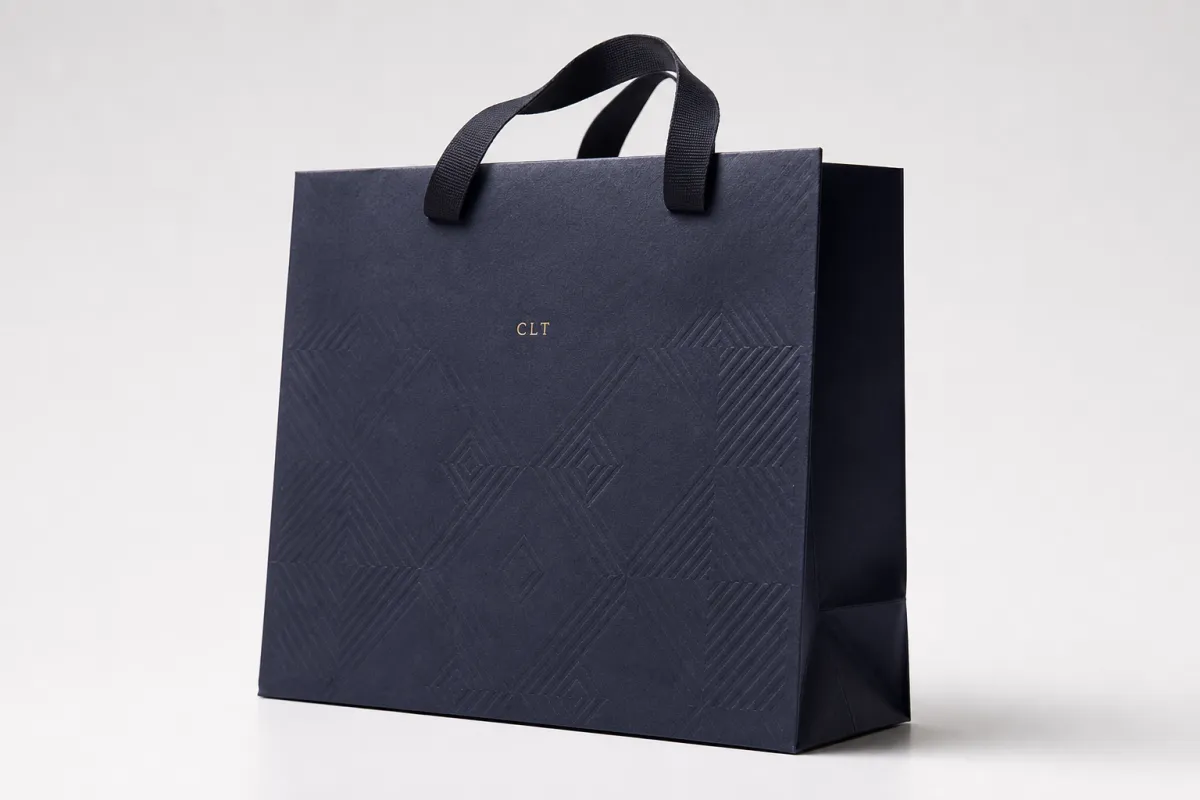
Walk past a jewelry counter, a fragrance shelf, or a bakery display with elevated packaging, and the pattern is easy to spot. Custom carry bags with embossing make the purchase feel considered. The bag stock may be plain kraft or a modest coated sheet, yet the pressed logo tells a different story. The message is not loud. It does not need to be.
Embossing raises the design above the surface. Debossing presses it inward. Both rely on pressure, die alignment, and the structure of the paper, not on ink coverage. That is one reason custom carry bags with embossing can look more expensive than a fully printed bag even when the print budget is similar. Texture reads as effort. Effort reads as quality.
For a packaging buyer, the detail matters because the bag is often the final touchpoint before the customer leaves. A well-designed product box loses some of its power if the carry bag feels generic. Custom carry bags with embossing work especially well for:
- Luxury retail and boutique apparel
- Cosmetics and personal care
- Gift packaging and event favors
- Jewelry, accessories, and small electronics
- Upscale takeaway or bakery packaging
There is a practical side too. A tactile mark can hold attention without adding more ink, more color matching, or more visual noise. Brands that already use custom printed boxes, labels, and inserts can treat custom carry bags with embossing as a finishing layer. It feels like the last note in a composition, not another instrument fighting for space.
Good to know: the strongest results are often the simplest. A restrained logo, clean placement, and enough paper body to hold the impression usually beat a complicated design trying to do too much.
In one sampling round I reviewed for a cosmetics brand, the plain printed bag actually cost less per unit than the embossed version, but the embossed sample won the shelf test by a mile. People picked it up. They turned it over. That kind of response is hard to fake, and it usually comes from restraint rather than decoration.
"A well-pressed logo can make a modest bag feel intentionally designed. A crowded logo just looks crowded."
The same logic shows up in other packaging choices. Custom printed boxes, insert cards, and embossed carry bags all work best when the customer can tell they belong to the same system. Packaging is not decoration for its own sake. It is a sequence of visual and tactile signals that shape what people notice, touch, and remember.
For reference material on packaging structures and terminology, the Institute of Packaging Professionals is useful for comparing concepts, and the FSC system often matters when a buyer wants traceable fiber sourcing for paper-based retail packaging.
How custom carry bags with embossing are made
The process behind custom carry bags with embossing is straightforward in theory. A metal die, or a matched pair of dies, applies pressure to paper or laminated stock so the logo rises or recesses in a controlled shape. The mark itself does not require ink. That is why the effect can look refined even on a bag with a very limited palette.
The result depends on more than the artwork file. Paper weight, fiber direction, coating, and finish all influence how sharply the press mark forms. Thin or weak stock can wrinkle, flatten, or crack around the design. A buyer may fall in love with the mockup and ignore the substrate. Production rarely forgives that mistake.
Three variants show up most often:
- Blind emboss - the logo is pressed without foil or ink in the pressed area, creating a subtle, tactile mark.
- Foil emboss - the design is pressed and combined with foil, so it adds shine and a stronger visual cue.
- Printed and embossed - the bag is printed first, then the logo or a detail zone is embossed for a layered finish.
Blind emboss usually feels the most restrained. Foil emboss draws attention faster and fits gifting or celebration-focused retail packaging. Printed and embossed combinations sit between the two, which is why they Work for Brands that want custom carry bags with embossing to support package branding without pushing the design into ornament.
Material choice is where many projects succeed or fail. Heavier paper, reinforced kraft, laminated paper, and panels with a firm backing all behave better under pressure. Textured kraft often looks excellent because the surface already carries a natural premium feel. Very thin paper can erase the detail. It can also crack around the pressed area, which looks accidental even when the artwork is clean.
Artwork needs the same discipline. Larger shapes, bold lines, and generous negative space usually press more cleanly. Small type, dense line work, and crowded marks lose clarity once pressure enters the picture. The logo does not need to be huge. It does need to stay legible from arm's length.
A useful rule in custom carry bags with embossing and other die-driven packaging projects: if the logo relies on micro-detail to be recognized, it is probably too complex for a strong tactile finish. Simplify first. Press second.
In practical terms, that means you should expect a bit of back-and-forth on artwork. A good factory is gonna ask for thicker strokes, cleaner vectors, and a safer minimum line weight. That is not the supplier being fussy; it is usually the difference between a crisp relief and a mushy impression.
Cost, pricing, and MOQ for custom carry bags with embossing
Pricing for custom carry bags with embossing usually falls into two parts: tooling or setup on one side, and recurring per-bag manufacturing cost on the other. Buyers often fixate on the unit price and miss the larger bill. A low per-bag quote can become expensive once tooling, sampling, freight, and packing assumptions appear.
The major cost drivers are predictable. Size affects material usage. Paper weight changes stiffness and how cleanly the impression forms. Handle style influences assembly time. Depth of emboss, finish on the paper, number of colors, and whether the bag ships flat or assembled all matter too. Custom carry bags with embossing are not priced like plain stock bags because the press work adds a separate production step.
| Option | Visual effect | Typical setup cost | Typical unit cost range | Best use case |
|---|---|---|---|---|
| Blind emboss on kraft | Subtle, tactile, understated | $80-$200 | $0.28-$0.55 | Boutiques, natural brands, understated package branding |
| Printed bag with emboss | Visible branding plus texture | $120-$260 | $0.40-$0.85 | Retail packaging, events, and product packaging with clear logo recognition |
| Foil emboss on heavy stock | Bright, premium, high contrast | $150-$320 | $0.65-$1.40 | Luxury gifting, cosmetics, jewelry, and higher-margin promotions |
Those numbers are directional, not universal. A 3,000-piece run of custom carry bags with embossing can land in a very different place from a 20,000-piece run, especially if the supplier already has the die, handle inventory, and substrate available. Larger runs usually lower the unit price because setup gets spread across more bags. The tradeoff is storage, cash tied up in stock, and less room for late design changes.
MOQ changes the economics in a visible way. Lower minimums often mean higher per-unit pricing because the vendor cannot amortize setup costs across many bags. Higher minimums improve pricing, but they raise risk if the campaign ends early or the design shifts. That is why quantity bands work better than a single exact number. If repeat orders are likely, custom carry bags with embossing can be set up as a program instead of a one-time buy.
Hidden charges are where quotes drift apart. Sampling may be billed separately. Dieline changes can add design time. Freight can swing dramatically with destination and service level. Rush fees are common when a launch date moves. Secondary packaging, such as bundling, carton labels, or pallet configuration, may also show up as a separate line. None of that is unusual. It is why true comparison takes more than a quick look at the headline price.
Use a simple quote checklist before approving custom carry bags with embossing:
- Confirm the exact bag dimensions, handle type, and paper weight.
- Ask whether tooling is included or charged separately.
- Check if the quote includes one sample, multiple samples, or only a digital proof.
- Verify packing method, carton count, and shipping terms.
- Ask whether the emboss is blind, foil, or printed plus embossed.
- Make sure the same assumptions apply to every vendor before comparing price.
The last point carries more weight than it seems. A low number means very little if it excludes freight or assumes a simpler finish than the one you actually need. Custom carry bags with embossing should be compared by structure, not by a single line item pulled out of context.
If you have ever compared packaging quotes that looked close on paper and wildly different in real life, you already know the trap. One factory may quote the bag body only. Another may include handle assembly, die use, carton packing, and a better stock. The honest comparison is the landed total, not the headline number.
Production process, timeline, and lead time expectations
The production flow for custom carry bags with embossing starts with the brief and ends with packing, but several checks happen in between. A reliable supplier should walk you through dieline confirmation, artwork proofing, die making, sample approval, mass production, quality control, and shipping. If those steps are missing on paper, they will not be missing on the factory floor.
Tooling is often the slowest part. The bag itself may be easy to assemble, yet the die still has to be made, tested, and aligned before press work can move cleanly into production. That is why the first order of custom carry bags with embossing usually takes longer than a reorder, even when the bag design stays unchanged.
A realistic timeline often looks like this:
- Brief and dieline confirmation: 1-3 business days if the specs are clear.
- Artwork proofing: 1-3 business days, longer if the logo needs simplification.
- Die making and test press: 3-7 business days, sometimes more for complex marks.
- Sample approval: 2-5 business days depending on shipping and review speed.
- Mass production: often 7-15 business days for standard volume, more for large orders.
- Packing and dispatch: 1-3 business days before freight or courier pickup.
International freight adds another layer. Air can save time and drain budget. Ocean freight lowers cost per unit and leaves less room for schedule changes. If the bags are tied to a launch, a trade show, or holiday retail packaging, the production window alone is not enough. Transit, customs, and a buffer for delays need to be built in from the start.
Delays usually come from the same places: artwork revisions, material sourcing gaps, emboss test failures, and seasonal congestion. None of those problems is exotic. They are ordinary production realities. Late approval remains the most avoidable one. If a supplier is waiting on sign-off, the schedule stops whether the die is ready or not.
For buyers who already manage custom printed boxes or other branded packaging lines, milestone dates help more than vague promises. A supplier should be able to show proof approval, die completion, sample dispatch, production start, QC completion, and shipment dates. That makes custom carry bags with embossing easier to track and less stressful to reorder later.
I have seen otherwise well-run launches stumble over one simple issue: the bag was approved late because everyone assumed it was a “small item.” It never is. Packaging has a habit of becoming the thing that holds the whole calendar together, which is kind of funny until it pushes a launch by two weeks.
Step-by-step sourcing guide for custom carry bags with embossing
Start with the use case, not the decoration. Custom carry bags with embossing for a luxury skincare line will not be spec'd the same way as bags for a weekend event or a takeaway concept. Retail, gifting, and food service place different stress on the handle, base, surface, and finish. The end use should drive the material choice.
Build a clean spec sheet next. Before you request quotes for custom carry bags with embossing, define the size, handle type, material, emboss location, quantity, target budget, and delivery window. If the bag will carry glass, makeup, or heavier merchandise, note the weight range. If the brand cares about sustainability claims, specify fiber content and certification needs early rather than after sampling begins.
That is also the point to think about the larger packaging system. If your business already uses custom printed boxes, tissue, or inserts, the bag should feel related rather than random. Package branding works better when the color tone, finish, and logo treatment share one visual language. A bag that belongs to the family strengthens the whole shelf presence.
A practical sourcing sequence looks like this:
- Write a one-page spec brief with exact dimensions and quantity bands.
- Shortlist at least three suppliers that can make custom carry bags with embossing at the stock level you need.
- Ask each supplier to quote the same assumptions so freight, tooling, and sampling stay comparable.
- Request a proof or physical sample, especially if the logo contains small text or thin lines.
- Compare the tactile result in hand, not just the screenshot.
- Lock the reorder plan so the first run becomes a repeatable supply program.
Ask about standards and verification too. If the bags move through distribution with product packaging, transit tests based on ISTA methods can matter, especially for heavier contents or multi-pack shipments. If paper source documentation matters to your retail packaging strategy, request FSC paperwork before production starts, not after delivery.
Many buyers do better by pairing the bag brief with the wider packaging conversation. If you are already sourcing related components, our Custom Packaging Products page is a useful place to map connected items in one place. It also helps keep the bag aligned with the rest of the launch.
One detail deserves more attention than it usually gets: ask for sample photos from arm's length and close range. A press mark can look perfect up close and disappear at retail distance. Custom carry bags with embossing need to hold up in both views, because customers do not inspect them like a designer does.
A supplier who knows the category will usually offer a second sample if needed, especially when the finish is borderline or the stock is right on the edge. That extra round can save a lot of grief later. It is slower, yes, but it is also cheaper than approving a bag that looks decent in email and underwhelming in hand.
Common mistakes when ordering custom carry bags with embossing
The first mistake is choosing a substrate that is too thin or too soft. If the paper does not have enough body, the pressure flattens the logo or distorts the area around it. Custom carry bags with embossing look better on stocks that can hold the impression cleanly, which usually means a little more thickness than a buyer expects from the first quote.
The second mistake is overworking the art. Tiny text, crowded taglines, gradients, and delicate line work all create trouble because embossing is a physical process, not a pixel effect. The more complex the logo, the more likely the tactile result loses clarity. Honest version: if the mark already feels busy in print, it will usually feel worse in custom carry bags with embossing.
The third mistake is finish confusion. Blind emboss, foil emboss, and printed-plus-embossed are not interchangeable. Each behaves differently under pressure and carries a different cost. Buyers often approve a visual that looks close enough on a screen, then receive a sample that feels off because the finish type was never pinned down.
The fourth mistake is treating the lowest unit price as the best offer. A quote that ignores sampling, freight, rush work, or storage can look attractive until the real total lands. For custom carry bags with embossing, the useful comparison is total landed cost divided by usable pieces, not the first number sitting at the top of a spreadsheet.
The fifth mistake is late ordering. This is not only a logistics problem. It changes the quality of every decision around it. Late orders compress artwork, shorten sample windows, reduce room for substrate changes, and narrow shipping options. Once the schedule tightens, custom carry bags with embossing become harder to optimize and easier to compromise.
A final trap is assuming embossing can rescue weak branding. It cannot. It can strengthen a clean mark, sharpen a premium feel, and add memory to retail packaging. It cannot make an unclear logo meaningful. Good package branding starts with a clear mark and ends with a controlled production process.
There is also the occasional obsession with making the bag do too much. I have watched teams try to fit logo, slogan, website, campaign copy, certification marks, and a social handle onto the same panel. The result is usually a crowded mess. Embossing wants breathing room, not a paragraph.
Expert tips and next steps before you request quotes
If you want custom carry bags with embossing to look expensive without inflating the budget, start with simplicity. Large, clean shapes usually press better than intricate marks. Negative space helps too. A logo that gives the eye room to rest often feels more confident than one trying to fill every inch of the bag.
Ask for a physical sample or, at minimum, a press sample that shows the depth of the mark, the paper grain, and the placement from a real viewing distance. A screen mockup has value, but custom carry bags with embossing are tactile by nature. The hand catches details the monitor cannot show.
It also helps to compare two material options side by side. One should be the premium heavy-stock version you would choose if budget were generous. The other should be a lighter but still workable version. The difference in texture and visual authority can be small, or it can be dramatic. Either way, the comparison teaches more than a single quote.
Document the approved specs with care. Keep a record of the paper grade, handle style, emboss location, die notes, and packing method. Reorders become far easier when the first run of custom carry bags with embossing is treated like a controlled reference sample rather than a shipment that simply happened to work.
"If the logo only looks good at ten inches, the emboss is probably doing too much. If it looks good at arm's length, the design is probably right."
Before you request quotes, gather the basics in one file: dimensions, quantity bands, budget range, required certification, shipping destination, and the exact style of emboss you want. Then send the same brief to multiple suppliers. That is the cleanest way to compare custom carry bags with embossing without getting distracted by a cheaper but mismatched offer.
If you are building out a full packaging system, this is also the point to align the bags with labels, custom printed boxes, and any secondary retail packaging you already use. Brands that keep the structure consistent usually get more value from the design work they have already paid for. If the bag is going to be reordered, that consistency matters even more.
My practical recommendation stays simple: use custom carry bags with embossing where the customer experience justifies the tactile upgrade, keep the artwork disciplined, and ask the supplier to prove the effect before mass production begins. That combination keeps the result premium without turning the project into a guessing game.
If you need a simple takeaway, use this one: pick a stock that can hold a clean impression, simplify the logo until it reads at arm's length, and lock the exact emboss type before you price anything. Do those three things first, and the rest of the job gets much easier.
How much do custom carry bags with embossing cost per unit?
Pricing usually splits into one-time tooling or setup and a per-bag manufacturing cost. For custom carry bags with embossing, the unit price rises with thicker stock, larger sizes, special handles, and more complex finishes. The most accurate quote comes from exact specs: size, material, emboss location, quantity, and delivery destination.
Are embossed carry bags better than foil-stamped bags?
Embossing creates a tactile, subtle premium look, while foil stamping adds shine and stronger visual contrast. Foil is easier to notice from a distance; embossing often feels more refined in hand. Many brands combine both when budget allows, using foil for visibility and embossing for texture.
What file format should I send for embossed bag artwork?
Vector files such as AI, EPS, or press-ready PDF are usually best because they preserve sharp edges. Use outlined fonts and clean line work so the die can reproduce the mark clearly. Include exact placement, safe margins, and any minimum line thickness the supplier recommends for custom carry bags with embossing.
What is the typical lead time for custom embossed carry bags?
Lead time depends on sample approval, die making, production queue, and shipping method. Tooling can add extra days before the first production run begins. Rush orders are possible in some cases, but they usually reduce flexibility and increase cost for custom carry bags with embossing.
Can I use embossing on recycled or kraft carry bags?
Yes, as long as the paper thickness and fiber structure can hold the pressure cleanly. Textured kraft often works well because the finish supports a more natural premium feel. Ask for a sample test if the logo has fine detail or if the bag will carry heavier product, because custom carry bags with embossing still depend on the stock behaving properly under pressure.

