Buyer Fit Snapshot
| Best fit | custom carton inserts for glass packaging for packaging buyers comparing material specs, print proof, MOQ, unit cost, freight, and repeat-order risk where brand print, material, artwork control, and repeat-order consistency matter. |
|---|---|
| Quote inputs | Share finished size, material target, print colors, finish, packing count, annual reorder estimate, and delivery region. |
| Proofing check | Approve dieline scale, logo placement, barcode or warning zones, color tolerance, and any recyclable or compostable wording before bulk production. |
| Main risk | Vague material claims, crowded artwork, or missing packing details can create delays even when the unit price looks attractive. |
Fast answer: Custom Carton Inserts for Glass Packaging: Dieline, Finish, Proof, and Buyer Review should be specified like a repeatable production item. The safest quote includes material, print method, finish, artwork proof, carton packing, and reorder notes in one written spec.
What to confirm before approving the packaging proof
Check the product dimensions against the actual filled item, not only the sales mockup. Ask for tolerance on folds, seals, hang holes, label areas, and retail display edges. If the package carries a logo, QR code, warning copy, or legal claim, reserve that space before decorative graphics fill the panel.
How to compare quotes without losing quality
Compare board or film grade, print process, finish, sampling route, tooling charges, carton quantity, and freight assumptions side by side. A lower quote is only useful if the supplier can repeat the same color, closure quality, and packing count on the next order.
Custom Carton Inserts for Glass: Packaging That Works
Most glass damage does not come from some dramatic warehouse disaster. It comes from movement, rub, and contact inside the shipper. That is the whole reason Custom Carton Inserts for glass matter. If the product can drift even a few millimeters, you are not shipping protection. You are shipping hope. Hope is not a packaging strategy.
The job of custom carton inserts for glass is straightforward: hold bottles, jars, vials, and other fragile parts in a fixed position so the outer carton can do its job without the contents colliding with each other or the box wall. For brands that care about retail packaging, branded packaging, or premium product presentation, the insert is not a side character. It is the part doing the heavy lifting.
Bubble wrap can fill space. Loose fill can hide a problem. Neither one is a real answer when you need repeatable packouts, lower claim rates, and an unboxing moment that does not look improvised. Custom carton inserts for glass give you control, and control usually means fewer headaches later. Brands usually learn that after the first ugly return wave, which is a very expensive lesson.
For the buyer, the real question is not “Can we cram this glass in safely?” It is “What design protects it, packs quickly, and does not eat the margin alive?” That is the standard that matters. Anything less is kinda decorative.
What Custom Carton Inserts for Glass Actually Solve
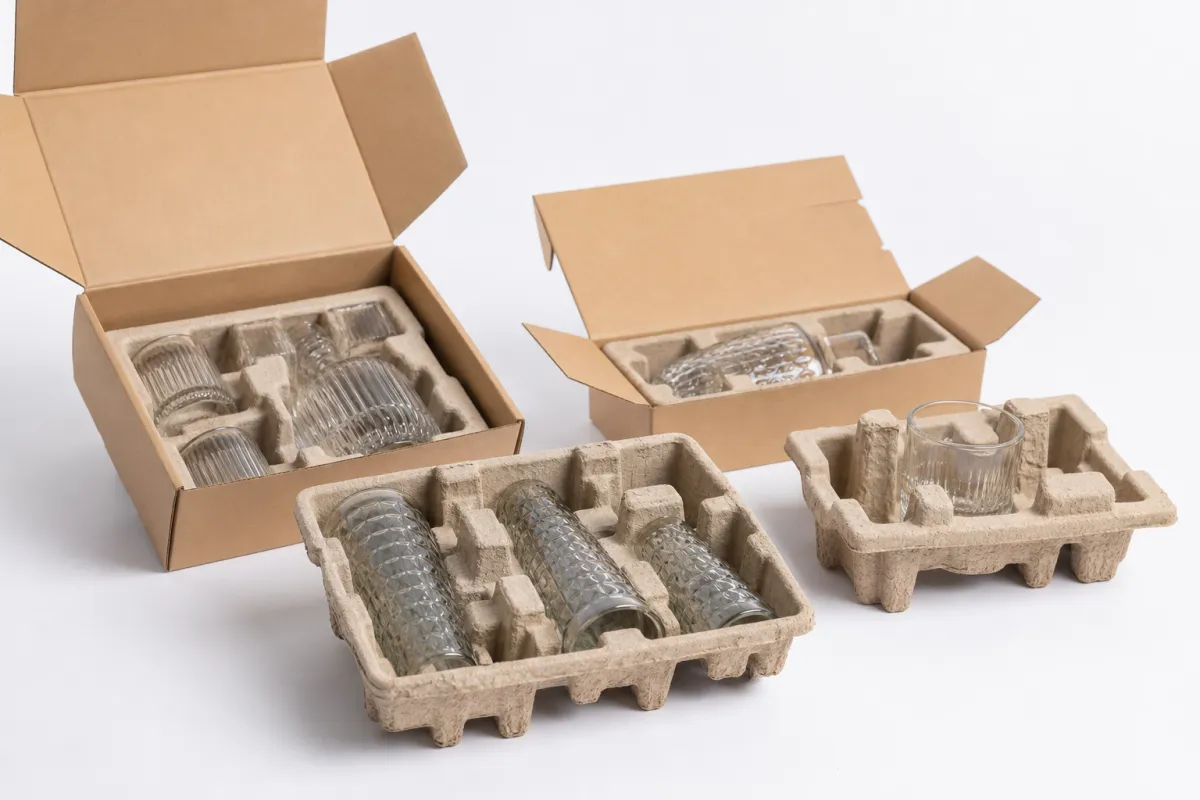
Custom carton inserts for glass solve a movement problem first and a branding problem second. Most breakage starts with product-to-product contact, edge impact, or vibration that slowly works a bottle loose until it presses against the carton wall. A proper insert removes that motion and gives each item a defined pocket.
Think of the insert as a load path. The glass should not take the hit. The force moves into the insert, then into the carton structure, and then across a larger area. That matters for tall bottles, narrow-neck jars, and decorative glass with painted or frosted finishes that scuff easily. It also matters for multi-item packs, because one loose piece can damage the others before the parcel even reaches the customer.
The useful versions of custom carton inserts for glass are usually die-cut corrugated, molded pulp, paperboard partitions, or foam cradles. Each one brings a different mix of cushioning, cost, and assembly speed. Corrugated is the workhorse. Molded pulp is strong on cushioning and sustainability. Paperboard often wins on pack speed and recyclability. Foam gives tighter control, but it is not always the best fit when recyclability or brand perception matters.
These inserts beat loose fill or bubble wrap mostly in repeatable shipping programs, premium launch kits, subscription packs, and any order that contains multiple glass items. If the same package is built hundreds or thousands of times, custom carton inserts for glass usually reduce variability. Less variability means less rework, fewer damaged shipments, and fewer awkward calls with customer service. I have watched teams chase “mystery breakage” for weeks, only to find the product was shifting inside a box that looked fine on the outside.
Custom carton inserts for glass also support package branding in a way loose fill never will. Customers notice when the product sits neatly in a formed cavity instead of rattling around like an afterthought. That is not magic. It is just disciplined product packaging.
If the insert does not stop movement, it is not a protective design. It is expensive cardboard pretending to help.
There is a business case too. Better fit usually means fewer claims, faster packout, cleaner presentation, and less pressure on the warehouse team to improvise. For any brand building custom printed boxes or a more polished retail packaging system, custom carton inserts for glass are often one of the cheapest ways to make the whole program look more intentional.
How Custom Carton Inserts for Glass Work in Transit
Custom carton inserts for glass work because they turn a fragile, free-moving object into a fixed system. The insert creates a pocket, the pocket isolates each item, and the outer shipper takes the abuse. That sounds simple because it is simple. Most good packaging is boring in the best possible way.
The outer carton, the insert, and the product dimensions have to work together as one structure. A perfect insert in the wrong box is still a bad design. If the carton is too loose, the insert can shift. If the carton is too tight, assembly becomes a fight and the board may crush under compression. Good custom carton inserts for glass are designed around the whole pack-out, not just the product silhouette.
There are several common structures. Top-and-bottom trays are useful when vertical restraint matters and the glass item needs a ceiling and floor. Partitions are common for bottles and jars because they keep products from touching side-to-side. Cradles work well for oddly shaped glass or premium pieces that need a more tailored hold. Sleeves and locking tabs can speed assembly when production labor is tight. The best option depends on the bottle neck, shoulder, and finish, not just the outer diameter.
Picture a real shipping lane. A courier parcel hits a conveyor drop, rides a truck route with vibration for hours, then gets handled again at delivery. If the insert only supports the base, the closure can still work loose. If it only supports the shoulder, the neck can flex. Custom carton inserts for glass need enough contact points to control motion without creating pressure points that transfer stress into the glass itself.
That balance is the whole job. Snug fit matters, but not every surface should be clamped hard. Edge support, controlled void space, and the right board caliper matter more than people think. The goal is not to trap the product like it is in a vise. The goal is to stop movement while letting the system absorb the normal abuse of parcel or pallet handling.
Custom carton inserts for glass are also where testing starts to matter. If a pack is going through parcel networks, ask for a test plan based on ISTA methods, or at least a simulation that resembles them. The ISTA resources are useful when you need a common language for drop and vibration expectations. For stacked freight, compression and distribution testing matter just as much as one neat photo of a sample on the table.
I have seen a sample pass a desk inspection and fail the first lane test because the closure rattled loose after a few miles of vibration. That is why I do not trust “looks good” on its own. A clean sample only tells you the geometry made sense in one moment, under one set of hands. Transit is less polite.
Bottom line: the insert is not decoration. It is the thing keeping a fragile product from turning into a breakage report.
Key Factors That Shape Fit, Protection, and Price
The starting point for custom carton inserts for glass is always the product itself. Weight, wall thickness, height, shoulder shape, neck diameter, closure type, and finish all affect the design. A 9 oz jar with a wide shoulder behaves very differently from a tall bottle with a thin neck and a heavy base. That is why generic one-size-fits-all packaging so often fails. Glass does not forgive lazy assumptions.
Material choice changes the performance profile fast. Corrugated board is usually the most economical option for straightforward bottle and jar packs, especially when you need enough strength without overengineering the structure. Molded pulp is a strong choice when cushioning and a more sustainable feel matter. Paperboard can be excellent for lighter items and faster hand assembly. Foam provides tighter cradle control, but it is not always the best fit for recycling goals or brand positioning. If you want neutral background reading on fiber packaging basics, the Institute of Packaging Professionals has useful reference material.
Protection is not just about cushioning. Compression strength matters, because a carton that collapses in a stack is not protecting anything. Stackability matters too, especially if cartons sit on pallets or go through warehouse staging. Humidity resistance matters more than many teams expect, because paper-based structures can lose stiffness in damp conditions. Assembly speed matters on the production line too. A fancy insert that takes forty seconds to load per unit can quietly wreck your labor budget.
Custom carton inserts for glass also depend on the shipping environment. A local delivery program is not the same thing as national parcel distribution. A subscription box is not a wholesale kit. A display pack for retail packaging is not a bulk shipper hidden inside a master carton. The more motion, stacking, or handling touchpoints the product sees, the more the insert has to do.
Price follows complexity more than people like to admit. More pockets, tighter tolerances, thicker board, printed instructions, or locking features all add cost. So does custom tooling. So does a low order quantity. If the insert has to solve a tricky neck geometry or a mixed-SKU pack, the quote will reflect it. That is normal. Packaging is a design decision, not a charity program.
| Insert type | Best use | Typical strength | Approx. unit cost at moderate volume | Main tradeoff |
|---|---|---|---|---|
| Die-cut corrugated | Bottles, jars, multi-item shippers | Good cushioning and compression | $0.18-$0.40 | Can take more board area and fold time |
| Molded pulp | Fragile items, sustainability-focused programs | Strong cushion, decent load distribution | $0.22-$0.55 | Tooling and lead time can be higher |
| Paperboard partitions | Lighter bottles, economy packs, fast assembly | Good separation, moderate protection | $0.10-$0.28 | Less forgiving in rough transit |
| Foam cradle | High-value glass, tight tolerance fits | Very strong support and isolation | $0.30-$0.80 | Recycling and brand fit may be weaker |
The numbers above are not magic quotes. They are practical ranges you might see once the structure, volume, and print requirements settle. A buyer evaluating custom carton inserts for glass should always ask what happens to the unit price if the board grade changes, if the insert is printed, or if the pocket depth shifts by a few millimeters. Those small adjustments are where budget surprise likes to hide.
One more thing: if the program needs fiber certification, ask for the right paper chain-of-custody documentation from the start. FSC claims are only useful if the paperwork follows the material. If sustainability is part of the brand story, that belongs in the spec, not in a vague marketing claim.
Cost and Pricing: What Custom Carton Inserts for Glass Usually Run
Custom carton inserts for glass do not have a single price. Anyone who tells you otherwise is either guessing or selling something with a very wide margin. Pricing usually depends on dimensions, material, structural complexity, print coverage, tooling, sample requirements, and annual volume. That is the boring answer, but it is the correct one.
For smaller custom runs, unit cost tends to sit higher because setup and tooling are spread across fewer pieces. Once the program repeats and the geometry is stable, pricing usually improves. A simple corrugated insert for a straightforward bottle pack might be around $0.10-$0.28 per unit at higher volumes, while a more engineered structure with tight tolerances may sit closer to $0.30-$0.80 depending on the build. Custom carton inserts for glass can be cheap, but only if the design is sensible and the order quantity supports it.
The smartest way to compare quotes is to stop looking at insert price alone. Compare total landed cost. That means freight, assembly time, breakage rate, rework, storage footprint, and any waste created by overpacking. A quote that looks $0.04 cheaper can become the expensive option if the warehouse spends an extra 6 seconds per pack loading the insert or if the damage rate doubles after the first courier lane.
Ask suppliers for tiered pricing at multiple volumes. Ask for sample charges too, because sample fees can be different for a die-cut prototype versus a production-style mockup. Before you lock the spec, ask what small design changes do to the quote. Switching from one board grade to another, or changing the pocket clearance by even a few millimeters, can move the price more than people expect.
Custom carton inserts for glass are also where print decisions quietly matter. Full coverage, spot color, or custom printed boxes can add value to package branding, but decoration should never get in the way of assembly or structural performance. If the insert sits inside a premium retail packaging program, the branding can be subtle and still feel intentional. If the insert lives in a shipper that no customer sees, pay for protection first and ornament second.
Here is a practical buying rule: if the insert saves one breakage claim on a high-value bottle, it may pay for itself. If it slows the line enough to add labor cost on every pack, it may not. That is why packaging design decisions should be tied to actual operating data, not just sample-room optimism.
For reference, a supplier should be able to explain where the cost sits:
- Material cost - board grade, pulp density, foam type, or caliper
- Tooling cost - dies, molds, cut samples, or setup
- Conversion cost - cutting, scoring, folding, and gluing
- Print cost - branding, instructions, or color coverage
- Logistics cost - freight, storage, and case pack configuration
Custom carton inserts for glass should be priced as a system, not a single line item. That is the part people miss when they focus only on board thickness or piece count.
Step-by-Step Process and Timeline for Custom Carton Inserts for Glass
The cleanest programs for custom carton inserts for glass start with measurement, not artwork. Capture the exact product dimensions, weight, closure details, and shipping configuration before anyone draws a die line. If the product has a pump, cap, cork, or fragile shoulder, that detail belongs in the brief on day one.
From there, the team moves into concepting. This is where you decide whether a partition, cradle, tray, sleeve, or molded shape makes sense. A real sample should be used for fit testing. Not a placeholder bottle that is close enough. Close enough is how expensive mistakes get approved.
- Measure the product - height, width, neck, shoulder, closure, and weight.
- Define the ship method - parcel, pallet, retail display, or mixed fulfillment.
- Choose the structure - corrugated, pulp, paperboard, or foam.
- Build samples - check fit with the real glass item and the real outer carton.
- Test the pack - drop, vibration, and compression based on the lane.
- Revise if needed - tighten a pocket, change board grade, or alter fold geometry.
- Approve production - confirm case pack count, packout speed, and reorder lead time.
Timeline depends on complexity. Basic corrugated custom carton inserts for glass often sample in about 1-2 weeks and can move to production in another 2-3 weeks after approval. More complex builds, especially those involving molded tooling, print changes, or tight tolerances, can stretch to 3-6 weeks or more. That is not a delay problem. That is a normal packaging schedule problem.
Validation is where a lot of teams get lazy. They approve a sample because it looks good in a photo, then skip the actual ship test. Bad idea. Ask for test conditions that match the distribution environment. If the item is going through parcel channels, use an ISTA-style approach. If it is being stacked on pallets, make sure compression is part of the evaluation. If the glass has a premium finish, inspect for rub marks after transit simulation, not just breakage.
Custom carton inserts for glass should also be reviewed for assembly speed. A design that is beautiful but awkward to fold will slow production and introduce human error. Have the warehouse team build several units in a row. Watch for snags, confusing folds, and any place where the product can be loaded backward or upside down. That is the kind of detail that separates a useful packaging design from a decent-looking headache.
One practical standard to borrow from the industry is ASTM D4169-style thinking for distribution risk, even if you are not running every exact test. The point is to simulate reality, not to congratulate the design because it survived sitting on a desk. Better to find the weak spot in sample stage than after 500 shipments have already gone out.
If you want the short version: measure, sample, test, revise, approve, then monitor the first production run closely. Custom carton inserts for glass reward methodical work. They punish rushed assumptions.
Common Mistakes That Cause Breakage or Budget Pain
The biggest mistake is sizing the outer carton first and the product second. That is backwards. Custom carton inserts for glass have to solve the glass problem, not just fill empty space in a box someone already chose six months ago. If the shipper is forcing the insert into a bad geometry, the design is already compromised.
Another common miss is ignoring the neck, shoulder, and closure. Lots of packs look great from the outside and still fail because the support points are wrong. A bottle can be held at the base and still crack at the neck from repeated flex. A jar can sit upright and still chip at the shoulder if the cavity is too tight. With custom carton inserts for glass, small clearance issues are not small.
Overpacking is another expensive habit. Too much cushioning can raise material cost, slow assembly, and create pressure points that stress the glass. People sometimes assume more material equals more protection. Not true. More material can also mean more friction, more labor, and more waste. Smart custom carton inserts for glass balance restraint with just enough compliance to absorb shock.
The testing mistake is probably the most common of all. A team approves a sample from a render or a photo and skips real drop, vibration, and compression checks. That is not testing. That is wishful thinking with a spreadsheet attached. If the product is valuable or fragile, run the sample through a lane that resembles the real trip. Then inspect for breakage, rub, cap loosening, and corner crush.
There is also a buyer mistake around print and branding. People want package branding on everything, even the hidden insert, and then wonder why the line slows down. If the packaging system includes custom printed boxes, the insert does not need to become a billboard. Keep the branding useful. Instructions, orientation marks, or simple color coding are often enough.
Custom carton inserts for glass should be judged by outcomes: lower damage, easier assembly, stable cost, and a cleaner customer experience. Pretty is nice. Functional is what gets reordered.
Expert Tips and Next Steps for Better Glass Packaging
My first piece of advice is simple: standardize carton footprints wherever you can. If the outer box sizes are all over the place, the insert program becomes more expensive, more confusing, and harder to reorder. A stable footprint makes custom carton inserts for glass easier to plan, easier to stock, and easier to train.
Keep the structure as simple as the product allows. A lot of brands reach for fancy geometry before they have even tried a straightforward partition or tray. If a simple corrugated solution protects the glass, packs fast, and looks clean, that is usually the better answer. The best packaging design often disappears into the operation because it just works.
Ask suppliers for the same comparison set every time:
- material spec and board grade
- sample cost and tooling cost
- MOQ and lead time
- estimated unit price at small, medium, and larger volumes
- expected packout time per unit
That list keeps the discussion honest. It also helps separate real engineering from vague sales talk. A supplier who understands custom carton inserts for glass should be able to explain how the design handles compression, vibration, and closure pressure without hand-waving.
Run a pilot before a full launch. A 100-unit or 250-unit pilot can reveal packout issues, warehouse friction, or weakness in the structure long before the first major shipment. That is not overcautious. It is cheaper than returns. It also gives your team a chance to see whether the insert supports branded packaging goals or just adds complexity to the line.
If you are sourcing alongside other product packaging, keep the insert spec aligned with the rest of the program. A line that uses custom printed boxes, retail packaging, and glass inserts should feel like one system, not three different vendors improvising in the same lane. That is where a disciplined packaging spec helps people think clearly about the whole package instead of obsessing over one isolated component.
For the next step, measure the product, define the ship test, request samples, and compare quotes against real operating cost. If you need a starting point for broader packaging work, see our Custom Packaging Products page for related options. Then push for a pricing target that actually fits your margin, not a fantasy number that only looks good in a meeting.
Custom carton inserts for glass are worth doing well because they sit at the intersection of protection, cost, and presentation. Get that balance right, and the packaging stops being a problem and starts doing its job.
Actionable takeaway: if you are building a new glass pack this week, start with the actual bottle or jar, pick the worst-case shipping lane, and test a sample before you approve tooling. That one step catches most of the expensive mistakes before they turn into claims, rework, and a warehouse full of regret.
FAQ
What do custom carton inserts for glass actually protect against?
They prevent item movement, edge impact, and product-to-product contact inside the shipper. They also help absorb vibration and reduce stress on necks, shoulders, and closures. Custom carton inserts for glass are especially useful for bottles, jars, vials, and fragile display items that need controlled positioning rather than loose fill.
How much do custom carton inserts for glass usually cost?
Cost depends on size, material, complexity, print, and order volume. Simple corrugated inserts are usually cheaper than molded or highly engineered designs. Ask for tiered quotes so you can compare unit price at small, medium, and larger runs. With custom carton inserts for glass, the cheapest unit price is not always the cheapest program.
How long do custom carton inserts for glass take to sample and produce?
Basic projects can sample in about 1-2 weeks and move into production in another 2-3 weeks. More complex structures, print finishes, or tooling changes can stretch the timeline to 3-6 weeks or more. Build in time for fit testing, shipping tests, and one revision cycle if the product is new. That is especially true for custom carton inserts for glass with tight neck or shoulder tolerances.
Are custom carton inserts for glass better than bubble wrap or loose fill?
Usually yes for repeat shipments, premium products, and multi-item packs where consistency matters. They pack faster, look cleaner, and keep the glass from shifting around in transit. Loose fill and bubble wrap can still work for low-volume or irregular shipments, but they are less controlled than custom carton inserts for glass.
Can custom carton inserts for glass be recycled?
Many corrugated and paperboard inserts are widely recyclable if they stay clean and dry. Molded pulp is often recyclable and can be a strong sustainability option depending on local systems. Foam inserts vary more, so confirm the recycling path before choosing them for a long-term program. If sustainability is part of the brief, custom carton inserts for glass should be specified with the end-of-life path in mind.
Choose the insert that matches the glass, the ship method, and the budget you actually have. Then test it with the real product, not a close enough stand-in. That is how custom carton inserts for glass stop being a cost line and start being a useful part of the packaging system.

