Buyer Fit Snapshot
| Best fit | Custom Carton Inserts Manufacturer projects where brand print, material claims, artwork control, MOQ, and repeat-order consistency need to be specified before quoting. |
|---|---|
| Quote inputs | Share finished size, material target, print colors, finish, packing count, annual reorder estimate, ship-to region, and any compliance wording. |
| Proofing check | Approve dieline scale, logo placement, barcode or warning zones, color tolerance, closure strength, and carton packing before bulk production. |
| Main risk | Vague material claims, crowded artwork, missing packing details, or unclear freight terms can make a low unit price expensive after revisions. |
Fast answer: Custom Carton Inserts Manufacturer: Board, Finish, Dieline, and Unit Cost should be specified like a repeatable production item. The safest quote records material, print method, finish, artwork proof, packing count, and reorder notes in one written spec.
Production checks before approval
Compare the actual filled-product size with the drawing, then confirm tolerance on folds, seals, hang holes, label areas, and retail display edges. Reserve space for logos, QR codes, warning copy, and material claims before decorative graphics fill the panel.
Quote comparison points
Review material grade, print process, finish, sampling route, tooling charges, carton quantity, and freight assumptions side by side. A quote is only useful when the supplier can repeat the same color, closure quality, and packing count on the next order.
A Custom Carton Inserts manufacturer does a lot more than trim board to a neat size and tuck it inside a box. The real work is closer to solving a packaging puzzle with real materials, real tolerances, and real shipping abuse in mind. The insert has to hold a product steady, protect it from movement, and still look composed when the carton is opened. For brands that care about both performance and presentation, the right custom carton inserts manufacturer ends up acting like a technical partner, a production guide, and a translator for packaging decisions all at once.
That matters whether the job is a retail carton for a cosmetic set, a mailer for fragile electronics, or a multi-piece kit with accessories that must stay separated until the customer opens the box. A good insert is not filler. It is part of the pack-out system, part of the customer's first touchpoint, and often the thing that decides whether a package feels thoughtfully built or kind of thrown together. If you are comparing Custom Packaging Products, it helps to understand how inserts actually function before you decide on a structure, a substrate, or a supplier.
I have seen packaging teams treat the insert as an afterthought because it sits inside the carton and nobody sees it on a shelf. That assumption can get expensive fast. A better insert can reduce movement, lower breakage, shorten pack-out time, and make unboxing feel intentional. A bad one can create the opposite effect even if the outer carton prints beautifully and the finish looks premium.
What a Custom Carton Inserts Manufacturer Actually Does
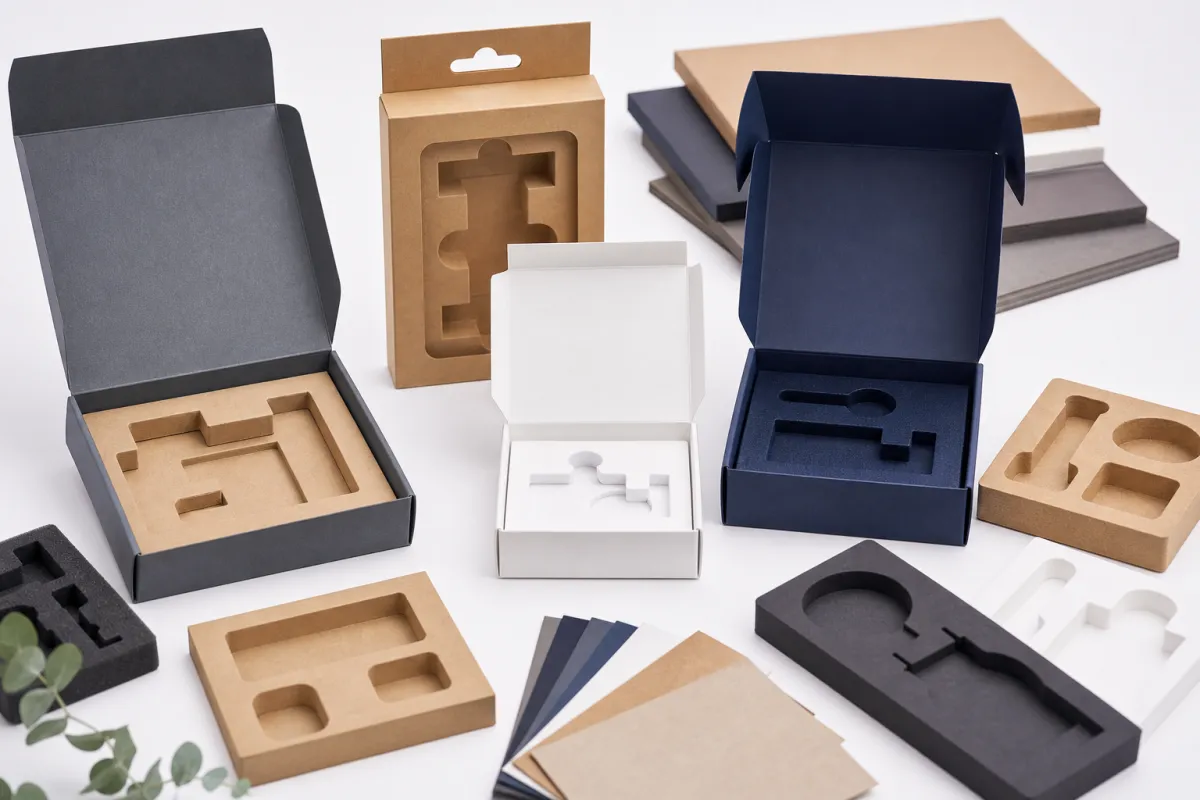
A Custom Carton Inserts manufacturer designs and produces the internal structure that holds a product in place inside a carton. That might mean a single cavity for one item, a multi-pocket layout for a kit, a top pad and bottom pad for shock control, or a layered structure that keeps fragile parts from touching each other during transit. It sounds straightforward until you start accounting for product shape, carton dimensions, handling conditions, and the way the pack behaves once it is on a real line and not just on a drawing.
Picture a fragrance set, a medical device, or a small appliance. The outer box may look clean from the outside, but if the item shifts, rubs, or tips during transport, the customer gets the problem the second they open it. The insert is what controls that movement. It also shapes the reveal, which is why many brands ask a custom carton inserts manufacturer to think about protection and presentation together instead of treating the insert as disposable packing material.
The difference between a generic insert and a custom solution usually comes down to fit and purpose. Generic formats are built for broad use, so they often leave extra play, extra void, or extra material where it is not needed. A custom insert follows the product geometry, the carton size, and the handling risks. That matters most for products with uneven weight distribution, brittle finishes, accessories packed in the same box, or a premium surface that shows marks easily.
Common formats include die-cut paperboard, corrugated partitions, molded pulp, foam alternatives, and hybrid structures that mix rigidity with display value. A custom carton inserts manufacturer may recommend one material for a lightweight retail kit and another for a heavier shipper that needs stacking strength. In a lot of projects, the insert is also tuned to pack-out speed, because the best design is the one line workers can place consistently without forcing parts into place or wondering whether they got the orientation right.
A good insert is not just something that fills space. It is the structure that keeps the carton, the product, and the first unboxing moment working together.
From the buyer's side, the insert sits right at the intersection of protection, branding, and labor efficiency. That is why experienced teams ask a custom carton inserts manufacturer to look past the cavity and study the full system: carton board grade, closure style, product weight, accessory count, and even how the finished pack feels in the hand. I have sat through enough pack-out trials to know that the smallest friction point, like a tab that catches or a cavity that is just a hair too tight, can slow a whole team down.
How Custom Carton Inserts Are Designed and Made
The design path usually starts with measurements, but not just one measurement. A careful custom carton inserts manufacturer will want product dimensions, product weight, carton dimensions, accessory details, and any areas that cannot be touched, compressed, or scuffed. If a bottle has a pump, a screen, a plated finish, or a sharp corner, those details change the contact points and the clearance needed around them.
From there, the manufacturer decides how the insert should hold the product. Some items need side restraint so they cannot rattle. Others need vertical support so they do not settle under vibration. Some need a positive lock at the neck or base. A custom carton inserts manufacturer may build all of that into one die-cut structure or split the job into multiple pieces, such as a base cradle plus a top lock. The design choice depends on the product, the carton, and how much room there is to work with once board thickness gets factored in.
Material selection is where packaging intent starts to show. Heavier corrugated grades are common when the insert needs structural support, especially for shipping. Paperboard is often chosen when the look matters and the product is lighter. For more complex packs, a custom carton inserts manufacturer may use layered board, nested folds, or mixed-material assemblies to improve stiffness without overbuilding the insert. Good packaging design rarely means using the most material. It means using the right amount of the right material in the right place.
Behind the scenes, the workflow usually moves through CAD layout, sample cutting, crease setup, fold logic, adhesive decisions, and quality checks for repeatability. If the insert is die-cut, tool setup matters because a small change in cut depth or crease score can alter the fit across thousands of pieces. That is why a seasoned custom carton inserts manufacturer spends time on prototypes instead of jumping straight into production. The tooling might be ready on paper, but the real proof shows up when the actual product gets dropped into the actual structure.
Prototypes are not a formality. They are the fastest way to catch fit issues, awkward folds, slow pack-out steps, and contact points that could mar the product. In many cases, a manufacturer will ship one or more samples for test fitting, then adjust the design if a component sits too high, compresses too much, or leaves too much void. A solid custom carton inserts manufacturer will welcome that back-and-forth because it saves time and frustration later. Honestly, a sample stage that feels too easy is often the one that worries me the most.
There is also a close relationship between the insert and the carton itself. The insert should not force the box out of square, create bulges, or make the closure difficult. A practical custom carton inserts manufacturer thinks about glue areas, folding direction, and how the pack behaves on a real line, not just on a screen. The cleanest structure on paper can still be the wrong one if it slows assembly or creates inconsistent results once workers start moving at production speed.
Key Factors That Shape Fit, Protection, and Appearance
Product fragility drives a lot of the decision-making. Glass, cosmetics, electronics, medical components, and premium gifts each fail in different ways, so a custom carton inserts manufacturer has to understand whether the main risk is impact, abrasion, compression, or simple movement. A glass bottle may need neck restraint and surface separation. A circuit board may need edge control and antistatic considerations. A luxury gift may need a reveal that feels deliberate instead of cramped.
Dimensions and tolerances matter just as much as the item itself. Products are rarely exact to the decimal forever. Manufacturing variation, coating thickness, closures, labels, and included accessories all change the fit. A good custom carton inserts manufacturer will ask about variation ranges, not just nominal dimensions, because an insert that fits the smallest sample can become too tight on the largest unit in a production run. That little detail gets missed more often than it should.
Presentation changes the specification too. Some brands want the insert to disappear visually so the product takes center stage. Others want the insert to be part of the reveal, especially for premium retail packaging or branded packaging that opens in stages. In those projects, the insert can carry print, a clean white edge, a natural kraft look, or a shaped opening that frames the product like a display tray. A custom carton inserts manufacturer should be able to discuss those choices in practical terms, not just aesthetic ones.
Shipping conditions matter more than many teams expect. Cartons face vibration, stacking pressure, temperature swings, and rough handling across distribution channels. That is why packaging teams often reference test methods such as ISTA procedures or ASTM shipping tests when they want to verify that the insert does more than look good in a sample photo. A custom carton inserts manufacturer that understands those test references can usually explain where the real risk sits and where a design has enough margin built in.
Sustainability has become part of the technical brief, not just the marketing brief. Recyclable board, FSC-certified fiber, reduced weight, and fewer mixed materials can all influence the final spec. If your program leans toward FSC sourcing, the forest stewardship standards at FSC are worth reviewing, especially for brands that want clearer chain-of-custody language in their packaging story. A thoughtful custom carton inserts manufacturer will help balance source claims, performance, and end-of-life considerations without pretending every material choice is equal.
The factors I see teams weigh most often are these:
- Fragility: glass, screens, coated surfaces, and precision parts all need different restraint strategies.
- Weight: heavier products usually need stronger board, better support points, or both.
- Assembly speed: a clever design that takes twice as long to pack may cost more than it saves.
- Brand feel: the insert can support premium presentation or stay visually quiet, depending on the goal.
- Material choice: recycled fiber content, printability, and recyclability all influence the final decision.
That is why the right custom carton inserts manufacturer is not always the one that answers fastest. It is the one that asks the right questions about product behavior, carton behavior, and the shipping environment. Fast answers can be useful, sure, but they do not protect a product by themselves.
Custom Carton Inserts Manufacturer Pricing: What Affects Cost
Pricing is usually where people start, and that makes sense. A custom carton inserts manufacturer can quote the same basic project in very different ways depending on material, complexity, setup, and volume. The unit price often looks small at first, but the total program cost can shift a lot once you add tool setup, prototype work, print coverage, and pack-out labor. If someone quotes only the piece price and skips the rest, I get suspicious pretty quickly.
The biggest cost driver is usually material. Corrugated board may be more economical for structural support, while paperboard can be attractive for lighter items and cleaner presentation. Specialty inserts, layered constructions, and hybrid builds can cost more because they take more board, more cutting, or more assembly time. A seasoned custom carton inserts manufacturer will usually explain not just the unit price but the tradeoff between board strength and labor efficiency.
Complexity matters too. A simple two-panel insert is far less expensive than a multi-compartment insert with nested locks, windows, folds, and product-specific cutouts. More compartments mean more engineering time and more opportunities for fit issues. If the design requires unusual die cuts or tight registration, the custom carton inserts manufacturer may need a more involved setup, which pushes the price upward.
Samples and tooling also deserve attention. Prototypes cost money up front, but skipping them can be expensive later if the insert crushes corners, scratches finishes, or slows the line. The best packaging buyers think in terms of total cost of ownership, not just the first invoice. If a custom carton inserts manufacturer helps reduce returns, breakage, and repacking, that often outweighs a slightly higher per-unit cost. That math is a lot less glamorous than a low quote, but it is usually the one that matters.
| Insert Type | Typical Use | Relative Cost | Best Fit For |
|---|---|---|---|
| Basic corrugated insert | Support, separation, shipping protection | Low to moderate | Heavier products, straightforward pack-outs |
| Die-cut paperboard insert | Presentation, light restraint, retail packaging | Moderate | Cosmetics, accessories, branded sets |
| Multi-compartment custom insert | Component separation and stable transit | Moderate to high | Kits, sample sets, mixed-item cartons |
| Hybrid structural insert | Protection plus display value | High | Premium launches, fragile products, gift sets |
For context, a simple insert on a mid-size run may land in a range such as $0.18-$0.40 per unit, while more complex structures can move higher depending on board grade, print, and quantity. At very low volumes, setup costs can matter more than the unit price itself. A custom carton inserts manufacturer should be able to show how the quote changes at 1,000 pieces versus 5,000 or 10,000 pieces so you can compare real breakpoints instead of guessing.
Finishing choices can also alter cost. Printing, coatings, tighter visual tolerances, and specialty die cuts add steps. If the insert is part of package branding, that extra investment may be justified. If the insert is hidden inside a shipper, a simpler build may be the better commercial choice. The right custom carton inserts manufacturer helps you make that call honestly rather than steering you toward the fanciest option by default.
One more point: price alone does not tell you whether the insert is economical. If a slightly more expensive insert reduces damage by even a small percentage, the program may pay for itself quickly. That is especially true for fragile retail packaging, high-return categories, and products that travel long distances. In other words, a cheaper insert that creates more breakage is not really cheaper.
The Custom Carton Inserts Manufacturer Process and Timeline, Step by Step
The process usually starts with a discovery conversation. A good custom carton inserts manufacturer wants to know what the product is, how it ships, what the carton looks like, and what the pack-out goal is. That first call or email exchange is where you should share product drawings, sample photos, carton dimensions, weight, and any special handling concerns. The more concrete the inputs, the cleaner the design path.
Next comes the structural recommendation. The manufacturer may suggest one cavity, multiple cavities, a locking tab, a cradle, or a top-and-bottom system. A strong custom carton inserts manufacturer will explain why one option holds better, packs faster, or uses less board. That explanation matters because the best answer is not always the most complicated one. Sometimes the simplest structure is the one that actually survives use.
After the concept is set, the sample stage begins. Depending on the complexity, you may see one prototype or several rounds of samples. Simple designs often move faster. More complex designs, especially those with multiple compartments or premium display requirements, need more back-and-forth. A practical custom carton inserts manufacturer will encourage sample approval before full production so you can check fit with real products rather than assumptions.
Here is a realistic timeline framework many packaging teams use:
- Discovery and data collection: 1-3 business days if drawings and dimensions are ready.
- Concept and sample creation: often 3-7 business days for straightforward structures.
- Sample review and revisions: 2-5 business days, depending on internal approval speed.
- Final production: commonly 7-15 business days after approval, with longer windows for complex builds or larger volumes.
That timeline can stretch if measurements are incomplete, product revisions keep changing, or the buyer needs extra internal sign-off. A custom carton inserts manufacturer can only move as quickly as the information flow allows. In practice, the biggest delays usually come from late approvals, unexpected product variation, or a sample that exposed a fit issue nobody saw on the drawing.
If your team wants to move faster, give the manufacturer the pieces that save time: exact carton dimensions, product photos from several angles, carton closure style, unit weight, accessory list, and the desired packing rate per hour. Those details help a custom carton inserts manufacturer reduce guesswork and build a structure that can actually be used on the floor instead of just admired in a mockup.
The best process also includes testing. That may be a hand pack-out, a drop test, or a shipping simulation tied to ISTA-style criteria. Not every project needs a full lab program, but a sensible custom carton inserts manufacturer will still want evidence that the design works under real handling conditions, not just on a clean bench. If a supplier skips that step entirely, you are basically betting the shipment on optimism.
For brands building a broader packaging system, it helps to review how the insert sits beside outer cartons, printed sleeves, and other branded packaging elements. If you need support from a broader packaging partner, the team at About Custom Logo Things can help frame the conversation around structure, presentation, and production reality instead of treating them as separate decisions.
Common Mistakes When Ordering Custom Carton Inserts
The first mistake is measuring only the product and ignoring the carton. A custom carton inserts manufacturer is working inside a full packaging system, not an isolated object. If the outer carton has board thickness, fold lines, print variance, or a closure style that steals internal space, the insert has to account for all of that. A design that looks perfect around the product can fail the moment it meets the box.
The second mistake is over-protecting or under-protecting the item. Too much insert material can raise costs, slow packing, and add bulk without improving results. Too little can leave the product loose or create points of contact that cause wear. A good custom carton inserts manufacturer should be able to explain where extra material truly helps and where it only adds weight and expense. That conversation is usually more useful than arguing over a few cents per unit.
Skipping the sample stage is another costly habit. It is tempting to approve drawings and move straight to production, especially on a tight schedule. The sample often reveals issues that the spec sheet never captured: a closure that pushes against the item, a cavity that is too shallow, or a board grade that flexes more than expected. Any experienced custom carton inserts manufacturer will tell you that a one-time delay for sampling is usually cheaper than a production correction.
Pack-out efficiency gets overlooked more often than people admit. A design can be technically correct and still be a poor choice if it takes too long to assemble. On a busy line, even a few extra seconds per unit can become a real labor cost. A smart custom carton inserts manufacturer will ask how the insert is assembled, who assembles it, and what the acceptable pack rate is. If that question never comes up, the design process is probably too shallow.
Choosing material based only on price can also backfire. Lightweight paperboard may be fine for a gift set, but not for a dense, heavy item that travels through rough distribution. Thick corrugated is not automatically the answer either if presentation and print quality are central to the brand. The right custom carton inserts manufacturer can show you where the material choice supports the business goal, not just the immediate quote.
Here is a quick way to think about the risk profile:
- Low risk: light, non-fragile products with generous carton clearance.
- Medium risk: mixed kits, cosmetics, or products with some finish sensitivity.
- High risk: glass, electronics, precision parts, or premium items with visible surfaces.
A careful custom carton inserts manufacturer helps you match the insert to the risk, which is exactly where strong packaging design earns its keep.
Expert Tips and Next Steps Before You Place an Order
Before you contact a custom carton inserts manufacturer, gather a clean product spec sheet, carton dimensions, product weight, photos, and any notes on accessories or finish sensitivity. If you have more than one product size, include the variation range. Those small details shorten the design loop and reduce the odds of a sample surprise. They also make you look prepared, which tends to get better answers from the other side.
Ask for a prototype or sample approval path before you commit to full production. The best time to discover a fit issue is after one sample, not after 5,000 units. A practical custom carton inserts manufacturer should be comfortable showing you how the insert works with the actual product and the actual carton, even if the first sample needs a revision. That part of the process is not a setback; it is how a decent design gets sharpened into a usable one.
Be clear about your priorities. Do you want maximum protection, a premium reveal, quicker assembly, lower material cost, or a balanced mix? Those goals can pull in different directions, so the manufacturer needs to know which one matters most. A good custom carton inserts manufacturer can optimize for one priority without accidentally hurting another, but only if the brief is honest. Saying "we want everything" usually means someone is going to be disappointed later.
I also recommend a short internal test with the people who will actually pack the product. The person on the line often sees issues that a designer or buyer misses, such as awkward fold sequences, tight tolerances, or a cavity that is hard to find quickly. A custom carton inserts manufacturer gets better input when pack-out staff are part of the review. That one extra voice can save you from a structure that looks neat but slows everyone down.
If you are comparing vendors, ask these questions:
- What material options do you recommend, and why?
- How do you test fit before production?
- Can you explain the cost difference between the sample and production stages?
- What packaging standards or shipping tests do you reference?
- How will the insert affect assembly time on our line?
Those questions separate a supplier that simply cuts board from a custom carton inserts manufacturer that understands product packaging as a system. For teams building branded packaging, retail packaging, or custom printed boxes, that difference shows up quickly in damage rates, labor cost, and customer perception. If the answers are fuzzy, that is usually your sign to keep looking.
If you want a broader view of the company behind the work, review About Custom Logo Things and compare it with the product range on Custom Packaging Products. Then look at the practical details: structure, sample path, lead time, and how clearly the custom carton inserts manufacturer explains the production path from prototype to shipment. That combination tells you far more than a polished sales page ever will.
My advice is straightforward: compare two or three material options, request a sample schedule, review likely damage risks, and choose a custom carton inserts manufacturer that can talk through both structure and production without hand-waving. If you can do that, the insert stops being a guess and becomes a controlled part of the package, which is exactly where it should be.
Frequently Asked Questions
How do I choose a custom carton inserts manufacturer for fragile products?
Look for a custom carton inserts manufacturer that starts with the product itself, not a pre-made insert shape. Ask how they test fit, vibration resistance, and surface protection before production. Request samples so you can confirm the insert holds the item without scuffing, tipping, or shifting during handling. If the answer feels generic, keep asking until you get specifics.
What materials are most common for custom carton inserts?
Corrugated board is common for support and cost efficiency. Paperboard works well when presentation matters and the product is lighter. Some projects use hybrid structures or specialty cushioning when the item needs extra restraint, and a good custom carton inserts manufacturer can explain which option fits the load and the brand experience. The right choice usually depends on what the product needs most, not on material popularity.
How long does the custom carton inserts process usually take?
Simple designs can move quickly if dimensions and requirements are clear. More complex inserts take longer because they may need multiple sample rounds. Fast approval depends on having accurate measurements, carton specs, and product photos ready, and a responsive custom carton inserts manufacturer can usually keep the process moving once those details are in hand. Delays usually come from missing information, not from the manufacturing step itself.
What drives custom carton inserts manufacturer pricing the most?
Material choice, insert complexity, and order quantity are usually the biggest factors. Tooling, samples, and finishing options can increase upfront cost. The cheapest insert is not always the lowest-cost option if it leads to damage, repacking, or slow assembly, which is why a clear quote from a custom carton inserts manufacturer should include the full production picture. If the quote seems unusually simple, ask what is not included.
Can a custom carton inserts manufacturer help reduce shipping damage?
Yes, if the insert is designed to control movement and protect key contact points. The best designs account for carton size, product weight, and transit conditions. A proper sample test is the fastest way to see whether the insert truly improves protection, and a capable custom carton inserts manufacturer will usually recommend that step before any full run is approved. That test is where theory meets the real world.
Choosing a custom carton inserts manufacturer is really about deciding who you trust to translate a product, a carton, and a shipping path into one working package. If that partner understands fit, materials, timing, and presentation, the insert does more than hold the item in place; it protects the shipment, supports the brand, and makes the whole pack-out easier to manage. The practical takeaway is simple: start with real product data, insist on a sample, and choose the custom carton inserts manufacturer that can explain exactly why the design will work before you approve a full run.

