Buyer Fit Snapshot
| Best fit | Custom chipboard mailer boxes wholesale projects where brand print, material claims, artwork control, MOQ, and repeat-order consistency need to be specified before quoting. |
|---|---|
| Quote inputs | Share finished size, material target, print colors, finish, packing count, annual reorder estimate, ship-to region, and any compliance wording. |
| Proofing check | Approve dieline scale, logo placement, barcode or warning zones, color tolerance, closure strength, and carton packing before bulk production. |
| Main risk | Vague material claims, crowded artwork, missing packing details, or unclear freight terms can make a low unit price expensive after revisions. |
Fast answer: Custom chipboard mailer boxes wholesale: premium options should be specified like a repeatable production item. The safest quote records material, print method, finish, artwork proof, packing count, and reorder notes in one written spec.
Production checks before approval
Compare the actual filled-product size with the drawing, then confirm tolerance on folds, seals, hang holes, label areas, and retail display edges. Reserve space for logos, QR codes, warning copy, and material claims before decorative graphics fill the panel.
Quote comparison points
Review material grade, print process, finish, sampling route, tooling charges, carton quantity, and freight assumptions side by side. A quote is only useful when the supplier can repeat the same color, closure quality, and packing count on the next order.
A thin bubble mailer can look fine on a screen. Then the carrier stack gets rough, a corner punches through, and suddenly the “cost-saving” choice is sitting in customer support as a damage ticket. I have seen that pattern more times than I care to admit. That is the problem custom chipboard Mailer Boxes Wholesale is meant to solve. It gives you a tougher shell, yes, but the real payoff is quieter: fewer replacements, fewer refund conversations, and a first impression that does not fall apart the moment the box leaves your warehouse.
For a packaging buyer, the smartest option is rarely the prettiest mockup or the cheapest quote. It is the format that protects the product, prints cleanly, and keeps your reorder math from turning into a headache. Custom Chipboard Mailer Boxes wholesale fits that brief because it behaves like part of the operating system, not an afterthought. That matters more than a lot of teams want to admit, especially when launch timing is tight and every mistake gets expensive fast.
The real benchmark is total landed cost. Not the sticker price. Not the render. Not the one sample that arrived looking perfect. You have to include damage exposure, support labor, replacement shipments, and the customer response after opening. If a box reduces those downstream costs, it earns its place. If it only looks good in a deck, it is just decoration with a freight bill.
Value Proposition: Why custom chipboard mailer boxes wholesale beat bargain alternatives
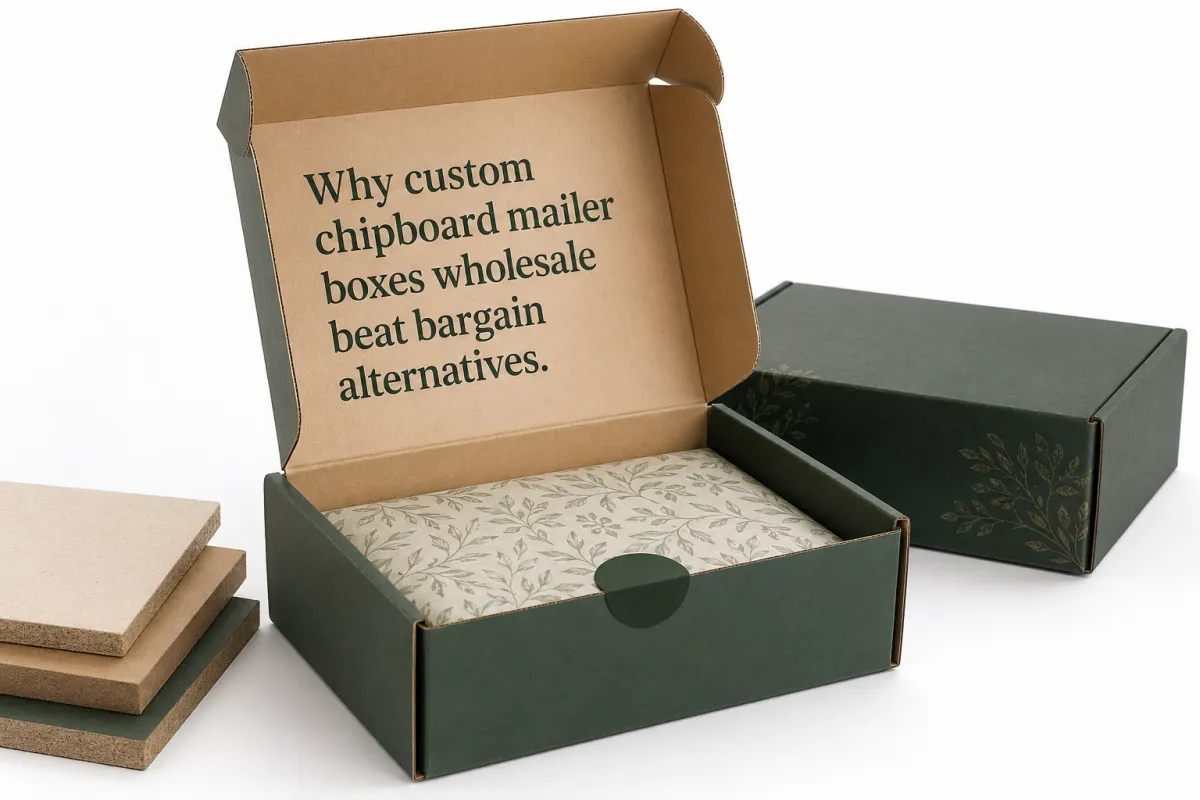
Buyers often start with the cheapest mailer they can find, then spend the next month patching tears, reshipping damaged goods, and explaining delays that could have been avoided. That is not savings; that is deferred pain. Custom chipboard mailer boxes wholesale usually makes more sense when the product has weight, hard edges, or a retail presentation requirement that flimsy mailers cannot handle. Apparel in soft stacks can sometimes ride in lighter packaging. Rigid kits, fragrance sets, beauty tools, and compact electronics are a different story.
The structural advantage is simple enough. Chipboard provides better stiffness than thin poly mailers and more controlled fold behavior than bargain cartons that buckle when packed a little too tightly. It also gives the package a more deliberate opening feel. That sounds cosmetic until you watch conversion numbers and customer reviews. People notice when a package opens like it was built by someone who cared. They also notice when it fights them the whole way.
Custom chipboard mailer boxes wholesale also closes a profit leak that is easy to miss because it does not show up in the first quote line. A stronger box can reduce damage claims, but the larger savings often sit in the boring middle: less repacking, fewer labor interruptions, fewer “where is my replacement” emails, and fewer carrier disputes. Those are real costs. They just hide behind packaging decisions that look minor on paper.
A cheap box stays cheap only until the first breakage. After that, it gets expensive in returns, delays, and the kind of customer friction nobody budgets for.
Here is the practical value stack:
- Protection: stronger crush resistance and more predictable closure behavior than bargain-format mailers.
- Presentation: a cleaner surface for brand cues, copy, and retail-style unboxing.
- Margin control: fewer damage events, fewer rework loops, and less manual handling in fulfillment.
- Repeatability: custom chipboard mailer boxes wholesale keeps structure and print behavior steadier from one reorder to the next.
For flat, low-risk goods, compare this route with Custom Poly Mailers. Poly mailers are efficient for simple soft goods and can be a sensible cost choice when shape is not doing much work. Chipboard mailers make more sense when the product needs defined geometry, tighter stacking, and a package that reads as part of the brand experience rather than shipping noise. Different tools, different jobs.
In a mature packaging setup, the best custom chipboard mailer boxes wholesale programs are the ones that stop guessing. The team knows board grade, finish, closure type, and reorder behavior before production begins. That is how custom printed packaging stops acting like a one-time visual project and starts behaving like infrastructure.
There is another angle worth saying plainly. A premium-looking mailer that collapses in transit is a false economy. If your campaign depends on launch timing, paid media, or a tight retail calendar, the cost of a damaged arrival can outrun the savings from thinner stock very quickly. I have watched brands lose more on replacements in a week than they saved on cartons in a quarter. It is kind of brutal, but it is also predictable.
Product Details: What makes custom chipboard mailer boxes practical for ecommerce and retail shipping
Chipboard mailers are not one generic thing with a different logo on the lid. If you treat them that way, the weak points show up in transit: corners deform, seams pull, and closures land unevenly. A custom chipboard mailer boxes wholesale program usually starts with structure, and structure should follow product behavior, not whatever happens to be trendy that month.
C-fold boxes work well for flatter assortments and lighter apparel sets. They keep the profile slim and give the exterior artwork a clean wraparound surface. Lock-bottom designs make more sense for heavier or denser contents because they hold shape better under stacking stress. Auto-lock versions are helpful on faster packing lines, where seconds per unit matter and assembly speed is not just a nice-to-have. Reinforced side gussets come into play when height, insert stacks, or rough handling threaten the side walls.
That is the part many buyers miss: format should be driven by the item, not the mood board. A subscription bundle with sample vials, inserts, and a note card is not the same as a folded garment set. Custom chipboard mailer boxes wholesale works because the package can be tuned to the load, the stack pattern, and the customer journey instead of forcing the product to fit a generic shell.
Chipboard and corrugated often get compared as if they are interchangeable. They are not. Corrugated still wins on raw crush resistance, but it brings extra bulk and can mute print detail. Chipboard sits in the middle. It offers enough structure for many ecommerce profiles, cleaner graphics, and Finish Options That include matte coating, water-based varnish, and soft-touch lamination. In practice, it behaves more like a controlled custom protective packaging format than a basic shipper.
The threshold is straightforward. If the product is heavy, sharp, or likely to see abuse, structure matters more than decoration. If the item is soft and low risk, a lighter build may be fine. If premium presentation, clean folding, and repeatability are all non-negotiable, custom chipboard mailer boxes wholesale is usually the better fit. It is less flashy than some options, but it does the work without drama.
Closure behavior deserves attention. Pre-glued flaps speed up pick-pack operations. Gummed flaps can offer stronger tamper resistance when security matters. Extra tape channels make sense when the package will see rough carrier handling or repeated motion inside larger shipment containers. Once corners get weak, corner reinforcement becomes more valuable than a bigger logo. That sounds obvious, yet it is still where many specs go off the rails.
Surface treatment changes both appearance and wear. Matte films keep graphics legible and cut glare under mixed light. Water-based varnish adds practical protection without turning the spec into a science project. Soft-touch lamination improves hand feel, though it should earn its place through actual brand value, not habit. Die-cut windows can show the product quickly, but large cutouts weaken the body. In a lot of programs, a reveal panel or partial opening gives you the visual cue without gutting the structure.
For visibility without sacrificing stiffness, teams often pair a labeled insert tray, belly band, and selective spot varnish instead of a huge window. The warehouse gets faster SKU checks. The customer still gets a clear branded signal. That is the real strength of custom chipboard mailer boxes wholesale: it lets you design for operations first and marketing second, without pretending those goals are always identical.
If your team needs consistent terminology around grading, fiber content, and finish vocabulary, Packaging.org is a useful reference point. Shared language cuts down on back-and-forth, and honestly, that alone can save a surprising amount of time. It is also helpful when procurement, design, and quality are not sitting in the same room.
How do custom chipboard mailer boxes wholesale improve ecommerce return rates?
Custom chipboard mailer boxes wholesale improves return outcomes when the returns are caused by packaging failure, not by product preference. That distinction matters. A customer returning a sweater because the color felt wrong is a merchandising issue. A customer returning the same order because the carton arrived crushed is a packaging failure that should have been prevented upstream.
In practice, the most common failure codes are seam splits, corner deformation, puncture marks, and “open on arrival” complaints. Better chipboard performance does not erase every risk, but it does remove a big chunk of the predictable ones. I have seen teams reduce those complaints just by tightening board spec and correcting the closure geometry. Not glamorous work. Very effective work.
When return data is tracked properly, the pattern usually shows up quickly after a switch away from bargain mailers. Fewer split seams. Less deformation at the corners. Lower complaint volume around opening failure. The first place you see the improvement is logistics. The second is customer service. Both matter, because both cost money, and one feeds the other if nobody intervenes.
The other gain is fit control. If insert sizing, closure pressure, and flap behavior are stable, you close the gap between “looked fine in the warehouse” and “arrived damaged at destination.” That gap is where a lot of wholesale packaging quietly leaks margin. For brands trying to keep a clean customer funnel, custom chipboard mailer boxes wholesale acts like a risk filter. It is not a magic fix. It just removes avoidable failure before it becomes expensive.
There is also a support-side effect that is easy to overlook. When the packaging is more forgiving under rough handling, the customer service queue gets fewer damage cases, and the fulfillment team stops spending time on preventable triage. That means the operation breathes easier. A lot of people focus on the package as if it were a marketing object. In reality, it is often a support burden or a support shield.
Specifications to Lock Before Ordering: GSM, size rules, print specs, and coating choices
Quotes get messy when the starting brief is vague. “Small,” “premium,” and “eco-friendly” are not enough to spec a box. A supplier needs measurable inputs. A reliable custom chipboard mailer boxes wholesale workflow begins with a locked spec package: board weight, thickness, dimensions, print coverage, finish, tolerance, and acceptance criteria. Otherwise, everybody is guessing, and guessing is where cost drift starts.
Start with board language. You will see GSM, caliper, and thickness references in points or similar measures. Higher values generally improve stiffness, but fiber composition and treatment still affect fold behavior. Recycled board can be a strong choice, though it may crease differently than virgin stock under repeated handling. If your dieline includes tight folds or precision closure lines, ask for fold-crack resistance to be tested rather than assumed. That one detail saves more headaches than most people expect.
Chipboard is a solid structure, so flute count is not the same kind of variable you would use with corrugated materials. If your design includes a hybrid build, such as a corrugated insert or outer shipper, that layer needs its own spec. Skipping that distinction is how buyers end up with a quote that sounds right and a structure that behaves wrong.
Dimensions are another place where teams lose time and material. Define the inside dimensions first, then build in flap allowances and closure depth. If the package includes an insert or divider, account for that space in the file rather than in a side note. A clearance difference of 1.5 mm to 3 mm can be the difference between smooth production and a stack of crushed corners. That is the sort of thing nobody remembers to mention until the first pilot run gets annoying.
Artwork should be approved under technical rules, not only on visual preference. For custom chipboard mailer boxes wholesale, a practical prepress package includes:
- Bleed: 0.125 in or 3 mm across all printed edges.
- Safe zone: at least 0.125 in inside the trim line, with larger buffers near folds.
- File format: print-ready PDF/X with the dieline separated onto its own layer where possible.
- Color mode: CMYK unless Pantone spot colors are explicitly approved.
- Raster resolution: 300 DPI minimum for images; 1200 DPI is safer for line art detail.
- Minimum stroke: avoid sub-0.5 pt hairlines unless the supplier signs off on that tolerance.
Finish specs should match handling conditions. UV spot can make logos and accents stand out against matte fields. Embossing adds tactile presence, but only if there is enough clear space and the fold lines are not crowded. Foil looks premium, though it usually adds setup time and cost. Anti-scratch coatings are worth considering when the carton will move through rough handling, short retail exposure, or repeated manual contact.
For shipping durability, ask the supplier to reference a recognized transit test. The ISTA transit testing standards are a solid baseline for checking how a unit behaves under real transport stress. A serious quote should explain the test method and the pass criteria, not just say the box is “high quality” and hope nobody asks follow-up questions.
QC should be disciplined and a little boring. Approve the dieline first, then the color proof, then the pre-production sample. For high-risk programs, a press pull or production-stack sample adds another layer of confidence that the online proof is not lying to you. A screenshot tells you almost nothing about fold behavior, crack initiation, or coating response. A physical sample does. That is the part worth waiting for.
If sustainability claims are part of the purchase, ask for proof early. FSC chain-of-custody documentation is more useful than a recycling icon on a sales page. The standards pages on FSC help clarify what credible certification looks like. A trustworthy supplier should be comfortable showing that paper trail before production, not after the shipment is already moving.
Pricing and MOQ for custom chipboard mailer boxes wholesale: what actually drives your quote
There is no mystery formula behind custom chipboard mailer boxes wholesale; most pricing comes down to additive costs. Board grade, structure complexity, color count, finish choice, and tooling all move the number. A complicated die line costs more than a simple one. Inserts cost more than flat interiors. Special closures cost more than plain folds. Nobody is being difficult when they charge for those things. They are just accounting for reality.
At lower volumes, setup costs dominate. That is why a two-color build often holds the best economics when quantities are small. Full-color print, soft-touch, foil, and embossing become easier to justify as volume rises and setup gets spread over more units. Custom chipboard mailer boxes wholesale works best when specs stay stable, because every change avoided trims variance later. That is not a glamorous insight, but it is one of the few that saves money consistently.
MOQ matters, though it is not the whole picture. A practical entry for a true custom structure is often around 500 units. Standard sizes with straightforward artwork may come in around 250-300 units if the structure is simple or an existing die can be reused. Nonstandard geometry and more advanced finishes usually push MOQ higher because tooling and process variation rise with them. Trying to force tiny quantities through a highly customized spec is usually where the quote starts acting weird.
The common pattern across buyers is easy to see: unit price tends to drop as quantity rises, and freight efficiency improves too. Larger shipments can be palletized more densely, which reduces wasted space and cuts transport cost per unit. That is one reason repeat programs often get better economics than launch-only orders. The box itself gets cheaper, but the logistics do some of the work too.
| Quantity band | Typical spec level | Estimated unit price | Best use |
|---|---|---|---|
| 250-300 pcs | Standard size, 1-2 colors, no specialty finish | $1.40-$2.20 | Pilot runs, small launches, sample programs |
| 500 pcs | Custom size, simple print, matte or uncoated finish | $0.95-$1.70 | First wholesale order, low-risk ecommerce test |
| 1,000 pcs | Full-color print, standard coating | $0.68-$1.25 | Repeat fulfillment, improving carton economics |
| 2,500 pcs | Better print coverage, optional soft-touch or spot UV | $0.48-$0.92 | Established SKU with steady reorder rhythm |
| 5,000+ pcs | Optimized production, stronger freight density | $0.35-$0.72 | High-volume branded packaging programs |
Those ranges are intentionally broad. One extra coating layer or a small change in board weight can shift the number more than buyers expect. A lighter, simpler box can sit near the low end, while a larger build with inserts and soft-touch finish moves upward quickly. Custom chipboard mailer boxes wholesale is not a one-number purchase. It is a spec decision.
Hidden costs are where people get cut. Freight surcharges can wipe out an attractive unit price. Customs and brokerage fees matter when production is overseas. Overstock creates carrying cost if launch timing slips. Inserts, dividers, and protective wraps should be included in the first quote packet. Comparing only the carton price ignores the system around it, and that is usually where the surprise lives.
The lowest headline quote is often the least honest one. Ask for a full landed-cost view: product, freight, handling, customs support, and any add-ons by quantity tier. If the supplier cannot show the quantity ladder or explain the all-in cost clearly, there is probably a blind spot somewhere. Better to find it before payment than after the boxes are already on the water.
Also ask about the revision policy for custom printed packaging. If a batch misses the approved QC range, what happens next? Who pays for the rework? How are file revisions handled? Teams that control those rules early usually save real money over the year, even though the savings never show up neatly in the first quote comparison.
Process and Timeline: from inquiry to production for custom chipboard mailer boxes wholesale
A disciplined process protects margin better than a dramatic negotiation. A strong custom chipboard mailer boxes wholesale program usually follows the same sequence: RFQ, sample request, technical review, proof review, first approval, pre-production run, QC checkpoints, and shipment handoff. If those steps are not named early, the project tends to collect surprises one by one. That is never fun.
With complete specifications, the initial quote typically comes back in 3-5 business days. Missing details slow everything down because prepress and production have to fill in the blanks. Proofing usually takes 5-10 business days, depending on structural revisions and finish requests. Production often lands in 7-18 business days, though die complexity, coating type, and press capacity can move that window.
Urgent jobs can be compressed, but they cannot escape the physical limits of printing, cutting, curing, and finishing. Faster lead times come from locking assets early, approving the dieline without endless churn, and freezing dimensions before prepress begins. Custom chipboard mailer boxes wholesale moves faster when decisions are synchronized. It does not speed up because everybody sends five more emails.
One review pass is not enough for a complex program. At minimum, there should be a structural sign-off and a separate color correction loop. For premium finishes, ask for a test strip or a physical sample before full production release. A screenshot is not proof of fold integrity. It is just a screenshot. Physical testing catches the stuff that looks fine in a PDF and fails in the hand.
Shipping should be part of the project timeline, not an afterthought. Ask about cartonization, pallet counts, insurance, and campaign-date alignment before the schedule is locked. For domestic receiving, confirm inspection and storage handling so the cartons do not create a bottleneck after arrival. Larger wholesale lots should include written notes on pallet quantity and liftgate requirements. That sounds procedural because it is procedural, and skipping it is expensive.
If the launch date is fixed, work backward from the latest acceptable arrival point. Leave room for approvals, transit, and a correction buffer. That is not slack. It is the difference between a controlled launch and a frantic scramble that everybody remembers for the wrong reasons.
The clearest sign of process health is visibility. You should always know what stage the order is in and what action comes next. A vague “in production” status is not enough. Good custom chipboard mailer boxes wholesale workflows give you milestone detail before the truck shows up. That is the standard worth insisting on.
Why choose us for custom chipboard mailer boxes wholesale: reliability without fluff
The strongest supplier is usually not the one making the loudest promises. It is the one that sends exactly what was approved, on the date promised, with paperwork that makes receiving and accounting painless. That is the standard behind our custom chipboard mailer boxes wholesale work: stable die specs, consistent color control, checked materials, and execution that does not wander.
Clarity should show up in the documentation. FSC labeling should be backed by actual certification records. Spec sheets should state board weight, finish, and closure type plainly, in language that looks like manufacturing data rather than marketing copy. Buyers focused on responsible sourcing should ask for those materials before release, not after the first pallet lands.
Operational support should be just as clear. A named production contact, regular status updates, and escalation rules ought to exist before sample approval. Catching a problem before it reaches fulfillment is cheaper than finding it after cartons are already routed to the wrong place. That part is not glamorous, but it is where the money is.
Risk falls quickly when change management is defined. Hidden setup charges and surprise tool revisions are common pain points in packaging procurement. So are late artwork corrections and unexplained freight add-ons. A quote with fixed revision rules and transparent line-item logic protects the launch more effectively than a low first-unit price that changes later. If the number keeps shifting, it is not really a quote; it is a draft with a trap door.
Teams managing more than one SKU should apply the same discipline to Custom Packaging Products and Wholesale Programs. A controlled purchasing system for board choice, artwork governance, and reorder logic usually scales better across a portfolio and cuts down on inconsistent specs from one product line to the next.
Reorder rhythm reveals another advantage. Once approved files and construction standards can be reused, artwork updates become simpler and production variation drops. That stability protects staff time and keeps costs calmer as volume rises. A good supplier relationship starts to feel less like a project and more like part of the supply chain. That is exactly what you want.
A reliable packaging program is usually quiet, repetitive, and a little boring. That is not a flaw. It is the sign of a system that works.
If your brand depends on package integrity, the upside is practical: the box stops being an afterthought. It becomes a dependable logistics component and a visible brand asset at the same time.
Conclusion: Your actionable next steps for custom chipboard mailer boxes wholesale procurement
If you are sourcing custom chipboard mailer boxes wholesale, start with utility before cost. Define the box profile you can use again and again at volume: fit accuracy, finish expectations, protection needs, and total landed cost. Once those four points are fixed, comparing quotes gets much easier and far less emotional.
Use this sequence:
- Identify the three core SKUs that will launch first and need custom packaging.
- Confirm external dimensions, product mass, and insert constraints before artwork begins.
- Choose a finish that matches both the brand promise and the handling conditions.
- Set a maximum budget range that includes landed handling and freight contingencies.
- Submit vector files, dieline limits, and any fragility or moisture cautions up front.
- Require two sample batches plus one full-color mock proof before approving volume production.
- Fix quantity band, pallet count, and delivery deadlines before final sign-off.
Keep the assumptions visible. Include board grade, print specs, coating, tolerance range, and test requirements in writing. Ask for a signed milestone timeline with dates and owners. That is not overkill. It is the normal cost of avoiding the same packaging mistakes people keep making because nobody wanted to be specific the first time.
Brands that do best with custom chipboard mailer boxes wholesale treat packaging as a repeatable operating decision, not a one-off artwork assignment. Once structure and visuals are locked, reorder cadence steadies, fulfillment gets calmer, and the box itself starts doing a better job with fewer surprises. That is the takeaway: buy the structure that matches the product, document the spec tightly, and let the packaging carry its weight in the system.
How does buying custom chipboard mailer boxes wholesale reduce shipping damage compared with standard mailers?
Higher board strength and tighter closure control reduce corner crush, seam stress, and structural failure under stacking pressure. A practical way to validate it is to run both formats on the same SKU and track failure codes over a small controlled lot: seam split, corner deformation, and return reason categories. Custom chipboard mailer boxes wholesale usually pays back quickly when the better-performing format survives rough handling with fewer exceptions.
What is a realistic MOQ for custom chipboard mailer boxes wholesale, and can low-volume brands test this?
Many buyers start at 500 pieces for a true custom structure. Lower minimums may be available if the design stays standard or simplified for production. If volume is tight, run a pilot with limited colors and a basic finish, then increase complexity once fit and strength are proven. Ask whether tooling charges step down at higher bands so you do not get surprised later.
What drives pricing differences in custom chipboard mailer boxes wholesale most of all?
Board strength, color count, finish complexity, and structural features such as inserts or reinforced flaps have the biggest impact. Small runs are sensitive to setup and approval cycles, so keep customization proportional to confirmed volume. custom chipboard mailer boxes wholesale is usually priced best when the quote includes quantity bands and freight in the full landed total.
How long does custom chipboard mailer boxes wholesale production usually take from approved artwork to dispatch?
For normal non-urgent demand, plan for around 1 to 2 weeks in pre-production and 1 to 3 weeks in production, with longer windows for heavy color effects, die changes, and finishing demand. Set the campaign date from the latest acceptable arrival point, then lock approvals early so the schedule does not drift.
Which artwork file format is safest for custom chipboard mailer boxes wholesale approval?
Use a print-ready PDF/X with dieline, bleed, crop marks, and color specs clearly defined. Separate print and die layers when possible. Spot color and metallic effects should include Pantone references plus physical samples in the brief. That shortens proofing and helps preserve consistency over repeated reorders.

