Most buyers begin with the quoted price per bag, then discover the final number shifts once the spec is fully defined. That is normal. Paper stock, handle type, print coverage, dimensions, packaging format, and quantity all move the cost in different ways. A bag that looks inexpensive on a spreadsheet can become the expensive option if it needs replacement, double-bagging, or urgent freight to catch a store opening.
For clothing retail, paper bags are not decorative extras. They are part of the sale flow, part of the customer’s first physical interaction with the brand, and part of the store’s operating cost. If the bag collapses on the walk to the car, wrinkles the printed logo, or feels too flimsy for the product inside, the checkout moment turns clumsy. Retail buyers see that quickly. Customers do too.
The useful way to read a custom clothing store paper bags Unit Cost Breakdown is the same way an apparel team reads a garment spec sheet: look at the materials, construction, finishing, and order volume before deciding whether the price actually makes sense.
Why low-cost bags end up costing more
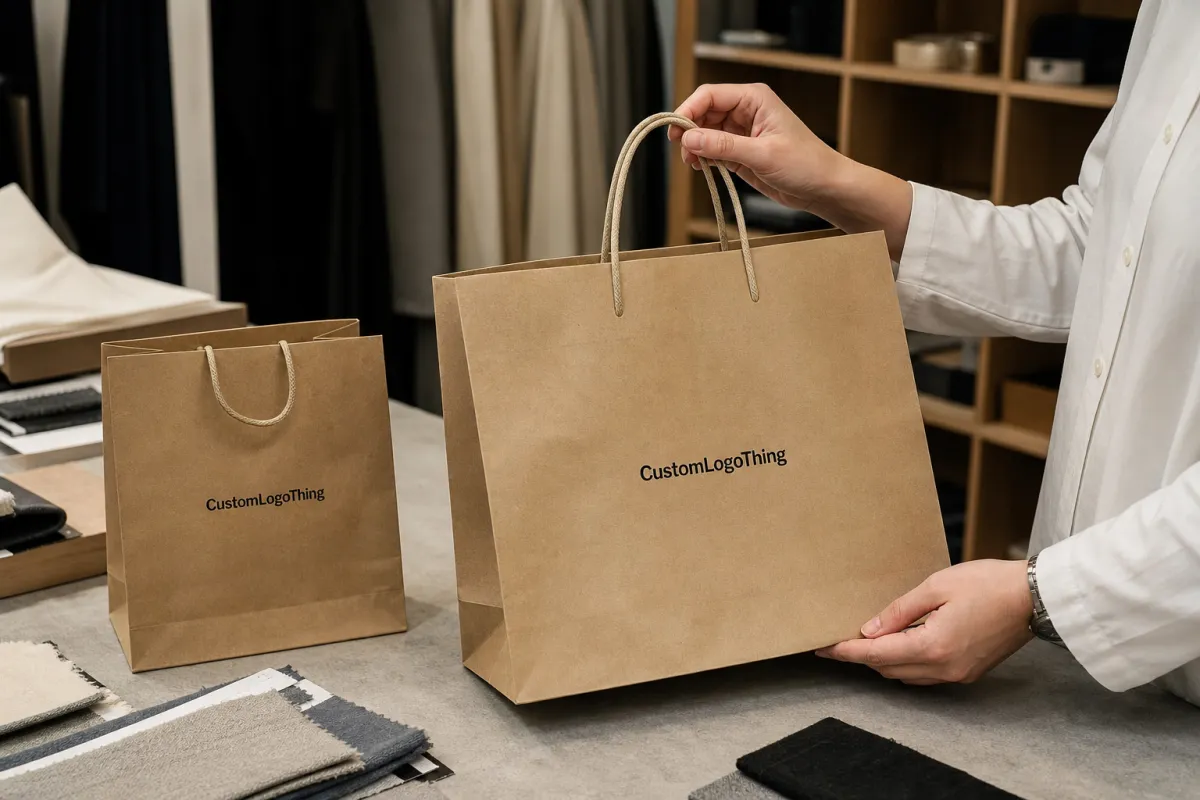
Cheap bags usually save money in only one place: the invoice. Thin paper, weak glue, undersized handles, and poor bottom reinforcement can all create costs after the sale. Staff may start double-bagging heavier items. Customers may complain about broken handles. Replacements may be needed before the run is even finished.
There is also a softer cost that shows up in the store, and it is easy to underestimate. A bent, greasy, or sagging paper bag makes a polished retail environment look temporary. In fashion retail, that matters more than many buyers want to admit. A bag is not the product, but it is part of the proof that the product belongs in a well-run store.
Freight and timing add another layer. A rushed reorder can cost significantly more than the first run, especially if the supplier has to rebook production or upgrade shipping. If the bags arrive after the campaign launch, the store may still pay for emergency replacements from a local supplier. Those emergency units are rarely cheaper than the original plan.
A bag that fails once is not a bargain. It is a future expense with a low starting price.
That is why the cost conversation should begin with performance, not print. If the bag cannot hold a folded garment, support a shoebox, or survive a wet commute, the price on the quote is only part of the story.
What a clothing-store bag needs to handle
Apparel bags have a practical job. They need to carry folded shirts, knitwear, denim, accessories, or boxed merchandise without collapsing, tearing, or looking awkwardly oversized. The right size depends on what the store sells most often, not on a generic “medium” label from a catalog.
That is where a lot of quoting goes sideways. A boutique selling scarves and tops has different requirements than a retailer moving jackets, shoes, and gift items. Ask for the folded dimensions of the typical sale basket. That gives a supplier a real target. Guesswork usually produces a bag that is technically custom and operationally wrong.
Gusset depth changes more than appearance. A deeper gusset gives the bag structure, keeps it upright at the counter, and makes it easier to fit layered items without stress on the seams. Bottom reinforcement matters for heavier garments and mixed purchases. Handle feel matters too. If the handles twist, cut into the hand, or sit too close to the top fold, customers notice immediately.
There is a visual function as well. A paper bag that stands square on the counter looks orderly. One that bows outward or slumps forward looks underbuilt, even if the print is perfect. That is one reason premium retailers often prefer a slightly heavier stock than the minimum required for load strength. The extra stiffness changes the whole impression.
A practical way to match bag style to store format:
- Small boutique - folded tees, jewelry, accessories, and light knitwear.
- Mid-range apparel store - denim, layered outfits, gift items, and occasional boxed goods.
- Premium fashion retailer - heavier stock, stronger visual standards, and more demand on the handle.
- Shoe or multi-category store - wider gussets, reinforced bottoms, and larger carry weight.
If the store already uses boxes, tissue, or inserts, the bag should fit that packaging system instead of competing with it. A checkout experience feels disjointed when each component looks like it came from a different spec sheet. If your packaging lineup includes Custom Packaging Products, keep the materials and finish language consistent across the range.
Paper stock, handles, and print details that change price
Paper weight is one of the first variables to move the quote. Heavier stock costs more, but it also improves rigidity, carry strength, and perceived quality. For many apparel buyers, kraft in the 120gsm to 200gsm range is a common starting point. Coated paper or premium board pushes both the appearance and the cost higher.
Kraft usually reads as practical and sturdy. Coated stock gives a smoother print surface and a sharper premium look. Recycled content can be a good fit for brands that want that story on the shelf, but the buyer still needs to check performance. Recycled paper is not automatically weak, and it is not automatically strong. Fiber quality and construction matter more than the label.
Handle style changes both cost and user experience. Twisted paper handles are common and economical. Flat handles are simple and utilitarian. Rope handles usually raise the unit cost, but they also improve comfort and make the bag feel more finished. Die-cut handles remove a separate handle component and can look clean, though they are not always the best option for heavier garments or mixed orders.
Print structure has a bigger impact than many buyers expect. A single-color logo on one side is the least expensive setup. Add second-side print, multiple colors, foil, embossing, spot UV, or inside printing, and the quote climbs fast. None of those upgrades are wrong. They just need a reason.
| Spec choice | Typical price impact | Best fit |
|---|---|---|
| Twisted paper handle | Lowest | Standard apparel orders |
| Flat paper handle | Low to moderate | Light retail loads and simple branding |
| Rope handle | Higher | Premium boutiques and gift-oriented packaging |
| 1-color logo print | Lowest print cost | Simple branded packaging |
| Full coverage or foil | Highest print cost | Luxury retail or launch programs |
On repeat orders, the smartest upgrades are usually the ones that improve durability or keep the visual identity consistent. Fancy effects can be useful, but they should not erode margin every time the store reorders. A clean logo on good stock often beats an elaborate finish on weak paper.
Custom Clothing Store Paper Bags Unit Cost Breakdown
A proper quote should show the cost structure clearly. The best way to read a custom clothing store paper Bags Unit Cost Breakdown is to split it into material, handle, print, setup, packing, and freight. If a supplier hides those pieces inside one number, comparison becomes guesswork.
The main reason unit price falls as quantity rises is simple: fixed work gets spread across more bags. Artwork prep, plate or screen setup, machine adjustment, test runs, and first-piece inspection all have to happen whether the order is 500 units or 10,000. On a short run, those costs can make up a large share of the landed price. On a longer run, they become much less visible.
| Order size | Typical unit cost range | What drives the number |
|---|---|---|
| 500 pieces | $0.55-$1.10 | Setup cost, small-run labor, freight share |
| 2,000 pieces | $0.28-$0.58 | Better production efficiency and more diluted setup |
| 10,000 pieces | $0.16-$0.34 | Material buying power and lower setup burden per bag |
Those are working ranges, not promises. A larger bag, a heavier paper weight, rope handles, foil stamping, or multi-color print can push the number upward fast. A simple kraft bag with a one-color logo and twisted handles usually sits near the lower end. A coated premium bag with special finishing usually sits much higher. The build decides the price, not the logo alone.
One useful way to think about it is this:
Unit cost = material + handle + print + setup allocation + packing + freight allocation
The sharpest cost drivers are usually the ones buyers can control early:
- Bag size - larger dimensions use more paper and larger components.
- Paper weight - heavier stock raises raw material cost and improves stiffness.
- Print colors - more colors usually mean more setup and more production complexity.
- Finish upgrades - foil, embossing, lamination, and specialty coatings raise the price quickly.
- MOQ - low minimum order quantity keeps setup costs visible on every unit.
For buyers comparing multiple suppliers, quote structure matters as much as the final number. A lower unit price that excludes freight, packing, or sample approval is not really a lower price. It is just a thinner quotation. The comparison only works when every supplier is quoting the same build.
As a broad sanity check, basic Retail Paper Bags often land around $0.50-$1.00 in small runs, mid-volume branded bags often fall around $0.25-$0.60, and larger repeat orders can move below that if the spec stays simple. Those ranges shift quickly with size, finishing, and shipping method. That is the part buyers learn the hard way if they only compare headline numbers.
Production, proofs, and timing
The production flow should be straightforward. Artwork review, dieline confirmation, proof approval, test sample if needed, mass production, inspection, and packing. The less ambiguity in the file, the fewer delays later. Missing dimensions, low-resolution logos, or uncertain fold lines tend to stall the job at the exact moment the schedule needs to stay still.
Simple one-color runs usually move faster than premium builds. Standard twisted handles and a single print location are easier to produce than custom handles, heavy board, foil accents, or full wrap artwork. None of this is mysterious. Every added step adds another point where quality can drift or timing can slip.
Before production starts, a buyer should confirm these items:
- Finished bag dimensions.
- Paper type and paper weight.
- Handle style and handle color.
- Print location, color count, and approved artwork version.
- Carton count and packing method.
- Delivery address and freight method.
Production time and transit time are separate clocks. That sounds obvious, but it is one of the most common planning mistakes. A supplier may quote 12-15 business days for manufacturing, then another week or several weeks for shipping depending on the route. If the bags are tied to a store opening, collection launch, or seasonal refresh, that distinction matters more than the unit cost itself.
For buyers who care about transport performance, third-party references help keep the conversation grounded. Shipping test standards from groups like ISTA are useful when packaging needs to survive the logistics chain. If recycled or responsibly sourced paper matters, FSC chain-of-custody certification is worth asking about. Neither one chooses the supplier for you, but both give you a cleaner way to judge claims.
Samples matter more than many teams assume. A blank dieline, a material swatch, or a pre-production sample can reveal problems that do not show up in the spec sheet: logo placement that sits too low, handles that feel awkward, a bottom fold that does not lie square, or paper that looks flatter than expected. Catching that early is cheaper than reprinting 5,000 bags after the fact.
Repeat orders and quality control
Repeat orders should be simpler than the first run. The best suppliers keep the approved dieline, artwork, paper weight, color references, and carton specifications on file. That makes reordering faster and reduces drift between batches. If a retailer has several branches, consistency matters even more. Customers notice when one location hands out a bag that feels different from another.
Changing vendors midstream can save a small amount on paper and cost more in consistency. Paper mills vary. Adhesives vary. Print interpretation varies. Two bags with the same artwork can still feel different in the hand. If the brand depends on a controlled look, the safest route is usually to keep one approved build and reorder against that spec.
A practical quality check before repeat shipment should cover:
- Handle pull strength.
- Glue line coverage.
- Print placement and color accuracy.
- Dimensional tolerance.
- Bottom support and square fold quality.
Most surprise charges are avoidable. Revised artwork after approval. A rush request after the production window is booked. Split shipments because delivery details changed late. A finish change after the sample is approved. Each one can move the unit cost upward, and the total increase is often larger than buyers expect.
There is a simpler rule that helps in practice: keep the spec stable unless the new version clearly solves a problem. Upgrades should reduce damage, improve fit, or keep the brand consistent. If they do not do one of those things, they probably only add cost.
How to quote the right bag
To get a quote that can actually be compared, send the information that changes price: finished size, typical contents, logo file, number of print colors, handle type, target quantity, and delivery location. If those details are missing, the reply will be vague. That is not a supplier problem. It is a missing-spec problem.
Ask for a blank dieline or a sample when the bag must fit folded apparel, a boxed item, or a mixed retail order. That is especially useful when the store carries products of very different shapes and weights. A bag that fits one product well can look too small or too generous with another.
Before choosing a supplier, compare these items on the same basis:
- Same size and stock.
- Same handle type.
- Same number of print colors.
- Same finish and coating.
- Same freight terms.
- Same MOQ.
If one quote looks much cheaper than the rest, ask what is missing. In many cases, the lower price excludes freight, packing, or setup. In others, it quietly uses lighter paper or a simpler handle. The goal is not the lowest number on the page. The goal is a bag that supports the sale, holds its shape, and stays consistent on reorder.
That is the practical value of a custom clothing store Paper Bags Unit Cost Breakdown. It turns a messy quote into a readable comparison, keeps the hidden costs visible, and helps a retail buyer choose packaging that performs the same way it looks: clean, controlled, and ready for the handoff.
What drives the unit cost for custom clothing store paper bags the most?
Bag size and paper weight usually move the price first. Handle style, print coverage, and finish upgrades can raise the per-bag cost quickly. Low quantities cost more because setup and labor are spread across fewer units.
What MOQ should I expect for apparel retail paper bags?
Many custom runs start in the few-hundred range, but the economical pricing usually begins higher. Smaller MOQs are possible, though the unit cost rises because setup does not shrink. If you need recurring orders, ask for a price ladder across quantities.
Which paper stock is best for a clothing store bag?
Heavier kraft or coated stock works well when the bag carries folded garments or shoeboxes. Recycled stock can be a good choice when sustainability matters, but the material still needs enough stiffness for daily retail use. Match the stock to the load, not just the look.
How much does printing add to the bag price?
A simple one-color logo is usually the most economical option. Multiple colors, foil, embossing, inside print, and full coverage add cost and often add setup time too. Artwork complexity can matter as much as ink coverage.
How long does production usually take after artwork approval?
Simple builds can move faster than premium ones with custom finishes. Sampling, approval, production, and freight all affect the final delivery date. Ask for separate production and transit timelines so the arrival date is clear.

