If you are comparing Zipper Pouches for Apparel Unit Cost Breakdown quotes and the numbers do not line up, that usually means the requests were not identical. One supplier may be pricing a bare pouch, another may be including print setup, cartons, and freight, and a third may be quoting a size that is 15 mm larger in both directions. Those differences are enough to move a unit price by a noticeable margin.
A pouch can look like a small line item, but in apparel packaging it touches product protection, visual presentation, warehouse speed, and freight efficiency all at once. A quote that looks low on the screen can turn into a higher landed cost once setup charges, rework, and shipping are included. The better question is not which pouch is cheapest. It is which spec protects the garment, fits the packing line, and stays economical at the order volume you actually need.
That answer changes with the fabric, the fold, the print area, and the way the pouch travels through the supply chain. A lightweight tee in a warehouse-only pouch does not need the same build as a swimwear set heading to retail. The cost structure follows that reality.
Why a cheaper pouch can cost more per garment
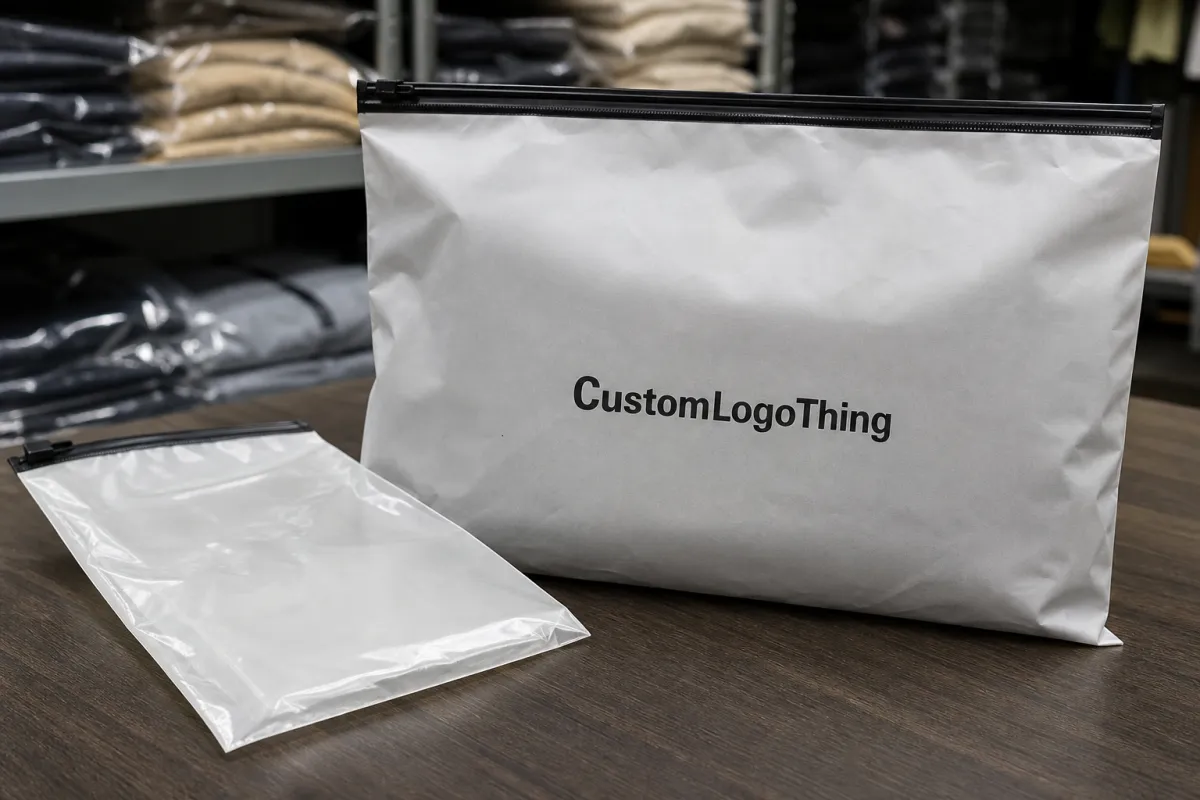
Low sticker price is not the same as low total cost. A thin pouch may save a fraction of a cent in material, then create expenses elsewhere: split seams, wrinkling, packing slowdowns, or repacking after inspection. If a line has to stop to fix fit issues, the labor cost rises faster than the packaging savings ever fall.
That is why the cheapest quote is often the most expensive option in disguise. A pouch that tears during bulk packing creates waste. A pouch that scuffs easily can dull the presentation of a garment that was otherwise ready for retail. A pouch that is too large wastes film and carton space. A pouch that is too small slows the team down and increases rejects. None of those problems are dramatic on their own. Together, they erode margin.
For apparel brands, the pouch is also part of the product story. Clear packaging gives visibility and helps with quick identification in a warehouse or store. Frosted film can make the package feel cleaner and more premium. Tinted or printed film can provide privacy for intimates or sleepwear. The material choice shapes the brand impression long before a customer handles the garment.
There is another hidden cost that buyers sometimes miss: overengineering. Some teams order oversized pouches because they want a cushion of safety around every product. That sounds cautious. In reality, extra empty space means more film, more storage, more freight volume, and sometimes more folded wrinkles. The smarter move is to size the pouch to the garment and then add only the features that solve a real handling problem.
Practical rule: if the pouch only needs to protect the garment, keep the build simple. If the pouch has to do retail work too, pay for clarity, closure quality, and print consistency where shoppers can actually see the difference.
What goes into a zipper pouch for apparel
A zipper pouch is straightforward in concept. In production, each detail affects cost, speed, and consistency. The core parts are the bag body, the zipper track, the seal, and the overall shape. Depending on the application, a pouch may also include a hang hole, a tear notch, venting, a gusset, or a tamper feature. Each added element means more material or another step on the line.
Size needs to match the folded garment, not a guess about the folded garment. Shirts, leggings, socks, underwear, and multi-piece sets all occupy different volumes. A slim pouch may work for a folded tee but fail on a bulkier knit or a layered set. A gusset can solve that problem, but it also changes the material use and assembly method. That is one reason two pouches that look similar from a distance can price very differently.
Material finish is another major decision. Clear film is common because it shows the product and helps retailers identify the item quickly. Frosted film softens the look and hides minor packing marks. Tinted film adds privacy and can reduce the visual clutter of multiple SKUs in the same assortment. Printed pouches carry branding, care information, or legal copy. Each option has a different cost profile, and each serves a different merchandising purpose.
Several practical details tend to matter more than design mockups suggest:
- Easy-open notch: useful for retail packaging, less necessary for warehouse-only use.
- Barcode zone: needs to stay flat enough for labels and scanning.
- Carton pack count: affects labor, receiving speed, and freight efficiency.
- Stacking behavior: a pouch that stacks neatly often saves time downstream.
Transport and handling standards matter as well, especially if pouches are packed into cases and moved through multiple distribution points. ISTA publishes widely used package testing guidance, and packaging teams often use those principles to check whether a pouch and shipper can survive sorting, stacking, and transit. For broader material and packaging context, packaging.org is a helpful reference point.
Specification choices that move the quote
Film thickness is one of the fastest ways to change the price. Thinner film lowers the base cost, but it can wrinkle more easily and offer less puncture resistance. Thicker film feels more substantial and usually handles packing better, yet it adds material cost and may reduce the number of pouches that fit in a carton. There is no universal winner. The right gauge depends on garment weight, shipping conditions, and whether the pouch needs to face customers or only warehouse staff.
Size has an equally direct effect. Extra width and height waste material on every unit. A few millimeters may seem trivial, but across 10,000 pouches the difference becomes measurable. Undersizing is worse. Once the fold no longer sits cleanly inside the pouch, packing time rises and quality checks become more frequent. That is not a design issue. It is a labor issue.
Print complexity can also push the price up quickly. One-color branding on one side is simple. Full-coverage artwork, white ink underlays, tight registration, or dual-sided print requires more setup, more inspection, and more opportunity for waste. If a brand needs color accuracy, the proofing stage may take longer and sometimes reveals that the first artwork version was never practical on the chosen film.
The zipper itself deserves attention. Standard zippers are usually economical and reliable for most apparel uses. Stronger closure tracks, tamper-evident features, or upgraded closure feel more premium, but they introduce extra cost and sometimes slower assembly. If the pouch needs to be opened repeatedly, handled by customers, or sealed for security, the closure spec should be chosen for the use case rather than for visual preference alone.
| Spec choice | Typical effect on unit cost | Why it changes the quote | Best use case |
|---|---|---|---|
| Thinner clear film | Lower base price | Uses less material, but offers less resistance to scuffs and tears | Warehouse packing, lightweight garments |
| Thicker film | Higher base price | Adds material and improves feel and durability | Retail-facing apparel, premium presentation |
| One-color print | Moderate increase | Simple setup and limited press time | Logo-driven branding |
| Full-coverage print | Higher increase | More ink, more inspection, tighter registration control | Privacy-focused or premium packaging |
| Standard zipper | Lower to moderate | Common hardware and easier production | Most apparel packing |
| Upgraded zipper or tamper feature | Higher | Extra components and assembly steps | Higher-value garments, retail display |
Zipper pouches for apparel unit cost breakdown
The quote that matters is the one that includes everything needed to put product into inventory and ship it out. For zipper pouches for apparel Unit Cost Breakdown analysis, the key is to separate the base pouch price from fixed costs and freight. On small runs, fixed costs can dominate the total. On larger runs, the material and labor costs take over. That shift explains why two buyers can see very different pricing from the same factory.
For a plain or lightly printed apparel pouch, the ranges below are a practical starting point. They are estimates, not promises. Film type, closure style, print coverage, and destination all influence the final landed cost.
| Order quantity | Typical cost per piece | Main cost pressure | Best fit |
|---|---|---|---|
| 1,000 units | $0.28-$0.55 | Setup charges, proofing, freight spread | Launches, samples, seasonal test runs |
| 3,000 units | $0.18-$0.36 | Fixed costs still matter, but spread improves | Small retail drops, limited collections |
| 5,000 units | $0.14-$0.28 | Material and labor become the main drivers | Core apparel programs |
| 10,000 units | $0.10-$0.22 | Print complexity and freight weight | Repeat programs, basic branded packaging |
Those numbers are useful because they expose whether a quote is in the right neighborhood. If a supplier is offering a heavily printed pouch at a price that sits below these ranges, something is probably missing. Tooling, cartons, freight, or a key spec may have been left out. If the quote is higher, that is not automatically a problem either. A thicker film, better zipper, or more demanding print process can justify the jump.
Tooling fees and setup charges deserve their own line. On simple work, they may land around $80-$300. More complex prints, specialty hardware, or multiple proof revisions can push that higher. The important issue is not the size of the fee by itself. It is how many units will absorb that cost. A $250 setup spread across 1,000 pieces is very different from the same fee spread across 10,000.
MOQ changes the economics in a clear way. Lower minimums help with new SKU tests, holiday launches, and uncertain sell-through, but the unit price climbs because the factory has less volume to absorb fixed costs. A lower MOQ also narrows the options for customization. If the pouch requires special ink, a custom zipper, or more complex print placement, minimums often rise.
To compare two quotes fairly, the request has to be controlled. Lock these five points before judging price:
- Exact pouch size, including usable opening width.
- Film gauge or thickness.
- Zipper style and closure requirement.
- Print method, coverage, and number of colors.
- Packing terms, freight terms, and carton count.
Once those items match, the remaining price difference is usually meaningful. Before that, it is just noise.
Production steps and lead time from proof to delivery
Lead time is usually a function of clarity. Clean specs move quickly. Incomplete specs slow everything down. A straightforward run follows a predictable sequence: request review, artwork check, spec confirmation, sample or proof, production, inspection, packing, and shipment. None of that is glamorous. All of it matters.
The sample stage is more than a formality if the pouch has to fit a specific folded garment. A knit tee, a bulky hoodie, and a flat pair of socks do not behave the same way inside a pouch. Fold structure, fabric thickness, and seam bulk can shift the fit enough to cause problems later. A pouch that seems fine on a flat proof can behave differently once it is being packed at speed.
The most common delays usually come from the buyer side:
- Missing dielines or low-resolution artwork.
- Unclear folded dimensions for the garment.
- Approval delays across multiple internal teams.
- Changing the pouch after the sample has already been reviewed.
For a standard custom run, many buyers see production and delivery windows around 12-20 business days after approval. That range can shorten if the spec is simple and the artwork is ready. It can stretch if the order includes print revisions, a new zipper construction, or additional testing. Freight method matters too. Air is faster and more expensive. Sea is cheaper and slower. The decision is usually driven by launch timing, not by packaging theory.
A clean master spec sheet prevents a lot of friction. One document, one approval path, one version of the truth. That approach is boring, but it keeps the schedule intact and reduces the chance of a misread on size, color, or packing count.
Why apparel brands stay with a packaging factory partner
Consistency is the real value of a stable packaging partner. A low quote from a supplier that cannot repeat size, color, or zipper feel becomes expensive fast. One batch arrives a little loose. The next is a little tight. The third has a color shift that looks wrong beside the first two. That is not savings. That is disorder with better margins on the first invoice.
Direct production control helps reduce that risk. Fewer handoffs mean fewer chances for spec drift. Fast answers matter too, because apparel teams work around launch windows and replenishment schedules. A supplier that understands the practical side of packing, stacking, and shipping can spot issues before they hit the line. A supplier that only reads the artwork file usually cannot.
Good factory relationships also keep the unglamorous tasks in order: quality checks, document control, stable MOQ paths for reorders, carton labeling, and packing count discipline. Those items rarely show up in a sales pitch, yet they are exactly what prevents receiving problems later. If 8,000 pouches arrive and half the cartons are mislabeled, the hidden cost can be days of labor.
Buyers often think they are comparing suppliers. In reality, they are comparing systems. One system gives a clean reorder path and predictable output. Another gives a lower headline price and more internal work for the buyer. The second option can still make sense on a short-run test, but it is a weak fit for ongoing programs.
The best partner is not the one promising magic pricing. It is the one that explains the tradeoffs, keeps defects low, and gives straight answers about what a spec can and cannot do. That is how packaging stops being a recurring headache and starts acting like a controlled input.
Next steps to get an accurate quote and lock production
If the goal is a useful quote, send a complete request in one shot. Include the garment type, folded size, target quantity, print requirements, target ship date, and any warehouse or retail conditions. Scattered details lead to guessed pricing. Complete details lead to something close to a real landed cost.
It helps to ask for a few pricing scenarios side by side:
- Lower-cost spec: basic film, simple zipper, limited print.
- Balanced spec: better thickness, clean print, durable closure.
- Premium spec: upgraded feel, stronger presentation, more decoration.
That comparison shows where the savings actually come from. Sometimes the low-cost spec is perfectly fine for warehouse use. Sometimes it is too thin for retail and ends up costing more in brand damage than it saves in packaging material.
Before bulk approval, request a sample or proof and confirm carton pack counts, freight terms, and responsibility for revisions triggered by unclear artwork. If the pouch includes paperboard inserts or recycled cartons, ask for those specs too. Sustainability claims are only meaningful when the materials and chain of custody are documented.
The cleanest buying process is simple: define the garment, size the pouch around the actual fold, choose the finish based on how the product will be handled, and ask for the quote to separate base price, setup charges, freight, and tooling fees. That is how a buyer gets a real zipper pouches for apparel Unit Cost Breakdown instead of a number that collapses under scrutiny.
What drives zipper pouch unit cost for apparel most?
Film thickness, pouch size, zipper style, and print coverage usually have the biggest impact. MOQ and freight can matter just as much on smaller runs because fixed costs are spread across fewer pieces.
What MOQ should I expect for custom apparel zipper pouches?
MOQ varies by size, print method, and material choice. Larger runs usually unlock better pricing, while smaller launches often carry a higher unit cost and fewer customization options.
How do I compare two pouch quotes fairly?
Match the exact size, film gauge, zipper type, print method, carton count, and freight terms before comparing price. Ask whether tooling fees, sampling, and packaging are included so the landed cost is clear.
Can I get samples before placing a full apparel pouch order?
Yes, and that is the safer path if the pouch needs to fit a specific folded garment or retail presentation. A sample confirms size, closure feel, print placement, and finish before bulk production starts.
What do I need to send for an accurate zipper pouch quote?
Send the garment type, folded dimensions, target quantity, artwork, and any special packaging requirements. Add the destination and the timeline so the quote reflects the actual landed cost.

