Buyer Fit Snapshot
| Best fit | Custom Cmyk Label Printing projects where brand print, material claims, artwork control, MOQ, and repeat-order consistency need to be specified before quoting. |
|---|---|
| Quote inputs | Share finished size, material target, print colors, finish, packing count, annual reorder estimate, ship-to region, and any compliance wording. |
| Proofing check | Approve dieline scale, logo placement, barcode or warning zones, color tolerance, closure strength, and carton packing before bulk production. |
| Main risk | Vague material claims, crowded artwork, missing packing details, or unclear freight terms can make a low unit price expensive after revisions. |
Fast answer: Custom Cmyk Label Printing: Material, Adhesive, Artwork, and MOQ should be specified like a repeatable production item. The safest quote records material, print method, finish, artwork proof, packing count, and reorder notes in one written spec.
Production checks before approval
Compare the actual filled-product size with the drawing, then confirm tolerance on folds, seals, hang holes, label areas, and retail display edges. Reserve space for logos, QR codes, warning copy, and material claims before decorative graphics fill the panel.
Quote comparison points
Review material grade, print process, finish, sampling route, tooling charges, carton quantity, and freight assumptions side by side. A quote is only useful when the supplier can repeat the same color, closure quality, and packing count on the next order.
Custom CMYK Label Printing: A Practical Brand Guide starts with a familiar packaging problem: the file looks crisp on a monitor, the logo gets approved, and the first printed labels arrive looking a little softer, darker, or flatter than expected. custom cmyk label printing is built to narrow that gap, not pretend it does not exist. The job is to get predictable color on paper, film, and roll stock, with enough consistency to keep a brand reading as one brand across several SKUs and packaging formats.
That sounds simple until you have stood next to a press check and watched the same blue behave differently on coated paper, clear film, and textured stock. I have seen that happen more than once, and it is usually not a failure - it is just the physics of print doing what physics does. A screen makes color with light. A press makes color with ink, dots, and the surface underneath them. Those differences matter a lot more than most people expect, and custom cmyk label printing is where they show up fast.
Custom CMYK Label Printing: Why Color Changes on Every Surface
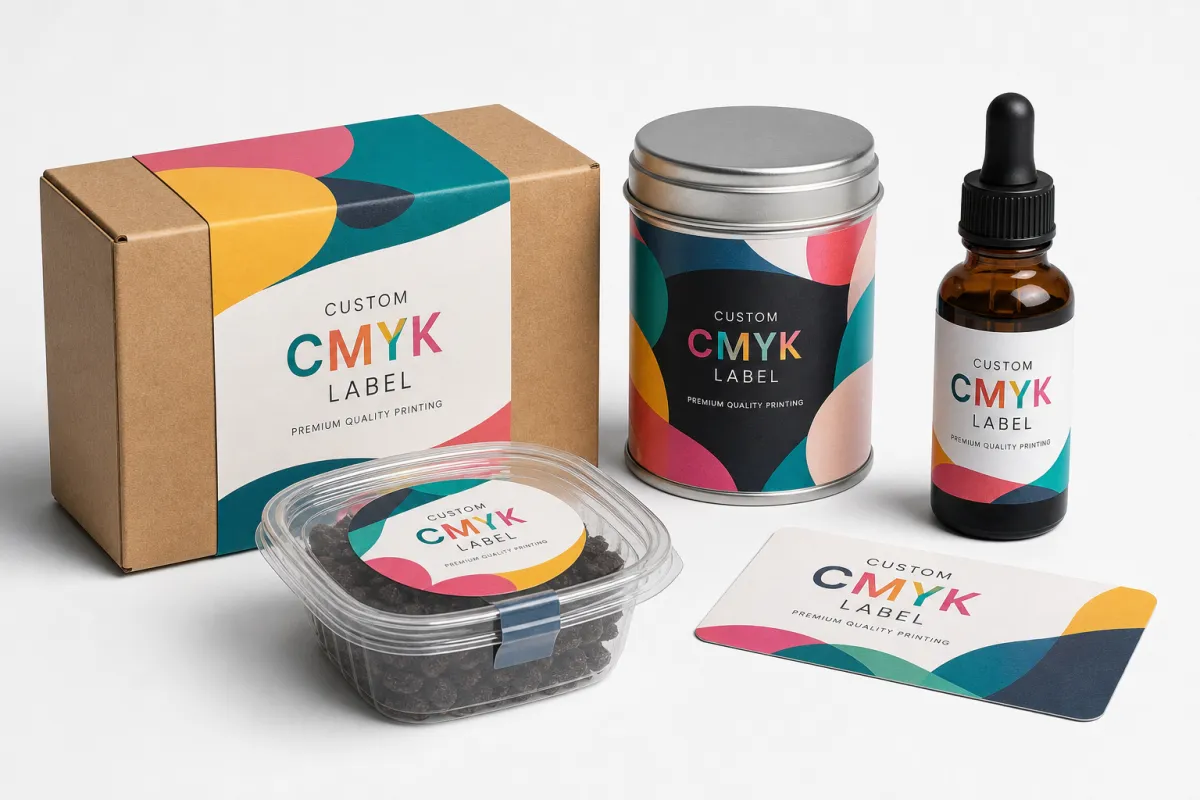
custom cmyk label printing uses four process inks - cyan, magenta, yellow, and black - to build a wide range of colors, gradients, photos, and layered artwork. That sounds straightforward until the substrate changes. A white coated paper label, a clear BOPP label, and a textured stock do not absorb or reflect ink in the same way, so the same file can read differently on each one. That does not mean the printer missed the mark. It is the physical behavior of print.
Custom cmyk label printing works best as a control system. The printer is aiming for a defined, repeatable result within a usable range, not a fantasy of identical appearance across every material. A monitor makes color with light. A press makes color with dots, ink, white space, and the surface under it. The eye reads all of that together. A saturated blue can look rich on glossy film and unexpectedly muted on uncoated paper. A dark green may hold well in one run and drift warmer in another if ink density or drying behavior changes. That is normal, even if it is a little annoying.
Brands usually notice that difference first when they have a lot of moving parts: seasonal flavors, short-run retail packaging, limited editions, private-label product packaging, or programs with frequent copy changes. In those situations, custom cmyk label printing is a practical fit because it supports flexibility. The artwork can shift without rebuilding an entire spot-color library for every version. For many teams, that matters more than locking one signature color to a single ink formula forever.
For a packaging buyer, the real question is not whether CMYK can make color. It can. The better question is whether the final label will stay inside an acceptable range on the intended substrate, finish, and application method. That is a much more useful standard. It keeps the conversation grounded and saves a lot of back-and-forth later, which is usually where custom cmyk label printing proves its value.
CMYK is less like a promise and more like a recipe. Change the paper, the film, or the finish, and the final color will change too.
If a brand needs exact repeatability for a simple logo, spot color can still be the cleaner path. If a brand needs photography, soft gradients, or frequent artwork updates, custom cmyk label printing usually gives more breathing room. That is why it shows up so often in branded packaging programs that also use Custom Packaging Products and Custom Labels & Tags. Labels do a different job than custom printed boxes, but they still need to support the same package branding.
The biggest mistake is treating CMYK as a weaker version of color management instead of a different one. It is a practical system. It is also a negotiable one. A buyer can decide whether a label should be judged by tight brand tolerance, by shelf impact, or by production efficiency. Once that decision is clear, custom cmyk label printing becomes much easier to specify.
How Custom CMYK Label Printing Works From File to Finished Roll
custom cmyk label printing starts long before ink hits a press. The first step is file intake. A printer needs the artwork, dieline, bleed, font handling, and any special notes about finish or application. If the file arrives as RGB, the production team will convert it to a CMYK workflow and often check it against an ICC profile or press-specific color setup. That conversion matters because RGB can describe colors that do not exist in a four-color press environment.
After that comes proofing. A soft proof is fast and useful for layout, copy, and general color direction. A hard proof gives a physical sample on actual stock, which is far more honest about texture, opacity, and finish. Press checks sit above both when the job is high-stakes. For custom cmyk label printing, the proof method should match the risk. A low-volume internal test does not need the same approval path as a nationwide retail launch.
Then the technical work begins. Small dots of cyan, magenta, yellow, and black overlap to create the final image. If the file is built poorly, the dots can spread too much, a problem known as dot gain. That is why gradients, thin rules, and tiny reversed text can behave badly if the artwork was not prepared with the press in mind. The file may look elegant on screen and still print muddy. In custom cmyk label printing, the file is part of the manufacturing process, not separate from it.
Finishing comes next. Labels may be die cut, kiss cut, laminated, varnished, slit into rolls, or sheeted depending on how they will be applied. A clear label on dark packaging often needs a white underprint so the artwork does not disappear into the product container. That extra layer can make the design pop, but it also changes the way ink sits on top of the surface. On clear film, custom cmyk label printing almost always needs more adjustment than a plain white paper label.
Here is the workflow in plain language:
- Artwork intake and dieline check.
- Color conversion from RGB or spot references into CMYK.
- Digital proof or hard proof review.
- Press setup, ink density calibration, and substrate loading.
- Printing, drying, and inline inspection.
- Finishing such as lamination, varnish, or die cutting.
- Final inspection, roll packing, and shipping.
That process sounds linear, but it rarely feels linear in practice. If the substrate changes, the proof can change. If the finish changes, the color can change. If the application method changes, the label may need a stronger adhesive or different release liner. Custom cmyk label printing rewards teams that give the printer complete information up front, especially on retail packaging programs that need consistency from one SKU to the next.
For teams that also manage Manufacturing Capabilities, the benefit is clarity. The same packaging partner can evaluate print method, finishing, and application constraints together instead of treating each one as a separate problem. That usually saves time and cuts down on revision loops.
Key Factors That Shape Color, Durability, and Readability
custom cmyk label printing does not live in a vacuum. Three variables usually shape the result more than anything else: the substrate, the finish, and the container itself. A coated paper label tends to hold detail differently from BOPP or clear film. A gloss lamination can make color feel deeper and sharper. A matte finish can make the artwork feel calmer, but it may also soften contrast. Those are not minor details. They are the reason one label looks premium and another looks merely acceptable.
Substrate choice is the first decision with real consequences. Paper tends to be easier to print and can be cost-effective for many food, beverage, and retail packaging applications. Film stocks such as BOPP are better for moisture resistance and handling durability. Metallic stocks can add visual punch, but they often make CMYK builds less forgiving because the reflective base changes the perceived tone. Textured papers can feel more artisanal, yet they may reduce fine detail. In custom cmyk label printing, the right surface is rarely the cheapest one; it is the one that survives the use case.
Readability matters just as much as color. Thin sans-serif type, small ingredient text, and reverse text on busy backgrounds can all fall apart if the contrast is weak. A label that looks elegant on a design comp may fail on a shelf if the eye has to work too hard. That is especially true on curved bottles and jars, where reflections can bend the light and obscure the copy. Packaging design should always be judged on the actual package, not only on the flat proof. custom cmyk label printing exposes those weak spots fast.
Durability is the other half of the equation. Chilled environments, condensation, oil, friction in transit, and frequent handling all stress labels differently. If the product needs to survive cold storage, the adhesive choice can matter as much as the print itself. Some teams also build validation around distribution testing from ISTA, because vibration, compression, and impact can reveal label failures that a tabletop inspection will miss. For paper-based materials, sourcing claims may also matter, so many buyers check whether the substrate supports responsible fiber sourcing through FSC documentation when that fits the brand story.
The practical takeaway is simple: custom cmyk label printing should be specified as a package system, not just as a graphic file. The ink, stock, finish, adhesive, and container all shape the outcome. Brands that treat those variables as separate line items often end up paying twice - once for the label, and again for the reprint.
| Variable | What It Changes | Practical Note |
|---|---|---|
| Coated paper | Color sharpness, detail, cost | Good for many dry retail packaging applications and short-run promotions. |
| BOPP film | Moisture resistance, handling durability | Often chosen for chilled, wet, or high-contact product packaging. |
| Gloss finish | Color depth, contrast, shelf pop | Can make custom cmyk label printing look richer, but glare may affect readability. |
| Matte finish | Softens color and reflection | Can feel premium and quieter, though dark tones may print less saturated. |
| White underprint | Opacity on clear or metallic stock | Essential when artwork needs to sit on a transparent container. |
That table captures the tradeoff most buyers eventually face. The prettier the effect, the more technical the construction usually becomes. A label that looks simple on a brief can be surprisingly specific once custom cmyk label printing turns into a production decision.
Custom CMYK Label Printing Costs: What Really Drives Price
custom cmyk label printing is usually priced by a mix of setup, materials, finishing, and quantity. The first cost lever is almost always run size. A 500-piece run has to absorb the same basic setup work as a larger order, so the unit price climbs quickly. By contrast, a 10,000-piece run spreads those fixed steps across more labels. That is why short-run label printing can feel expensive per piece even when the total invoice looks modest.
Material choice comes next. Coated paper is usually less expensive than specialty film or metallic stock. White BOPP, clear BOPP, and freezer-grade adhesives often add cost because the construction is more demanding. White ink also changes the budget. It is not expensive in every case, but it can increase press complexity, especially on clear film or when the artwork needs a high-opacity underlayer. In custom cmyk label printing, the cheapest quote is not always the most economical once the label has to survive actual use.
Finishing makes a bigger difference than many buyers expect. Gloss or matte lamination, soft-touch coatings, embossing, foil accents, and Custom Die Cuts all raise the price because they add steps and waste. Even a small change in shape can influence tooling and trim. If the label needs to fit around a curved bottle shoulder or align with a dispenser system, the production team may need additional setup time. That is one reason custom cmyk label printing quotes can vary so much for nearly identical-looking artwork.
There is also a difference between setup cost and unit cost. A vendor may show a low piece price but a higher proof fee, plate fee, or die fee. Another vendor may look pricier at first yet include several production steps in one quote. Buyers should compare the total package, not only the per-label number. That includes proofing, waste allowance, shipping, and reprint policy. If the label is part of a larger launch, ask whether the vendor can bundle it with Custom Labels & Tags or coordinate with broader Custom Packaging Products for a cleaner production schedule.
Here is a practical comparison to help teams budget custom cmyk label printing more clearly:
| Print Option | Typical Fit | Illustrative Unit Range | Notes |
|---|---|---|---|
| Digital CMYK | Short runs, frequent artwork changes, many SKUs | $0.08-$0.28 per label | Fast turnarounds and flexible data, with setup kept relatively light. |
| Offset CMYK | Longer stable runs with consistent art | $0.04-$0.14 per label | Can be cost-efficient at scale, but setup and finishing complexity rise quickly. |
| Hybrid CMYK + spot or special finish | Brand-critical labels needing exact accents or premium effects | $0.10-$0.35 per label | Useful when process color needs help from spot ink, varnish, or white underprint. |
Those ranges are directional, not fixed. Label size, coverage, roll count, artwork density, and substrate all matter. A dense full-bleed label will cost more than a small one-color mark on plain stock. A rush request can add 10% to 30% in some shops. A second proof round may add a modest fee or simply extend the schedule. That is normal. Custom cmyk label printing is price-sensitive because it sits at the intersection of print, packaging, and logistics.
One useful way to think about the budget is this: digital printing tends to win on flexibility, offset printing often wins on scale, and custom cmyk label printing as a broader category wins when brands need color variety without managing a heavy inventory of preprinted stock. For many companies, that is the real savings - fewer obsolete labels, fewer emergency reprints, and less dead inventory sitting in the warehouse.
Timeline and Production Steps for Custom CMYK Label Printing
custom cmyk label printing moves fastest when the file is clean, the specifications are complete, and the proof gets approved quickly. In a simple digital workflow, the timeline may be only a handful of business days after approval. More complex jobs - multiple SKUs, specialty finishes, white ink, or unusual substrates - often need 10 to 15 business days, sometimes more if the printer has to source material or coordinate a second approval round.
Stage one is intake. The printer checks the dieline, bleed, font handling, and image resolution. If anything is missing, the job slows immediately. Stage two is prepress, where the team converts color, confirms overprint behavior, and prepares the file for press. This is the point where custom cmyk label printing either gets easier or gets messy. Clear instructions reduce surprises. Ambiguous copy creates them.
Stage three is proof approval. This is where many schedules slip. The file may be fine, but the customer needs internal sign-off from marketing, compliance, procurement, or the product team. A brand with multiple stakeholders can lose days here. That is normal in product packaging. It is also why experienced buyers keep approval chains short and predictable. A fast proof cycle matters as much as the press itself.
Stage four is production. The press is loaded, ink density is checked, and the substrate is adjusted for the run. If the job includes custom cmyk label printing on clear film, the printer may need to dial in a white underprint and more aggressive inspection because opacity becomes more noticeable. Stage five is finishing: die cutting, lamination, slitting, rewinding, and carton packing. Stage six is final quality control. That is where print registration, cut accuracy, and basic appearance checks get verified before shipment.
The biggest delay factors are usually mundane, which is frustrating because they are also preventable:
- Missing dieline or incorrect trim dimensions.
- RGB artwork that was never properly converted to CMYK.
- Low-resolution images or embedded files that break on export.
- Late changes to finish, adhesive, or quantity.
- Substrate substitutions because a preferred stock is out of inventory.
- Shipping constraints that require a different carton count or freight method.
Inventory matters more than many teams expect. If the printer has the wrong roll stock on hand, custom cmyk label printing can stall even when the artwork is ready. That is one reason buyers should ask about material availability before they approve the proof. A good schedule is not only about speed. It is about removing the specific points where a job can get trapped.
There is also a relationship between timeline and cost. Rush work reduces flexibility. Extra proofs add time. Expedited freight increases the total. If the job is a seasonal launch, plan backward from the retail ship date, not forward from the design approval date. That avoids the common mistake of assuming printing is the last step. In packaging, it is one of the last steps, which means it often inherits everyone else’s delays.
Common Mistakes That Lead to Flat Color or Reprints
custom cmyk label printing has a short list of predictable failure points, and most of them are avoidable. The first is designing in RGB and assuming conversion will solve everything. It will not. RGB is a display space. CMYK is a print space. If the artwork depends on luminous blues, neon greens, or ultra-saturated oranges, the conversion can dull the result. That is not a printer problem. It is a file problem.
The second mistake is falling into the Pantone trap. Many brands believe every color can be matched exactly with process inks. That is not true. Some hues are easy. Others are stubborn. Saturated blues, hot reds, and bright accent tones often shift. If brand accuracy is non-negotiable, a spot color may be smarter for the logo while custom cmyk label printing handles the rest of the artwork. Hybrid work is often the practical answer.
The third problem is proofing on the wrong surface. A screen proof only tells part of the story. A flat paper mockup also misses the point if the final label will sit on clear film, a chilled bottle, or a metallic carton panel. The exact same design can read differently on shelf because the product itself changes the visual context. That is why product packaging teams should always review the label in conditions close to the final use case.
The fourth issue is typography. Tiny type, thin rules, and low-contrast copy become risky fast. Ingredients, warnings, and legal copy are not the place to be clever. If the label has to live on a damp bottle or under retail lighting, the type should stay readable from a normal viewing distance. That is especially true for custom cmyk label printing on small formats, where every millimeter matters.
The fifth mistake is ignoring the application environment. A label that performs well on a dry carton may fail on a curved bottle or in a cold room. Moisture can lift the edge. Oil can weaken adhesive performance. Tight application lines can change the way the label lays down. If the package will be handled in a warehouse or refrigerated distribution chain, ask for a construction that fits that environment. For some teams, that means a tougher adhesive. For others, it means a different face stock or finish. Either way, the label should be engineered for the real use case, not the mockup.
Most reprints begin with one of these issues:
- Wrong color space or unmanaged color conversion.
- Proof approved on the wrong stock.
- Tiny text that looked acceptable on screen but failed in print.
- Artwork that ignored the curvature of the container.
- Label construction that was too light for the environment.
In many jobs, custom cmyk label printing is not the risky part. The risk is making assumptions before the job reaches press. That is why careful buyers ask for physical samples, keep a record of approved versions, and compare the label on the actual package before signing off.
Expert Tips and Next Steps for Custom CMYK Label Printing
Good custom cmyk label printing starts with a better brief. The best teams do not send a logo and hope the printer can guess the rest. They send the dieline, final quantity by SKU, substrate preference, finish, application method, and approval deadline. That small amount of discipline saves a surprising amount of back-and-forth. It also gives the printer room to recommend a better build before the job is locked.
One useful habit is building a reference kit. Keep the approved physical sample, the color target, the rejected version, and a few photos of the filled package under real lighting. That kit gives everyone a shared reference point. It is much more useful than arguing over a screen capture viewed under different brightness settings. For custom cmyk label printing, the right reference is a physical one.
Another strong move is asking for substrate-specific proofing guidance. If a label may need to work on paper and film, ask how the same artwork will change on each. If the label has to live on chilled packaging, ask how the adhesive behaves after condensation. If the project includes special finishes, ask whether the finish will raise or mute contrast. That kind of question separates routine label buying from experienced packaging management.
Teams should also think about the label as part of a broader system. A brand launching product packaging for a beverage, supplement, or personal-care line may also need Custom Packaging Products or a box program that matches the same visual language. Labels, sleeves, cartons, and inserts should not feel like they came from different rooms. That is where package branding either feels intentional or starts to look patched together.
A pilot run is often worth it, especially for a new substrate, a new line, or a product that will face moisture, abrasion, or frequent handling. The first run gives you a real-world read on color, adhesive, and finish without committing to a large inventory. If the pilot works, scale it. If it does not, fix the weak point before the larger order. That is a better use of budget than discovering the issue after distribution.
I have seen teams save themselves a headache by approving one extra sample on the actual container before launch. It is a small step, but it catches the stuff that software cannot - a barcode that gets crowded by the seam, a matte finish that dulls the contrast too much, or a clear label that disappears a little more than expected. Those are the details that matter once the product hits the shelf, and they are kinda hard to ignore after the fact.
A label is judged on the shelf, not in software.
For teams comparing options, the next step is simple: gather the specs, confirm the application environment, and ask for a quote that spells out setup, proofing, die work, finish, shipping, and reprint terms. If the project needs more than labels, review the Manufacturing Capabilities page and align the print plan with the rest of the packaging program. That keeps the label from drifting away from the rest of the launch. Done well, custom cmyk label printing supports the whole brand instead of just the artwork file.
One last practical rule: do not approve custom cmyk label printing from a screen alone if the label will live in a tough environment. Ask for a physical proof, confirm the substrate, and compare the sample on the real package under the lighting where customers will actually see it. That one habit prevents a lot of flat color, a lot of guesswork, and more than a few reprints.
Frequently Asked Questions
Is custom CMYK label printing better than Pantone for short-run packaging?
Usually, yes, if the artwork includes multiple colors, gradients, or frequent updates. custom cmyk label printing is often a better fit for short-run packaging because it avoids the cost and delay of separate spot-color setups. Pantone still wins when a brand needs one exact signature color every time, especially for a simple logo. Many teams use a hybrid approach: CMYK for imagery and spot color for the brand-critical element.
What file format should I use for custom CMYK label printing?
A print-ready PDF is usually the safest option because it preserves bleed, fonts, and placement more reliably than a loose design file. Use the printer's dieline, keep image resolution high, and confirm that colors are set for the correct print profile. Before export, check transparency, overprint settings, and font outlines so the production file opens cleanly. That preparation makes custom cmyk label printing much less likely to stall at prepress.
How long does custom CMYK label printing usually take?
Simple digital jobs can move quickly once the proof is approved, often in a few business days. More complex runs take longer because of finishing, inventory checks, and scheduling. The biggest variable is usually approval speed, not the press. Special substrates, multiple SKUs, or rush shipping can extend the timeline even when the artwork is already finalized. For brands that need predictable launch timing, build the schedule backward from the ship date.
Why does my custom CMYK label printing quote change by substrate?
Different materials absorb ink differently and may need different adhesives, coatings, or laminates. Some stocks also require slower press speeds or extra waste allowance to get a clean result. If the label has to survive moisture, cold storage, or heavy handling, the construction usually becomes more expensive. That is normal. custom cmyk label printing is not just about image transfer; it is about matching the material to the use case.
Can custom CMYK label printing match my brand colors exactly?
It can get very close, but exact matching is not guaranteed across every material and finish. The safest approach is to define an acceptable color tolerance and compare against a physical master sample. Always test the final label under the lighting and packaging conditions where customers will actually see it. If the shade is brand-critical, ask whether a spot color or hybrid build would reduce risk before you approve the run.
For most packaging teams, custom cmyk label printing works best when it is treated as a production decision, not just a design choice. The cleaner the brief, the better the proof, and the more honest the sample, the fewer surprises you will see on press and on shelf. If you remember one thing, make it this: specify the label the way it will actually be used, not the way it looks on a flat file.

