Custom Coffee Stickers Turn Plain Bags Into Shelf Talkers
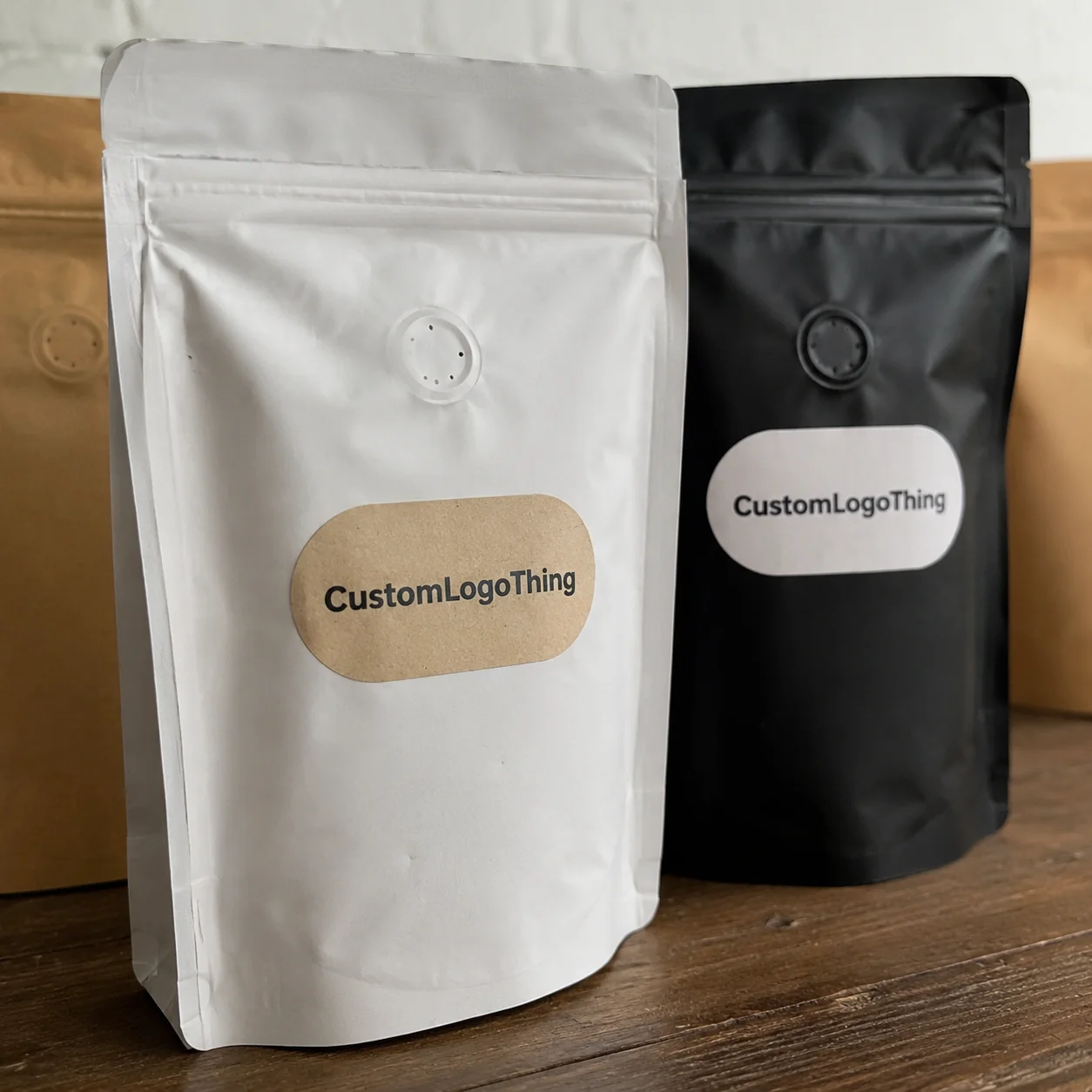
Two identical kraft coffee bags sit on a farmers market table. The one with sharp custom coffee stickers gets picked up first, not because the beans are better, but because the label did its job before the customer smelled anything.
That is the practical power of a good coffee label. It turns a plain pouch, jar, sample pack, cold brew bottle, mailer box, or promotional insert into branded packaging that feels finished. Not decorated. Finished.
Custom coffee stickers are printed adhesive labels made for coffee packaging and related product packaging. They carry the roast name, blend name, flavor notes, origin, grind type, roast date, barcode, net weight, compliance copy, and enough brand personality to help the bag earn attention in about three seconds.
They also solve a real inventory problem. Fully printed bags can look excellent, but they usually mean higher setup costs, bigger minimums, longer lead times, and more risk if a blend changes. Stickers let roasters test microlots, change seasonal notes, update roast levels, and launch gift sets without sitting on 10,000 obsolete pouches. Expensive rectangles with regret attached. Nobody needs those.
Common use cases include cafes selling retail bags, subscription coffee brands, farmers market sellers, corporate gift boxes, private-label coffee programs, and roasters testing new blends before committing to printed pouches. Treat this as a buying guide rather than a design pep talk. Pretty labels are nice. Labels That Fit, stick, scan, ship, and sell are better.
How Coffee Bag Labels Work on Different Packaging Surfaces
A coffee sticker is a small construction: face stock, adhesive, ink, and often a finish such as varnish or lamination. Each layer changes how the label looks, feels, and behaves after it is applied to a bag.
Face stock is the visible material. Paper feels warm and natural, especially on kraft bags. BOPP film is tougher and more moisture resistant. Clear film works well on jars and bottles where the container or product color should show through. Textured stocks can make specialty coffee feel more premium, but they cost more and can blur tiny detail if the artwork is too delicate.
Adhesive is the part buyers often underestimate. A label that sticks beautifully to a smooth laminated pouch may lift on textured kraft paper or compostable film. Packaging does not care about a brand mood board. Surface energy, texture, oil exposure, temperature, and handling all matter.
Common coffee packaging surfaces include matte kraft paper, glossy laminated pouches, foil bags, compostable films, tins, glass jars, plastic jars, and cold brew bottles. Smooth foil and gloss pouches usually take labels cleanly. Rough kraft may need a more aggressive adhesive. Refrigerated bottles need film labels that tolerate condensation. Compostable films can be unpredictable, so testing is not optional on larger orders.
Finish affects both appearance and durability. Matte labels give a craft retail packaging look, but they can scuff if the bags are stacked and handled often. Gloss makes colors brighter and improves contrast, though some coffee brands find it too shiny. Soft-touch feels premium on gift coffee, but fingerprints can show on dark artwork. Lamination adds protection against abrasion and moisture. It also adds cost and can change the feel of the stock.
Placement deserves the same scrutiny as material. Front labels create the first impression. Back labels carry origin notes, brewing suggestions, barcodes, and compliance details. Side labels can work as tamper cues or batch markers. Circle stickers are common for sample packs, closures, and roast-date callouts.
- 2-inch circles: useful for sample bags, closures, or roast-date stickers.
- 3 by 4-inch rectangles: common for 8 to 12 oz coffee bags with moderate copy.
- 4 by 5-inch labels: better when the front panel needs brand, roast, origin, tasting notes, and barcode space.
- Tall panel labels: suitable for full-panel branding on plain pouches or private-label coffee.
Before ordering thousands of labels, test them on the actual package, preferably filled and folded the way it will sit on the shelf. Oils, seams, valves, gussets, and refrigerated storage can change the result fast.
Key Specs That Decide Whether Your Coffee Sticker Looks Premium
Premium is not just a logo with extra spacing. It is the sum of material, print method, color behavior, finish, and whether the label can be read by a normal human under retail lighting.
Paper labels are a strong choice for dry coffee bags, especially kraft pouches and natural-looking retail packaging. They feel familiar and approachable. Standard white paper gives cleaner color than brown kraft paper. Textured paper can look beautiful for specialty roasts, but tiny type and thin lines may not print as crisply.
BOPP film labels are better for moisture, oils, condensation, and frequent handling. White BOPP gives strong color and durability. Clear BOPP works for jars, bottles, and minimal package branding, though it may need white ink underprinting if the design requires opaque color.
Print method matters. Digital printing is usually best for short runs, multiple SKUs, seasonal blends, variable designs, and lower minimums. Flexographic printing tends to make more sense at higher quantities because setup costs can be spread across more labels. Specialty effects such as foil stamping, spot UV, embossing, and metallic inks can help premium launches, but restraint matters. Coffee bags are already visually crowded. One good accent beats five shiny distractions.
Color expectations need a reality check. Coffee brands love deep blacks, warm browns, creams, copper, gold, and muted greens. On uncoated kraft, color will look softer and less saturated than on white film or coated paper. That is not a printer malfunction; it is physics. If exact color matters, ask about material samples, printed swatches, or a press proof.
Artwork setup is where many reprints are born. Send vector logos when possible. Outline fonts. Use high-resolution images at 300 dpi at final print size. Add bleed, usually 0.0625 to 0.125 inch depending on the printer’s template. Keep key text inside the safe zone. Make QR codes and barcodes large enough to scan after printing, finishing, and application.
Practical rule: brand name first, roast or blend second, flavor notes third, technical details last. If customers need a microscope to find the roast level, the design is not minimalist. It is underperforming.
Compliance copy should be planned before printing. This may include ingredients, net weight, business details, barcode space, country-of-origin statements, certifications, and product claims. This is not legal advice, because labels can have different requirements by product and selling region. Still, leaving a blank corner for “we’ll figure that out later” is how rush reprints happen.
For sustainability claims or paper sourcing, ask suppliers clear questions. FSC-certified paper can support responsible sourcing goals; the Forest Stewardship Council explains chain-of-custody basics if you want to understand what a certification can and cannot prove. Compostable packaging claims require similar care. A compostable pouch with a standard label may not behave as one compostable package unless the full material system has been evaluated.
Cost, Pricing, and MOQ Factors for Coffee Stickers
Sticker pricing is driven by size, material, finish, quantity, shape, number of designs, roll versus sheet format, and specialty effects. The boring specs decide the invoice. Design taste can sit quietly in the passenger seat for a minute.
Short digital runs cost more per sticker, but they reduce inventory risk. That matters for new blends, seasonal roasts, farmers market testing, and subscription experiments. Higher-volume runs reduce unit cost, but only if the label keeps selling. A low price on 20,000 labels is not a win if the origin changes after six weeks.
Minimum order quantity, or MOQ, depends on the production method and material. Low MOQs are useful for limited drops, trial SKUs, and small cafe runs. Higher MOQs make sense for core blends that move every week, especially if the label size, material, and artwork are stable.
| Order Type | Typical Use | Cost Behavior | Buyer Watchout |
|---|---|---|---|
| Short digital run | 100 to 1,000 labels for new blends or events | Higher unit cost, lower inventory risk | Good for testing, not always cheapest for core SKUs |
| Mid-volume label run | 1,000 to 5,000 labels for cafe retail or subscriptions | Better unit pricing with manageable inventory | Confirm artwork fields before scaling |
| High-volume production | 10,000+ labels for wholesale or established blends | Lower unit cost, higher commitment | Demand and copy must be stable |
| Specialty finish order | Gift coffee, premium retail, launch boxes | Higher setup and finishing cost | Use foil, spot UV, or soft-touch only where it adds value |
As a broad planning range, simple paper coffee labels in moderate quantities may land around $0.08 to $0.25 each depending on size and finish. Small short-run labels can run $0.25 to $0.75 each, especially with multiple designs or low quantities. Premium film labels, specialty stocks, lamination, foil, or custom shapes can push higher. These are not universal prices. They are planning ranges so nobody builds a launch budget on vibes.
Custom shapes can look excellent, but tooling and die costs may apply. Standard rectangles, squares, ovals, and circles are usually cheaper and faster. Custom dielines can help the bag stand out; the invoice will also have opinions.
Multiple designs affect pricing too. Gang-run printing can help if all labels share the same size, material, shape, and finish. Different shapes or finishes often split the job into separate setups. If you have six blends, a consistent template can reduce cost and production errors.
Pay more when the packaging needs it: refrigerated bottles, textured bags, premium gift coffee, wholesale retail, or anything handled heavily during fulfillment. For shipping-heavy programs, basic package testing ideas from groups like ISTA are useful because labels do not live in a design file. They live on Bags That Get packed, rubbed, boxed, and delivered.
For a clean quote, provide label dimensions, quantity, material preference, finish, packaging surface, application method, number of versions, and target delivery date. If you also need Custom Labels & Tags for matching products, keep the sizes and materials aligned where possible.
Process and Timeline From Artwork to Finished Labels
The cleanest label orders start with packaging, not artwork. Choose the bag first. Measure the usable panel. Then design. Designing a perfect label for a bag size you later change is a lovely way to waste time.
A normal order flow looks like this: choose packaging, measure the label area, prepare artwork, request a quote, review the proof, approve production, print, finish, pack, and ship. The clock usually starts after final artwork approval, not after the first email asking for pricing. Annoying? Maybe. True? Absolutely.
Digital proofs check layout, spelling, bleed, safe zone, barcode placement, label orientation, and general color direction. They do not fully prove material feel, adhesive performance, or final color on every stock. Physical samples are better when timing allows, especially for textured kraft, compostable pouches, cold brew bottles, or high-value retail packaging.
Simple digital sticker orders can often move in a few business days after proof approval for straightforward materials and quantities. More custom work can take 7 to 15 business days, and longer if specialty materials, foil, lamination, die cutting, physical sampling, or large quantities are involved. Shipping adds time. So does indecision, the silent killer of launch schedules.
Common blockers include missing dielines, low-resolution logos, undecided bag material, last-minute flavor changes, incomplete compliance copy, barcode changes, QR codes that do not scan, and delayed proof approval. If three people need to approve the label, decide that before the proof lands.
Plan backward from the real deadline: roast date, packaging day, market launch, subscription shipment, wholesale delivery window, or gift box assembly. Labels should arrive before packaging day, not while someone is refreshing tracking at 6 a.m. next to a stack of naked coffee bags.
Step-by-Step Guide to Ordering Coffee Labels Without Reprints
Reprints usually happen for boring reasons. Wrong size. Wrong copy. Wrong surface. Wrong file. The good news is that boring problems are preventable if you slow down before approval.
- Gather the packaging. Measure the exact flat label area on the filled or folded bag, not just the manufacturer’s listed bag size. Valves, seams, gussets, and curves reduce usable space.
- Decide the label role. Is it a full front brand label, roast-specific label, back information label, seal sticker, date sticker, or promotional add-on? One sticker cannot do every job gracefully.
- Choose material based on surface and environment. Paper works for dry bags. Film is safer for moisture, oils, condensation, refrigeration, glossy pouches, and frequent handling.
- Build artwork correctly. Use proper bleed, safe margins, readable type, barcode space, and a clear visual hierarchy. Do not cram the entire brand manifesto onto 12 square inches. Your customers have coffee to buy.
- Request a quote with real specs. Include size, shape, quantity, material, finish, number of designs, packaging surface, application method, and deadline.
- Review the proof slowly. Check spelling, roast names, origin details, net weight, QR codes, barcode scans, label orientation, and version names. Print the proof at actual size if possible.
- Test application when possible. Apply the label to the real bag, bottle, jar, or tin. Rub it. Bend it. Let it sit. Approve production only when the label sticks, reads, and fits correctly.
If you are building a broader launch with mailers, inserts, or Custom Packaging Products, coordinate the sticker specs with the rest of the system. Good packaging design is not matching everything perfectly. It is making every piece feel intentional.
Common Coffee Sticker Mistakes That Make Bags Look Cheap
Most bad coffee labels do not fail because the brand lacks taste. They fail because someone skipped the practical details. The bag then looks unfinished, even if the beans are excellent.
- Choosing a label that is too small: Tiny type may look clean in a mockup and completely useless in a real store. If the label needs origin, notes, roast level, net weight, and barcode, size it honestly.
- Ignoring bag texture: Kraft, compostable, glossy, matte, and soft-touch pouches can all behave differently with adhesive. Test first, especially before ordering custom coffee stickers in bulk.
- Using low-contrast colors: Brown type on tan paper may feel earthy, but customers still need to read the roast name. Contrast sells. Squinting does not.
- Forgetting oil, condensation, and handling: Coffee bags get touched, packed, stacked, shipped, squeezed, and sometimes refrigerated. A fragile label may look good for five minutes and tired by delivery.
- Treating every blend as a brand-new design: A flexible template system saves money, reduces errors, and keeps the shelf set consistent across roast levels and origins.
- Approving proofs too fast: Most reprints come from human misses: typos, wrong roast level, bad QR code, outdated weight, incorrect origin copy, or a barcode placed over a curve.
- Ordering too much before testing demand: Bulk pricing is tempting. Obsolete labels are still waste, even if the unit price looked clever on the quote.
One more mistake: designing only for a straight-on product photo. Real coffee bags wrinkle, puff, fold, and lean. The label has to survive the actual shelf, the fulfillment table, and the customer’s kitchen counter.
Build a Sticker Spec Before You Ask for a Quote
Before asking for pricing, build a basic sticker spec. It should include bag type, label size, quantity, number of SKUs, material preference, finish, application method, and deadline. That one document saves days of back-and-forth and gives suppliers enough information to quote something real.
Start with core products first. Build labels for best-selling blends before chasing every seasonal roast, limited drop, and experimental microlot. Core SKUs teach you what size, material, copy structure, and finish actually work in daily use.
A strong label system usually has one master layout, fixed logo position, consistent roast color coding, and editable fields for origin, tasting notes, roast level, grind type, and roast date. That keeps package branding clean across the shelf and makes future updates faster.
Order samples or a short run if the packaging is new, textured, compostable, refrigerated, oily, or headed into wholesale retail. Upgrade specs for premium gift coffee, high-touch retail, subscription boxes, cold brew bottles, or programs where the label carries most of the brand impression.
Good coffee packaging does not need to be complicated. It does need to be specific. Confirm the bag surface, label size, artwork files, finish, quantity, and deadline before ordering custom coffee stickers so the quote is accurate and the finished labels do not surprise anyone.
FAQs
What size should custom coffee labels be for 12 oz bags?
A common front-label range is about 3 by 4 inches to 4 by 5 inches, depending on bag width, gusset style, valve placement, and how much information needs to fit. Measure the actual filled bag before finalizing the label because folds, seams, and curved surfaces reduce usable space. Leave enough margin so the sticker looks intentional instead of slapped on during a lunch break.
Are paper or waterproof coffee stickers better?
Paper stickers work well for dry coffee bags and give a natural craft look. Water-resistant film labels are better for cold brew bottles, refrigerated products, glossy pouches, oily surfaces, or packaging that gets heavy handling. The better choice depends on the package surface, storage conditions, finish preference, and budget.
How much do custom coffee stickers cost?
Pricing depends on size, quantity, material, finish, shape, roll or sheet format, and the number of artwork versions. Short runs usually cost more per sticker but reduce inventory risk; larger runs usually lower unit cost but require more confidence in demand. For an accurate quote, provide dimensions, quantity, material, finish, packaging surface, design count, and delivery deadline.
How long does it take to produce custom coffee bag stickers?
Simple digital label orders can move quickly after proof approval, while custom materials, specialty finishes, sampling, or larger quantities take longer. Production timing usually starts after final artwork approval, not when the first quote request is sent. Build in extra time for proof review, shipping, and testing labels on your actual bags.
Can I order different coffee sticker designs in one run?
Yes, many orders can include multiple blends or SKUs, especially when the labels share the same size, material, shape, and finish. Different sizes, shapes, or finishes may require separate setups and can affect pricing. A consistent template across blends keeps costs cleaner and makes the retail shelf look more organized.