Buyer Fit Snapshot
| Best fit | Custom Compostable Product Boxes Quote projects where brand print, material claims, artwork control, MOQ, and repeat-order consistency need to be specified before quoting. |
|---|---|
| Quote inputs | Share finished size, material target, print colors, finish, packing count, annual reorder estimate, ship-to region, and any compliance wording. |
| Proofing check | Approve dieline scale, logo placement, barcode or warning zones, color tolerance, closure strength, and carton packing before bulk production. |
| Main risk | Vague material claims, crowded artwork, missing packing details, or unclear freight terms can make a low unit price expensive after revisions. |
Fast answer: Custom Compostable Product Boxes Quote: Pricing and Specs should be specified like a repeatable production item. The safest quote records material, print method, finish, artwork proof, packing count, and reorder notes in one written spec.
Production checks before approval
Compare the actual filled-product size with the drawing, then confirm tolerance on folds, seals, hang holes, label areas, and retail display edges. Reserve space for logos, QR codes, warning copy, and material claims before decorative graphics fill the panel.
Quote comparison points
Review material grade, print process, finish, sampling route, tooling charges, carton quantity, and freight assumptions side by side. A quote is only useful when the supplier can repeat the same color, closure quality, and packing count on the next order.
Custom Compostable Product Boxes Quote: Pricing and Specs
A buyer asking for a custom Compostable Product Boxes quote usually assumes the print price tells the whole story. It does not. The expensive part shows up later: crushed corners, extra filler, rework, slow packing, and returns because the box looked great in a mockup and fell apart in transit. Packaging that has to protect a product, support branded packaging, and still match an eco-friendly claim needs a real spec before the quote means anything.
That is the practical side of a custom compostable product boxes quote. Smart buyers are not chasing the lowest number first. They are trying to understand how material choice, box style, print coverage, MOQ, and certification targets change the actual landed cost. Tight specs cut waste without blowing up spend. Vague specs do the opposite. The comparison is not "cheap versus expensive." It is "clear enough to price accurately versus vague enough to cause surprises."
Custom compostable product boxes quote: what buyers miss first
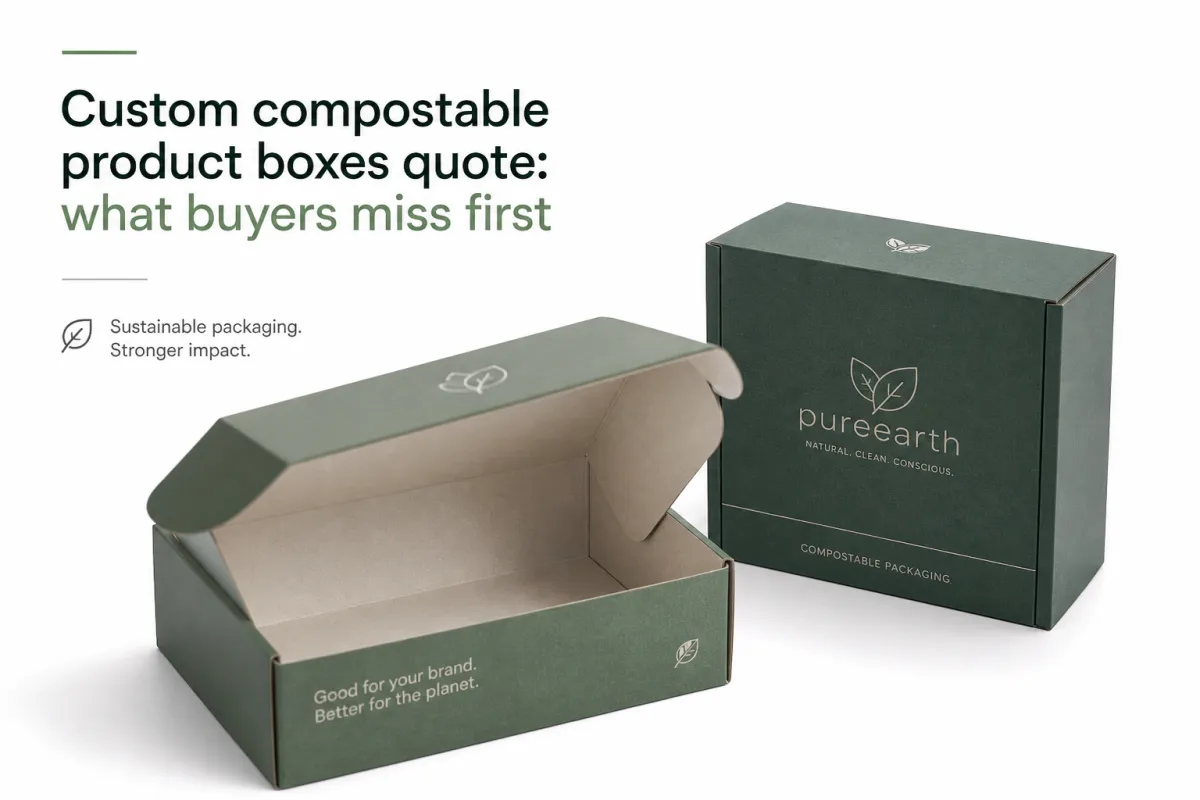
Most teams request a custom compostable product boxes quote before they lock the product weight, box format, or the standard they actually need. That feels efficient. It usually produces a quote that looks polished and means very little. A rigid serum carton, a candle mailer, and an apparel subscription box have different demands. The outside dimensions may look close. The internal structure often changes the price anyway.
From a packaging buyer's point of view, the first mistake is treating compostability as a material label instead of a full structure decision. A custom compostable product boxes quote only works if the supplier knows whether the job needs a tuck end carton, a sleeve, a folding mailer, or a tray-and-lid system. Add an insert, a window, a divider, or reinforced corners, and the number shifts again. The faster the supplier understands the real load, the cleaner the estimate.
There is a familiar mismatch between sustainability goals and product protection. Thinner board sounds greener. Then the box arrives with crushed corners, filler goes in, more units get damaged, and the tidy environmental story turns messy. Cute. A weaker structure can raise the real footprint if it drives damage, returns, and extra packing materials. I have watched teams chase a prettier material spec and end up paying more for void fill and replacement stock. That is the part many buyers miss when they rush the quote.
Use this filter before you ask for a custom compostable product boxes quote:
- Define the product first: dimensions, weight, fragility, and whether it ships single-unit or multipack.
- Define the protection level: insert, divider, molded tray, or no internal component.
- Define the target claim: industrial compostable, recyclable fiber, or a fiber-based structure with compostable inks and coatings.
- Define the use case: retail shelf display, e-commerce shipping, or subscription fulfillment.
The best suppliers ask those questions before they price. That is not delay. It is discipline. A disciplined custom compostable product boxes quote is usually more useful than a fast one, because it compares the same packaging reality across vendors instead of comparing guesses.
"A quote is only as strong as the spec behind it. If the box protects poorly, the purchase price is not the full cost."
For teams building broader Custom Packaging Products, packaging design and procurement should sit in the same conversation. The goal is not only to buy custom printed boxes. The goal is to buy the right structure once, then repeat it without drama. That is how product packaging becomes predictable instead of reactive.
Product details: what counts as a compostable product box
A custom compostable product boxes quote can cover several box families, and the category is broader than many buyers expect. In practice, that usually includes mailer boxes, folding cartons, sleeve boxes, subscription-style boxes, and retail-ready cartons. Some programs also include molded fiber trays paired with paperboard outer packaging. The real question is not whether the package sounds eco-friendly. The real question is whether the full structure supports the product and the end-of-life claim.
Material choice matters more than most buyers realize. A compostable paperboard box may use fiber-based board with water-based or compostable inks, while a molded fiber option can give better cushioning for fragile items. Some programs use compostable coatings or barrier layers, and those layers can affect both certification and cost. A solid custom compostable product boxes quote should spell out the substrate, ink system, coating, and finishing method instead of hiding them under one price.
Product fit matters just as much as material choice. A lightweight skincare jar, a candle, a supplement bottle, and a folded apparel item do not stress packaging the same way. Too much space means filler and voids. Too little space slows packing and can scuff the product. Good packaging design balances protection, shelf presence, and line speed. That balance is what makes a custom compostable product boxes quote feel expensive up front but reasonable after returns are counted.
Compostability claims also vary by region and standard. Buyers should verify whether the package is being positioned as industrial compostable, home compostable, or fiber-based with compostable components. The proof often matters more than the label. Standards and certifications can involve ASTM pathways, EN compostability requirements, FSC chain-of-custody for fiber sourcing, or other regional documentation. If the claim is fuzzy, the risk lands on the brand, not the printer. I am going to be blunt here: a vague claim is not a sustainability strategy.
Two authority references worth keeping close are ISTA testing standards for shipping performance and FSC for responsible fiber sourcing. Neither one replaces a packaging spec, but both help buyers ask better questions before they approve a custom compostable product boxes quote.
Retail packaging and shipping packaging are not the same beast. A retail carton needs visual appeal, stackability, and decent crease control. An e-commerce mailer has to survive vibration, compression, and abrasion. If one box is supposed to do both jobs, the spec changes fast. That is one reason a custom compostable product boxes quote should always name the channel: shelf, parcel, or both.
Say the product plainly. Say how it moves. Say what failure looks like. A good supplier can then match structure to use case instead of sending a generic offer. That makes the custom compostable product boxes quote easier to compare and easier to defend in procurement.
One more thing: if a supplier cannot explain the difference between fiber content, coatings, and add-on components in plain language, the quote is probably not ready for a buying decision. Packaging jargon is cheap. Clear specs are not. There is a difference.
Specifications that shape a custom compostable product boxes quote
Specifications drive almost every line in a custom compostable product boxes quote. Box dimensions are the first lever, but not the only one. Board caliper, panel structure, print coverage, adhesive requirements, and finishing all influence price. A box that is 2 mm wider may force a larger sheet size, more trim waste, and a different die layout. That looks tiny in a spreadsheet. In production, it is not tiny at all.
Dieline complexity is one of the quiet cost drivers. A straight tuck carton is usually easier to cut, fold, and inspect than a structure with lock bottoms, windows, nested inserts, or unusual closure tabs. Each added feature raises tooling time and proofing risk. A custom compostable product boxes quote should reflect that complexity honestly. If a vendor prices a complicated structure too low, the missing cost usually shows up later in sampling, revisions, or slower throughput.
Print coverage is another lever. A minimalist one- or two-color design can reduce ink use and make compostability claims easier to support. Heavy flood coverage, rich solids, and tight registration often increase setup and raise waste during startup. That does not kill premium branding. It just means the design team should know where the extra effect is worth the cost. A custom compostable product boxes quote is a good place for that discussion.
Some finish choices complicate the compostability story. Soft-touch effects, metallic foils, heavy UV, and plastic windows may look attractive, but they can clash with the claim or push the structure away from a cleaner fiber-based solution. In many cases, a simpler single-pass print on natural board delivers a stronger sustainability story and a more controllable quote. That matters even more for brands that want eco-friendly packaging without adding unnecessary process steps.
To get a sharper custom compostable product boxes quote, send these inputs:
- Exact product dimensions, including caps, closures, or accessories.
- Unit weight and fragility notes.
- Artwork files in the correct format, along with brand color references.
- Quantity tiers, not just one number.
- Shipping destination, because freight changes the landed cost.
- Any compliance target such as industrial compostability, FSC fiber preference, or transit-test expectations.
The faster those inputs arrive, the cleaner the estimate becomes. That matters because a first-pass custom compostable product boxes quote that lacks dimensions or finish detail often hides a correction later. It is better to price accurately up front than to discover that the "good deal" was built on incomplete assumptions.
There is also a line between structural performance and package branding. A design that looks elegant on screen may not hold up once the carton is scored, folded, and filled at speed. A practical supplier will flag those issues before production starts. That candor improves the odds that the final custom printed boxes work in real operations, not just in a presentation deck.
Pricing, MOQ, and the drivers behind your quote
The anatomy of a custom compostable product boxes quote is easier to read when you break it into components. Most prices include substrate cost, print setup, tooling, sampling, labor, finishing, packing, and freight. Some vendors separate each line item. Others bundle them. Either way, the economics are similar: fixed costs at the start, variable costs per unit, and transport costs that change with destination and volume. If the quote does not show the major assumptions, comparison gets sloppy fast.
MOQ matters because fixed setup costs have to be spread across the order. A 1,000-unit run can look much more expensive than a 10,000-unit run even when the same box is used. That is not gouging. It is how production works. A custom compostable product boxes quote should show breakpoints so the buyer can see where the unit price drops in a meaningful way. The real question is not whether a smaller run is possible. The real question is whether the higher unit price still makes sense for launch volume, seasonal demand, or test-market use.
These cost drivers usually move pricing the fastest:
- Heavy ink coverage or complex multi-color graphics.
- Custom inserts, dividers, or molded cushioning.
- Unusual box sizes that waste sheet space.
- Rush production windows that compress proofing or manufacturing.
- Special coatings or finishes that add process steps.
For a practical comparison, here is a simple pricing framework. The numbers are illustrative, but they reflect the kind of spread buyers often see when they request a custom compostable product boxes quote with clear specs.
| Box style | Typical MOQ | Common material | Indicative unit price at 5,000 pcs | Best fit |
|---|---|---|---|---|
| Simple folding carton | 1,000-5,000 | Compostable paperboard | $0.18-$0.32 | Lightweight cosmetics, supplements, small retail items |
| Mailer box | 2,000-5,000 | Fiber-based corrugated or heavy board | $0.45-$0.85 | E-commerce shipping, subscription kits, branded unboxing |
| Sleeve box | 3,000-10,000 | Paperboard with compostable inks | $0.12-$0.24 | Retail packaging, secondary branding, product bundling |
| Tray with insert | 5,000-10,000 | Molded fiber plus carton | $0.60-$1.20 | Fragile products, premium sets, added protection |
Those ranges change with size, print coverage, and freight. A larger box may cost more even if the graphics are simple. A smaller box with a complicated insert can cost more than a bigger plain mailer. That is why a custom compostable product boxes quote should never be read without the full spec sheet beside it.
Ask for tiered pricing too. A quote at 3,000 units, 5,000 units, and 10,000 units shows whether the run size is actually optimized. Often the 5,000-piece tier lands much better than the 3,000-piece tier, while the 10,000-piece tier offers only a small extra discount. Those breakpoint numbers matter because they affect cash flow, storage, and reorder planning.
"The best price is rarely the lowest unit number in isolation. It is the number that fits the run size, the damage rate, the lead time, and the brand promise."
One more practical point: ask what the quote excludes. Freight, taxes, sample shipping, and revision charges can change the final invoice. A supplier that presents a clean custom compostable product boxes quote with assumptions listed is more useful than one that buries them in fine print. Clear assumptions make it easier to compare eco-friendly packaging vendors and avoid surprises after approval.
Process and timeline for custom compostable packaging
The request process starts on the buyer side. Send product dimensions, unit weight, quantity, artwork, destination, and target in-hand date. If the project has a compostability target, say so early. A custom compostable product boxes quote becomes more accurate when the supplier can see whether the job is for industrial composting, fiber-first branding, or a transit-heavy retail packaging program. Strong inputs cut guesswork.
On the vendor side, the normal flow is spec review, quote generation, proofing, sample approval, production, and final shipping. The longest delay is often not printing. It is waiting for the spec to be confirmed or the artwork to be approved. Teams lose time fast when half the approvals live in one email thread and half live in another. A clean custom compostable product boxes quote process usually names one decision-maker and one technical contact. Boring? Sure. Effective too.
Typical timing, assuming no unusual tooling, can look like this:
- Initial quote: 1-3 business days once the spec is complete.
- Digital proof or layout check: 1-2 business days.
- Physical sample or prototype: 5-10 business days, depending on structure.
- Production: often 10-20 business days after approval.
- Freight: depends on destination and mode, and should be added separately.
Those ranges are realistic, not promises. A custom compostable product boxes quote for a simple folding carton may move faster than a quote for a box with a custom insert and tight color tolerances. If the project needs transit validation, shipping tests add time. Resources from ISTA can help teams understand what kind of package performance is being evaluated before they commit to a structure.
To keep the schedule under control, approve final artwork early, answer proof questions quickly, and lock compliance language before print plates or cutting tools are made. Minor wording changes late in the process can trigger rework. The easiest way to keep a custom compostable product boxes quote on track is to reduce the number of late decisions. Obvious advice, yes. Also the exact place where launches slip.
Rushing costs money. Accelerated schedules can force overtime, limit sampling, or reduce room for revision. If the brand launch is fixed, that may be worth it, but the buyer should see the surcharge. A transparent custom compostable product boxes quote should show whether fast-track production is a real premium or just a vague rush fee.
For buyers comparing vendors, the strongest signal is not speed alone. It is whether the supplier can explain the schedule in plain terms, tie it to the spec, and show where the dependencies sit. That kind of communication makes a packaging supplier useful beyond a single order.
Why choose us for custom compostable boxes
Custom Logo Things earns trust by making the quoting process concrete. A custom compostable product boxes quote should be built on verified materials, clear assumptions, and a plain explanation of what is included. Buyers comparing vendors do not need more adjectives. They need numbers that can survive a procurement review and a production floor.
What most buyers want is consistency. If the first run is approved, the second run should match it without drama. That is harder than it sounds. Color drift, board variation, and minor size changes can create avoidable friction. A disciplined custom compostable product boxes quote process helps control those variables from the start, which is especially useful for repeat product packaging and retail packaging programs that cannot absorb surprises.
We also look at the project from a business angle, not just a print angle. Better fit can reduce void fill. Cleaner structures can speed packing. A more accurate quote can simplify procurement comparisons. That is where eco-friendly packaging starts paying back beyond the sustainability story. A lower failure rate and cleaner warehouse workflow often matter as much as the visual finish.
If you are building a wider range of Custom Packaging Products, we can help you compare formats without blending the spec lines together. That means fewer assumptions, fewer revisions, and a faster path to a quote that makes sense. If the project needs follow-up, the useful next step is not a sales pitch; it is a complete spec sheet with measurements, quantity tiers, and the exact compostability claim you plan to use.
The real value is clarity. A strong custom compostable product boxes quote should help you compare apples to apples across vendors, not force you to decode different definitions of compostable, recycled, or premium. That matters a lot for brands that care about package branding and want the outer box to support the product story without weakening operations.
Honestly, the best packaging partners are not the ones that promise everything. They are the ones that tell you where the limits are before the order is placed. That is how you protect margin, preserve quality, and keep the customer experience aligned with the brand.
Next steps after your custom compostable product boxes quote
Once you receive a custom compostable product boxes quote, use a short checklist before you approve anything. Confirm the exact dimensions, unit weight, quantity needed, print coverage, insert requirements, and destination ZIP or postal code. If one of those items is missing, the quote may look precise while still being built on assumptions that do not match your operation.
Then ask for price breakpoints. A quote at 2,500, 5,000, and 10,000 units can reveal whether it is smarter to place a slightly larger first run or keep inventory lean. Many buyers choose the wrong quantity because they only see one price. A better custom compostable product boxes quote shows how the math changes across tiers, which makes the decision easier to defend internally.
If color accuracy, fit, or compostability language matters, request a sample or digital proof. That step is not red tape. It is the cheapest place to catch a problem. A sample can show whether the board feels too light, whether the closure holds, or whether the branding reads the way it should. For custom printed boxes, that early check often saves both time and money later.
Use this action plan:
- Gather the exact product measurements and photos.
- Decide whether the box must be industrial compostable, fiber-based, or both.
- Request quote tiers and ask what is excluded.
- Approve proofing only after checking structure, copy, and fit.
- Confirm freight timing separately from production timing.
If you follow those steps, the next custom compostable product boxes quote you review will be easier to compare and less likely to create surprises. The goal is not simply to buy a box. The goal is to buy a box that protects the product, supports the brand, and holds up in production without creating avoidable waste.
For brands that want a clear, defensible path forward, the next move is simple: lock the spec, ask for tiered pricing, and compare the assumptions line by line. That is how a custom compostable product boxes quote turns into a useful buying tool instead of a vague number on a page.
Frequently asked questions
How do I request a custom compostable product boxes quote?
Send the product dimensions, target quantity, artwork files, and shipping destination so the estimate reflects real production and freight costs. Include whether you need inserts, coatings, windows, or special folds, because those details can change both tooling and unit price. Ask the supplier to separate setup, sampling, and shipping so you can compare quotes more accurately.
What details change the price of compostable product boxes the most?
Box size, board grade, and print coverage usually have the biggest impact on unit price. MOQ matters because setup costs are spread across every box in the run. Special inserts, rush timelines, and custom finishing can add noticeable cost, especially when the structure moves beyond a basic carton.
What MOQ should I expect for custom compostable product boxes?
MOQ depends on the box style, print method, and material choice, so the best answer comes from the exact spec sheet. Smaller runs are possible, but the unit price is usually higher because setup costs are not diluted. If you plan to reorder, ask for tiered pricing so the first run does not lock you into a poor volume decision.
How long does production usually take after approval?
Timing depends on whether you need sampling, artwork revisions, or custom tooling before production starts. Simple runs move faster than boxes with inserts, specialty structures, or complex print requirements. Freight time should be added separately so the delivery date is realistic, not optimistic.
Can compostable product boxes still be printed with strong branding?
Yes, most compostable box formats can handle full-color branding if the print system matches the material. The key is choosing inks and finishes that support the compostability target instead of weakening it. A good supplier will show where design limits exist before you approve the final artwork.
The clean takeaway is this: do not ask for a custom compostable product boxes quote until you know the product size, protection needs, certification target, and order volume. Once those four things are locked, the quote gets sharper, the comparison gets fairer, and the whole project stops pretending that a nice mockup is the same thing as a box That Actually Works.

