Custom cookies boxes do more than carry product from the bakery case to the customer’s kitchen. They protect soft edges, keep frosting off the lid, and make the price feel justified before the box is even opened. That matters because cookies are one of those products where packaging changes the buying decision fast. A neat, well-sized box reads as fresh and intentional. A flimsy one reads as cheap, even if the cookie itself is excellent.
A good cookie box earns its space: it protects the product, supports the selling price, and tells the customer what kind of bakery they are buying from.
The packaging job is practical first. It has to hold up under stacking, case display, counter handoff, local delivery, and sometimes parcel shipping. It also has to work as branding without turning the box into a cluttered billboard. For bakeries, that balance is where the margin lives or dies. Too little structure and breakage eats profit. Too much packaging and the unit cost starts to outrun the cookie.
That is why custom cookies boxes deserve more than a generic carton choice. The right spec protects texture, keeps the presentation clean, and makes the product easier to price honestly. The wrong one creates the usual mess: crushed corners, greasy panels, stale cookies, and customers who notice the damage before they notice the flavor.
What custom boxes do beyond packaging
Cookies are more fragile than people think. A round cookie chips at the edge. A sandwich cookie breaks under a light stack. Decorated cookies lose value if the icing smears or the color transfers to the inside lid. A box for cookies has to solve all of that while still looking like it belongs on a retail shelf.
That is why Custom Printed Boxes need to do three things at once: protect the product, present it clearly, and communicate the brand without crowding the panel. The best boxes do not fight the cookies. They frame them.
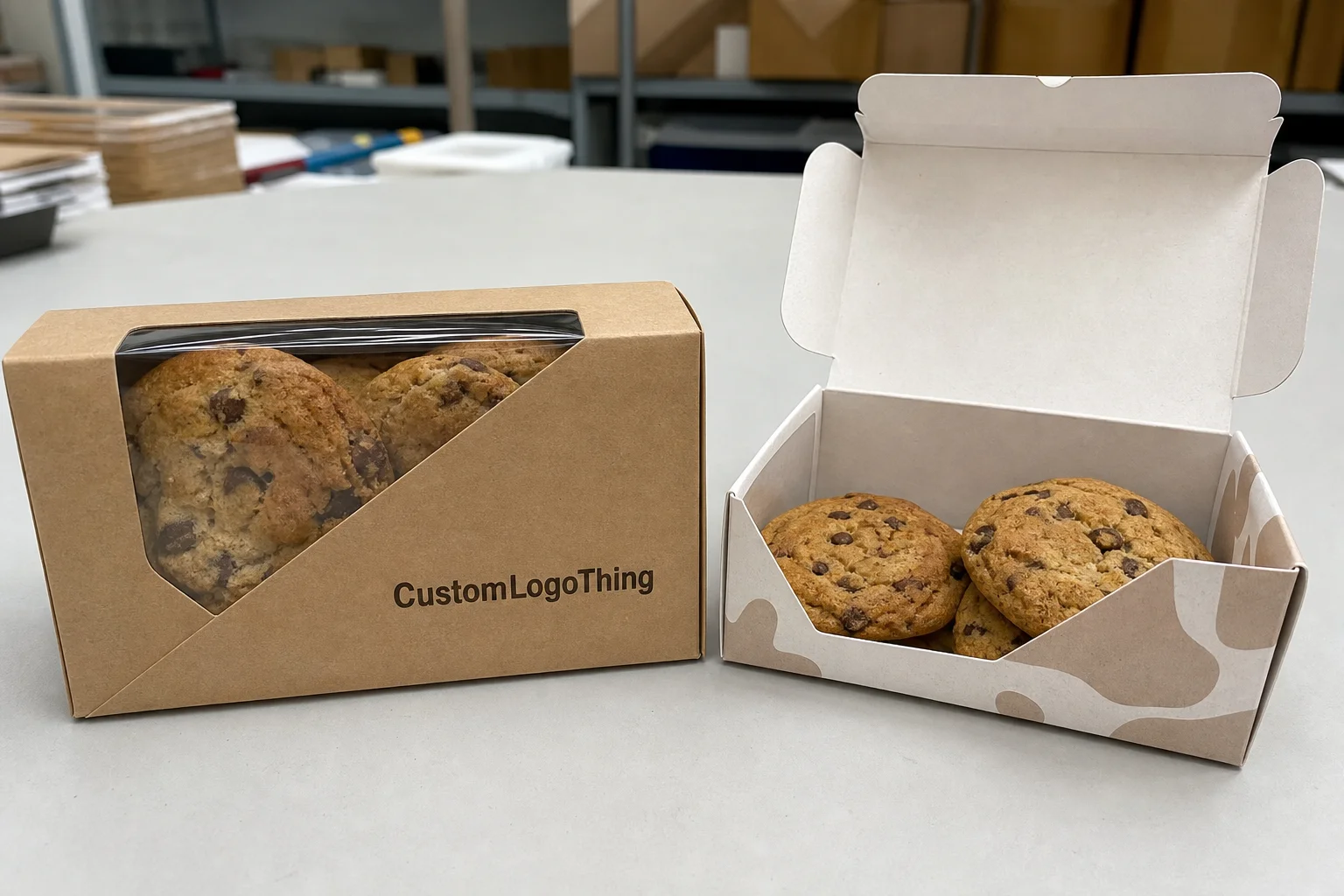
Folding cartons are usually the starting point because they are light, efficient, and easy to print. They work for smaller counts, single-flavor packs, and bakery counters where products move quickly. Window cartons add shelf appeal because buyers can see the cookies without opening the pack. That alone can lift sell-through for decorated cookies and gift sets. Rigid boxes sit at the premium end. They cost more, but they also feel more substantial, which matters for holiday assortments, corporate gifts, and higher-ticket bakery sets.
Finish changes perception quickly. Matte and soft-touch coatings feel quieter and cleaner. Gloss coatings add brightness and can improve scuff resistance. For grease-heavy cookies, the surface treatment matters as much as the artwork. A pretty box that absorbs oil looks tired before the box is empty. That is a bad trade.
In real buyer terms, the question is simple: which box protects freshness, survives handling, and supports the price without forcing the bakery to eat the cost later? That usually means a clean layout, a legible flavor callout, and one or two design details that feel deliberate. A small window, a smart insert color, or a tidy logo placement often does more than a packed front panel full of effects.
Branded packaging should answer three things fast: what is inside, how many are inside, and why this product costs what it costs. If the box cannot do that on a shelf or in a handoff, it is not doing enough.
Box styles, board, and inserts that fit the product
Different cookie formats need different box structures. A tuck-top carton is economical and fast to pack. A sleeve box feels more gift-like and can reduce accidental opening during transport. Window cartons work well for retail display, especially when the visual payoff matters. Rigid gift boxes make sense for premium sets and seasonal collections where the package is part of the product story.
For mixed assortments or individually wrapped cookies, compartmented packs are often the most practical choice. They keep flavors separated and reduce movement inside the box. If the cookies are iced or decorated, inserts become less optional and more necessary.
Board grade changes how the box behaves in the real world. A lighter SBS or C1S board can work for small, dry cookies sold locally. Heavier paperboard or corrugated support is better when the product needs more stiffness or when shipping is involved. A common range for bakery cartons is 16pt to 24pt paperboard, but that is only a starting point. Box size, print coverage, grease exposure, and closure style all affect the final choice.
Grease resistance is not a minor spec. Butter-rich cookies can stain uncoated board fast. Once that happens, the box looks older than the product inside it. The customer may not know the board grade, but they know when a package looks handled too much.
Inserts and dividers usually decide whether the box protects or just encloses. Thin paperboard dividers can keep decorated cookies from touching. Molded trays or insert cards can stop movement during delivery. For thick sandwich cookies, the cavity has to be snug enough to stop sliding but not so tight that the edges chip on the way in. For frosted cookies, the goal is different: keep the icing from rubbing while still allowing enough headspace to prevent sticking to the lid.
Cookie shape changes the spec. Soft-baked rounds need more crush resistance. Bars need a long, stable footprint. Decorated iced cookies need more clearance and a surface that will not rub color off. The most expensive box is not always the right one. The best box is the one that fits the product so well that nobody has to think about the packaging at all.
For a buyer comparing Custom Packaging Products, one question filters the weak options quickly: does the box protect the cookie during the roughest part of its journey, or only look good in a mockup?
Cost, pricing, and MOQ: what changes the unit cost
Cookie packaging pricing comes down to a few repeatable variables. Box size is one. Board grade is another. Print coverage, die-cuts, window film, inserts, and special finishes all add cost because they add material or production steps. A simple one-color tuck carton can be far cheaper than a full-coverage window box with a custom insert and soft-touch coating, even if both hold the same number of cookies.
MOQ affects the math just as much as the structure does. Setup costs, plates, cutting dies, and press calibration have to be spread across the run. That means larger quantities usually lower the unit price. Small runs still make sense for seasonal drops, test flavors, or limited edition sets, but they almost always carry a higher per-box cost.
A practical directional range for a straightforward custom carton might land around $0.20 to $0.45 per unit at a few thousand pieces. More complex premium styles can move well above that once inserts, specialty coating, and heavier board are involved. Those numbers are not fixed quotes. They are only useful as a reality check before the first round of pricing comes back.
| Box style | Typical use | Relative unit cost | What drives the price |
|---|---|---|---|
| Standard tuck carton | Single flavor, local retail, small counts | Lowest | Simple structure, light board, minimal finishing |
| Window carton | Counter display, gift packs, bakery assortments | Moderate | Window film, die-cutting, tighter alignment |
| Rigid gift box | Premium sets, holiday bundles, corporate orders | Highest | Thicker board, wrapping, assembly, inserts |
There are sensible ways to lower cost without making the box look cheap. Simplify the artwork. Reduce unnecessary finishes. Standardize one box size across a few cookie varieties if the product line allows it. Keep the window shape practical instead of decorative for its own sake. Clean design often reads as more premium than a busy front panel, especially in retail packaging where clarity matters.
Ask for quotes on the same spec sheet. If one supplier quotes a thinner board, a smaller print area, or a simplified insert, the price means something different. Comparing mismatched specs is how buyers end up paying twice: once for the box and again for the damage it causes.
Hidden cost matters too. Damaged cookies create refunds and replacements. Oversized boxes waste filler and make the product look undersold. Underbuilt boxes can collapse in distribution and erase any savings the quote promised. A low carton price is not a good deal if the box weakens the product’s selling price.
Production steps and timeline for a custom run
A custom run starts with the brief. That should include box dimensions, cookie count, artwork files, target quantity, and the handling conditions the box has to survive. From there, the supplier chooses or creates a dieline, places the artwork, and sends a proof for review. Once approved, sample or pre-production checks may follow, then printing, converting, finishing, packing, and shipment.
That is the basic flow whether the order is a simple folding carton or a more layered premium build. The difference is usually in how many approvals and fit checks are needed along the way.
Lead time depends on structural complexity. A stock-based box with printed branding may move faster because the tooling already exists. A fully custom structure, especially one with new window geometry or a custom insert, usually takes longer. A reasonable planning window for many bakery orders is 12 to 20 business days after proof approval, but quantity, finish complexity, and seasonal demand can push that either way.
The approval steps matter. Color should be checked against expectation, not just a screen image. Barcode placement should stay readable after folding and packing. Window alignment needs to be verified so the product shows the right surface, not a broken edge or blank corner. Ingredient text, allergen disclosures, and brand marks all need enough contrast to stay legible after print and coating.
If the box uses FSC-certified paperboard, confirm the chain-of-custody language early so it prints correctly. The same is true for any sustainability claim or recycling message. For reference, the FSC site at fsc.org is useful when a team needs to check standard language rather than guess at it.
Most schedule slips do not come from the press room. They come from late artwork, changed quantities, revised dimensions, or added finishes. Holiday demand does the rest. If the launch is tied to a product drop or a retail reset, build in room for proof cycles. For transit-heavy programs, review shipping test expectations such as the protocols discussed by ISTA, especially if the packaging has to survive parcel handling instead of a short counter handoff.
How to spec boxes for counter sales and shipping
Start with the cookie itself. Measure the finished diameter, thickness, and pack count before choosing the box interior. A 3-inch cookie in a box designed for 3.5 inches can shift enough to chip. A frosted cookie packed too tightly can rub the lid and lose its finish. The goal is not just fit. The goal is fit with enough breathing room to prevent damage without making the box look half empty.
Counter sales and mail-order packaging are not the same problem. Counter packaging prioritizes display speed, visual appeal, and easy handoff. Shipping packaging needs stronger closure strength, tighter internal fit, and enough crush resistance to survive stacking, bagging, and vibration. A retail box can be lighter and more open if the product is handed over immediately. A ship-ready box may need a secondary mailer, stronger board, or internal dividers so the cookies do not move once the outer shipper takes a hit.
Moisture and temperature also change the spec. Butter-rich cookies leave grease marks if the interior coating is weak. Iced cookies can smear if they are packed before the icing sets fully. In humid storage, plain board can soften faster than expected. Aqueous coating, proper lining, and correct staging time before packing help, but none of those fixes the wrong structure. If the product is sensitive, the pack-out process needs clear handling instructions too.
Branding should support the product price, not fight it. Large windows help when customers need to see the decoration. Smaller windows can work better when the brand wants a cleaner, more premium frame. Inserts should match the visual language of the box, because a flimsy insert inside a luxury-looking carton creates a disconnect fast.
Strong package branding is usually quiet, consistent, and easy to read. It does not need to shout. It just needs to look confident.
From a practical packaging point of view, the best boxes are the ones that make operations easier as the order scales. If the pack team can load the cookies in one motion, the box locks properly, and the finished pack still looks neat after transport, the design is doing its job.
Common mistakes that lead to crushed or stale cookies
The most common mistake is too much empty space. Buyers sometimes think a larger box looks more generous. Usually it just lets cookies slide, collide, and break. It also makes the product look smaller than it is, which hurts perceived value. A tight but not cramped fit is usually the right answer.
Surface treatment is another place where shortcuts show up. Uncoated or poorly sealed interiors absorb grease and create a tired-looking package before sell-through is even finished. That is especially risky for butter cookies, shortbread, and richer doughs. If the box will sit in a case for several days, the interior finish should be tested under real conditions, not assumed from the spec sheet.
Window size can backfire too. A large window improves visibility, but it can weaken the panel if the cut-out is too aggressive. It can also expose decorated cookies to scuffing, dust, or condensation if the product is packed warm. In some cases, a smaller window or a side-view design gives a better balance between display and protection.
Skipping transit testing is expensive. A box that looks fine on a shelf may fail once it is stacked, handled by delivery staff, or shoved into a tote bag with other items. If the order is intended for shipping, ask for sample drops, stack tests, or a simple route simulation. Standards such as ASTM and ISTA exist for a reason: they show how packaging behaves under movement, compression, and vibration instead of in a perfect mockup photo.
Shelf life is easy to overlook. If the closure is weak or the seal is poor, cookies can stale faster than expected. That is not always a recipe issue. Sometimes the package simply did not control air exposure well enough for the product and the sales channel. Good bakery packaging should support texture, not undo it.
Next steps: build a quote-ready box brief
The fastest way to get a useful quote is to send a spec that answers the production questions up front. Include cookie dimensions, quantity per box, total order volume, preferred box style, shipping method, artwork files, target budget, and launch date. If the cookies are fragile, frosted, or unusually shaped, say so early. That gives the supplier a real chance to recommend the right board, insert, and closure style instead of guessing.
When you compare quotes, compare the same thing. Ask for the board grade, finish, insert details, and any tooling or setup charges to be spelled out. A quote that looks cheaper may be using a thinner board, a smaller print area, or a simplified insert. None of that is automatically wrong. It just changes the value of the offer.
If the structure is still not settled, request a sample or prototype. That is especially useful for decorated cookies, mixed assortments, and products with icing that sits close to the lid. A prototype shows fit more clearly than any mockup can. It also reveals whether the box is easy to assemble on a real packing line, which matters more than most teams expect.
The best results usually come from matching structure, price, and timeline to the actual sales channel before ordering custom cookies boxes. A counter box, a gift box, and a ship-ready box are not the same job, even if they hold the same cookie. When the packaging is built around how the product is sold, it protects the cookies, supports the price, and makes the brand easier to trust.
FAQ
What size should custom cookie boxes be for 6 or 12 cookies?
Size should match the cookie diameter, thickness, and the spacing needed to prevent breakage or frosting contact. For mixed assortments, a compartmented insert is often better than a larger empty carton. The safest approach is to measure the finished product first, then build the box around the pack count.
Are windowed custom cookie boxes better than solid boxes?
Windowed boxes usually help retail sales because customers can see the cookies immediately. Solid boxes can protect decorated surfaces better if scuffing, condensation, or light exposure is a concern. The better choice depends on whether the box is meant for display, gifting, or shipping.
What material works best for greasy or iced cookies?
A sturdier board with an appropriate protective liner or coating helps resist grease and moisture transfer. For iced cookies, the interior should also minimize smearing and keep the cookies stable during movement. The material choice should match both shelf life and how the box will be handled.
How do I lower custom cookie box pricing without cheapening the look?
Simplify finishes, reduce unnecessary die-cuts, and standardize sizes across multiple cookie varieties. A cleaner layout often looks more premium than an overworked design with too many effects. Ordering a larger quantity can also reduce unit cost if storage and turnover support it.
What do I need before requesting a custom cookie box quote?
Have the cookie dimensions, count per box, target quantity, artwork files, and preferred box style ready. Include your shipping method, budget range, and deadline so the quote reflects real production needs. If the product is fragile or decorated, mention that early so the supplier can recommend the right structure.